From Four Open Tabs to One Seven-Day Career Test of What Fits
The Sensible Career Choice That Felt Wrong at 11:40 p.m.
I could see a management-track application open in one tab, a course Alex (name changed for privacy) actually cared about in another, and a colour-coded decision sheet designed to make sure no preference got through without a defence brief. At 28, with a stable product operations job in London, Alex had reached the kind of career crossroads that looked manageable from the outside and felt impossible from inside an ordinary Tuesday.
It was 11:40 p.m. in the shared kitchen of their flat when they joined my video call. A cold ceiling light flattened the room; the refrigerator hummed behind them; tea sat untouched beside the laptop. Alex rubbed the hinge of their jaw while LinkedIn glowed in a fourth tab, ready to turn everyone else's polished milestone into a verdict on their own timeline.
“I can explain every option except the one I actually want,” they said. “If the sensible choice feels wrong, I assume I'm the problem.”
I heard the real question beneath the career decision: not simply management track or course, but whether a personally meaningful choice was allowed to count before it looked respectable to other people. The confusion seemed to sit in Alex's chest like a hand holding an elevator between floors: no fall, no arrival, just the strain of remaining suspended.
“I don't think we need to force an answer tonight,” I told them. “I want to help you see which life script is speaking, what your indecision is protecting, and what your own voice sounds like when it isn't standing trial. We can draw a map through the fog without pretending the map gets to choose for you.”
Choosing the Four-Layer Insight Ladder
I invited Alex to put both feet on the kitchen floor and take one ordinary breath. I shuffled slowly while they held the question in mind. I treat this small ritual as a transition of attention, not a supernatural performance: it helps the nervous system leave the browser-tab loop long enough to look at the pattern as a whole.
I chose the Four-Layer Insight Ladder, a focused four-card tarot spread for career indecision and self-trust. The question was about internal authorship, so I did not need a large spread full of predictions, timelines, and distant outcomes. I needed the smallest structure capable of showing the visible behaviour, the fear sustaining it, the relationship that could change, and one practical way to test that change.
For anyone wondering how tarot works in my practice, I use card meanings in context as structured psychological prompts. A card does not announce a fixed future or reveal a decision Alex is obligated to make. Its symbols help me externalise a pattern so that Alex can examine it with more distance, challenge what does not fit, and recognise what they already know but have struggled to articulate.
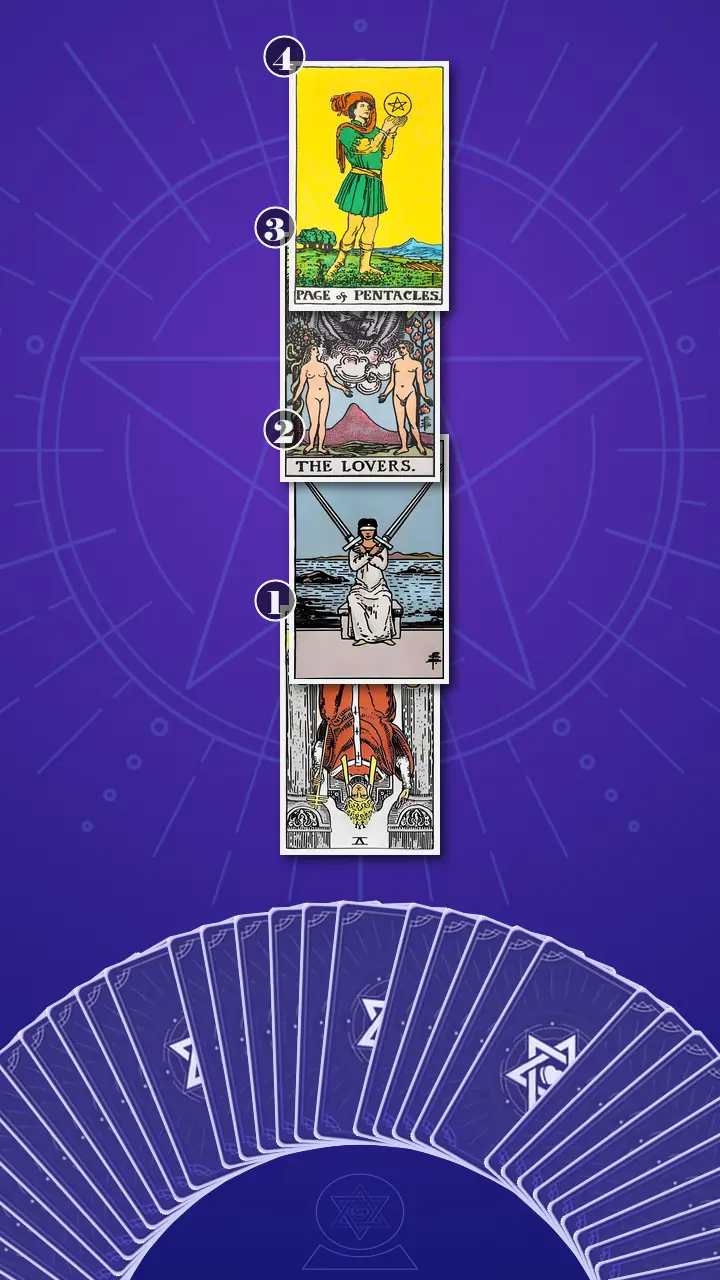
I placed the cards in a narrow vertical line, like four steps rising through the cold pool of ceiling light. The first position would show the current observable pattern. The second would reveal the defensive mechanism beneath it. The third, our focal point, would identify the transformation from external correctness to conscious values. The fourth would ground that insight in a seven-day, reversible experiment.
Years of travelling across cultures had taught me to be careful with maps. A guide can help someone orient themselves, but every map leaves something out. Trouble begins when a borrowed map marks every street it does not recognise as unsafe. I suspected Alex had been using someone else's map of adulthood in exactly that way.
The Borrowed Rulebook Still Had Comment Access
Position One: The Hierophant Reversed and the Invisible Panel
“The card I am turning now represents the current observable pattern,” I said. “It shows how borrowed standards are filtering your preferences, whether you comply with those standards or push against them.”
I revealed The Hierophant in reversed position.
I pointed out the robed authority, the formal gesture, the crossed keys, and the two acolytes kneeling below. Upright, The Hierophant can represent useful teaching, established structures, and shared knowledge. Reversed here, that relationship to authority was blocked and internalised. Alex no longer consciously believed there was one correct career script, yet they still positioned that script above themselves and asked every preference to earn its approval.
I returned to the kitchen scene. At 11:40 p.m., Alex had drafted their career plan as if an invisible panel of managers, friends, LinkedIn peers, and future versions of themselves had comment access. They had replaced the plain sentence “I want to explore this course” with language about strategic progression and market value. Then, when management began to feel too conventional, they had considered rejecting it simply to prove they were independent.
“That is the reversed energy in both directions,” I explained. “Obedience says the management role must be right because it is legible. Reactive opposition says it must be wrong because it is conventional. In either case, the script still chooses the question. This is less about escaping the set in The Truman Show than noticing that doing the exact opposite of the script can still leave the script directing the scene.”
I asked Alex which sentence they had removed because it would have been harder to explain.
They did not nod. They gave a short laugh that landed with more bitterness than humour, then pressed both palms around the cold mug. “That is uncomfortably accurate. Almost rude,” they said. “I wrote that I wanted broader impact. What I meant was that I wanted time to learn something I can't yet make useful.”
I let the silence stay gentle. Recognition did not need to become an accusation. “Wanting credibility, stability, or progression is not evidence that you are performing a false life,” I said. “Those can be real values. The question is whether you consciously consent to them, or whether you are still kneeling before them. An invisible panel should not have permanent comment access to your private life.”
Position Two: The Two of Swords and the Spreadsheet That Never Lets Anything Win
“The card I am turning now represents the root mechanism,” I said. “It asks what your indecision protects you from, especially when choosing without certainty feels like exposing your judgment to a public test.”
I revealed the Two of Swords upright.
The figure's blindfold covered her eyes. Two blades crossed tightly over her chest, while moonlit water remained behind her, visible to me but unavailable to her. I saw Alex's decision spreadsheet in those swords: two columns continually rebalanced whenever one option began to lead.
Alex had added salary, status, commute, CV coherence, London rent, future employability, and imagined regret to the sheet. Each factor was reasonable by itself. The pattern emerged when the course became preferable and a new criterion appeared, or when one friend's answer brought relief until another friend's answer returned the score to a tie. Their phone would grow warm in their hand while a cursor blinked over one more request for advice. Their breath would stop just before Submit.
The card's upright Air had moved into excess. Thought was not clarifying the decision; it was cancelling itself out. The crossed blades offered protection from blame, while the water behind the figure showed emotional information being treated as inadmissible because it could not be proved. Certainty had become the admission price for contact with preference.
“Indecision can protect you from blame while also keeping you from evidence,” I said. “If you can find one more criterion, you do not yet have to be the person who chose. That makes sense as protection. It also ensures that neither path can teach you anything real.”
I used my Inner-Critic Neutralization lens to separate responsible caution from the subconscious prosecution that was masquerading as self-discipline. Responsible caution said, “Rent matters, so define a budget and avoid an irreversible leap.” The inner critic said, “If you ever regret a choice, the regret will prove you were never capable of directing your life.” One voice managed risk; the other converted uncertainty into a character trial.
I asked, “The last time one option nearly won, what did you add to return the decision to a tie?”
Alex's breath paused first. Their fingers stopped against the mug; then their gaze moved beyond the screen, as though a memory had started replaying on the kitchen wall. Finally, their grip loosened. “Pension progression,” they said quietly. “It matters, obviously. But I had already checked it. I added it again because the course was winning.”
“Then the spreadsheet was no longer only collecting information,” I said. “It was regulating exposure. I am not asking you to discard analysis. I am asking you to notice the moment analysis changes jobs and starts providing indefinite postponement.”
When The Lovers Opened the Sky
Position Three: A Value Without a Defence Brief
The refrigerator motor clicked off as I reached for the third card. The sudden quiet changed the texture of the kitchen. I could hear the soft tap of rain against the window, and the vertical spread seemed to pause beneath my hand.
“The card I am turning now represents the key transformation,” I said. “It asks what becomes possible when you stop measuring a choice by universal correctness and begin measuring it by conscious values, while responsibility and uncertainty remain in the room.”
I revealed The Lovers upright.
I watched Alex study the two uncovered figures standing beneath the angel and clear sky. Their postures were open, but the mountain between them had not disappeared. I explained that The Lovers is not merely a romance card. In a decision reading, it can represent congruence, meaningful choice, and the willingness to let desire, responsibility, cost, and consequence enter the same conversation without forcing one voice to destroy the others.
The card held balanced energy where the Two of Swords had shown blockage. Air no longer had to audit itself endlessly. Water, the quieter emotional response, could be acknowledged. Fire returned as desire and personal meaning. The Page waiting above this card would later bring Earth, but The Lovers first required Alex to stand without armour and name what mattered.
I asked them to close LinkedIn and open a blank private note. Beside the course, they wrote “curiosity” and then changed it to “craft.” Beside management, after a longer pause, they wrote “stewardship” and “stability.” I did not ask which word was nobler. I asked which value they were willing to make visible in one accountable action on an ordinary week.
“This does not erase London rent, time limits, or the consequences of a career decision,” I said. “The mountain is still in the card. Alignment is not consequence-free, and a conventional path is not automatically inauthentic. The shift is that no option receives authority merely because it looks impressive, and no option is rejected merely because other people approve of it.”
Before interpreting further, I guided Alex through what I call a Shadow Integration Audit. I use it to map emotions that have been pushed outside the official decision but continue consuming psychological bandwidth. I offered three hypotheses, not diagnoses: anger might be saying, “I resent having to audition for my own life.” Shame might be saying, “Wanting this course makes me look unserious.” Grief might be holding the time spent making every desire presentable.
Alex looked at the words, then tapped “anger” with one finger. “And grief,” they added. “Not because the job is terrible. It isn't. I think I'm grieving how quickly I edit myself.”
That distinction mattered. The audit did not turn anger, shame, or grief into commands. It restored them as information. Suppression had made those feelings leak into resentment, comparison, and reflexive rebellion; naming them allowed Alex to consider what each one was protecting without handing any single feeling the steering wheel.
I returned to the moment their hand had hovered between the management application and the course page. Until then, Alex had been asking, “Which choice proves I have good judgment?” The Lovers offered a more workable question: “Which value am I willing to make visible for seven days?” Life could stop functioning as a verdict and become accountable participation.
Discomfort is not proof that your choice is wrong; name the value you are choosing, take one honest step, and stand as openly as the figures beneath The Lovers' clear sky.
Alex stopped breathing for a beat. Their fingers, which had been pinching the cuff of their sleeve, remained suspended; their eyes moved from the card to the course tab and lost focus, as if every respectable sentence they had written was replaying at once. Then their eyebrows drew together. “But doesn't that mean I've been doing this wrong for years?” they asked, their voice suddenly sharper. I told them no: the comparison loop had been an intelligent attempt to stay safe, not a moral failure. Their mouth tightened before the anger gave way to a long exhale. Their eyes shone; their shoulders dropped; the hand at their sleeve opened against the table. A second expression followed the relief, smaller and more exposed. “If no one else chooses, then I am responsible,” they said. I acknowledged the slight vertigo that can arrive when an old judge leaves the room. “Yes, you retain responsibility,” I said. “But you do not have to carry it as a demand for omniscience. We are asking for one bounded test, not blind faith in yourself.”
I invited them, “Now, using this new perspective, think back to last week. Was there a moment when this insight could have changed how the choice felt?”
Alex mentioned the career-development meeting where their manager had called them a natural fit for leadership. “I felt flattered and heavy at the same time,” they said. “I treated the heaviness as proof that I should either accept and grow up or reject it and be honest. I didn't ask what part of management might actually express stewardship, or whether I could test that part without committing to the whole identity.”
I named the movement I was watching: from guilt-laced confusion and approval-seeking indecision towards grounded self-trust built through values-aligned lived evidence. It was not a complete transformation, and Alex did not suddenly know which career to choose. The crucial crossing was smaller: inner conflict had become information to investigate rather than evidence of personal failure.
“Discomfort is not a verdict on your choice,” I said. “Sometimes it is what self-authorship feels like before lived evidence arrives. The Lovers does not choose for you. It changes the standard by which you participate in choosing.”
One Calendar Block, Not a New Identity
Position Four: The Page of Pentacles and the Seven-Day Pilot
“The card I am turning now represents the actionable next step,” I said. “It grounds your named value in a reversible experiment, so direct experience can contribute evidence without demanding a permanent life decision.”
I revealed the Page of Pentacles upright.
The Page held one pentacle at eye level. A cultivated green field stretched beneath them, while a distant mountain kept the larger journey visible but unresolved. I saw focused, balanced Earth energy: curiosity given a boundary, attention given an object, and learning given enough structure to become observable.
For Alex, the modern version was not twenty more saved links. It was one calendar block receiving full attention: one free course taster, one informational conversation, or one thirty-minute mini-project. The experiment would have a seven-day limit, a spending cap chosen in advance, and a clear exit option. Afterwards, Alex could record energy, attention, resistance, and practical cost in three lines.
“This is not my new identity,” Alex said, testing the sentence aloud. “It is one piece of evidence.”
Their posture changed without becoming triumphant. They uncrossed one ankle and opened their calendar, but their thumb hovered above the screen. “I can manage one session,” they said. “I still don't want it to snowball into buying a course, telling everyone I'm pivoting, and then feeling trapped by the announcement.”
“Then the boundary is part of the experiment, not a lack of commitment,” I replied. “No announcement. No resignation. No identity claim. One free session, followed by a private evidence log. Run the experiment before you rewrite your identity.”
The Rule-Value-Test Note
I drew the four cards together into one story. The reversed Hierophant showed a borrowed rulebook retaining authority through both compliance and rebellion. The Two of Swords showed how fear of regret turned intelligence into a self-cancelling defence. The Lovers restored conscious consent by asking which values Alex could responsibly inhabit. The Page of Pentacles replaced abstract certainty with a small piece of lived evidence.
The cognitive blind spot was not that Alex lacked enough information. It was the assumption that tension around a choice proved something was wrong and that more analysis was always neutral. In practice, some of the research had become reassurance seeking, and some of the self-discipline had become an inner trial where regret would count as evidence of defective judgment.
The transformation direction was therefore precise: Alex did not need to follow their heart while ignoring rent, nor choose the management track because it looked safe, nor reject it to prove independence. They needed to replace the search for a universally correct choice with one personally named value and a seven-day reversible alignment test. Self-trust could then grow from participation and feedback instead of external confirmation.
I gave Alex two pieces of actionable advice. Both were deliberately small, private, and easy to stop.
- The Active Imagination Rule-Value-TestOn one evening this week, Alex would open a private note and set an eight-minute timer. Using my Active Imagination Protocol, they would create three headings: 'The rule I am being graded against', 'The value that actually matters to me', and 'One seven-day test'. They would let the internalised panel speak under the first heading, let the usually edited or suppressed preference answer under the second, and use the final minutes to design one reversible action. The purpose was dialogue, not letting either voice win.Tip: Use an ordinary value such as curiosity, craft, autonomy, stability, connection, or stewardship. Do not ask anyone whether the word is valid. If eight minutes feels too exposed, write only: 'More of ___, less of ___ for seven days.' The note can remain completely private.
- The One-Value Seven-Day PilotWithin the next seven days, Alex would book one free taster session for the course already open on their laptop and place only that session in the calendar. They would set a zero-spend boundary, make no employment decision, and avoid announcing a career pivot. After the session, they would record three lines: 'Energy before and after', 'What held my attention', and 'What cost more than expected'. They would wait until the next morning before asking anyone else what the experience meant.Tip: Keep the log descriptive, not predictive. At the end of seven days, choose only among three reversible outcomes: repeat once, adjust the test, or stop. Stopping is evidence about fit or capacity, not proof of failure.
I reminded Alex that the cards had not declared the course authentic or management false. Tarot had given us an objective surface on which to map the loop, but Alex would decide what deserved consent. Their budget, limits, body responses, values, and lived observations all belonged in that decision. The authority returned to them without requiring them to pretend they could control every outcome.

A Week Later, the Tab Became an Appointment
Six days later, I received a message. Alex had attended the free course taster and left the management application untouched, not rejected. They slept through the night, woke with “What if I'm wrong?” pressing lightly at their chest, smiled at the familiar thought, and went to work anyway.
They had written three lines after the session: their energy was low before and steadier afterwards; they had lost track of time during one exercise; the evening commute had cost more energy than expected. None of it settled their whole career. It did something more useful: it gave their preference a real Tuesday-shaped piece of evidence.
I saw the quiet proof in the sequence. Alex had felt tension, named the value of craft, completed one bounded action, and recorded the result before opening LinkedIn or polling the group chat. Their first interpretation had been allowed to exist before other people's opinions arrived.
That was the Journey to Clarity I had hoped to support. Clarity did not appear as a flawless answer delivered by four cards. It appeared as Alex's growing capacity to hold desire, stability, responsibility, and uncertainty in the same frame, then choose the next experiment for themselves.
When I think of a hand hovering over Submit and a chest tightening beneath two crossed swords, I remember that the hardest part may not be choosing between two paths. It may be allowing a private desire to count before it wins a trial. Simply noticing the invisible panel, the borrowed rulebook, and the urge to request one more verdict already loosens their authority.
So I will leave you with the question I left beside The Lovers: if this choice did not have to prove that you can control your whole future, what small, reversible expression of your own value would you be curious to place in one calendar block this week?