A Deleted Message About a Brutal Day Became a Direct Request for Care

The 9:18 p.m. Audition for Care
I know this version of caring-friend burnout: you have survived a full Toronto workday, a delayed commute, and twelve unread messages, yet your first move after something hurts is still to ask someone else how they are. When the attention finally turns toward you, "I'm fine lol" appears before the honest answer has a chance.
Casey joined my video call at 9:18 on a wet Tuesday night, still wearing the black trousers and soft grey sweater she had worn to her junior communications job. She sat on the edge of an unmade bed with her phone warm in one palm. Behind her, the radiator clicked in uneven bursts; below the window, tyres hissed through rain and a streetcar dragged its metallic complaint along the tracks.
She had just finished answering a friend's six-minute WhatsApp voice note. I watched her replay the three-minute reassurance she had recorded in response, listening for any phrase that might sound insufficiently kind. Her own update had begun as, "Honestly, today was brutal." She had deleted it and sent, "Fine, just tired," instead.
The longing in her chest seemed to behave like an unsent voice note: full of warmth, pressure, and human sound, but trapped behind a finger that could not quite press Send. Her shoulders carried the physical weight of every sentence she had made gentler for somebody else.
"I want someone to notice without me having to make it a whole thing," she said. Her smile arrived quickly, Fleabag-fast, as if humour could escort sincerity out of the room. "But then I get annoyed when nobody notices. I know that isn't fair. I just don't want to be loved only when I'm useful."
I told her I did not hear selfishness or failure in that contradiction. I heard a protective pattern: asking for care felt dangerous, so usefulness had become the safer route toward closeness. "We're not going to put your kindness on trial," I said. "We're going to look at the role it has been asked to play. Let's make a map of the fog, then find one next line you can actually say."

Six Cards Across a Wet Toronto Night
I asked Casey to place both feet on the floor and take one ordinary breath. I shuffled slowly while she held a single question in mind: "Why do I keep playing the caring one instead of asking for care?" The breath and shuffle were not supernatural requirements. They were a transition, a way to bring one complicated relational pattern into focus.
I chose the Relationship Spread · Context Edition, a six-card relationship tarot spread designed for questions about emotional reciprocity, role conditioning, boundaries, and difficulty receiving care. I explained that I would not use it to predict whether a particular friend would accept her next request. Tarot cannot responsibly make that promise. I would use the cards as an external storyboard, giving us six visible frames in which to examine behaviour, fear, exchange, need, language, and practice.
For a reader wondering how tarot works in this setting, the value lies in card meanings in context. A larger Celtic Cross might have produced more material, but more material was not what Casey needed. This focused linear spread could show the complete loop without burying its turning point.
I laid the cards from left to right like a bridge. The first position would show Casey's current caring-role pattern. The second would reveal the relational expectation underneath it. The middle positions would expose the reciprocity loop and the care she had not acknowledged aloud. The fifth card would meet the protective belief at her vulnerability threshold, and the sixth would turn that insight into one small reciprocal practice.
"This is a map, not a verdict," I reminded her. "You remain the person who decides where to step."
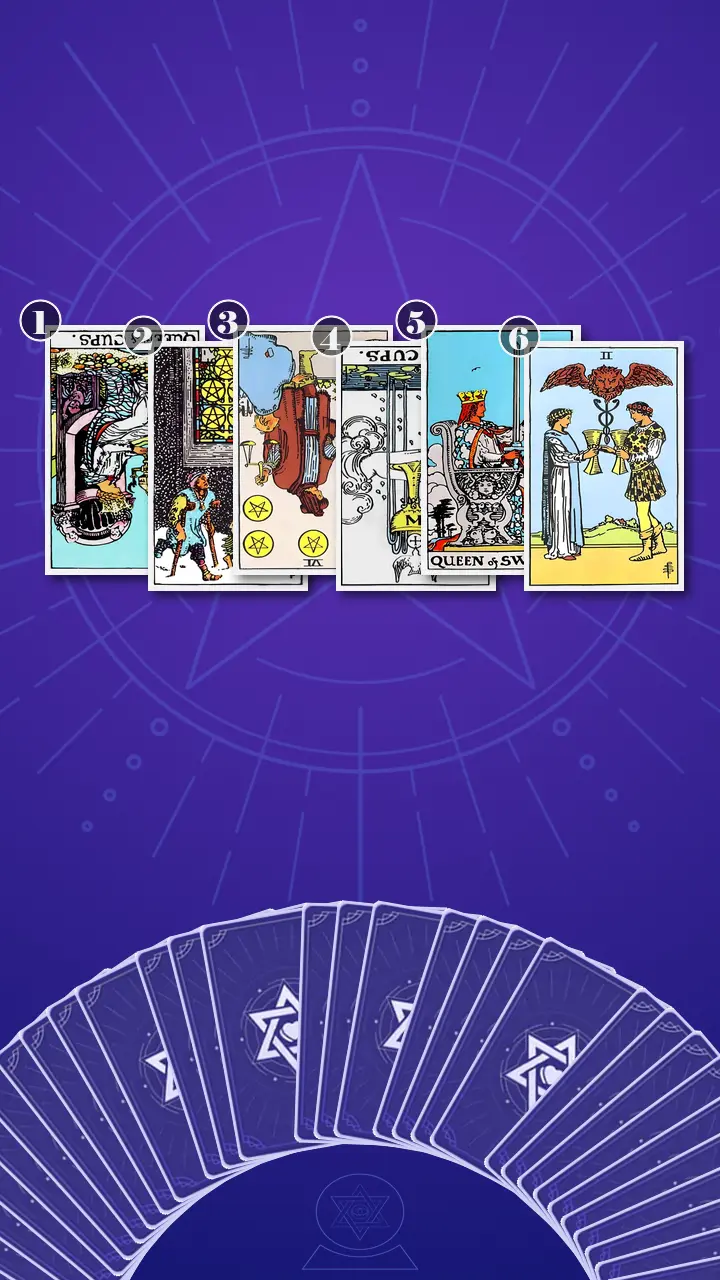
Reading the Role Casey Could Not Put Down
Position One: The Cup Watched Too Closely
I turned over the card representing Casey's current caring-role pattern: the Queen of Cups, reversed.
I pointed to the Queen's absorbed gaze, fixed on the ornate closed cup in her hands. Upright, she can represent emotional receptivity, compassion, and exquisite attunement. Reversed here, that Water energy had become excessive in one direction and deficient in the other. Casey could receive minute signals from everybody around her, but her own feelings reached a blockage at the point where they might become visible.
In ordinary life, this was the exact WhatsApp scene we had just discussed. After a difficult day at work, Casey caught every change in her friend's tone, wrote the perfect reassuring reply, and replaced "I am not doing well" with "Fine, just tired." Then she kept checking the typing indicator, hoping the friend might somehow detect the emotional content Casey had deliberately removed.
"The inner sentence sounds something like this," I said. "I can tell exactly what they need, but if I say what I need, I might become difficult to hold."
Casey did not nod politely. She gave one short laugh that landed with more pain than humour. "That is so accurate it feels a little rude." Her fingers tightened around the phone, her gaze dropped to the reversed Queen, and then the grip slowly loosened as recognition reached her.
I let the laugh settle before I clarified the distinction that mattered. Compassion was not the problem. The problem was compassion being used as a one-way exit from vulnerability. "You can be caring without making yourself unavailable to care," I said. "What feeling do you keep offering to other people instead of naming for yourself?"
"Reassurance," she said after a pause. "I keep telling everyone they're not too much."
Position Two: Outside the Lit Window
I turned over the card representing Casey's internalized relational expectation: the Five of Pentacles, upright.
The two figures moved through snow beside an illuminated stained-glass window. I read the card as an active scarcity expectation, not a forecast of rejection. Its energy showed how strongly Casey anticipated exclusion before another person had been given the opportunity to answer. Her sense of possible welcome was underfed; the fear story was overactive.
I asked about the last time she had almost requested support. She described standing on a crowded 504 streetcar, watching Instagram Stories of friends delivering soup and flowers after somebody's breakup. She had typed, "Could you call me tonight? I've had a hard week." Then she closed the draft and decided it was safer to remain the dependable person at the edge than to discover whether anybody had room for her need.
"I would rather be the useful person outside the lit room," I reflected, "than knock and risk hearing that the room is full."
Her breathing paused. Her eyes moved away from me as if replaying the streetcar scene, fluorescent lights and all. Then she exhaled from deep in her chest and rubbed one thumb over the side of her index finger.
I was careful not to turn the Five of Pentacles into evidence against her friends. A delayed reply, an unavailable evening, or an imperfect response can hurt, but none automatically proves that a person is uncaring. This card showed the expectation Casey carried into the exchange. It asked: "If I make a direct request, what exactly do I fear will happen next?"
"They'll realise I'm not as low-maintenance as they thought," she said.
"And if nobody can see the request you deleted," I asked, "can their failure to answer it be a fair test of love?"
She looked back at the spread. I gave the answer its simplest form: "An unspoken need cannot become a fair test of love."
Position Three: The Invisible Care Ledger
I turned over the card representing Casey's reciprocity loop: the Six of Pentacles, reversed.
The merchant's scales and downward flow of coins made the unequal exchange visible. Reversed, the card showed the spread's main blockage: generosity had become entangled with an unspoken ledger. The energy of giving was in excess, the capacity to receive without debt was constricted, and the terms of reciprocity existed mostly inside Casey's head.
I described it as a banking app that recorded every emotional transfer but had no field for the request she never made. The app remembered the late-night calls she answered, the CV she edited, the birthday plan she organised, and the last-minute favour she accepted. It could not record, "I wanted somebody to ask about my presentation," because Casey had said, "No worries," and entered no request at all.
"I never asked them to repay me," she said slowly, "but part of me hoped doing enough would make them notice without being asked."
Her jaw set first. Then her eyes lost focus as a recent conversation seemed to replay behind them. Finally, she released a small, embarrassed breath and covered her mouth with two fingers. I could see the sting of recognition arriving alongside shame.
"Resentment often keeps the receipt for a request you never made," I said. "That doesn't mean every generous act was secretly manipulative. It means one part of you hoped usefulness could secure care without exposing you to a direct answer."
I also told her that abandoning the ledger did not mean ignoring genuine patterns of imbalance. If a relationship repeatedly has room for one person's feelings and not the other's, that matters. The cleaner test is observable participation over time: what was actually asked, what actually happened, and whether both people were permitted to have needs, choices, and limits. Immediate fifty-fifty symmetry is not the same thing as reciprocity.
Position Four: The Offer Redirected
I turned over the card representing Casey's unacknowledged care need: the Ace of Cups, reversed.
The offered cup was still present. Reversed, however, its replenishing Water could not complete its movement. I read this as blockage rather than absence: care might be offered, and Casey might genuinely want it, but receiving made her hands restless enough that she interrupted the delivery.
I asked her to remember a Sunday call when a friend had heard strain in her voice and asked, "Do you want advice, company, or just someone to listen?" Casey had reacted with a heart emoji, said anything was fine, and redirected the conversation. At the kitchen table, with the dishwasher humming and steam from her tea touching her face, the offer had come close enough to receive. She had made herself emotionally unspecific at the final second.
"The offer is here," I said. "Why does receiving it make your hands want to do another job?"
She looked down and noticed that she was picking at the edge of her phone case. A breath caught high in her chest; her fingers became still; then her shoulders lowered by a fraction.
"Because if I say I want listening, then the need becomes real," she said. "And I can't pretend I didn't care how they responded."
I asked her to choose only one form of care, with no obligation to disclose anything more. Listening, reassurance, quiet company, a check-in tomorrow, or help with one task would all count. "Ten minutes of listening," she answered. The specificity changed the room. We were no longer dealing with a bottomless abstract need. We were looking at one cup that could be named.
When the Queen of Swords Rewrote the Role
Position Five: One Sentence, Upright
The radiator went quiet as I reached the card representing Casey's protective belief and vulnerability threshold. For a moment, the only sound was rain tapping the window. I turned over the reading's catalyst: the Queen of Swords, upright.
I traced the upright sword, a clean vertical line, and then the Queen's raised open hand. Her Air energy was balanced: precise enough to state reality, receptive enough to leave room for information, and bounded enough not to control the response. She did not ask Casey to become colder. She asked Casey to separate the fact of a need from the shame story attached to it.
The image took me briefly back to an editing room. I have always understood lives as films still in production, and I could see that the reversed Queen of Cups did not need to be written out of Casey's story. She needed dialogue. The same caring woman could remain in the frame, but the Queen of Swords would stop letting every other character speak over her.
This was where I used what I call a Sidekick Syndrome Diagnosis. In a close friend group, a capable person can become boxed into a supporting role: the therapist, the organiser, the funny one, the crisis-communications department. Nobody has to hold a secret meeting for the role to become restrictive. It can be reinforced through small assumptions, affectionate jokes, and the fact that the group keeps rewarding the performance it knows how to request.
Casey gave a startled smile. "They literally call me crisis comms."
I explained the related Clique Power Dynamics I could see without inventing villains. Other people were allowed to arrive messy; Casey was expected to translate the mess into something manageable. Her competence brought status, but not necessarily room. That subtle hierarchy could survive only while Casey kept accepting its script without naming the terms of her participation.
"The Queen of Swords is not telling you to leave the cast or punish anybody," I said. "She is showing you that a role is not an identity. You can decline the old part and offer one true line instead."
I brought Casey back to 9:18 p.m. on Tuesday: twenty minutes spent steadying a friend's night, "mine was fine" typed into the chat, and the deleted sentence reopened in her mind. She was still trying to make one perfect decision while her shoulders felt heavier than her phone.
You do not have to keep earning care by staying useful; let the Queen of Swords turn a hidden need into one clear, bounded sentence.
I let the sentence sit between us. Then I translated it into the exchange beneath the cards: You do not have to pre-pay for care with usefulness; one clear request lets reciprocity become visible.
For one beat, Casey stopped breathing. Her fingers remained suspended above her phone, and her pupils widened as though the screen had changed brightness. Then her brow pulled tight. The first feeling was not relief but anger. "But doesn't that mean I've been doing this wrong the whole time?" she asked, her voice suddenly sharper. Her eyes reddened before any tears fell. One shoulder dropped, then the other, while the fist resting against her knee gradually opened. The release looked almost disorienting, as if putting down a heavy bag had left her unsure what to do with the empty hand. A trembling breath came out, followed by a quieter admission: "If I ask clearly, I can't hide from the answer." The new clarity had given her room, but it had also returned responsibility to her. I could see both the relief and the brief, vulnerable blankness that followed.
"It means the helper role protected you," I replied. "It does not turn your past care into a mistake, and it does not make you responsible for everybody else's limitations. It gives you another option now. Your need is a fact; 'too much' is the fear story attached to it."
I invited her to test the new perspective against lived evidence. "Now, with this new view, think back to last week. Was there one moment when this insight might have changed how you felt?"
She returned to a Friday night when she had almost sent another automatic "How are you?" message after a punishing workday. "I could have written, 'I had a rough day. Do you have ten minutes to listen tonight?'" she said. "No apology. No offer to edit their cover letter first."
That sentence marked the key emotional crossing in the spread: from automatic caretaking and silent longing toward direct self-advocacy, self-trust, and reciprocal participation. It was not certainty that she would receive the response she wanted. It was the first grounded act of letting herself be known.
Two Raised Cups, No Hidden Invoice
Position Six: A Conversation With Two Microphones
I turned over the final card, representing Casey's small reciprocal practice: the Two of Cups, upright.
The two figures faced one another with equally raised cups. I read this upright Water as the balanced emotional current that had been unavailable at the beginning of the spread. It did not promise that every person would meet Casey well. It showed the structure she could consciously enter: two visible participants, each allowed to bring a need, an offer, an honest capacity, and a limit.
In modern life, this could be a ten-minute call. Casey would make one specific request and listen to the answer without rushing to minimise herself or attach an immediate favour. The other person could say yes, no, or "not tonight, but tomorrow." All three answers would provide information. Casey could then observe mutuality through repeated exchanges rather than treating one response as a final verdict on her worth.
"So reciprocity isn't somebody reading my mind perfectly," she said. "And it isn't both of us doing the exact same amount every day."
"Right," I said. "It is more like a conversation with two active microphones instead of one person hosting and the other being interviewed. Reciprocity becomes visible when both people are allowed to be specific."
Her shoulders softened. She placed the phone faceup beside her rather than gripping it. "I can let the conversation contain me too," she said, testing the sentence aloud.
I looked across the full spread: Water reversed, Earth, Earth reversed, Water reversed, Air, and finally Water upright. No Wands appeared. Casey did not need a dramatic reinvention or a scorched-earth confrontation. The first movement was smaller and more demanding than performance: give one feeling language, make one bounded request, and allow reality to answer.
The Role Resignation Act for the Next 48 Hours
I gathered the six cards into one coherent story. Casey's sharp emotional attunement had taught her to become useful whenever she needed care. Usefulness briefly protected her from the Five of Pentacles fear of being left outside belonging. Because she gave rather than asked, the Six of Pentacles reversed kept an invisible ledger. The Ace of Cups showed that her need remained present but blocked at the point of receiving. The Queen of Swords supplied the bridge: clear language. The Two of Cups showed how that language could support equal participation without guaranteeing a particular outcome.
The cognitive blind spot was simple but painful: Casey had been treating the sentence she deleted as though it were a request other people had failed. She also feared that naming a need would create a scorecard, even while silence was producing the most punishing scorecard of all. The transformation was not from caring to uncaring. It was from the Helpful Self as a compulsory role to caring as a choice made by an Equal Participant.
"But what if they say no?" she asked.
"A no can sting," I said. "We don't have to pretend otherwise. But one no may describe timing or capacity. A repeated pattern can describe the relationship. Neither has to become a verdict on your worth. Our job is to record what actually happens instead of letting fear write the result in advance."
I gave her three forms of actionable advice, each deliberately small enough to try without turning one vulnerable evening into a referendum on her entire social life.
- The One-Sentence Care Ask. On one weeknight, open Notes for no more than five minutes and write: "I am feeling overwhelmed. Would you have ten minutes to listen without fixing it tonight?" Choose one friend who has previously respected limits. Remove the apology, the long defence, and any immediate offer to repay the care. Sending remains your choice. Tip: If the full version feels too exposing, write only "I feel overwhelmed, and I want listening." A private draft still interrupts self-erasure.
- The Role Resignation Act. The next time a group chat or close friend automatically casts you as therapist, organiser, or fixer, pause for sixty seconds before replying. Use a graceful pivot: "I care about this, but I can't be the problem-solver tonight. I've had a rough day too. Does anyone have ten minutes to listen?" This refuses the assigned character without attacking the people involved. Tip: If saying it to the group feels unsafe or too public, use only the boundary there and send the care request privately to one trusted person.
- The No-Repayment Pause and Fact Check. When somebody offers one suitable call, meal, lift, or check-in this week, answer, "Yes, that would help, thank you." Wait ten minutes before offering a favour back. Afterwards, create a two-column phone note labelled "What I asked" and "What happened," and record only observable facts. Tip: Do not add "They think I'm needy" or "Everything is fixed." Record the words, timing, and action. Let reciprocity reveal itself over several moments.
I reminded Casey that she was allowed to draft, revise, choose a different person, or stop if the exercise felt exposing or unsafe. A bounded request protects both people's autonomy: she could ask without coercion, and the other person could answer without being assigned responsibility for her worth.

The Quiet Proof in a Reply Sent Without Apology
Six days later, Casey sent me a screenshot. At 10:03 on Monday night, with rain against her kitchen window, she had written to a friend: "I had a hard day. Do you have ten minutes to listen without fixing it?" She had deleted "Sorry to bother you" and resisted adding, "But how are you?"
The friend replied, "I can't call tonight, but I can ring you at lunch tomorrow. Would that help?" Casey's first impulse was to write, "No worries, forget it." Instead, she answered, "Tomorrow would help. Thank you."
During the call, the friend listened. Casey described the workday without shrinking it into a joke, and she allowed a quiet pause without filling it with questions about the other person. Nothing cinematic happened. No relationship was instantly perfected. For ten minutes, however, the conversation contained her too.
That night she slept through until morning. Her first thought was still, "What if I was too much?" She noticed it, smiled without fully believing the smile, and got out of bed without reopening the chat for evidence.
I considered that the honest proof of our Journey to Clarity. The fear had not vanished, but it no longer held the pen by itself. Tarot had not rescued Casey or predicted who would care for her. The six-card Relationship Spread had made an old script visible, and Casey had chosen to write one different line.
I often think our lives are films currently in production. Sometimes clarity is not a perfect ending; it is the moment an actor realises she can stop auditioning for a supporting role in her own emotional life. Casey remained warm, observant, and caring. She had simply begun to participate in relationships without disappearing behind the care she gave.
When your chest tightens around one honest request, it can still feel safer to carry everyone else's cup than to discover whether there is room for yours. If that reflex is familiar, noticing it already means you are no longer standing at the beginning of the bridge.
If you let one relationship meet you as an equal participant, what small cup of care could you name in one Queen-of-Swords sentence: ten minutes of listening, quiet company, practical help with one task, or a reassuring check-in tomorrow?