Always the Photographer, Never in the Photos: Try a Shared Rotation

Always the Photographer, Never in the Photos
"You're the friend who says 'I've got it' before anyone even asks, and by the time the group photo happens you're three steps back holding someone's phone while your own drink goes warm on the table."
I said this to Jordan (name changed for privacy) after they settled into the chair across from me. They were twenty-six, non-binary, a junior graphic designer living in a shared London flat, and they gave a small, startled laugh that sounded like recognition arriving before permission. Jordan had told me about 9:14 p.m. at a birthday dinner in a loud East London pub: someone handed them a phone mid-conversation as if it were muscle memory, and they accepted it before their brain caught up. They moved around the sticky floor beneath the fairy lights, catching friends mid-laugh while the light blew out every third frame. Someone offered to take over. Jordan heard themself say, "After this one."
"Why am I always taking photos for my friends but never joining them?" Jordan asked. I watched their shoulders rise toward their ears as they described leaving with a full camera roll, a warm phone, and almost no evidence that they had been there. They wanted to join their friends in the moment, but kept staying behind the camera to take photos for them. The loneliness in their story felt like standing outside a warmly lit room with the key in your hand, still checking whether everyone else had what they needed before letting yourself enter.
I told Jordan that I was not going to turn one group of friends into villains or use tarot to predict whether anyone secretly cared. We would use the cards as a clear, structured mirror for the arrangement they were helping create. "We can look at where the exchange becomes uneven, where the pattern repeats, and what small boundary would let you contribute without disappearing," I said. "Our job today is to draw a map through the fog, so you can decide where you want to go."
Choosing a Map for the Missing Frames
I asked Jordan to place their phone face down and take one slow breath before I shuffled. The pause was practical: a way to move from replaying the last gathering into observing it, without treating the preparation as a supernatural test.
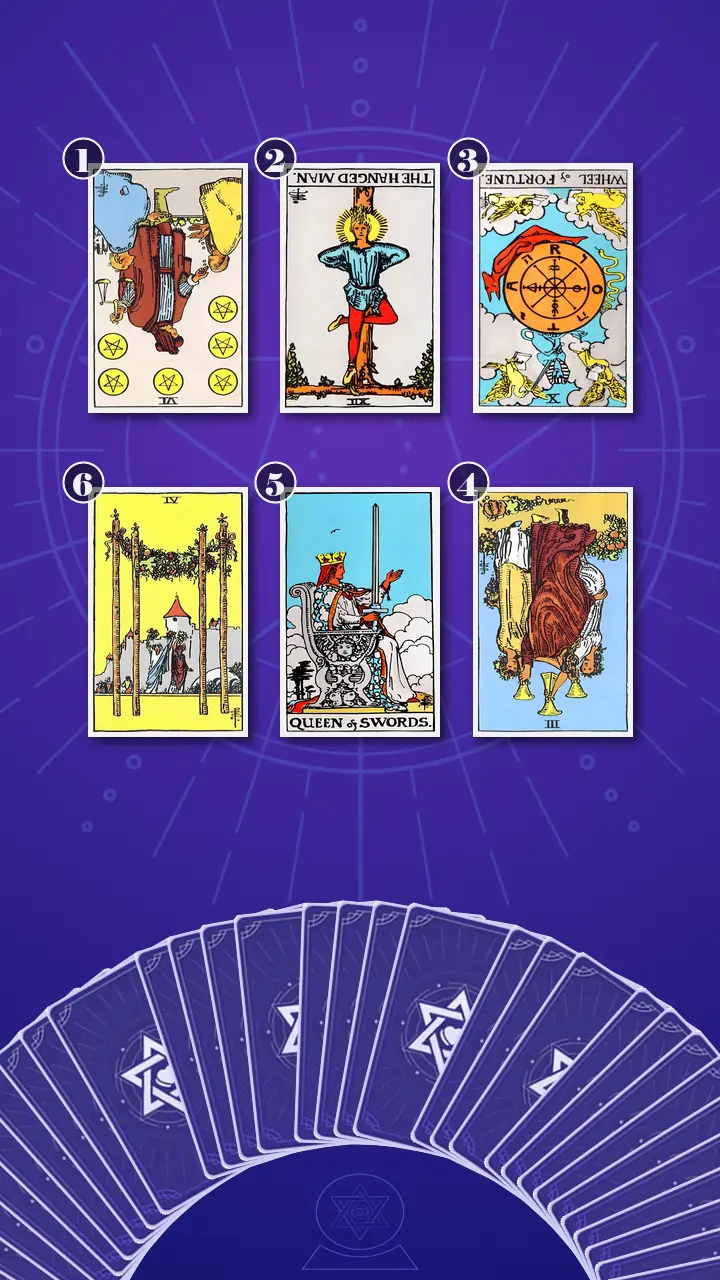
For this reading, I chose the Transformation Path Grid (6) · Context Edition. For anyone wondering how tarot works in a focused reading like this, the cards provide symbolic prompts that help separate a visible habit from the belief, trigger, and choice underneath it. This six-card tarot spread is useful because Jordan's question is not simply about what friends think; it is about a repeating friendship pattern that returns at different dinners, birthdays, and park hangouts.
The grid follows a compact route: the first card shows the observable photographer role and its immediate cost; the second reveals the blockage beneath it; the third traces the root pattern that keeps resetting; the fourth catches the social cue that activates the loop; the fifth offers a concrete boundary; and the sixth shows what reciprocal belonging could look like when the change is lived. That structure keeps the reading centered on Jordan's choices rather than speculation about anyone else's private motives.
Reading the Pattern in Context
The Six of Pentacles and the Price of Being Reliable
Now I turned over the card for the observable role Jordan accepts at gatherings and the immediate emotional cost of staying behind the lens. The card was the Six of Pentacles, reversed, representing the present condition or visible pattern.
I told Jordan, "This is the exact moment someone hands you their phone at the start of the night and you accept it like a job you never applied for. You get thanked, called a legend in the group chat, and the exchange feels warm right up until you notice what you traded away: your seat in the memory." The reversed card shows generosity with its scales tipped. Jordan's practical contribution is visible, but their participation is treated as the thing that can be postponed. The energy is not a lack of care; it is an excess of giving in one direction and a deficiency of explicit reciprocity.
"The giver's scales become an unspoken ledger," I continued. "Your hours of photographing count as contribution, but your absence from the frame counts as nothing. Gratitude doesn't show up in the album." I asked Jordan to consider the last outing in three columns: what they gave, what they received, and what they wanted but did not name.
Jordan gave a short, bitter laugh. "That's too accurate. Almost rude." Their fingers tightened around the edge of the chair, their eyes fixed on the reversed card as if replaying a group chat, and then their grip loosened with a long breath. I did not rush to make the insight nicer. "We do not have to decide that your friends are intentionally using you," I said. "We only need to notice that thanks and inclusion are not the same return."
The Hanged Man's Unfinished Minute
Now I turned over the card for the blockage beneath the behavior, including the sacrifice-based belief that postponing Jordan's participation is the safest way to remain useful and included. The card was The Hanged Man, reversed, representing the obstacle or what blocks movement.
"'I'll join in a minute' is this card in sentence form," I said. "You're not lazy and you're not avoiding people. You've suspended yourself so smoothly it looks like patience: one more angle, one more group shot, one more candid. The pause was supposed to be temporary, but it has run so long that it has become the posture itself." The single bound foot became Jordan's "just one more shot" promise: technically free to walk into the frame, practically held in place by a rule they were enforcing alone.
I repeated the internal sentence Jordan had given me without correcting it: "Everyone else gets to be in the memory; I can wait for the next one." I let its loneliness sit beside the quiet resentment and the guilt about wanting recognition. Jordan's thumb pressed hard against an invisible phone, their shoulders stayed lifted, and their gaze drifted past me toward the window. After a few seconds, they looked down and rubbed the heel of their hand across their palm.
"When you say, 'I'll join in a minute,' what are you actually waiting for?" I asked. "A natural pause, a direct invitation, or proof that handing over the phone will not make you seem selfish?" I was not asking Jordan to judge the pattern. I was asking them to see that waiting to be invited had stopped being a strategy and had started becoming the cage.
The Reversed Wheel and the Autoplay Queue
Now I turned over the card for the Repetition Compulsion that makes the same photographer arrangement recur and makes the role feel fixed or inevitable. The card was the Wheel of Fortune, reversed, representing the underlying cause or root pattern.
I described the invisible script I had heard in Jordan's account: nobody assigns a photographer, Jordan notices, Jordan waits for the request, Jordan picks up the phone, and later Jordan says, "Somehow it was me again." The reversed Wheel names a cycle, but it does not call that cycle destiny. The wheel did not spin Jordan into the role from nowhere. Each automatic yes helped turn it back to the same position.
"The wheel didn't put the phone in your hand. Your yes did," I said. "That is not a reason to blame yourself. It is the reason there is an interruptible point." I compared the pattern to an autoplay queue that keeps reloading the same track. The useful edit point is the second between noticing that a photo needs taking and reaching for the phone. The energy here is repetition and resistance to change, but the hidden resource is timing: Jordan can catch the sequence before the familiar role loads.
I suggested that after the next event Jordan write down three things: the trigger, the automatic thought, and one alternative response. The request was deliberately small. A new response did not need to make the whole evening different; it only needed to create one honest data point.
The Three of Cups Outside the Circle
Now I turned over the card for the immediate social trigger, the moment when friends cluster for a photo and Jordan automatically steps backward to document them instead of joining. The card was the Three of Cups, reversed, representing the catalyst or immediate trigger.
"Friends cluster together laughing, and your body steps backward before your feelings get a vote," I said. "Celebration is happening, connection is available, and you convert it into composition instead of participation. You capture their closeness perfectly from the outside of it." The reversed cups show communal feeling that is not fully circulating. The card is not proof that the friendship is false; it captures the instant when Jordan's own movement turns a possible shared moment into a camera angle.
I asked Jordan to picture the park hangout they had described: cold grass through their trainers, friends' arms around one another, their own voice saying, "Scooch left, chin down, wait, one more." The environment seemed to join the memory; outside my window, a bus passed in a wash of white light and was gone before the room settled again. Jordan's mouth tightened, then softened. They looked at the empty space on the table where a phone might have been.
"The finished image shows exactly what happened," I said. "The friendship is visible. Your presence in it is not."
When the Queen of Swords Cut a Doorway into the Frame
The Upright Blade of Reciprocal Participation
The room grew quieter as I turned to the card beneath the blockage. Now I turned over the card for the concrete self-directed action that can interrupt the Martyr Complex through clear communication and a request for reciprocal participation. The card was the Queen of Swords, upright, representing the recommended action or available choice.
"This is the card of saying the plain thing before resentment writes the script for you," I said. "I can take a few photos, and then I want a turn in front of the camera. Not a speech, not a confrontation, not a test of who cares more. One clear sentence, delivered while you still mean it generously." The upright sword brings Air into a spread that began with practical service and moved through suspended action, repetition, and blocked communal joy. Its energy is discernment, self-trust, direct communication, and fair boundaries.
I told Jordan that this was where I use my Reciprocity ROI Analysis. I do not use it to turn a friendship into a spreadsheet or to calculate whether every kind gesture has produced an equal return. I use it to distinguish a warm exchange from a high-drain arrangement that keeps asking one person to provide the visible labor while treating their presence as optional. In this case, the question is simple: can the photo contribution move in both directions?
I also brought in my Sunk-Cost Decoupling in Loyalty lens. Whatever years of history Jordan valued with these friends could remain meaningful without automatically approving the current arrangement. History is context, not a lifetime contract to stand outside every frame. The Queen's sword does not cut people off; it cuts the assumption that asking for a turn makes Jordan selfish. It separates generosity from self-erasure.
At that point, an old Wall Street reflex passed through me. Years in high-stakes rooms had taught me to look for the actual structure beneath a reassuring headline. Here, the headline was "Jordan is helpful and everyone appreciates it." The structure was different: appreciation arrived, but participation was deferred. I kept my voice warm because analysis is only useful when it protects the person being analyzed rather than making them feel inspected.
Then I asked Jordan to replay 11:52 p.m. on the Night Tube home: forty perfect photos of everyone else's night, a warm phone in their hand, the carriage humming, and no face of their own in the album. They were looking for evidence of belonging and finding only the shape of their absence. I asked them to notice what the old script had made that moment mean.
You do not need to stay behind the lens to earn belonging; speak the limit and enter the picture, using the Queen of Swords' upright blade to separate generosity from self-erasure.
For a second, Jordan's thumb hovered as if it were still over the shutter button. Their breath paused. Their eyes lost focus, and I could see them replaying the Night Tube window, the shared album, the missing face. Then their jaw released, their clenched hand opened one finger at a time, and their shoulders dropped with a small, uneven exhale. Their eyes brightened, not with a dramatic collapse but with the sting of a truth that had finally found a usable shape. Jordan gave a quiet, almost disbelieving laugh. "I could just say it before I start," they said. The relief brought a brief blankness with it, the light dizziness of having no old role to perform for a moment. I asked Jordan to open their notes app and type the sentence they would actually use: "I can take a few photos, and then I want a turn in front of the camera." They read it once, looking exposed. I said that feeling was information, not failure.
"Now, using this new perspective, can you remember a moment last week when this sentence might have made the evening feel different?" I asked. Jordan looked down at the card, then described the birthday dinner without turning the story against themself. The shift was not from loneliness to perfect confidence. It was from earning inclusion through automatic photo service to reciprocal participation with clear boundaries, one uncomfortable but possible step at a time.
The Four of Wands Makes Room
Now I turned over the card for the integrated state in which Jordan can document part of a gathering while also occupying a visible, reciprocal place within it. The card was the Four of Wands, upright, representing integration or the lesson.
"Picture the end state," I said. "You shoot the first few frames, pass the phone to someone by name, and step into the picture while the night is still happening. The four-wand canopy is a frame wide enough to include the person who usually stands outside it." The energy is not a demand for Jordan to stop caring about photos. It is balance: contribution and presence can coexist inside the same shared structure.
I pointed out that the Four of Wands was not a promise that every friend would respond perfectly or that one boundary would solve the entire friendship dynamic. It was a picture of a possible equilibrium that Jordan could help create and evaluate. Belonging could become something they occupied, visibly, with their face in the album and their contribution still valued.
From Being Useful to Being Seen
When I put the six cards together, the story became coherent. The reversed Six of Pentacles showed Jordan paying for a place in the group with practical service. The reversed Hanged Man showed the payment being deferred through "one more shot." The reversed Wheel explained why a fresh dinner could still load the same old script, while the reversed Three of Cups caught the exact backward step that converted connection into documentation. The Queen of Swords supplied the interruption, and the Four of Wands showed how a rotating role could turn that interruption into shared belonging.
The cognitive blind spot was not simply that Jordan had failed to ask. It was that Jordan had been treating the absence of spontaneous inclusion as a complete verdict while making the need for inclusion almost impossible to see. By saying yes before anyone negotiated the role, joking about being the official photographer, and waving away offers to swap, Jordan made the arrangement look voluntary even when it felt lonely. The cards did not say that friends were bad. They showed that an unspoken need cannot reliably organize a reciprocal exchange.
"The transformation direction is not from caring to not caring," I said. "It is from being on the guest list only as staff to being a guest who can also contribute. The boundary is a crop tool: you are not deleting your generosity; you are reframing the shot so you fit in it too."
I gave Jordan my Friendship Downgrade Strategy as a contingency, not as a verdict. The sequence is clarify, rotate, observe, and then adjust the amount of photo labor if a fair request is repeatedly ignored. A gradual move toward lower-maintenance contact can protect Jordan's energy without a dramatic group-chat prosecution, but it is not the first move and it is not required by the cards. First, Jordan would gather real information through one clear request.
- The Rotating Photographer RuleBefore the next outing, send the group one message: "Photo plan for Friday: I'll take the first few, then someone else takes a turn so I'm in some too." It takes about thirty seconds and names the shared arrangement before anyone hands Jordan a phone.Send it early, while the request still feels practical rather than resentful. If the wording feels too exposed, rehearse it once in your notes app and edit it until it sounds like your voice.
- The Ten-Minute Photo ShiftAt the event, set a silent ten-minute timer. When it goes off, hand the phone to a named friend, such as Maya, and say, "Maya, you're up. I want to be in one." Then sit or stand with the group before a new photo request can pull you back behind the lens.If ten minutes feels like too much, start with two minutes or three shots. The goal is one honest data point about what happens when you ask, not a personality overhaul.
- The Frame Entry SentencePractice once alone on your walk or in your room: "I can take a few photos, and then I want a turn in front of the camera." Say it out loud for less than a minute so your body has heard the sentence before the next group photo.Expect the resistance to sound like "this is awkward" or "it's easier to just do it." Nobody is grading your delivery, and you can choose an easier friend or lower-pressure event first.
These are small boundary scripts for people-pleasing in friendships, not demands for perfect performance. Jordan remained the person deciding whether to try them, when to adapt them, and what the results meant. Tarot could organize the evidence, but the choice belonged to Jordan.
The First Photo With Jordan in It
Four days later, Jordan texted me: "Three shots, then I handed it to Maya and said the sentence. I'm in the album." They slept well, woke with "What if I made it awkward?" and smiled; the question was still there, but it no longer ran the evening.
I held that as the first quiet proof, not a final solution. The friends had not been required to read Jordan's mind, and Jordan had not needed to abandon the group to protect themself. One clear request created room for a different kind of evidence: Jordan could be the group's photographer and still be in the picture.
That was the Journey to Clarity we had completed together. The cards did not change Jordan's friends or claim ownership over Jordan's future. They helped Jordan see the old exchange, name the limit, and choose a new response. The person holding the camera was still the person holding the decision.
I have watched many people stand at the edge of their own friends' joy, phone warm in hand, telling themselves the next picture will be theirs. Being needed was never the same thing as being included. Belonging isn't a wage. Stop clocking in for it.
If you let yourself imagine stepping into the frame at your next gathering, just for one photo, what's the first thing you'd want that picture to hold?