Fear of Exclusion Fuels Overplanning; One Ask Leaves Room to Respond

The 10:40 p.m. Plan That Could Not Breathe
"You can map a flawless user flow at your junior design job, but one "I'll let you know" in the weekend group chat can send you into friendship anxiety and a midnight rewrite of the entire plan." I said it gently, watching Casey settle into the chair across from me in Toronto.
She had shown me the scene from the night before. At 10:40 p.m., WhatsApp sat open beside Google Calendar while a third message filled with arrival times, two restaurant options, a transport question, and a Thursday confirmation deadline. I could almost hear the refrigerator hum from her apartment; she told me the phone had felt warm in her palm, and her jaw had ached from clenching it.
"I just need to know whether I am actually part of the plan," she said. "If I leave the details loose, I'll be the last person anyone thinks about. I call it organising, but I know I'm trying to guarantee my place."
I heard the real conflict beneath the itinerary: Casey wanted secure inclusion in the friendship, while fearing that uncertainty meant her friend might quietly exclude her. Her anticipatory anxiety had the physical shape of a seatbelt pulled too tight across her chest, with a restless hand reaching for the phone before the facts had caught up. She was gripping a social plan until it could not breathe.
"Wanting clarity is valid; trying to guarantee belonging through logistics is the trap," I told her. "I am not here to decide what your friend secretly means. We can use the cards as an objective reflection tool, separate observable facts from the rejection story, and draw a map through the uncertainty. Our Journey to Clarity starts there."

Choosing the Compass for Friendship Anxiety
I invited Casey to put both feet on the floor and take one unhurried breath. Then I shuffled slowly while she held the question in mind. I explained that this was a focusing practice, a way to move from the rapid checking of messages into a more deliberate conversation, rather than a mysterious test that could overrule her judgment.
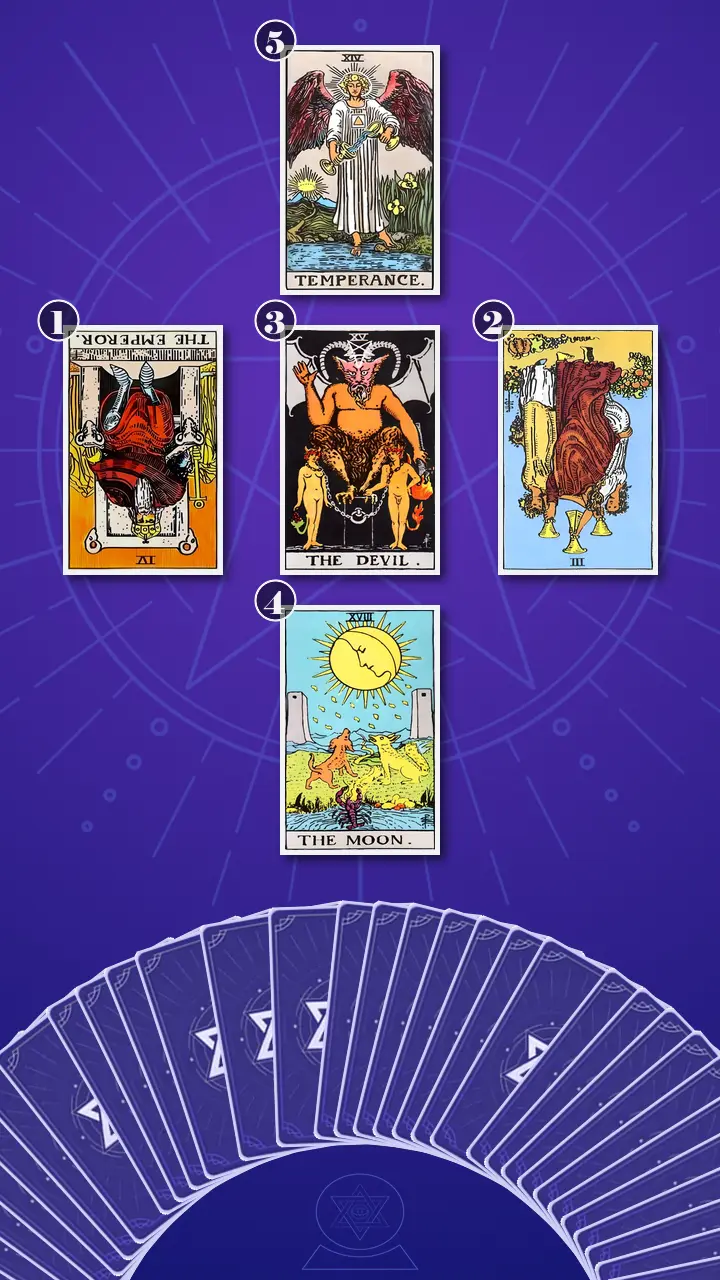
"Today I am using the Relationship Spread · Context Edition," I said. "For anyone wondering how tarot works in a situation like this, this five-card spread does not claim access to your friend's private motives. It helps us examine your current stance, the behaviour you can observe, the shared pattern that forms between you, the fear underneath it, and an actionable way forward."
This is why the spread fits friendship anxiety around uncertain plans. It is the smallest structure that can hold the whole relationship interaction without adding unnecessary predictions: self, observable relational input, feedback loop, root obstacle, and integration. A Celtic Cross would add layers of timing and circumstance that this question does not need. The five cards form a bridge, with the current stance and the friend's visible contribution at either side, the shared dynamic in the centre, the obstacle below, and the constructive response above.
I told Casey I would read from the controlling stance into the social trigger, then look directly at the loop those two behaviours created. After that, we would descend into the fear that turned an information gap into a verdict, before rising to a response that protected both inclusion and autonomy.
Reading the Map of Belonging
The Rigid Throne in the Group Chat
"Now turning is the card for the position that reveals the presenting knot: how you turn fear of exclusion into schedule control, repeated confirmation requests, and rigid planning." I placed the first card between us. "The Emperor, in reversed position."
The Emperor normally gives structure, order, authority, and the ability to organise. Reversed, that energy becomes excessive and defensive. At 10:40 p.m., Casey had taken a loose Saturday suggestion and transformed it into a mini operations plan: restaurant options, assigned arrival times, a transport question, and a confirmation deadline. Her product-design ability to identify owners and dependencies had crossed into a social Jira sprint, because the schedule was being asked to prove that her place in the friendship was secure.
I pointed to the rigid stone throne and the armour hidden beneath the red robe. "The throne is the fixed itinerary. The armour is the fear you are protecting with visible competence. Structure is not the problem. The problem begins when flexibility feels like exposure, and every open calendar field reads as "access uncertain.""
In elemental terms, initiative is in excess while inner steadiness is underfed. The more Casey tried to control every variable, the less room remained for another person to participate freely. An itinerary can coordinate a group, but it cannot create mutual willingness. It can make a plan clearer without making belonging more real.
Casey gave a short laugh that held no amusement. "That is too accurate," she said. "A little rude, honestly." Her thumb rubbed the edge of her phone, and her eyes moved from the card to the draft message she had brought with her.
"I am not judging the part of you that is organised," I replied. "I am asking which detail is genuinely useful and which detail is trying to make uncertainty stop hurting. For the next casual plan, what would happen if you kept only the date and meeting point, asked one open question, and waited until the next day before adding more structure?"
As I looked at the stone throne, a memory surfaced from a design workshop I once joined in Lisbon. A perfectly assigned agenda kept the meeting moving, but no spreadsheet could tell me who felt free to disagree. I recognised the same distinction here: structure can support collaboration, but it cannot manufacture freely chosen belonging.
The Circle Seen Through a Phone Screen
"Now I turn to the card that examines your friend's observable contribution and your interpretation of it, without claiming access to your friend's private intentions." I turned over the second card. "The Three of Cups, in reversed position."
The card brought me back to the Sunday laundry-room scene Casey had described. At 9:32 a.m., the dryers thumped behind her while she opened an Instagram Story showing her friend at a bar with two mutuals, after the night had been described as informal and uncertain. She scanned tags, timestamps, and the visible guest list to work out whether the social circle included her. The three inward-facing celebrants on the card became a modern group-chat circle, full of shared context that can look closed from the outside.
I asked her to hold two lines beside each other: "What I saw: two mutuals at the bar. What I heard inside: everyone had a place except me." The reversed Three of Cups acknowledges that social disconnection can be a meaningful cue. It does not prove why the friend gave a vague answer, whether the gathering changed spontaneously, or whether anyone intended to exclude her.
This is wounded or blocked social Water. Casey's hurt, jealousy, and wish for equal access are real, but her mind keeps converting visibility into rank: who was asked first, who confirmed, who received more detail, and who appeared in the Story. A warm one-to-one coffee can feel secure until a wider group enters the picture, and then access to that group begins to measure the entire friendship.
Casey's fingers tightened around the paper cup she had brought from the café. She did not nod. She looked briefly toward the window, as though checking whether the city itself could provide a missing piece of evidence.
"I want to validate the sting without filling in your friend's motive for them," I said. "A real exclusion cue and an unverified explanation can exist at the same time. The useful question is not whether you are allowed to feel hurt. It is what the available behaviour actually supports."
The Loose Chain of One More Message
"Now turning is the card that maps the shared relational feedback loop, the pattern created between your planning pressure and the information you receive back." The third card went to the centre. "The Devil, upright."
I asked Casey to replay Saturday at 3:16 p.m. She had sent a message asking for the guest list, transport plan, and final meeting time. Her chest loosened for less than a minute. When no one answered, she checked the thread, noticed two people were online, felt heat rise into her face, and began drafting another follow-up. The internal sequence repeated itself: "One more message and I'll know. No reply, so I need one more message."
The plan gets tighter, the friendship gets quieter, and the silence starts looking like proof.
The Devil here is not a warning of doom. It names an attachment loop that feels compulsory while still containing a point of choice. Control briefly reduces the fear, then the added questions make the conversation feel demanding. Other people contribute less, Casey receives less usable information, and the reduced response seems to confirm that exclusion is imminent. The loose chains around the figures matter more to me than the imposing figure above them: the pattern has influence, but it is not destiny.
Casey's breathing stopped for a beat, her finger suspended above her phone. Her gaze went unfocused as she seemed to replay the same exchange, then she looked down at the chain in the card and let out a quiet, surprised "Oh." Her shoulders did not fully relax, but the next-message impulse no longer looked like a personality trait. It looked like a link I could help her examine.
"Your first point of leverage is your own next action," I said. "You cannot control whether your friend responds, but you can delay a second follow-up. That pause is not a performance of being chill. It is a way to see whether the strategy that promises certainty is actually producing information."
The Moon Between Fact and Verdict
"Now I turn to the card that reveals the deeper obstacle behind the Betrayal-Closure Lock: the difficulty of tolerating ambiguity without turning it into a rejection narrative." I placed the fourth card below the centre. "The Moon, upright."
I returned with Casey to the Queen West café at 12:07 p.m., to the message that read, "Maybe, I'll confirm later." The espresso machine hissed in her memory; her fingers tightened around the paper cup and her stomach dropped. Before another fact arrived, her mind had travelled from an incomplete answer to a full story in which everyone else knew the plan and had chosen not to tell her.
I placed three blank lines on the table and wrote: Fact.Story.Need. "Fact: there is no confirmation yet. Story: they are replacing me. Need: I want a direct answer about whether I am included."
An unclear text is an information gap, not an automatic verdict. The Moon does not ask Casey to pretend the gap is comfortable. Its winding path between two towers shows the narrow route between treating every shadow as rejection and pretending that uncertainty does not hurt. The dog and wolf respond to the same moon; attachment alarm and available evidence can be present together without becoming the same thing.
The spread contains no Swords card, so the missing Air has to be introduced deliberately through factual language. That is the point of the three lines. They do not erase emotion. They keep emotion from becoming a detailed command before Casey knows what she is actually asking for.
Casey exhaled slowly. Her hand moved toward the phone, stopped, and returned to the table. "I hate that I can hear rejection in a vague text," she said. "But I also do not want to use anxiety as an excuse if people really are leaving me out."
"That concern keeps the reading honest," I said. "The practice is not self-silencing and it is not an instruction to tolerate a repeated pattern of exclusion. It is a way to compare one upsetting message with the broader pattern of clear answers, follow-through, and reciprocal effort."
When Temperance Let the Plan Breathe
The Stream Between Two Autonomous People
The room seemed to quiet as I lifted the final card above the centre of the bridge. "Now turning is the card that offers a non-predictive integration practice: regulate first, make one clear request, establish a personal boundary, and leave room for reciprocal choice. Temperance, upright."
Temperance is the Antidote in this reading. Its energy is emotional regulation, proportionate communication, patience, and connection with enough space for autonomy. The water moving between two cups is not a command to hold the relationship still. It is a model of one clear message travelling between two people who are both allowed to choose. One foot on land gives Casey a practical boundary; the path toward distant light gives her gradual movement instead of instant closure.
I brought in my signature diagnostic, Savior Complex Auditing. I use it carefully, not as a label and never as a judgement of character. I asked whether Casey had quietly made herself responsible for fixing the entire social atmosphere: anticipating every preference, preventing every awkward pause, carrying the discomfort of a possible no, and managing the plan so nobody had to confront uncertainty.
"You are not required to rescue the friendship from every ambiguous moment," I said. "Your part is to notice the fear, say what you need, and decide what you will do. Your friend's part is to respond. A savior reflex can make those responsibilities blur until their freedom feels like your failure."
I could see the group chat beside her calendar and a third draft taking shape again. Her jaw was tight because the schedule was carrying a question it could not answer: "Do I still belong here?" Every new detail promised closure, but none could make another person's choice mutual.
You do not need a watertight plan to prove that you belong; make one clear request and let Temperance's flowing water model a connection that remains secure without being held still.
I let the sentence settle. For a second, Casey's face went blank, her eyes widening as her thumb hovered above the send arrow. Her gaze slipped out of focus, as if the third draft, the read receipts, and the imagined guest list were replaying behind the screen. Then her jaw tightened again. "But doesn't that mean I was wrong before?" The words carried a flash of anger at all the work she had done to keep herself safe. I stayed with it. "It means the strategy made a promise it could never keep. It does not mean your need was wrong, or that every exclusion cue is imaginary." Her fist opened against her knee. A long breath moved through her chest, her shoulders lowered, and the corners of her eyes grew bright. The relief had a slight dizzy edge, the blank space left when a guaranteed answer disappears. "You cannot make belonging watertight. You can state your need once, set your own boundary, and let reciprocity provide the information."
"Now, use this new perspective to remember whether there was a moment last week when this insight might have made you feel differently," I invited. "What fact was available before the story took over?"
For me, that was the emotional transformation in miniature. Anticipatory tension did not vanish; it moved toward the discomfort of one clear request, the curiosity of separating facts from feared interpretations, and the first steadier layer of self-respect regardless of an immediate reply. The cards had not predicted her friend's choice. They had made her own choice easier to see.
The One-Ask, One-Deadline Practice
When I laid the five cards together, the story became precise. Casey's work-trained strength had given the reversed Emperor its vocabulary: owners, dependencies, deadlines, and backup plans. The reversed Three of Cups showed the social cue she was watching, but not a secret motive. The Devil revealed the bargain that followed: fear of exclusion led to control, control created pressure, pressure reduced relational information, and that silence looked like proof. The Moon showed the unresolved root, where an information gap became a betrayal story. Temperance offered the missing sequence: regulate, ask once, set a boundary, and observe.
Casey's blind spot was not that she cared too much or needed too much. It was believing that more detail could create the mutual choice she was longing for. She had been gripping the plan until it could not breathe, mistaking a watertight itinerary for secure belonging. The transformation direction was smaller and more honest: move from trying to guarantee a place to observing whether a place is offered through repeated, reciprocal behaviour.
I framed the next steps through my Compassionate Detachment Protocol, a boundary script that validates another person's uncertainty without absorbing responsibility for it. Detachment here does not mean coldness, punishment, or pretending the friendship does not matter. It means allowing Casey's need to be clear while leaving the other person's answer with them. One honest ask protects her dignity better than five disguised ones.
- The Fact-Story-Need CheckBefore replying to the next vague planning text, put both feet on the floor and set a two-minute phone timer. In the Notes app, write one line under each heading: Fact, Story, Need. For example: "Fact: she said she will confirm later." "Story: they are replacing me." "Need: I want to know whether I am included." Draft in Notes first, then remove every question that would not change your own decision about attending.If two minutes feels too long, take one slow exhale and write only the Fact line. The pause does not ask you to ignore a real pattern of exclusion; it only separates evidence from alarm before a second message.
- The Temperance Text PauseUse the Compassionate Detachment Protocol with the friend: "Hey, I'd like to join if this is happening. Can you let me know by 6 p.m. Saturday so I can make my own plan?" Set one private Google Calendar reminder for six, close or mute the chat until then, and choose one low-effort alternative before the deadline, such as coffee with another friend, a cinema ticket, or dinner and a show at home.Make the deadline about what you will do, not what your friend must do. The minimum version is one sentence asking whether you are included. You are allowing two autonomous people to communicate, not issuing an ultimatum or disguising retaliation as independence.
I asked Casey to judge the eventual response through reciprocity rather than surveillance. Did her friend answer clearly? Did they follow through? Did they initiate contact later? Those were useful observations. Timestamps, punctuation, online status, and Instagram detective work were not. If a repeated pattern showed that plans were chronically vague or excluding, Casey could step back from those plans with self-respect. Spaciousness did not require endless availability, and one pause did not obligate her to stay where her needs were repeatedly ignored.

A Small Reply, Not a Solved Life
Four days later, Casey texted me from a coffee shop: she had sent one request, muted the chat at six, and gone to a movie alone when the deadline passed. The plan was not resolved. On Sunday morning, "What if I'm wrong?" arrived with her coffee, but this time she smiled and made breakfast.
I recognised that as the first quiet proof of our Journey to Clarity. She had not used tarot to secure her place, and she had not silenced the part of her that wanted inclusion. She had given herself enough room to choose, then let the friendship answer through behaviour. That is the beginning of regulated communication, self-respect, and evidence-based clarity.
When a group chat stays vague and your chest starts to clamp shut, I know why a colour-coded plan can feel safer than waiting. Beneath the logistics is a tender, legitimate wish: to know that you matter without having to manage the room.
If you let one clear request represent you, what would you want it to say before you leave the next move in your friend's hands?