Two Browser Tabs, One 20-Minute Inquiry, and a Route Beyond Campus

The Two Tabs at 11:42 p.m.: A Toronto Campus Crossroads
I recognized the particular shape of post-grad decision paralysis before Jordan (name changed for privacy) finished taking off their coat: they kept calling it careful planning while reopening the same housing and next-stage tabs after midnight, a comparison loop that left their chest tight and nothing closer to decided.
At 11:42 p.m. on a Tuesday, Jordan had switched between a campus-near rental spreadsheet and a job or program page pointing toward life after university. The laptop warmed their knees, its fan humming beneath the radiator’s sharp clicks, while the TTC rumbled somewhere beyond the apartment window. Their phone felt hot in one palm. Every rent column, commute estimate, and vague note marked feels safe seemed to ask the same impossible question.
“If I move away, I might lose the people who make this place feel like home,” Jordan told me. “Why does every practical decision feel like a decision about who I get to keep? I know I want a next step, but I keep waiting for it to feel completely safe.” The real crossroads was clear: staying near campus to preserve safety and connection, or moving toward the next path without knowing whether those supports would follow.
Their ambivalence moved through the body like a hand holding two elevator doors open at once. Every extra second hurt, but closing either door felt like losing a floor of their life. I listened without trying to make the choice sound smaller. “You are not failing at adulthood,” I said. “You are trying to make one location guarantee both belonging and safety. Let us use the cards as a mirror, then draw a practical map through the fog. This Journey to Clarity does not end with the deck choosing for you. It ends with you seeing what you can choose.”

Choosing the Compass: The Decision Cross Tarot Spread
I asked Jordan to place both feet on the floor, take one ordinary breath, and name the question without trying to solve it. I shuffled slowly while they listened to the soft movement of the cards. The small ritual was a psychological threshold, a way to gather attention from the browser tabs and bring it back into the room, not a mysterious demand to hand over their agency.
For this reading, I chose a five-card Decision Cross tarot spread. I use this structure when a question has two visible routes but an emotional root underneath them. It lets me compare what each option genuinely offers, reveal the hidden influence making the choice feel heavier, and finish with an integrating action. This is how tarot works most usefully here: not as a prediction of which Toronto address will guarantee happiness, but as an organized mirror that brings card meanings in context.
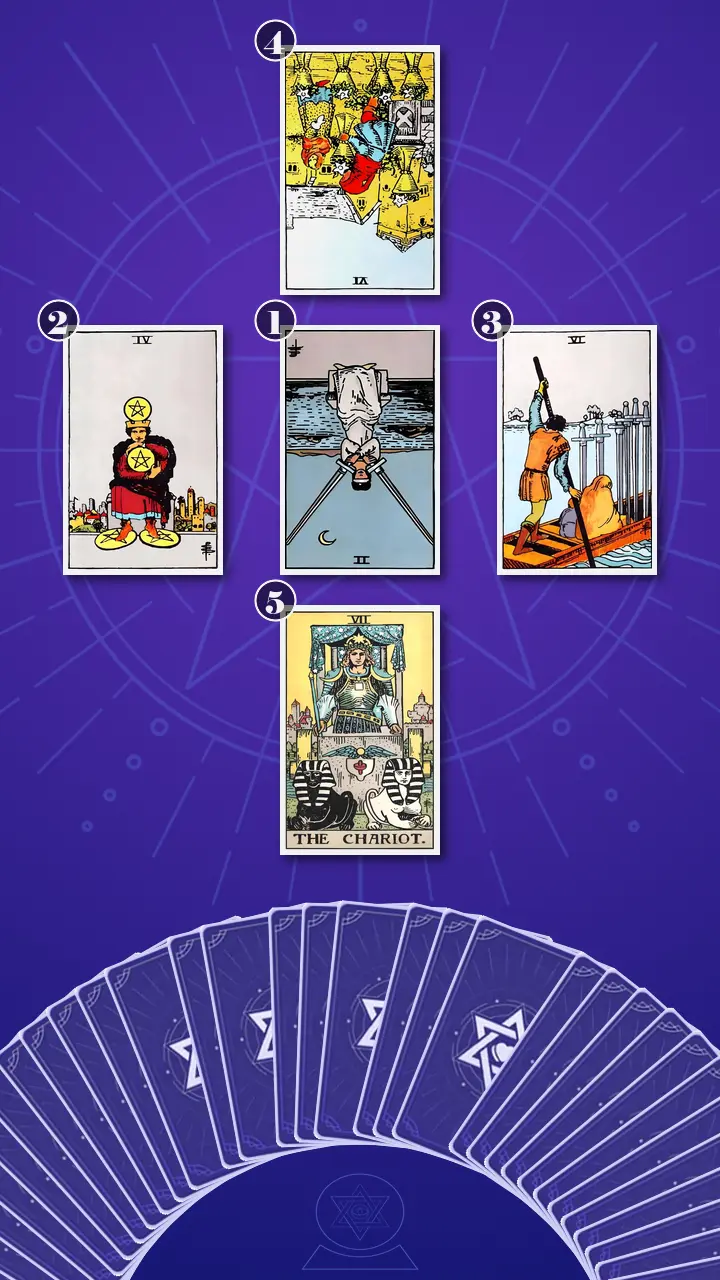
The centre card would show the present dilemma and the contracted energy behind the comparison loop. To one side, I would read what staying near campus protects and constrains. Opposite it, I would look at what the next path could teach through a gradual transition. Above the centre would sit the hidden emotional driver, and below it would be the practical bridge, the smallest route Jordan could steer without making a permanent decision.
The Map Beneath the Open Tabs
The Blindfold Between Two Browser Tabs
Now I turn over the card representing the present dilemma: the observable choice-paralysis behavior, contracted energy, and Inner Conflict described in the diagnosis. It is the Two of Swords, in reversed position.
The blindfolded figure and the crossed swords held across the chest brought Jordan’s late-night scene into focus. At 11:42 p.m., they switch between a campus-near rental spreadsheet and a next-path job or program page, editing commute and rent columns instead of contacting anyone. The screen looks neutral, but their tight chest knows the hidden question is whether moving toward one path means losing the people who make campus feel like home.
Reversed, the Air energy is blocked and overworked. Thinking is not absent; it is circling the same facts so carefully that no new information can enter. The surrounding water suggests emotional uncertainty that has not been given a direct name, while the blindfold shows how keeping both options open can protect the heart for one night and postpone the information needed for the next week. I asked, “Which part of this is a practical question about money, commute, or work, and which part is asking for reassurance that you will still belong?”
Jordan did not nod. They gave a small, bitter laugh and rubbed their forehead. “That is too accurate. Almost rude. I keep saying I need more information, but I already know the trade-off.”
I let the laugh be useful rather than treating it as resistance. “Then we do not need to punish the delay or swing into a panic decision,” I said. “We only need to notice what the comparison has been protecting. You do not have to end the whole uncertainty tonight. You can stop asking it to become certainty before you take one honest look.” Jordan’s hand moved away from the phone, though their shoulders remained raised.
The Ground That Feels Like a Guarantee
For the first side of the choice, I turn over the card representing staying near campus: the safety, continuity, and familiar connection this option appears to protect, along with the cost of holding tightly to it. It is the Four of Pentacles, upright.
Jordan keeps a campus-near room saved because it makes daily life easy to picture: the same cafe, the same TTC route, friends within reach, and fewer unknowns. The pentacle pressed against the figure’s chest translates that physical closeness into a body posture. The two coins under the feet show how much familiar ground has been asked to do. Campus is not merely a place in Jordan’s mind; it has become a single container for routines, relationships, access, and emotional protection.
Upright Earth offers a real need for stability, but in excess it becomes a grip. The card does not say staying near campus is wrong, immature, or less ambitious. It asks what this option genuinely supports and what conversation, application, or new routine Jordan may keep postponing because releasing the familiar package feels like releasing the people inside it. I placed one finger beside the pentacle. “What would remain valuable if you separated the address from the support?” I asked.
Jordan looked at the card for a long moment. Their feet pressed into the floor as if testing whether it would hold without the campus buildings beneath it. “The Sunday voice notes with Priya would still be real,” they said. “The cafe would not be the same, but the friendship is not actually stored in the cafe.” Their mouth tightened after saying it, because the statement was logical and still carried grief.
The Boat Small Enough to Try
Now I turn over the card representing the next path: the nature of transition, what can be carried forward, and what Jordan can learn through a bounded move toward the unfamiliar. It is the Six of Swords, upright.
The boat is leaving rougher water for calmer conditions, but it is not empty. Six swords remain standing inside it. The ferryman does not promise a perfect destination; he provides passage. In real life, this looks like Jordan spending 20 minutes arranging an informational conversation or visiting a possible next-path setting, then scheduling one intentional check-in with a trusted campus friend. The experiment is a crossing, not a permanent relocation. It creates new information while keeping one chosen thread of connection active.
This is directed Air, a movement of thought that finally makes contact with reality. Jordan does not have to know the whole destination to learn something from this crossing. A viewing, a short call, or a conversation with someone already working in a possible field can be data, not a declaration of where they will belong forever. I said, “You do not need a permanent answer to take a reversible step. Let the next step be a test, not a verdict on who you belong with.”
Jordan’s exhale came slowly, as if it had been waiting behind their ribs for permission. Their fingers uncrossed on the table. They opened their notes app and typed, 20-minute inquiry, then looked up with a cautious expression that contained the first small glint of curiosity.
The Old Group Chat as Emotional GPS
Now I turn over the card representing the hidden emotional driver: the memory-based attachment that turns campus proximity into a condition for belonging and maintains the Safety-Connection Fusion. It is the Six of Cups, in reversed position.
The flower-filled cup and the old village in the background became Jordan’s camera roll and an old WhatsApp thread. Before opening a next-path application, they reread first-year messages and scrolled through campus photos. Their chest loosened for a few seconds, then the draft closed because the old feeling of belonging had become a safety test. The memory was meaningful, but it could not tell them what a new neighbourhood, workplace, or study setting would actually provide.
Reversed Water is flowing backward. Nostalgia has stopped being a warm place to visit and started acting like an emotional GPS for a neighbourhood Jordan has not yet experienced. I asked what the remembered feeling was being asked to guarantee in the present. Jordan’s thumb froze over the phone. Their eyes went unfocused as familiar photos seemed to replay by themselves, and then they said, “I am not just choosing a place; I am trying not to lose the feeling that place gave me.”
I answered gently, “That feeling deserves tenderness, but it does not deserve the entire authority of the decision. Notice what your current relationships actually provide today: a text, a voice note, a shared plan, mutual effort. Missing campus is not proof that the next path is wrong. It is evidence that this transition matters.” Jordan’s shoulders dropped on the second breath. They were not suddenly detached from campus. They were beginning to distinguish a valued memory from a present-day instruction.
When The Chariot Held Both Reins
The Bridge with the Campus Gate Behind It
The room grew quiet before I touched the final card. Even the radiator seemed to pause between clicks. Now I turn over the card representing the integrating action: translating the transformation from location-based safety to deliberate connection and self-directed movement into a small, practical experiment.
It is The Chariot, in upright position, the Bridge card of the reading. The charioteer faces the route while the campus-like city recedes behind them. The black and white sphinxes do not pull in identical directions, yet they stand within one composition. I read them as Jordan’s competing needs for autonomy and belonging, not as enemies that must be defeated. The upright Fire is disciplined movement: choosing a course while both needs remain visible.
The modern translation is concrete. Jordan chooses one defined next-path experiment, gives it a review time, and creates a realistic recurring connection ritual such as a Sunday voice note or monthly coffee. The move is not framed as proving independence or abandoning campus. It is a direction Jordan can steer. The Chariot’s power is not a magical guarantee that distance will feel easy. It is the capacity to act deliberately while uncertainty is still present.
Here I brought in the diagnostic lens I have carried through seven generations of Highland healing work. I call it Seasonal Trajectory Alignment: noticing whether someone is trying to force a spring harvest during a winter dormancy phase. Jordan was not in a dead end. Their decision process was in a winter phase, gathering resources and grieving a familiar rhythm before it could support a new route. A season of pause is not a verdict about a person’s future.
I also used Environmental Friction Sensing, which asks whether internal growth energy is meeting a macro environment that has become too narrow, too familiar, or simply mismatched for the next experiment. Campus was not bad soil, and a farther setting was not automatically better soil. The friction came from asking one address to certify every friendship, every future routine, and every version of safety. My own inner image was the winter field I have watched all my life: I would never call the ground behind because nothing was blooming in January. I would ask what it was gathering underground, and what small change in weather would make the next movement observable.
I asked Jordan to remember the late-night scene: two browser windows, one campus-near and one pointing toward the next stage, while the laptop fan runs and their chest tightens. They keep editing the comparison because choosing a tab feels like choosing who gets to remain close.
Stop treating campus proximity as the only proof of safety and connection; carry those needs through deliberate practices while choosing a testable next step, like The Chariot’s driver holding the black and white sphinxes to one course.
I let the sentence settle before making it shorter and easier to carry.
Connection is not proven by staying in one place. Name the support you need, then let one bounded step show you what can travel with you.
For one second, Jordan’s breath stopped. Their fingers, which had been pinching the edge of the card, froze in place. The laptop fan hummed, and the room seemed to hold its own breath. Then their eyes left The Chariot and went unfocused, replaying the rental tabs, the unsent inquiry, and the old group chat. Recognition arrived before words did. Their jaw worked once. They drew in a shallow breath, held it, and let it out with a surprised, shaky sound. Their shoulders lowered, though not completely. Relief brought a brief blankness, the vulnerability of having no perfect answer to hide behind. Their eyes brightened. “So I can keep the friendship without making the address do all the work,” they said.
I wrote the grounding sequence in the margin: Set a 10-minute timer. Write two headings: location-based support and connection practices. Under each, add one honest example, then choose a two-minute next-path action such as drafting one inquiry. Stop when the timer ends. If the exercise feels too activating, pause and return to something grounding that you choose.
“Now, use this new perspective to think back to last week,” I invited. “Was there a moment when this insight could have made you feel different?”
Jordan named the TTC ride after the library, when a classmate had mentioned a job in another part of Toronto. They had gone home, opened LinkedIn, and then scrolled through campus photos until the application draft disappeared beneath the comfort of remembered belonging. Their anger was brief and honest. “I thought I was waiting for clarity,” they said. “Maybe I was waiting not to feel the loss.”
That was the crossing from contracted indecision and fear of disconnection toward grounded agency. Not a leap into certainty, and not a promise that grief would vanish. It was the first moment Jordan could hold autonomy and belonging in the same frame, then imagine maintaining connection through deliberate action rather than location alone.
From Insight to Action: The Carry-Forward Experiment
I gathered the five cards into a single story. The reversed Two of Swords showed the comparison loop: analysis briefly protected Jordan from emotional risk while blocking new information. The Four of Pentacles showed that staying near campus offered genuine continuity, but its tight grip made every farther option feel dangerous before it had been tested. The reversed Six of Cups revealed the root beneath that grip, a memory of belonging being asked to make the present decision. The upright Six of Swords supplied the passage, and The Chariot supplied the steering.
The answer to “Why am I torn between staying near campus and my next path?” was not that one option was secretly correct. Jordan had fused location with safety and connection, then interpreted the uncertainty created by postponement as proof that staying close was necessary. The cognitive blind spot was mistaking the discomfort of an open loop for evidence about the future. The key shift was to separate the needs for safety and connection from the campus location, define one support practice, and take one low-stakes step toward the next path.
I told Jordan, and I want to make this plain for anyone searching for actionable advice at a career crossroads: the cards were not selecting an address. They were separating variables. Distance is a logistics question; connection is a practice. Jordan remained the person in charge of the route, and the next steps only needed to be small enough to produce real information.
- The 20-Minute Next-Path TrialBy Thursday at 6:30 p.m., choose one person, program, workplace, or neighbourhood connected to the next stage. Set a 20-minute timer and draft an informational-chat message, book a low-stakes viewing, or identify one application question. Record one fact learned and one feeling noticed. This is exploration, not a final decision.Define success as contact with new information. Draft the message without sending it first, use a two-minute version if needed, and stop when the timer ends. No friend has to approve the experiment.
- The Connection-Without-Proximity PlanBefore the week ends, ask one trusted campus friend for one sustainable practice, such as a Sunday voice note, a monthly coffee, or a shared calendar reminder after graduation. Add one person, one routine, and one practical resource to a carry-forward list in a notes app or Notion board.Do not promise constant availability. Choose one realistic reciprocal practice. If one person is unavailable, try another connection rather than treating a missed reply as evidence that belonging has disappeared.
- The Winter Dormancy ProtocolWhen comparison fatigue spikes, pause for 10 minutes before reopening a housing or career tab. Put both feet on the floor, close the duplicate comparisons, and write two headings: location-based support and connection practices. Add one honest example under each, then choose one two-minute action that gathers information.This is a grounding pause to gather resources and stop forcing directionless movement until the climate becomes readable, not a command to freeze your future. Return to the question when your body has more room.
A Week Later, One Quiet Proof
Six days later, I received a message from Jordan: “I sent the inquiry. Sunday coffee is in the calendar.” That was the first proof I needed. They had not solved housing, work, friendship, or the whole post-campus transition. They had created contact with the next path and named one connection practice that could travel.
The plan was clear but fragile. Jordan slept a full night, then woke with the familiar thought, “What if I am wrong?” They smiled, made tea, and left the inquiry sent. The fear had not disappeared, but it was no longer allowed to unsend the message.
That was Jordan’s Journey to Clarity: not a prophecy, but a movement from comparison fatigue to one observable act of self-direction. I watched the decision become less like a verdict at a campus gate and more like a route with room for adjustment. The belonging was not guaranteed by the cards. Jordan was learning how to tend it.
When moving away makes your chest tighten, it can feel as if one address has been asked to guarantee both your safety and your belonging. The first proof of clarity is not certainty; it is noticing that those needs can be carried and tended.
If connection could travel through one small, chosen practice, what part of the next path would you feel curious enough to approach for 20 minutes?