The Prestige-Security Trap: A Closed Tab, Then a Work Test Booked

The Prestige-Security Trap at 11:40 p.m.
I have learned that a person can be highly competent, financially careful, and still notice that every “practical” career decision ends with the work they care about removed from the table.
Jordan, a 29-year-old corporate strategy analyst in London, joined my video session from the small table in their shared flat at 11:40 on a Tuesday night. The radiator clicked behind them. A mug of tea had gone cold beside the laptop, whose fan kept whirring as if it, too, had been assigned overtime.
Jordan shared their screen. A mission-driven research role sat open beside a salary-comparison spreadsheet. The sheet had columns for title, promotion certainty, employer recognition, résumé value, and worst-case earnings. There was no column for interest, values, or what an ordinary Tuesday in the role might feel like.
“I checked three former classmates on LinkedIn,” Jordan told me. “Then I added another risk column and closed the listing. I want evidence before I experiment, even though the experiment is how I would get evidence.”
I watched their shoulders brace as they reopened the tab. Their apprehension looked like a hand gripping a Tube rail after the train had already stopped: the safety response was still active, even though a small movement had become possible.
“What keeps happening when you choose between the respected, predictable path and work you genuinely care about?” I asked.
Jordan looked from the job description to the spreadsheet. “I keep calling it practical, but practical always seems to mean the option I care about least. A role feels safer when other people immediately understand why it is impressive. I’m scared that choosing meaning will look like moving backward.”
I told them I was not there to persuade them to quit, take a pay cut, or treat financial reality as an inconvenience. London rent was real. Their savings goals were real. Their right to remain in a secure role was real. Our task was more precise: to see whether security was functioning as a thoughtful safeguard or as an automatic veto.
“Let’s make a map of the fog,” I said. “We are not asking the cards to choose your career. We are asking them to help us see the decision rule that keeps choosing before your curiosity gets a vote.”
Choosing the Compass: A Five-Card Shadow Spread
I asked Jordan to put both feet on the floor and take one unforced breath. I shuffled slowly while they held a single question in mind: “What keeps me choosing status and security over work I care about?” The pause was not mystical theatre. It was a practical transition away from the open tabs and toward sustained attention.
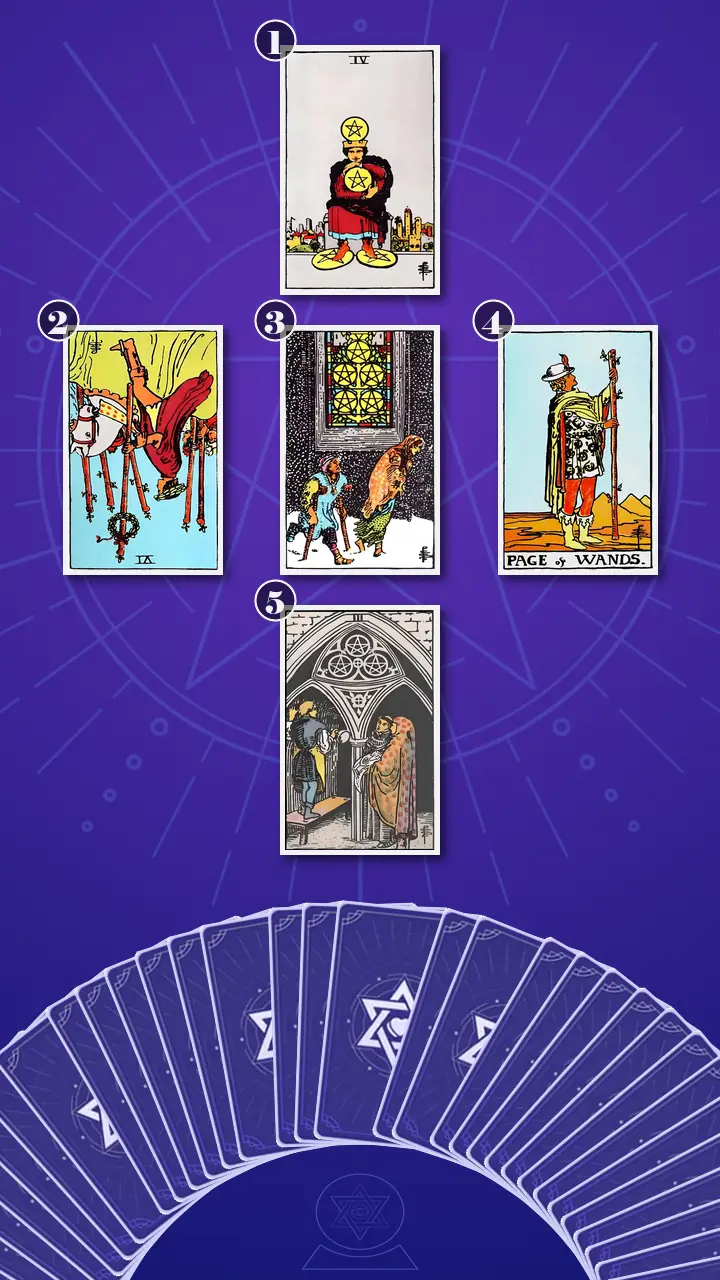
I chose The Shadow Spread, a five-card career shadow-work tarot spread. For anyone wondering how tarot works in my practice, I use it as a structured cognitive mirror, not as a machine for forecasting a destined outcome. Card meanings in context can make an invisible pattern visible enough to examine, test, and change.
This spread suited Jordan’s question because they were not asking which of two jobs would guarantee success. They were asking what psychological mechanism kept reproducing the same choice. A larger Celtic Cross would have added unnecessary situational detail, while a simple decision spread would have made the issue look like a contest between “secure” and “meaningful.” The five-card Shadow Spread could follow the deeper chain: visible behaviour, protective payoff, hidden fear, disowned desire, and conscious integration.
I placed the first card at the top, where it would reveal the behaviour Jordan could already see. The third went in the centre, where it would expose the fear turning a career crossroads into a survival alarm. The fourth would show the neglected capacity trying to re-enter the decision, and the fifth would translate that insight into practical next steps.
The layout resembled a compass. Its centre held the fear. Its eastern point opened a new direction. Its southern point would tell us how to walk toward that direction without dismantling the security Jordan had responsibly built.
Reading the Orbit That Had Become Too Tight
Position One: The Spreadsheet as Armour
“Now turning over is the card that represents the visible recurring behaviour: holding status and predictability so tightly that meaningful work is eliminated before exploration begins,” I said. “It is the Four of Pentacles, upright.”
I showed Jordan the figure with one pentacle pressed against the chest, another balanced over the head, and two pinned beneath the feet. A distant city remained visible but unreachable. I read the coins as the resources Jordan kept fixed in place: a respected title, predictable income, a polished résumé, a growing savings buffer, and a promotion track that made progress easy to explain.
At 11:40 p.m., the spreadsheet had become the modern image of this card. Jordan had required the mission-driven role to prove complete safety before it could earn an application, a conversation, or even one hour of direct contact. Adding “promotion certainty” reduced uncertainty for the night, but it also pinned both feet to the existing path.
The upright Four of Pentacles can express healthy conservation, and I did not dismiss that. Jordan had legitimate resources to protect. Here, however, fixed Earth had moved into excess. Protection had become a blockage because every unknown variable was treated as disqualifying, while the known cost of disengagement was entered into the model as zero.
“Your spreadsheet is not lying,” I said. “It is answering the question it has been designed to answer. The problem is that its formula gives title, salary, and predictability a weighting of one hundred, leaves the cells for interest and daily experience blank, and then presents the result as objective.”
I offered Jordan a sentence to test against their own experience: “I am only protecting my income and savings, so why does protecting them require me never to test the work I care about?”
Their breath caught. Their fingers stopped on the trackpad, and their eyes moved back across the spreadsheet as if they were seeing its columns for the first time. Then they gave a short laugh that carried no amusement.
“That is so accurate it feels a bit brutal,” they said.
“Then let’s slow it down,” I replied. “Recognition is not an accusation. Valuing security is not the problem. We are only noticing the point where a sensible boundary turns into a closed decision rule. You remain free to decide that your present role is right for you. I simply want that decision to include more than the fear of moving.”
Position Two: The Internal LinkedIn Audience
“Now turning over is the card that represents the protective reward behind the pattern: the way prestige and external recognition temporarily stabilise professional self-worth,” I said. “It is the Six of Wands, reversed.”
In the upright image, a laurel-crowned rider moves through an admiring crowd. Reversed, I saw the crowd migrate inward. Jordan no longer needed anyone to criticise an unconventional move; an internal audience was already evaluating how the title would look on LinkedIn, how the employer would sound at dinner, and whether the choice could be narrated as obvious advancement.
Jordan had described the mechanism from the Northern line. They could be interested in a role until a former classmate’s promotion post appeared on their phone. With damp coats around them, brakes shrieking into Bank, and the screen hot in their palm, the less recognisable title suddenly felt like a social demotion. Before reading the responsibilities again, Jordan would search the employer’s prestige.
“You were interested until you imagined explaining it,” I said.
Jordan’s chin lifted, then dropped. They turned their mug in a slow circle but did not drink from it.
“Yes,” they said. “The work does not change. I just picture telling someone about it, and suddenly it feels embarrassing.”
The reversal showed Fire caught in an unstable loop. There was an excess of attention directed toward recognition, but a deficiency of confidence that could survive without that recognition being renewed. A prestigious title provided quick reassurance, yet it could not permanently settle the question of worth. That was why another promotion or credential could feel necessary even when it did little to improve the daily work.
I thought of the professional identity at the centre of The Devil Wears Prada: so legible, elevated, and socially rewarding that the fit of the ordinary workday becomes difficult to hear beneath it. I was not treating ambition as shallow. I was separating two questions that Jordan’s internal leaderboard had merged.
“Would other people read this as progress?” I asked. “And would you respect how you spend a Tuesday here?”
Jordan stared beyond the camera for several seconds. “I know how to answer the first question instantly,” they said. “I almost never let myself answer the second one.”
Position Three: The Warm Window and the Feared Exile
“Now turning over is the card that represents the fear beneath the recurring pattern: that choosing meaningful work could cost security, professional belonging, or the sense that you are still someone who is doing well,” I said. “It is the Five of Pentacles, upright.”
The card showed two figures moving through snow beneath an illuminated window filled with pentacles. The warm interior seemed close enough to see but not close enough to enter. I read the image as Jordan’s assumption that moving away from a prestigious track would mean moving outside the room where secure, respected professionals belonged.
I asked about the last lower-paid role they had considered. Jordan told me that they had stood at the kitchen counter on a Sunday night with the listing open beside their banking app. Rain had tapped the window. The fridge had hummed. The next London rent payment had been visible on-screen.
A modest salary difference had not remained one financial variable. In Jordan’s mind, it had expanded into depleted savings, unaffordable rent, lost contacts, stalled momentum, and former classmates advancing without them. Their body had reacted to a career question as though it were exile from safety and belonging.
“If I leave the legible path, will I still count as someone who is doing well?” I asked softly.
Jordan became still. First, their breath paused and their fingers hovered over the mug. Then their focus seemed to turn inward, as if a private sequence of promotion posts, salary bands, and unanswered project emails were replaying behind their eyes. Finally, they let out a low “Oh,” and their shoulders descended by a fraction.
The upright card placed scarcity energy directly in the centre of the spread. Again, it was not a prediction. It did not say that meaningful work would cause hardship or exclusion. It showed how the fear of those outcomes had become excessive enough to make any uncertain path feel like the worst-case path.
“A fear script can feel like a forecast when your worth is inside the risk calculation,” I said. “The goal is not to ignore the script. It is to check which parts are verified constraints, which parts are temporary alarm, and which parts are inherited rules about what success must look like.”
I validated the real conditions first: rent, current commitments, savings, and Jordan’s personal comfort threshold. Then I drew the distinction the spread was asking for.
“Practical should describe your safeguards, not automatically select the work you care about least.”
Jordan nodded, but their eyes had reddened slightly. “The career question has always felt bigger than preference,” they said. “It feels like if I choose wrong, I lose the life where people can tell I’m okay.”
“That makes sense of the grip,” I replied. “It also tells us why more abstract comparison has not freed you. The spreadsheet is being asked to calculate money, belonging, reputation, and personal worth all at once.”
When the Page Raised the Living Question
As I reached for the fourth card, the radiator went quiet. The laptop fan slowed, and the room seemed to gather around the small patch of table visible between Jordan and me. I could feel that we had reached the bridge of the reading.
Position Four: Curiosity Before Comparison
“Now turning over is the card that represents the disowned desire asking to be recognised: curiosity, meaningful engagement, and permission to learn through direct experience,” I said. “It is the Page of Wands, upright.”
The Page stood in an open landscape, studying a sprouting wand. I saw neither a guaranteed destination nor a dramatic resignation. I saw focused attention meeting one living question. Upright Fire was returning in balance, no longer performed for the crowd but used to investigate what generated energy, concentration, frustration, and genuine interest.
I translated the card into a Saturday morning near London Fields. Jordan could open one real research brief for a community organisation, hide the title and future-career implications, and spend an hour noticing the work itself. The exercise would not prove that they had found a perfect vocation. It would simply allow direct experience to produce information before status comparison erased the signal.
I held the card between us. At 11:40 p.m., the meaningful role had still been open beside the spreadsheet; three promotion posts had arrived; Jordan’s chest had tightened; and they had called closing the tab practical before giving the work any chance to answer back.
This was where I used what I call Decision Timing Calibration. I was not trying to identify a cosmically perfect date for a career pivot. I was assessing whether the current cyclical environment was structurally fit for a high-stakes choice. A tired mind, a late-night LinkedIn comparison spiral, and a fresh rent alarm formed a real emotional weather system, but they did not deserve a permanent vote on Jordan’s entire working life.
I paired that with Cyclical Variable Filtering. I separated temporary friction from variables likely to affect Jordan’s longer orbit. Fatigue, a peer’s announcement, and the need to defend a title in an imagined conversation were temporary signals. Minimum monthly costs, required savings, interest in the actual tasks, repeatable energy, skill development, and informed feedback were durable variables. The filtering did not tell Jordan which job to choose. It stopped a passing storm from disguising itself as the whole climate.
Caring about the work is not evidence against being practical. It is decision evidence you can test before asking your security to carry the entire answer.
You do not need an impressive title to prove your worth; let curiosity earn a place in the decision, as the Page lifts the sprouting wand toward what is ready to be tested.
I let the sentence remain in the quiet. Jordan’s breathing stopped for a beat, and their pupils widened before their gaze slipped away from the screen. Their mouth opened, closed, and tightened at one corner. Both hands had been clasped around the mug; I watched one thumb release, then the other, until their palms rested flat on the table. Their shoulders softened, but the relief did not arrive cleanly. A flash of anger crossed their face.
“But doesn’t that mean I’ve been wrong this whole time?” they asked. The words came quickly, then their voice thinned. “I’ve built so much around being the person who makes the smart choice.”
I heard the vulnerability beneath the protest. “No,” I said. “It means your earlier choices protected needs that mattered. They gave you income, skill, and room to save. The Page is not putting your past on trial. It is showing that the old rule has become too narrow for the next question. Clarity creates responsibility, and that can feel briefly disorienting, because now you can choose instead of only defend.”
Jordan’s eyes shone. Their jaw loosened, followed by a long, trembling exhale. For a second they looked almost blank, like someone who had set down a heavy bag and had not yet adjusted to the missing weight.
“Now, using this new perspective, think back: was there a moment last week when this insight could have made you feel different?” I asked.
Jordan remembered a two-hour sample task they had opened for a community organisation. For twenty minutes, they had been absorbed. Their jaw had unclenched, and the work had held their attention. Then they had searched the organisation’s prestige and begun debating whether the experience would “count.”
“What if I don’t need to know what it becomes before I learn what it feels like to do it?” Jordan said.
That was the Page’s bridge. It was not certainty, and it was not a promise of a better career. It was the first movement from apprehensive, status-driven risk analysis toward grounded self-trust based on safeguarded real-world evidence. Curiosity was becoming decision evidence, even before it became a career plan.
Position Five: The Project Brief Beneath the Cathedral Arch
“Now turning over is the card that represents conscious integration: a bounded, collaborative experiment that protects minimum security while creating real evidence about meaningful work,” I said. “It is the Three of Pentacles, upright.”
The image showed a craftsperson standing with tools while two other figures consulted an architectural plan. I translated the tools into Jordan’s existing strategy skills, the plan into a one-page pilot brief, and the consulting figures into collaborators able to offer feedback grounded in actual contribution.
In modern terms, this could be a two-week project with one values-aligned organisation. Jordan could contribute a defined skill, cap the time commitment, retain their current income, and schedule one feedback conversation at the end. Instead of deciding between secure corporate work and a dramatic escape, they could collect evidence about the tasks, team, learning curve, and energy required.
The Pentacles energy had changed. In the first card, Earth was clenched against the body. In the centre, Earth had become exposure and scarcity. Here, Earth returned in balance as planning, craft, collaboration, and observable feedback. Security no longer had to be a locked door. It could become the structure around a responsible experiment.
“The Page changes the order,” I told Jordan. “First contact, then comparison. The Three of Pentacles gives that contact a scope, a deadline, another person, and an exit condition.”
Jordan opened Notes instead of reopening the spreadsheet. Their hand hovered over the keyboard, their eyes narrowed in concentration, and then their shoulders settled as they typed: “One research task. Two hours. One person. One feedback question.”
“I don’t need a verdict on my whole career,” they said. “I need one piece of trustworthy feedback.”
“Exactly,” I replied. “Do not decide your whole career when one honest experiment would answer the next question.”
The 72-Hour Orbit and the One-Task Evidence Pilot
I gathered the spread into one story. Jordan’s respected career had provided real stability, competence, and social proof. Over time, those rewards had taught their nervous system to treat legible success as evidence of personal worth. The Four of Pentacles showed the visible grip; the reversed Six of Wands showed the internal audience rewarding it; and the Five of Pentacles revealed the deeper fear that loosening the grip meant financial exposure and professional exile. The Page of Wands restored private curiosity, while the Three of Pentacles gave that curiosity a responsible structure.
The core blind spot was not caring too much about security. It was treating prestige, safety, belonging, and worth as though they were one indivisible variable. That made any less recognisable role appear financially dangerous before the actual figures, tasks, or boundaries had been examined. It also hid the long-term cost of remaining disengaged and prevented meaningful work from generating evidence of its own.
I described Jordan’s current role as a stable orbit that had gradually become confused with the whole sky. My aim was not to knock them out of it. The transformation was smaller and more useful: define the minimum conditions that genuinely needed protection, filter out temporary comparison pressure, and run one time-boxed experiment before making a major decision.
I gave Jordan three pieces of actionable advice. Each was deliberately small enough to preserve choice.
- Use the Orbital Pause and define the security floor.After a promotion post, salary scare, or late-night comparison spiral, delay any irreversible career verdict for 72 hours unless a real deadline requires action. At a calmer point, set a five-minute timer and write two headings: “Minimum security I genuinely need” and “One meaningful-work question I could test.” List no more than three essentials under the first and one 60-minute experiment under the second.The pause delays a fear-driven conclusion, not an application or low-risk conversation. If the exercise feels too large, write one protected condition, such as “I will not risk this month’s rent,” and stop.
- Run the Title-Hidden Work Test.Choose one role from the saved-jobs folder. For five minutes, hide the employer, title, and salary. Score only the daily tasks from one to five for interest, values fit, and desired learning. Restore the practical information afterward and compare both sets of evidence.This does not replace salary or stability data. It collects the missing category before the internal LinkedIn audience can change the question.
- Build a one-task collaborative pilot.Send one message this week to a community organisation, practitioner, or trusted contact. Offer one bounded contribution, such as a research call, data review, or two-hour strategy session. Put four lines in the brief: task, time limit, skill contributed, and one feedback question. Cap the pilot at one session or two weeks.Define success as learning, not proving that the work is perfect or that a new identity is justified. Keep an explicit exit condition and schedule one 20-minute debrief.
I reminded Jordan that the Orbital Pause Strategy did not mean waiting passively for the universe to reveal an answer. It created enough distance from temporary macro-friction for better variables to become visible. After the pause, Jordan would still be the person deciding what level of risk, income, prestige, and engagement belonged in their life.
The cards had not instructed them to leave corporate strategy. They had shown why every alternative was disappearing before it could be tested. That distinction returned the authority to Jordan, where it belonged.
A Week Later, the Tab Stayed Open
Six days later, I received a message from Jordan. They had used the title-hidden test on the community organisation’s role and scored the daily research tasks before looking at the employer name. Then they had sent one email offering a two-hour strategy session with a clear scope and a request for feedback.
“I hovered over Send on the Overground platform for about four minutes,” Jordan wrote. “My body treated it like a resignation. Then I remembered: first contact, then comparison. They said yes. The session is next Saturday.”
Jordan had not solved their entire career, and I was glad they were not pretending otherwise. They had protected their income, kept their current role, and created one piece of reality where previously there had only been assumptions.
They slept through the night after sending the message. In the morning, their first thought was still, “What if this makes me look as if I’m moving backward?” Jordan wrote that they smiled at the thought, then left the calendar booking in place.
I saw that as the quiet proof of our Journey to Clarity. Tarot had not supplied a verdict from outside Jordan’s life. The five-card Shadow Spread had helped them separate an actual constraint from a feared scenario, a security floor from a status veto, and a reversible experiment from an imagined irreversible leap.
I have spent years watching cycles turn, and I no longer mistake every low tide for evidence that the shore has disappeared. When a meaningful option tightens the chest, loosening an impressive career can feel as though it would also loosen one’s claim to safety, belonging, and worth. Yet clarity does not always arrive as a final destination. Sometimes it begins when the fog thins enough to reveal one sprouting wand, one protected boundary, and one task that can be tried without surrendering the life already built.
If curiosity were allowed to count as one honest piece of evidence in your own career decision, what is the smallest real task you would place inside a protected 60-minute orbit and notice more closely?