Promotion Form, Unopened Notes, and a Two-Hour Test of Her Own

The 10:45 p.m. Future That Was Easy to Explain
If you are a 28-year-old Toronto tech worker with a promotion application open on Sunday night and a private Notes page full of Other Directions, career pivot anxiety may look less like indecision and more like choosing the easiest future to explain.
Maya appeared on my screen from her condo kitchen at 10:45 p.m. She turned her laptop towards the camera: a promotion application occupied one half of the display, while the Notes page sat untouched on the other. Cold light from the range hood flattened the room into shades of blue and grey. The radiator clicked behind her, and an empty mug caught the glow each time she rewrote the same achievement bullet.
One future had requirements she could list. The other had a pull she could not yet package.
“I can build a five-year plan for a path I am not sure I want,” she said. Her shoulders had risen almost to her ears. “Then I tell myself I need more clarity, so I collect more opinions. Somehow I always end up applying for the sensible thing.”
She glanced at the unopened note. “I keep calling it sensible because it is easier to explain.”
The apprehension in her body looked like a seat belt locked across her ribs while the car was still parked: nothing was moving, yet every muscle was braced for impact. Beneath that pressure, I could hear longing, guilt and a thin current of resentment. Maya wanted a self-authored future, but the expected path offered recognisable milestones, a predictable salary and the comfort of choices nobody would ask her to defend.
I did not tell her that stability was false, that a promotion was spiritually inferior, or that she needed to make a dramatic career change. Toronto housing costs were real. So were the benefits of experience, income and professional structure. The question was whether those realities were informing her decision or being recruited to silence a preference she had never tested.
“We are not going to ask the cards to choose your future for you,” I said. “We are going to use them to separate real constraints from the imagined audience in your head. Let us make a map of the fog, then see which part of the next step actually belongs to you.”

Choosing Four Rungs Through the Fog
I invited Maya to put both feet on the kitchen floor, take one unforced breath and hold a single question in mind: Why do I keep choosing the expected path over my own future? I shuffled slowly, not as a supernatural performance, but as a clean transition from scrolling, comparing and defending into focused attention.
I chose the Four-Layer Insight Ladder, a four-card tarot spread designed to trace a repeated pattern from its visible behaviour to its underlying root, then upwards into transformation and action. I arranged the cards in a vertical column, leaving a slightly wider gap before the third card so the turning point would be visible.
For anyone wondering how tarot works in a career decision, I treat a spread like an externalised thinking structure. It does not predict which job Maya must take. It gives distinct images and positions to forces that have become tangled together, allowing card meanings in context to reveal where one concern ends and another begins. Maya remains the source of lived truth and the owner of every decision.
The bottom card would show the present layer: the observable pattern that made the expected path feel like the definition of a valid future. The second would reveal the root layer: the approval-and-belonging fear maintaining that pattern. The third, our catalyst, would identify the inner evaluation capable of interrupting it. The final card would translate that shift into one low-risk, time-boxed experiment.
This spread suited Maya because she was not really asking which of two external options would guarantee a better outcome. She was asking why the same self-silencing process kept repeating. Four cards were enough to follow that chain without giving her hyper-analytical mind another elaborate system to optimise.
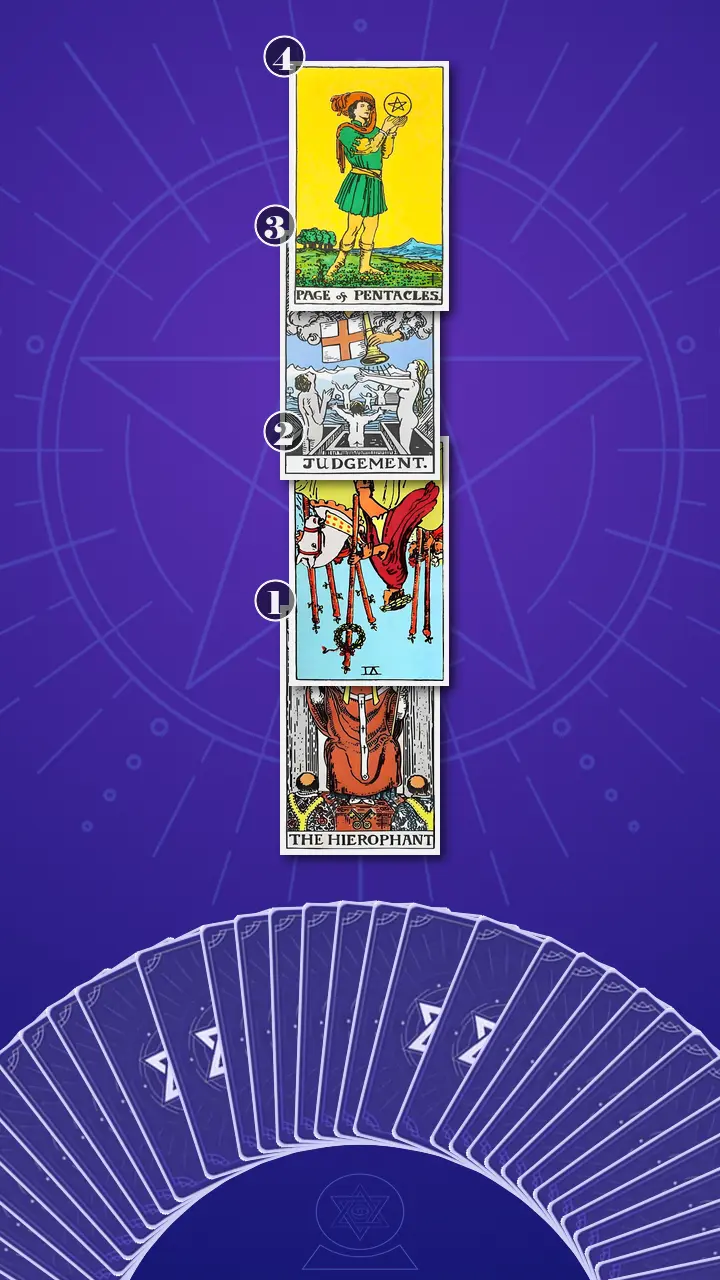
The Rules Beneath the Career Plan
The Present Layer: The Hierophant at the Gate
The first card I turned over occupied the present layer, representing Maya's observable habit of choosing recognisable milestones and allowing the expected path to define which futures counted as valid.
It was The Hierophant, upright.
I showed her the robed authority between grey pillars, the two acolytes kneeling below and the crossed keys at his feet. The Hierophant can represent institutions, inherited standards, formal teaching and the value of established structures. In Maya's life, those crossed keys had become promotion criteria, credentials, salary bands and polished explanations: the official entry pass to an acceptable adult future.
“This is not simply you considering a promotion,” I said. “It is you treating the title ladder and competency matrix as proof that the future behind them is legitimate. You can say, I can justify this. I can name the requirements. I can tell people what comes next. The quieter direction stays in Notes because it does not yet have institutional language proving that it counts.”
The Hierophant's upright energy was not harmful in itself. In balance, it offered Maya useful training, reliable standards, colleagues, income and a way to develop skills. Here, however, its authority had become excessive. A structure designed to guide her was acting as a gatekeeper to what she was allowed to want.
I thought of The Truman Show. The problem with the familiar set was not that everything inside it was fake or worthless; it was that familiarity and an invisible audience had acquired final edit over the protagonist's entire story. Maya did not have to reject the set. She needed to notice where she had mistaken a script for the edge of the world.
She gave a brief laugh, but the sound carried a bitter edge. “That is so accurate it feels slightly brutal.”
I let the comment stand without rushing to soften it into a slogan. “It would be brutal if the card were saying your promotion is wrong. It is not. It is asking us to separate what genuinely supports you from what has been granted too much authority.”
I asked her, “When you picture the daily reality of the promotion, which parts feel useful to your life, and which parts feel valuable mainly because other people will immediately understand them?”
Her thumb rubbed the handle of the empty mug. She named the salary increase, mentorship and broader experience as real benefits. Then her gaze moved back to the screen.
“The actual day-to-day would be more status meetings and escalation work,” she said. “That part does not excite me. What excites me is being able to say I got promoted.”
“That distinction is the first honest piece of evidence,” I said. “Easy to explain is not the same as right for you.”
The Root Layer: A Victory Waiting for Reactions
The next card represented the root layer: the fear that a personally chosen future might cost Maya approval and belonging, along with the validation-seeking loop that kept the expected path in place.
It was the Six of Wands, reversed.
In the traditional image, an elevated rider passes through a crowd wearing a laurel wreath. Upright, its Fire can describe visible achievement, recognition and well-earned confidence. Reversed here, that Fire was blocked and redirected towards an imagined audience. Maya had an excess of attention on how a choice would be received and a deficiency of private recognition for what she already knew.
She had described a Tuesday commute on Line 1 at 8:47 p.m. I could almost see it as she spoke: fluorescent lights buzzing above wet wool coats, the phone growing warm in her palm, brake dust in the air. A former colleague's promotion post had filled the screen with congratulatory reactions. Before Maya pictured the lived reality of her own alternatives, her jaw had tightened and she had opened a Toronto salary calculator.
The reversed victory scene captured the sequence precisely. She imagined the announcement before the day-to-day work. She asked whether a possible future would make a clean LinkedIn update, reassure her friends or impress a mentor. If no applause was immediately available, she quietly downgraded the option before testing it.
“The private question is, What fits me?” I said. “The public question is, What will be applauded? You have been asking the second one so quickly that the first has barely had time to form.”
Maya's lips parted, then closed. Her eyes moved away from the cards and fixed on something beyond her screen. After several seconds, she exhaled through her nose.
“I do not even picture myself doing the work,” she said. “I picture telling people what I chose. Before I let myself want anything, I need to know how it will sound.”
I named the loop without blaming her for having learned it. A conventional choice brought temporary relief because it was defensible. But because her own preference remained untested, she gathered no direct evidence of independent judgment. The next time she faced a decision, outside approval felt even more necessary.
“You are not indecisive; you may be waiting for permission in a place where only experience can answer,” I said. “And the need for belonging is not a character flaw. We simply need to stop treating every imagined reaction as if it were a material constraint.”
Rent, salary and job security belonged in the decision. A hypothetical LinkedIn audience did not deserve the same vote.
When Judgement's Trumpet Cut Through the Noise
The Transformation Layer: The Call Without a Crowd
The radiator in Maya's kitchen stopped clicking just as I reached for the third card. In my study, the rain against the window thinned to a faint, even sound. The pause did not feel ominous; it felt like the instant after twenty browser tabs have finally closed.
This card occupied the transformation layer. Its role was to identify the inner evaluation that could interrupt Maya's habit of treating other people's recognition as permission.
I turned over Judgement, upright.
An angel sounded a trumpet above the landscape. Below, figures rose from their enclosures with open arms. Unlike The Hierophant's sanctioned keys or the Six of Wands' public wreath, the trumpet was heard directly. No gatekeeper translated it. No crowd had to applaud before the figures responded.
Judgement can be distorted into frightening language about final verdicts, but I do not read it as a sentence imposed from outside. Its balanced energy is honest reckoning: the ability to review an inherited path without automatically defending it or rebelling against it, and then to answer what remains meaningful after the noise drops away.
In Maya's modern life, Judgement looked like putting her phone face down during lunch, closing the advice threads and writing one private page about the direction she kept reopening. She would assess it through meaning, curiosity, practical fit and lived experience before asking whether it could become a polished announcement.
At 10:45 on Sunday, the promotion form could hold Maya's attention because every requirement was visible. The Notes page was harder to open: it asked for a preference before there was a title, a reaction count, or a clean explanation to protect her.
I reduced the immediate implication to one sentence: Your preference does not need public recognition before it deserves an honest, practical test.
Then I gave her the sentence at the centre of the reading.
Your future does not need an audience to become legitimate; answer the call you can already hear, as Judgement's figures rise when the trumpet sounds.
I stopped speaking.
Her breath stopped first. On my screen, her fingers froze above the keyboard, and her eyes held on the trumpet as if she were replaying every group-chat poll she had opened before naming her own view. Her brow tightened; recognition arrived with a flash of resistance rather than relief. “But does that mean I have been doing it wrong this whole time?” she asked, her voice sharper than before. “Have I wasted years building a life other people could approve of?” I watched her shoulders drop, then draw back up as the new clarity exposed its own responsibility. I told her no: previous choices had given her income, skills and relationships. Awakening did not require her to prosecute her past. Her fingers slowly uncurled against the mug. Her eyes reddened slightly, and a long breath left her chest, followed by a small, disoriented pause, as though setting down a heavy box had revealed how tired her arms were.
I let the silence settle, then asked, “Now, using this new perspective, think back to last week. Was there a moment when this insight could have made you feel different?”
“Tuesday on the train,” she said. “I had a workshop page open about community research and service design. I closed it when I saw that promotion post. If I had thought of it as a two-hour test instead of a career announcement, I probably would have booked it.”
This was where I reached for a perspective I call Historical Crossroad Matching. At genuine historical turning points, the old road rarely disappears the moment a new route becomes visible. Established systems and emerging practices overlap. People preserve useful infrastructure while deciding which authority no longer deserves to govern the entire map.
“Your promotion route can remain open,” I told Maya. “The shift is that it no longer has a monopoly on legitimacy. You are not choosing between obedience and reckless escape. You are moving from receiving a script to evaluating it.”
Looking at Judgement, I remembered an excavation trench where a later wall had been built from stones taken from an earlier structure. The builders had not denied their past; they had reused what endured without remaining trapped inside the original blueprint. That professional memory gave me the clearest language for Maya's position.
I used my Enduring Value Assessment to sort the options by what might survive the test of time. The promotion's salary buffer, skills and relationships could have lasting value. The immediate relief of a respectable announcement would fade quickly. Maya's recurring curiosity about public-interest service design was not proof of a destined career, but its persistence made it worthy of investigation.
“It does not need to be a resignation letter, a rebrand or a five-year plan,” I said. “It only needs to be named honestly enough to test.”
I could see the first movement in Maya's emotional transformation: not instant certainty, but a step from contracted apprehension and approval-driven conformity towards grounded self-trust. Her preference had not become a command. It had become admissible evidence.
The Page and the Two-Hour Future
The Action Layer: A Beginner Holding One Real Thing
The fourth card represented the action layer: the grounded next step through which Maya could turn self-authorship into a low-risk, time-boxed experiment and gather direct evidence before seeking feedback.
It was the Page of Pentacles, upright.
The Page held one pentacle at eye level, studying it with quiet concentration. A cultivated field stretched behind the figure, and mountains waited in the distance. The Page was not standing at a summit or announcing expertise. This was balanced Earth energy: careful beginnings, practical learning, sustained attention and permission to be new.
For Maya, the image translated abstract longing into a task she could put on Google Calendar. She did not need to quit her job, publish a career-pivot post or produce a complete plan. She could go to the Toronto Reference Library, give one possibility two uninterrupted hours and complete a beginner-level exercise. Afterwards, she could record what happened in her attention, body and practical circumstances.
“A private experiment is not a public announcement,” I said. “The Page is not asking you to prove that this direction will work forever. It is asking you to learn what the work is actually like.”
The lack of Swords in the spread felt significant to me. Maya had plenty of analysis available already. Another month of comparison could not supply the kind of clarity that only contact with the work would produce. The Page offered the missing Earth container: limited scope, a clear finish line and observable results.
I asked, “What could you complete in two hours that would teach you something about community research or service design without requiring any larger commitment?”
Maya looked towards the unopened Notes page. “There is a beginner lesson I saved months ago. I could finish that and draft a short interview guide for one public service I use.”
Her shoulders did not relax completely. Her stomach still fluttered, she told me, and she immediately worried that two hours was too small to count. But her hand moved to the trackpad. She created a Saturday calendar block while we were still speaking and titled it Private Field Test.
That small movement mattered more than a dramatic promise. She was no longer researching whether she was allowed to begin. She was arranging to learn.
Excavating the Choice That Will Still Matter
When I read the four cards as one story, the pattern was coherent. The Hierophant showed how a useful professional system had become the official language of legitimacy. The Six of Wands reversed revealed why that system held so much emotional power: Maya checked for applause before allowing a preference to become real. Judgement moved evaluation from gatekeeper and crowd to Maya's own reflective process. The Page of Pentacles then prevented that awakening from becoming another grand performance by giving it a modest, practical container.
The cognitive blind spot was not that Maya cared about money, reputation or advice. It was that she had begun treating recognisability as evidence of personal fit and more analysis as the route to clarity. Her career GPS kept selecting the road with the clearest signs, even when she could see that it was not necessarily heading towards her desired destination.
The transformation direction was equally specific: move from asking which option would look most acceptable to running one low-risk experiment chosen by a personal criterion before requesting feedback. Conventional paths could remain options. They simply had to stop behaving like commands.
I invited Maya to approach the next week as an archaeologist of her own future. My Time Stratigraphy Exercise asks a person to stand mentally with their ten-year-future self and examine the present dilemma as one layer in a much longer life. From that distance, a friend's puzzled reaction may prove temporary, while skills, health, financial resilience, curiosity and the ability to trust direct experience may show more enduring value.
“Two hours sounds small until I look at my calendar,” Maya said. “Then it suddenly feels impossible.”
“Small does not mean effortless,” I replied. “It means bounded. If two hours becomes a reason to postpone, we reduce the first version to twenty minutes. The experiment serves you; you do not serve the experiment.”
Three Boundaries for a Self-Authored Test
- Run the 15-Minute Time Stratigraphy Check Before submitting the promotion application or opening salary sites and group chats, set a 15-minute timer. Imagine Maya at 38 looking back at this week as one visible layer. Write two columns: “What fits me?” and “What gets applause?” Mark real constraints such as income and housing separately from predicted reactions. Finish with one undefended sentence: “I am curious about community research because I want to know how that work feels in practice.” Keep the promotion if its daily reality and durable value still fit. This check is not automatic rebellion; it is a way to make sure urgency has not taken authorship away from you.
- Book the Private Field Test Before Friday, reserve exactly two hours on Saturday at the Toronto Reference Library. Complete one saved beginner lesson and draft one short interview guide. At the start, write the success criterion in Notes: “I will know more about my lived fit if I finish this task and notice my energy afterwards.” Choose a task with a clear finish line. If resistance makes two hours feel too exposing, do one twenty-minute lesson. The result does not obligate a job change, disclosure or continuation.
- Hold the 48-Hour Feedback Boundary Immediately after the field test, write four lines: “What I did,” “what felt alive,” “what felt draining” and “the smallest next test, if any.” Wait 48 hours before asking friends, colleagues, mentors or LinkedIn to evaluate the direction. Afterwards, request one practical resource instead of a verdict. Ask for input after you have heard yourself once. If the chest-tightness spikes, put both feet on the floor and return to one observation rather than trying to defend an entire future.
These were actionable next steps, not a demand for certainty. The reading had found the fracture in Maya's old decision process, but the cards were not going to rebuild it for her. That work belonged to her choices, her evidence and her right to revise either path.

A Week Later, Two Hours of Her Own
Seven days later, I received a photo from Maya. Sunlight lay across the edge of a notebook at the Toronto Reference Library. Her laptop showed the completed beginner lesson, and four handwritten debrief lines sat beside it. I could almost hear the study floor she described: keyboard taps, muted footsteps and the steady whir of the ventilation system.
Her message read, “I did not discover my one true career. I did notice that I lost track of time while drafting the interview guide, and I felt flat during the software section. That is more useful than another ten advice threads. I have not asked the group chat what it means yet.”
She had also completed the Time Stratigraphy Exercise before returning to the promotion application. She decided to submit it because the salary buffer and mentorship still mattered, but she booked a second private field test as well. The promotion had become an option she could evaluate, not a command she had obeyed automatically. The quieter direction had become a source of evidence, not a fantasy required to defeat the conventional path.
She told me she slept through the night. Her first thought on waking was still, “What if I am wrong?” She smiled because the question no longer sounded like a verdict. It sounded like something another small test could help her investigate.
That was the quiet proof of our Journey to Clarity. The Four-Layer Insight Ladder had made Maya's approval loop visible, but no tarot card created her self-trust. She did that by hearing her own preference once, protecting it from immediate judgment and giving it two real hours in the world.
When you keep your shoulders tight over the most defensible choice while the future you actually want remains open in another tab, it can feel as though belonging depends on never choosing a path that needs your own voice first. I hope Maya's story offers a gentler possibility: noticing that bargain means you are no longer kneeling before it without seeing it.
If you gave the quietest tab in your own life two private hours this week, without turning it into a resignation letter, a public announcement or a verdict on your whole future, what would you be curious to learn from one Page-sized answer to Judgement's call?