Career Options v11: Choice Paralysis Gives Way to a 25-Minute Test

Career Choice Paralysis at the 8:47 p.m. Crossroads
If you are an early-career city professional with a reliable job and a private creative tab always open, Career Pivot Anxiety may look like reopening the same pros-and-cons note the moment an opportunity asks for a reply. I know the pattern well: the mind calls it research, but the body is waiting for an impossible level of safety.
I met Jordan (name changed for privacy) on a Tuesday evening after she had taken the southbound Line 1 home. At 8:47 p.m., she reopened the comparison note she had already edited at lunch and added another line about irregular income. The TTC fluorescent lights buzzed overhead, the carriage smelled of wet wool, and her warm phone pressed into her palm while her shoulders folded toward her chest.
She had a stable communications role, a familiar commute, benefits, and enough income to make rent feel manageable. She also had a small creative opportunity sitting in Drafts, one that would not require her to quit but would make the life she wanted more visible. The safe option gave her immediate relief. The desired option gave her a pulse of aliveness, followed by a spreadsheet.
Jordan looked at me and said, 'I keep calling it patience, but I am mostly waiting to feel invulnerable. Why does the safe option keep pulling me from the life I want?'
The feeling had settled behind her breastbone like a fist closing around a paper map. Each possible route was technically visible, yet every time she tried to move, the map creased across the same place. I recognized the tight chest, shallow breathing, and heavy pause before commitment from my years on Wall Street, where uncertainty could make a whole room stare at the same numbers long after the useful information had run out.
'I am not here to tell you which future is destined to work,' I said. 'I want to help us separate facts from forecasts, security from relief, and desire from the pressure to justify an entire life in advance. We can draw a map of the fog, then let you decide what deserves a small, honest test.'
The Crossroads Map on the Table
I asked Jordan to put both feet on the floor, take one slower breath, and hold the question without trying to solve it. I shuffled at an even pace. The preparation was a practical transition: a way to gather attention from the banking app, the Drafts folder, the LinkedIn announcements, and the running mental forecast, then bring it back to one decision.
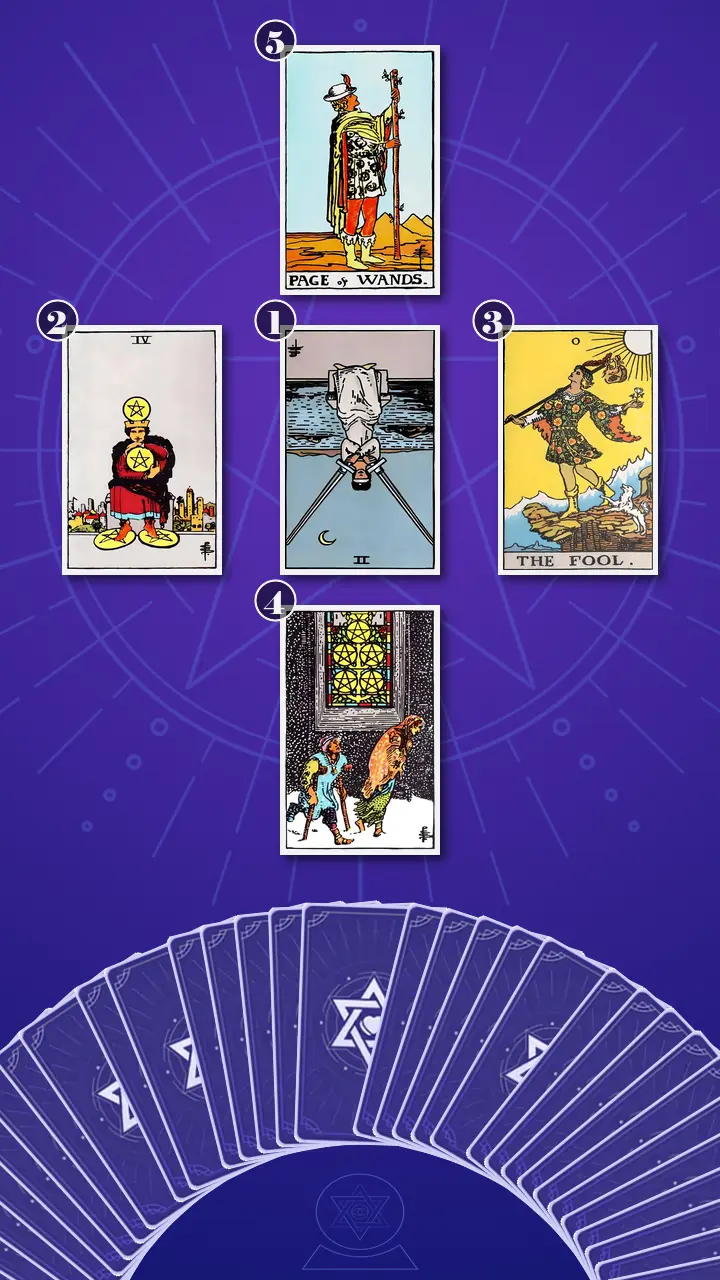
I told her that we would use a Decision Cross tarot spread. For anyone wondering how tarot works in a reading like this, I use the cards as structured prompts for observation, not as an authority that can remove choice. The spread gives competing forces a visible arrangement so that card meanings can be read in context: what is happening, what security is protecting, what desire is inviting, what fear is underneath, and what could be tested next.
Position one would sit at the center and show the observable decision pattern: how the safe option was currently pulling Jordan away from the life she wanted. Position two, to the left, would show the appeal of the safe option and the control or relief it offered. Position three, to the right, would show the invitation of the desired life. Position four, below the center, would expose the hidden fear beneath the choice. Position five, above the center, would offer a self-directed bridge: one bounded experiment capable of creating evidence without demanding an irreversible decision.
The Decision Cross was appropriate because Jordan was not asking for a prediction about a distant event. She was asking why security repeatedly won over desire. The five positions could compare both paths, name the scarcity fear beneath the comparison, and finish with an integrating next step. The purpose was not to make the safe path wrong. It was to stop asking safety to eliminate every uncertainty before Jordan was allowed to begin.
When the Comparison Loop Stopped Looking Like Research
Position 1: The Drafts Folder with Crossed Swords
Now I turned over the card representing the observable decision pattern: how the safe option was currently pulling Jordan away from the life she wanted. It was the Two of Swords in reversed position.
The blindfold and crossed swords showed a mind trying to create control by withholding commitment. The still water beneath the night sky made the image feel quiet, but not peaceful. In Jordan's life, this was Career Options v11 on the TTC. She already knew the stable role protected her routine and that the creative opportunity had a limited scope. Still, she added another salary scenario, asked one more friend, and left the reply in Drafts because non-choice lowered the pressure for the evening.
The reversed energy was blocked Air becoming unstable. Thinking had stopped opening possibilities and had become a closed loop. I said, 'You are not short on information; you are waiting for information to remove the feeling of risk.' The crossed swords protected Jordan from the immediate exposure of choosing, while also blocking the new evidence that only a small experiment could provide.
I used the inner sentence I had heard in the card: 'I already know X, but if I could just confirm Y, then I could finally choose.' The wish for certainty sounded rational until I placed it beside the actual result: another longer list, no reply, and no direct experience of the work she wanted. This was career choice paralysis in its most ordinary form, not a dramatic refusal to live, but a series of reasonable delays that quietly kept the desired path hypothetical.
Jordan did not nod. First, her breath stopped and her thumb froze above the Notes app. Then her eyes went unfocused, as if the train windows were replaying every comparison she had reopened that week. Finally, she gave a short, bitter laugh. 'That is too accurate. Almost rude.'
'I do not want the card to shame you,' I said. 'It is showing the function of the loop. Postponement is buying you a few minutes of relief, but it is not answering the question. We can respect the protection and still ask whether it is costing you contact with your own life.'
The Grip That Promised to Keep Everything Safe
Position 2: Four Points of Contact
Now I turned over the card representing the appeal of the safe option: the form of security, control, or relief that made it difficult for Jordan to loosen her grip. It was the Four of Pentacles in upright position.
The figure held one pentacle tightly against the chest, stood on two more, and wore another above the head. I connected the image to four points of contact around Jordan's body: Friday's pay deposit, the benefits portal, the familiar commute, and the rent reminder. These were not imaginary comforts. They were real supports in an expensive city, and I would not treat concern about housing or income as a character flaw.
The Earth energy was excessive rather than absent. Security had expanded from a floor beneath exploration into a full-body permission gate. Jordan's private monologue was clear: 'At least with this option, I can explain how I will pay for X and recover from Y.' That explanation mattered to her because it made disappointment feel survivable. But a defensible choice was not automatically the same thing as a meaningful answer.
'The safe choice gives you relief; it does not automatically give you your answer,' I said. 'The question is not whether the familiar role has value. The question is how much protection you need before you can test one part of the life that feels more like yours.'
Jordan exhaled and stopped gripping the edge of her chair. Her face softened with the recognition that I was not asking her to reject stability. I watched her identify the resource she was most afraid to loosen: not only money, but the ability to explain her decision to herself if the creative path disappointed her.
Position 3: The Open Edge and the White Rose
Now I turned over the card representing the invitation of the desired life: the quality of experience the less familiar path was asking Jordan to explore. It was The Fool in upright position.
The small bundle over The Fool's shoulder suggested a limited load, not an entire household carried into the unknown. The white rose suggested an open motive, and the alert dog near the cliff showed attention to the edge. I connected the image to a Wednesday evening in a Queen Street West coffee shop, where Jordan had a blank portfolio page open beside a spreadsheet called Career Options v11. The espresso grinder shrieked. Rain streaked the window. Her hands adjusted a formula instead of writing the first line of a sample campaign.
The Fool's Air was open and available, but Jordan had held it at a safe distance. She had treated the desired life as a finished identity she needed to prove she could sustain, rather than as a beginning she could meet. This card did not tell her to leap, resign, or ignore practical limits. It asked a smaller question: what is the smallest honest version of this beginning?
Jordan looked at the white rose and said, 'What if this first step only had to introduce me to the work, not prove I can build a whole life from it?'
'Exactly,' I said. 'A first step can be evidence, not a verdict.' Her shoulders softened. For the first time, she imagined an exploratory call, a private sample, or a small brief that would let the work speak before she had to name a new career.
The Cold Forecast Beneath the Choice
Position 4: The Cold Window Below the Choice
Now I turned over the card representing the hidden fear beneath the choice: the psychological cost Jordan imagined if she gave up the safe option. It was the Five of Pentacles in upright position.
The two figures moved through snow beside a lit stained-glass window. One relied on crutches. The image held hardship without pretending that hardship was beautiful, but it also placed possible shelter inside the same frame. I connected it to a snowy Sunday in Jordan's Toronto condo: wet boots by the door, slush tapping the window, and a rent notification glowing beside the unanswered opportunity email.
Her mind moved from 'less predictable work' to an empty account, a lost apartment, an embarrassing call to friends, and no professional way back. 'If this goes wrong,' she said, 'I will be outside the life I understand, and everyone will know I chose it.'
The Five of Pentacles showed Earth in the form of scarcity fear. A possible cost had been emotionally magnified until it felt like an established fact. The card did not predict financial loss, and I would never use it to manufacture that fear. It showed how the forecast was pushing available support out of the frame: savings, transferable communications skills, friends, trial limits, and routes back to stable employment.
Jordan went quiet. Her left hand turned cold against her mug. Her eyes moved from the snowy figures to the illuminated window, then back to the rent notification on her phone. 'I keep acting like one wrong choice would erase every way back,' she said.
'That is the hidden obstacle,' I answered. 'Not the fact that risk exists, but the belief that risk must be total before it is worth acknowledging. We can name a concrete downside, size it, and protect against it without letting an imagined catastrophe make the entire decision for you.'
When the Page of Wands Turned Wanting into Evidence
The room grew quieter when I reached above the center of the cross. The radiator clicked once, then stopped, as though even the background noise had made space for the bridge card.
Position 5: The Living Wand
Now I turned over the card representing the self-directed bridge: one bounded experiment that could create evidence without demanding a final, irreversible decision. It was the Page of Wands in upright position.
The young figure studied a sprouting wand rather than waving a finished achievement. The salamander-patterned tunic and open desert suggested curiosity, heat, and a beginning with room to learn. I connected it to a two-week sample project, one exploratory conversation, or one low-stakes creative brief. The Page did not promise success. The Page offered direct contact.
The Fire energy arrived only after blocked Air and protective Earth had been named. It was not a reckless blaze. It was a small flame placed inside a container. The experiment could have a time limit, cost ceiling, audience, and review date. Jordan would not need to decide whether she was a creative professional forever. She would need to observe what happened when she gave the work one honest block of time.
At this point I used a diagnostic lens I call Sunk Cost Neutralization. I asked Jordan to separate what had already been invested from what the next experiment would actually require. Her salary, routines, communications experience, and years of learning were facts worth respecting, but they were not votes that had to force her into another year of the same life. Past time, money, and emotion could inform practical boundaries without becoming a bill she had to keep paying.
I drew two headings in her notebook: 'What I have already built' and 'What this test costs from here.' The first column held real value. The second held a 25-minute sample, one conversation, and a review date. The distinction changed the shape of the decision. She did not have to recover every past investment before exploring a new direction. She only had to stop adding future opportunity cost to a path she had never permitted to produce evidence.
It was Sunday night in a Toronto condo: the Notes app was open, rent was due, and the reply was still in Drafts. Her shoulders dropped when she postponed it, then her chest sank as the creative tab disappeared behind another comparison search.
The safe option is not the only proof of responsibility; let the Page of Wands turn desire into a small experiment, so self-trust grows from what you try rather than from waiting for certainty.
For a beat Jordan did not move. Her breath stopped halfway in, and her fingers hovered above the phone. Then her eyes lost focus, replaying the train window, the rent reminder, and every reopened note in one private frame. Finally, a sound rose from deep in her chest, not quite a laugh and not quite a sob. Her shoulders lowered. The fist she had made with one hand opened finger by finger. Relief did not make her radiant; it left a brief, lightheaded blankness, as if someone had removed a weight she had learned to balance. Her eyes reddened. 'So I can test it,' she said, her voice thin but steadier. I slid a blank page toward her and said, 'Open a blank note and set a 10-minute timer. Complete four lines: I am curious whether...; The smallest test is...; My practical limits are...; I will review what happened on....' I reminded her that no resignation, major purchase, public announcement, or identity-level commitment was required. She could write the experiment without scheduling it, or stop. Choosing the pace was part of the boundary. 'Now, use this new view to think back to last week,' I said. 'Was there a moment when this insight could have made you feel differently?'
Jordan looked down at the four empty lines. Her fear had not vanished. It had become specific enough to sit beside a practical question. That was the first movement from anxiety-driven comparison and repeated postponement to bounded exploration and evidence-based self-trust. The shift was not from fear to certainty. It was from demanding that certainty arrive first to allowing experience to participate in the answer.
A Practical Container for the Life That Feels Like Mine
When I placed the five cards together, the story became coherent. The reversed Two of Swords showed blocked Air turning an emotional trade-off into an information problem. The Four of Pentacles explained why the safe option won: it protected income, routine, and a defensible explanation. The Fool showed the desired life as an open beginning rather than a guaranteed destination. The Five of Pentacles revealed the fear that one uncertain move could mean material loss, social embarrassment, and no way back. The Page of Wands offered Fire in a useful form: one small experiment capable of producing evidence.
Jordan's mind had been running an algorithm trained only on worst-case searches, then mistaking the result for a neutral summary of reality. Each new article, salary calculator, and reassurance text changed the screen without moving her from the platform. The safe option was not her enemy. It had become a gatekeeper with the power to deny every experience until the future could be guaranteed.
The blind spot was treating the temporary relief of postponement as proof that postponement was the right decision. Her shoulders relaxed when she delayed, but the heaviness returned on Sunday night. Relief proved that pressure had stopped. It did not prove that the safe option was the life she wanted. The transformation direction was clear: safety could become a support for exploration rather than the final criterion for a meaningful life.
Because Jordan saw the stable job and the all-in creative leap as two zero-sum choices, I gave her a communication and planning tool from my own practice: the 3rd-Option Leverage Test. It is a rigorous 72-hour exercise for finding the hidden route between Option A and Option B. The third option is not a fantasy compromise. It is a bounded bridge with a defined cost, a real action, and a review date.
I asked her to use the following next steps. They were deliberately small. A small, reversible career experiment with practical boundaries could generate direct evidence before she made any identity-level decision.
- The 25-minute private betaOn Tuesday at 7:00 p.m., Jordan will set a phone timer for 25 minutes and create one sample communications concept in Google Docs or Canva for a cause, product, or cultural project she genuinely cares about. She will stop when the timer ends and record energy, interest, friction, and practical fit.Treat the sample as data collection, not a declaration of identity. The minimum version is a private ten-minute draft. No resignation, debt, or public announcement is required.
- The practical containerIn the Notes app, Jordan will write two non-negotiables for the experiment, such as no spending beyond a preset amount and no creative work after 9:00 p.m. She will choose a review date seven to fourteen days away and add a 15-minute calendar event for that review.Keep the container to two genuine limits, one cost cap, and one review date. Boundaries protect rent, health, work obligations, and consent; they do not need to remove every uncomfortable feeling.
- The 72-hour third optionWithin 72 hours, Jordan will write Option A as staying fully familiar, Option B as making an all-in creative leap, and Option C as a two-week contained trial. She will send one low-pressure message to a Toronto-based independent creative or former colleague requesting a 20-minute conversation about weekly work, income variability, and a first paid experiment. At the top of her comparison note, she will add: 'What specific decision would this new information change?'If the answer is nothing concrete, close the search. Move duplicate research tabs into a folder titled 'Review on Friday' and let the trial produce information the spreadsheet cannot manufacture.
I told Jordan that the point was not to make the future comfortable before she entered it. The point was to make the next action proportionate to the question. Safety can hold the experiment without deciding the whole life.
A Week Later, the Quiet Proof
Five days later, I received a message from Jordan while I was making coffee. She had completed the sample concept, sent it privately to one trusted former colleague, and asked for a short conversation with an independent creative in Toronto. Her message did not say that she had solved her career. It said, 'I finally have something real to evaluate.'
That night she slept a full night. On waking, her first thought was, 'What if I am wrong?' She smiled at the question, opened the sample, and made coffee before answering it.
That was the quiet proof. The fear was still present, but it no longer held the only microphone. Jordan had moved from waiting for certainty to gathering direct evidence. She had not abandoned the practical life she built. She had started treating it as a platform from which to explore.
I do not believe the cards chose for Jordan. They gave her a visible structure for what her body and decisions had already been trying to say. The Decision Cross helped her name the safe-option pull, the hidden scarcity forecast, and the kind of bounded action that could rebuild trust from experience. Her next chapter remained hers to write.
When the option you can defend loosens your shoulders for five minutes but leaves your chest heavy again by Sunday night, you may be carrying two real needs at once: a life that feels like yours and the safety that lets you breathe. Naming both is already part of finding clarity.
If one small, reversible experiment did not have to decide your whole future, what part of the life you want would you be curious to meet this week?