Three Review Notes Beside FINAL, Then a Two-Day Private Pause

Why the 10:45 p.m. Export Felt Safer
I met Jamie, a 27-year-old freelance visual designer in Toronto, and recognised the pattern before they opened the project file: a quiet inbox had turned an ordinary refinement week into career comparison anxiety.
At 10:45 p.m. in their small apartment, I watched Jamie rename a Figma case study FINAL and move it toward the upload window. The radiator clicked behind the desk, cold street light pressed through the blinds, and the laptop fan whined against the warm phone in their hand. Three unresolved layout notes sat beside the trackpad. Jamie refreshed the live page twice, tapped the desk with restless fingers, and tightened their jaw.
When I asked what had brought them in, Jamie said, 'I know it needs another pass, but I need something to show for the week. Why do I rush the harvest before the work is ready?' I heard the central conflict immediately: Jamie wanted the work to ripen into something genuinely credible, but waiting for that quality felt dangerously close to being unseen and left behind. For a freelancer, a career crossroads can hide inside a self-imposed launch date. One route protects the work; the other offers a quick sign that the work, and perhaps the person behind it, still matters.
The pressure moved through Jamie's body like a metronome wound too tightly, clicking faster whenever the project entered its quiet middle. I told Jamie that I would not treat the cards as a verdict or a deadline oracle. I would use them as an objective visual thinking tool, so we could separate evidence about the work from the demand to be seen. 'We can give this pressure a name, then draw a map through it,' I said. 'That is our Journey to Clarity today.'
Choosing a Ladder Instead of a Leap
I asked Jamie to place the phone face down, take one unforced breath, and hold the question in plain language. I shuffled slowly, using the movement as a changeover from scrolling and calculating into observing. For me, this is a focus practice, not a supernatural performance.
Today I used the classic Four-Layer Insight Ladder tarot spread. For anyone wondering how tarot works in this kind of reading, the spread gives us a sequence for comparing a visible behaviour with the belief underneath it, the quality that can change the pattern, and a practical next step. It is deliberately smaller than a Celtic Cross because this question needs a clean causal line rather than ten competing explanations.
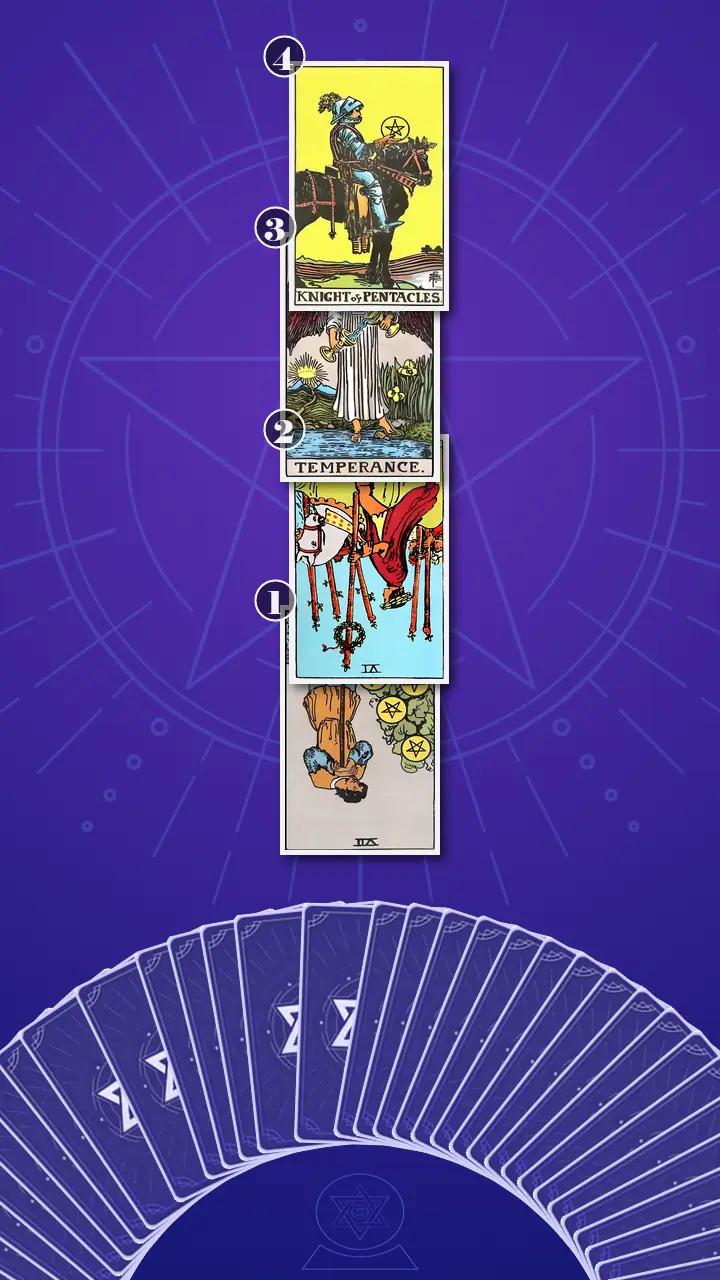
The four cards would rise like measured steps. The first would reveal the observable present-state symptom: the premature launch. The second would expose the root beneath the rush, including the fear that slower progress might reduce recognition and worth. The third would identify the central transformation, and the fourth would translate that insight into repeatable craft. This is card meaning in context: the images matter because they give Jamie a different way to inspect a real decision.
Reading the Quiet Middle
Position 1: The Harvest Pulled Too Soon
Now I turned over the card representing the observable present-state symptom: moving a launch or submission forward before the work has passed a deliberate review process. It was the Seven of Pentacles, in reversed position.
In the image, a worker leans on a cultivation tool while examining pentacles growing at different levels on a vine. Reversed, the scene became Jamie hovering over the publish button while the review list remained visible beside the laptop. The portfolio piece had not produced a public result all week, so Jamie had mistaken a normal assessment phase for an emergency. They exported after one review, refreshed twice, and began repairing the version that other people could already see.
This was blocked earth: the work itself was growing, but the ability to count cultivation as progress had become unstable. The Seven of Pentacles reversed tarot meaning for rushing results was not laziness or a lack of discipline. It was the impulse to extract one visible fruit from the branch in order to prove that the tree was growing. The useful question was narrower and kinder: which specific readiness criterion still needed time?
Jamie gave a small, bitter laugh instead of nodding. 'That is too accurate. Kind of brutal,' they said. I saw their fingers stop tapping, then return to the edge of the desk. I placed the three unresolved notes beside the card and asked, 'If nothing went live, what did you actually complete this week, even if nobody could see it?' I wanted the question to loosen the false choice between immediate publication and wasted effort. A quiet project is not necessarily a stalled project.
Position 2: The Applause That Would Not Hold
Now I turned over the card representing the root beneath the rush: the fear that slower, less visible progress will reduce recognition and therefore personal worth. The card was the Six of Wands, in reversed position.
The rider's raised wand and visible wreath usually make recognition easy to see. In Jamie's modern version, I saw the morning scene they had described: at 8:18 a.m., still under the duvet, they opened Instagram and watched a former classmate's polished launch Reel. The room was cold, the phone screen was hot against their palm, and a streetcar scraped along the wet road. Before opening their own project file, Jamie moved the launch date forward because the other designer's finished result was visible while their own unfinished process was not.
Reversed, the fire of ambition had become overdirected toward public response, while self-trust had become too dependent on an audience. The Six of Wands reversed tarot meaning for recognition anxiety was not that visibility was bad or that Jamie should stop sharing work. It showed that views, replies, Behance features, or a LinkedIn thrilled-to-share post had been asked to answer a question they could not answer: whether Jamie's private work was valuable before applause arrived.
I said, 'You keep calling it momentum when the real request is proof.' Jamie's thumb pressed into the side of the phone, and their eyes moved from the card to the floor. I asked what they had feared other people would conclude if the project stayed private for another week. After a long pause, Jamie said, 'That I had nothing going on.' I did not argue with the fear or promise that waiting would guarantee success. I helped Jamie separate a peer's visible launch from its unknowable timeline, budget, and discarded drafts.
When Temperance Changed the Tempo
Position 3: The Measure Between Two Cups
For the position that identifies the central transformation, regulating urgency through proportion, pacing, and iterative integration rather than forcing completion, I turned over the next card. The radiator clicked once, then the room seemed to narrow around the image: Temperance, upright.
Water moved steadily between two cups. One foot stood on dry land and one in water, while a path continued toward a distant crown of light. For Jamie, the modern translation was simple and active: making, resting, reviewing, and releasing could become separate containers. Jamie could complete a focused pass, let the file sit overnight, ask one trusted peer one craft-specific question, and integrate only the feedback that served the work. No public proof had to appear during the interval for the project to become more coherent.
Temperance brought balance to the earlier blocked earth and recognition-hungry fire. Its patience was not passive delay; it was controlled exchange. I ran my Tempo Misalignment Audit, my way of decoding the feeling of pushing against a wall by locating where psychological and executive BPM have fallen out of sync. Jamie's ambition was trying to make every stage happen at launch-day tempo, while the actual work needed a slower rhythm for review and integration. The friction was not a lack of drive. It was ambition demanding that every beat sound like the chorus.
I told Jamie, 'You know the 10:45 p.m. version of this: the export says FINAL, the review notes still name three problems, and your hand reaches for publish because an invisible week suddenly feels unbearable.'
You do not have to force proof from unfinished work; choose measured revision instead, like Temperance pouring steadily between two cups until separate efforts become one coherent result.
Jamie did not nod. First, their breathing stopped halfway in, and the fingers hovering above the card curled against their palm. Then their gaze lost focus; I watched the 10:45 p.m. export, the three notes, the warm phone, and the imagined audience replay across their face. Their jaw worked once. 'But does that mean I was wrong all along?' they asked, with a flash of anger that sounded more protective than defiant. I answered gently, 'No. It means you were asking one public action to carry the weight of progress, reassurance, and proof of worth. The work can be unfinished without your judgment being wrong.' Finally, their shoulders dropped; a long breath left their chest, and their eyes shone without turning the moment into a promise. The release was real, but so was the blankness after the pressure lifted. I asked Jamie to set a ten-minute timer, write three observable readiness criteria, and mark only what was true that day, with no revision or publishing during the timer. 'Now use this new view to recall last week,' I said. 'Was there a moment when this insight might have made the choice feel different?'
That was the first movement from compressed urgency toward grounded confidence in mature, genuinely completed creative work. I reminded Jamie that readiness is built in private before it can be recognised in public. Temperance was not asking them to make less. It was asking them to stop forcing every stage to become the launch stage.
The Calendar Holds Its Ground
Position 4: The Patient Craftsperson
For the position that translates patient regulation into a repeatable next step, consistent craft, readiness criteria, and completion through steady effort, I turned over the final card: the Knight of Pentacles, in upright position.
The horse stood still on worked ground, and the Knight held one pentacle steadily at eye level. The image did not perform speed. It showed preparation, concentration, and a field receiving the same necessary care across time. I connected it to the Monday-afternoon scene Jamie had described: a recurring review block on the calendar, a mobile-width test waiting in the project file, a radiator humming beside the desk, and Instagram left unopened.
This was balanced earth. The Knight of Pentacles turned patience into quality control rather than a vague instruction to wait. Progress could become visible in completed review stages: hierarchy tested, focused feedback addressed, final pass completed after a break. The release date would follow those criteria instead of following a spike of comparison or decision fatigue. The apparent lack of speed was the point. A process that arrives by making every necessary stop can be more trustworthy than a route chosen in panic.
Jamie wrote three lines into a notes app and asked, 'What if I meet the criteria and still feel nervous?' I said, 'Then nervousness can travel with the decision without making the decision for you.' I used my Execution Rhythm Calibration to locate the specific friction point: not Jamie's ambition, and not the act of making, but the handoff from private review to public release. The next task was clear enough to survive a quiet inbox. The work did not need to feel finished in the body before it could be checked in reality.
Let the Checklist Decide What Pressure Cannot
When I placed the four cards in their ascending line, the story became coherent. The Seven of Pentacles reversed showed why an ordinary maturation period felt like a practical emergency. The Six of Wands reversed revealed the bargain beneath it: a quick launch could provide a brief reaction, but the reaction could not stabilise self-trust. Temperance introduced paced integration, and the Knight of Pentacles gave that inner adjustment a dependable routine.
The project was never barren. Jamie had been digging up the seed every few days to check whether growth was happening, then damaging the process in order to obtain proof of the process. The cognitive blind spot was not an inability to recognise quality; the three notes beside the laptop proved that Jamie could already see what needed work. The blind spot was treating only public results as legitimate progress.
The transformation direction was therefore specific: replace self-imposed early launches with a fixed readiness checklist and one protected maturation interval before public release. This did not romanticise quiet weeks, dismiss uneven freelance income, or deny real client deadlines. It created a finite test in which revision could count, visibility pressure could be named, and Jamie could remain the person deciding what to do.
I called the next three days The Syncopation Reset, a small tempo adjustment experiment. Instead of forcing the whole routine into one urgent push, Jamie would let each day hold one useful beat. This was actionable advice, not a promise that waiting would guarantee a successful launch. The point was to restore enough space for judgment to enter before pressure seized the publish password.
- Day One: Build the Private Readiness GateChoose one current Figma or portfolio project and write three observable criteria in Notion, Apple Notes, or on paper: structure tested, one focused review addressed, and final pass completed after a break. Add a private 48-hour maturation interval to the calendar. During that interval, do not announce, submit, or move the release date forward unless a genuine client constraint requires a revised plan.Keep the list finite, not perfect. The minimum version is one readiness item and one overnight pause. When the agreed criteria are met, release is allowed.
- Day Two: Give Feedback One Clear ChannelSend one private preview through Figma, email, or a private link to one trusted design friend. Ask only, 'What is the first place where the hierarchy or purpose becomes unclear?' Wait 24 hours before changing the public release date, then label the response use, test, or decline. Mute one comparison-heavy professional account for seven days.One precise response is enough for this experiment. Feedback is information, not an instruction, and muting is a temporary attention boundary rather than a judgment of someone else's success.
- Day Three: Separate Work Evidence from Visibility PressureWhen the urge to publish spikes, set a five-minute phone timer and write two columns titled Work evidence and Visibility pressure. Before changing any self-imposed date, read the three readiness criteria aloud and create a daylight calendar event called Release Decision. Decide from the first column, not from the intensity of the second.If five minutes feels impossible, take one slower breath and ask, 'Is this a readiness signal or a visibility signal?' If body-focused attention feels uncomfortable, use the written checklist alone.
I told Jamie that this practice could be shortened, extended, or stopped around real project conditions. The 48-hour interval was protection from a premature launch, not a new perfection rule. The aim was to let the checklist decide what pressure could not, while keeping Jamie's ambition intact.
A Quiet Proof
Six days later, Jamie texted me from a sunlit cafe: 'I slept a full night, tested the mobile hierarchy, and kept the file private for two days. I still woke thinking, What if I am wrong? Then I opened the checklist before Instagram.' The fear remained, but it no longer held the publish password.
I saw the change as small and therefore believable. Jamie had not solved a career or guaranteed a perfect response. They had completed one private stage, allowed the release decision to follow evidence, and discovered that a quiet project could still be moving. That is finding clarity: not receiving an answer from the cards, but becoming able to hear the answer already forming in your own work.
The Four-Layer Insight Ladder had traced a path from premature creative release, through recognition pressure, into paced integration and dependable craft. Tarot gave us the images and the questions; Jamie chose the timing, the criteria, and the next action. The person holding the publish password remained the author of the outcome.
When the inbox stays quiet and the project remains private, I know that jaw-tightening moment when another day of careful work starts to feel less like growth and more like evidence that you are becoming invisible.
If your next release did not have to prove that you still matter, what small sign of genuine readiness might you become curious enough to wait for?