Why the Weekend Reset Never Ends: Protect One Plan Before More Chores

The 8:15 Spreadsheet and the Weekend Reset That Never Ended
If you rent alone, manage your own errands, and answer Saturday brunch texts with “maybe later” until the laundry, groceries, and life admin are done, rest guilt may be running your calendar.
Jordan was twenty-eight, a hybrid project coordinator living alone in Toronto. At 8:15 on Saturday morning, she sat at her narrow kitchen counter with a spreadsheet open and coffee cooling beside it. The washing machine thudded through the wall, blue screen light caught the crumbs beneath her wrist, and her phone buzzed with a message from a friend near Trinity Bellwoods: “We grabbed a table if you want in.”
I watched her show me what happened next. She checked off laundry, noticed the cupboard beside the machine, and added “sort winter clothes” to the next row. Then she typed “maybe later” beneath the brunch invitation.
“Once the laundry is folded, once the groceries are done, once Monday is mapped, then I can relax,” she said. “Except I keep preparing to have a life instead of having one.”
Her shoulders sat close to her ears even while she was still. Her legs felt heavy, she told me, but the inside of her body kept moving, as if a treadmill were running beneath the kitchen floor and the finish line slid backward whenever she approached it. That was the physical shape of her frustrated exhaustion: tired limbs trapped inside a system that refused to declare the shift over.
The contradiction was clear. Jordan wanted a finite weekend reset that would create space for living, but every attempt to reset postponed living again. She was not short on discipline. She was trying to fit an unlimited condition for rest inside two finite days.
“I am not here to tell you whether your apartment should be cleaner or whether you should accept every invitation,” I told her. “Those choices are yours. I want us to identify the rule that keeps moving your stopping point. Let us draw a map through the fog and see where your control is real, where it is costing you, and what clarity would look like in practice.”

Choosing the Switchback Map
I asked Jordan to place both feet on the floor, take one ordinary breath, and hold one question in mind: “Why do I sacrifice every weekend for a reset that never ends?” I shuffled slowly. The pause was not a mystical performance; it gave her attention somewhere to land before we examined the pattern.
I chose the Transformation Path Grid · Context Edition, a six-card tarot spread built for a repeating feedback loop. A Past-Present-Future spread would have made Jordan's problem look linear, while a decision spread would have implied that one dramatic choice could solve it. Her weekend reset loop had six linked functions: visible behavior, immediate blockage, root belief, pivotal reframe, behavioral experiment, and lived integration. Six cards were the smallest map that could show the whole mechanism without pretending to predict an outcome.
I use tarot as a structured mirror, not a verdict about fate. The imagery slows down fast mental habits and gives us something concrete to examine. That is how tarot works best in a situation like this: card meanings in context help turn a vague sense of feeling stuck into observable choices, costs, and resources. Jordan would remain the person deciding what to keep, what to change, and what enough meant within her actual obligations.
I arranged the first three cards from left to right across the upper row. They would show the expandable workload, the rest that could not become restorative, and the fear beneath Jordan's constant monitoring. From the third card, the path would drop to the pivotal fourth position, then return across the lower row through action and integration. The layout resembled a switchback: it entered through the obvious Saturday problem, reached the belief keeping it alive, and turned toward a more livable definition of readiness.
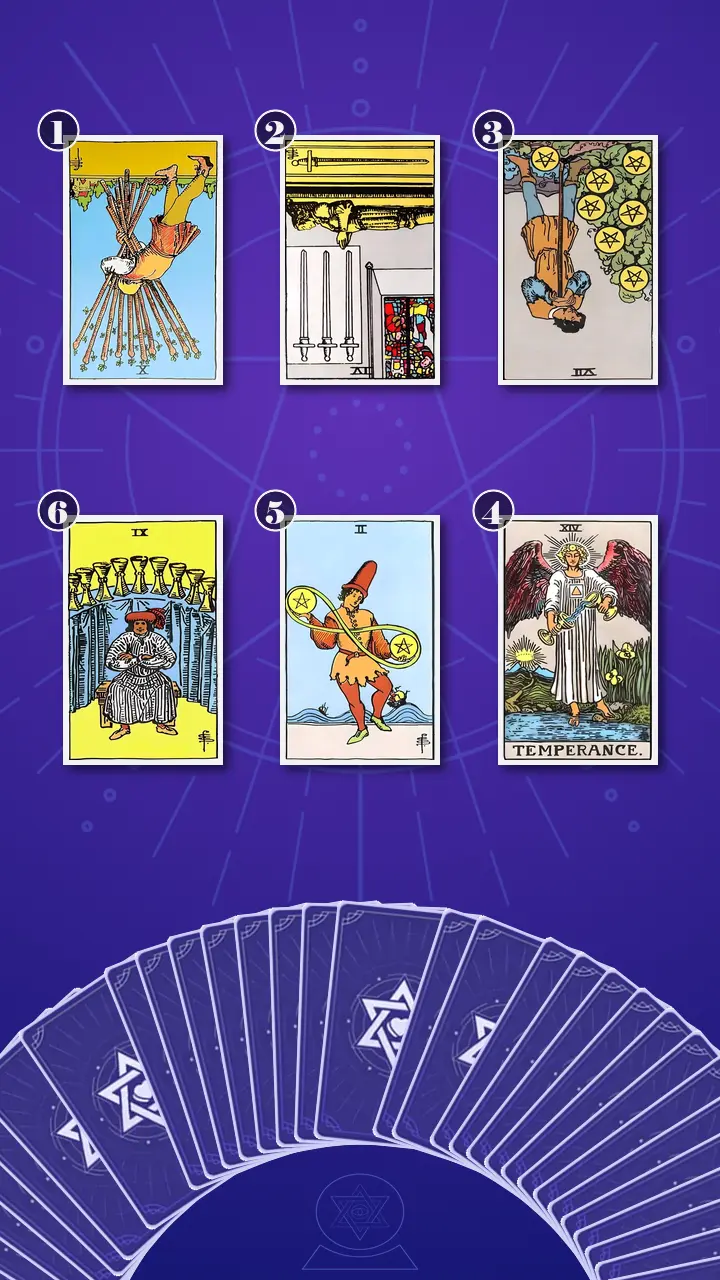
Reading the Upper Row Where the Weekend Disappeared
Position One: Ten of Wands Reversed and the Expandable Load
The card I turned first represented the observable present-state behavior: carrying an expandable weekend reset list and postponing personal life while trying to complete it. It was the Ten of Wands, reversed.
In the Rider-Waite-Smith image, a bowed figure carries all ten wands at once. The bundle is so dense that it blocks the destination from view. I placed the image beside Jordan's Saturday morning: cleaning, groceries, meal preparation, inbox clearing, budgeting, exercise, and Monday planning held as one mentally binding bundle. She checked off laundry, noticed the cupboard, added a new row, and pushed brunch later again.
“Your inner sentence sounds like this,” I said. “I only need to finish the laundry, but since I am already here, I should also sort the clothes. And if I sort the clothes, I should probably check what needs replacing.”
The reversed energy showed a blockage of release, not a deficiency of effort. Jordan had more than enough willingness to carry responsibility. What she lacked was a rule allowing a newly visible, non-urgent task to remain on the ground. Each completed chore created a brief hit of control, but each newly noticed chore became personally binding. The reset expanded until the labor intended to create freedom obscured freedom entirely.
Jordan's mouth twitched first. Then she let out a sharp, almost amused breath and looked at the brunch message still visible on her phone. Finally, the expression settled into a small, bitter smile.
“That is brutally accurate,” she said. “I can literally create three new jobs by wiping one counter.”
“I am not reading that as evidence that you are irresponsible or doing adulthood wrong,” I replied. “I am reading it as a scope problem. An unlimited list cannot be the gatekeeper of finite time. You keep preparing to have a weekend instead of having one.”
Position Two: Four of Swords Reversed Beneath a Ceiling of Alerts
The next card represented the immediate blockage preventing the reset from delivering its stated purpose: attempted rest remained occupied by monitoring, optimization, and unfinished tasks. I turned the Four of Swords, reversed.
The card's recumbent figure appeared to be still, but three swords hung overhead. In Jordan's apartment, that image became 12:40 on Saturday afternoon. She lay on the sofa while the dishwasher hummed and flat grey light pressed against the window. Her phone grew warm in her hand as she checked Slack “just for a second,” watched a polished Sunday reset video, and glanced at the clock to judge whether the break was working.
“I am technically resting,” I said, voicing the loop back to her, “so why am I still waiting to get back to the list?”
This reversal held two imbalances at once: an excess of mental monitoring and a deficiency of unmeasured recovery. Jordan could stop moving without going off duty. When stillness did not produce an immediate improvement, she treated the pause as underperforming and got up to reorganize something. Even recovery had acquired a performance review.
“Rest watched by a mental stopwatch is still answering to productivity,” I told her. “The card is not asking you to find a better bath, stretch, tracker, or reset video. It is asking whether any part of your weekend is allowed to exist without being graded.”
Jordan rubbed the back of her neck. Her shoulders rose as if the suspended swords had become physical, then lowered by a fraction.
“That is the part I hate,” she said. “I can be on the sofa and still feel like I am late for my own list.”
Position Three: Seven of Pentacles Reversed and the Missing Definition of Done
The third card represented the psychological root of the loop: delayed gratification, compulsive outcome monitoring, and the fear that stopping before a visible transformation would prove a lack of control. It was the Seven of Pentacles, reversed.
I pointed to the worker leaning on his tool and staring at the pentacles growing on the vine. Reversed, the pause was not patient recognition. It was an impatient audit of whether the effort had produced enough return.
Jordan knew the scene immediately. At 4:36 on Sunday afternoon, she would stand in the kitchen doorway after buying groceries, washing clothes, and preparing meals. The apartment smelled of detergent and roasted vegetables. Yet her eyes would lock onto the unopened mail or one cluttered counter. The functioning kitchen, stocked fridge, and clean laundry would disappear from her mental frame.
“If I still feel behind, what did all those hours even do?” I asked, echoing the sentence she had described.
The reversed earth energy had become an excess of return-on-effort checking. Ordinary progress could not register unless it produced a dramatic before-and-after result. The compressed edit of a Sunday reset video made that distortion sharper: the screen skipped the help, the interruptions, the ordinary middle, and the fact that a lived-in home becomes lived-in again. Jordan was comparing maintenance with transformation, then calling maintenance a failure.
The image pulled me briefly back to my years on Wall Street. I remembered screens covered in red and green, and the danger of judging a sound long-term position by refreshing one volatile minute. Measurement can protect a decision, but compulsive measurement can also destroy the time a process needs to show its value. Jordan's personal algorithm was refreshing the weekend every five minutes and treating the absence of a dramatic spike as proof that the whole strategy had failed.
“What would count as sufficient maintenance if your weekend did not have to produce a reveal video?” I asked.
Jordan's fingers tightened around her mug. Her eyes shifted away from the card and held on the window for several seconds.
“Honestly? I do not know,” she said. “I know what unfinished looks like. I do not think I have a picture of enough.”
That answer exposed the cognitive blind spot beneath the chores. Jordan thought control meant eliminating loose ends, but her real system had no agreed definition of done. Because the list could generate tasks indefinitely, completion could never be a fair condition for rest.
When Temperance Changed the Definition of Ready
Position Four: Two Cups at the Turning Point
The next card represented the pivotal reframe that could interrupt the pattern: integrating maintenance and enjoyment instead of forcing them into consecutive phases. The radiator clicked once, then the room seemed to become unusually quiet as I turned Temperance, upright.
Water flowed continuously between two cups. One of the angel's feet rested on land while the other touched water. Nothing in the image suggested that balance was a finished, motionless state. It was an active exchange between practical responsibility and emotional life.
I asked Jordan to imagine one cup holding necessary maintenance and the other holding present-tense living. In practical terms, that looked like giving two bounded hours to three essential chores, keeping an 11:30 brunch plan, and allowing both preparation and enjoyment to count as parts of a successful weekend. The card carried balanced energy: proportional effort, sustainable moderation, and self-permission moving together.
This was where I used what I call a Resource Readiness Assessment. I separated Jordan's internal assets from the timing of the outside world. After groceries, one load of laundry, and Monday lunch preparation, she would have enough practical support to enter the week. The remaining cupboard and inbox tasks were renewable; they would still exist later. The friend's open seat at brunch was time-sensitive. Delaying a perishable experience for endlessly renewable maintenance was not greater control. It was a trade Jordan had never consciously chosen.
I paired that assessment with Strike Timing Calibration. I was not assigning a commercial value to friendship or rest. I was distinguishing between windows. A safe household chore could wait without losing its purpose. A café table, a film showing, a clear hour of daylight, or the energy to call someone might not return in the same form. Decisive action belonged to the finite window; strategic holding belonged to the renewable task.
I brought Jordan back to 8:15 on Saturday: the cold coffee, the spreadsheet growing as quickly as she cleared it, the brunch text answered with “maybe later,” and the private rule that an empty inbox and one finished room still stood between her and permission to leave.
A complete reset is not the price of permission to live; keep maintenance and pleasure moving together, as Temperance keeps water flowing between both cups.
I stopped speaking and let the sentence remain between us.
Jordan's inhale stopped halfway. Her fingers stayed suspended above the mug, and her pupils widened before her gaze slipped away from the table. I could see the idea moving through remembered Saturdays: unanswered messages, reheated coffee, the sound of a streetcar bell after the café table was already gone. Then her jaw tightened. Her shoulders rose, not in relief but resistance.
“But does that not mean I have been doing every weekend wrong?” she asked. The words came out sharper than anything she had said before. Her eyes had begun to redden, and one hand closed into a fist against her knee.
I let the anger have room. “No. It means your strategy probably protected you from feeling out of control, and it worked briefly every time you checked a box. We are not putting your past self on trial. We are noticing that the cost is now higher than the protection. You can respect why the strategy formed without renewing its contract.”
Her fist opened one finger at a time. Her chin dipped, her shoulders descended, and a long breath left her with a slight tremor. The release was visible, but so was the vulnerable blankness that followed it. A clearer path meant she could no longer wait for the checklist to make the choice on her behalf.
“Now, using this new perspective, think back to last week,” I said. “Was there a moment when this insight might have made you feel different?”
“Saturday at 1:07,” she answered after a pause. “My friend texted from that café. I could hear the streetcar outside. If I had thought of being ready as a proportion instead of a finish line, I think I would have gone. Not without guilt, but I would have gone.”
I named the crossing carefully. This was not a leap from pressure to permanent peace. It was the first movement from pressured urgency and guilt about stopping toward bounded maintenance, self-permission, and present-tense satisfaction. The new vulnerability was responsibility: Jordan would have to choose the boundary before she felt completely comfortable with it.
Putting the Two Cups on a Real Calendar
Position Five: Two of Pentacles and the Visible Trade-Off
The fifth card represented the practical behavior through which Jordan could test the reframe: limited priorities, flexible trade-offs, and one protected enjoyable commitment. I turned the Two of Pentacles, upright.
The figure held two pentacles inside an infinity-shaped ribbon while ships moved across uneven waves behind him. I did not read the card as a promise that life would become calm or that every category could remain equally complete. I read it as balanced, adaptive earth energy: a workable rhythm that responds to change without silently increasing capacity.
I translated the image into the calendar interface Jordan already used. On Friday evening, she could choose three concrete tasks: buy groceries, wash one load, and prepare Monday lunch. Then she could place one wanted activity into the calendar with a start time before adding anything else. If a new errand appeared, the governing question would be: “If this comes in, what goes out?”
That question converted optimization into an explicit trade-off. A new priority could replace an old one, but it could not invisibly lengthen the weekend. Changing the order would be adaptation, not proof that the reset had failed.
Jordan opened her calendar while the cards were still on the table. Her thumb hovered over Saturday morning, then she created three task blocks and placed brunch at 11:30.
“This feels suspiciously small,” she said.
“Small is useful here,” I replied. “We are collecting evidence, not designing your perfect future. The experiment has to fit inside a real weekend, including low energy, TTC delays, money limits, and the possibility that plans change.”
Position Six: Nine of Cups and the Question “What Is Here?”
The final card represented the integrated state available through the experiment: recognizing enoughness, permitting present satisfaction, and allowing unfinished tasks to remain without turning them into a verdict on competence. It was the Nine of Cups, upright.
I placed it beside the Ten of Wands. The first figure could not see beyond the burden. The seated figure in the Nine of Cups could see the vessels already gathered behind him. The contrast changed the closing question from “What is left?” to “What is here?”
In Jordan's life, the card became a Sunday evening after brunch. She returned to a functional but imperfect apartment and noticed the taste of café coffee still lingering, a friend's voice note, clean sheets, groceries in the fridge, and energy remaining in her body before she reviewed the overflow list. The counter could still hold mail. The afternoon could still count.
The upright water energy was balanced recognition, not a prediction that Jordan would feel satisfied on command. The Nine of Cups did not ask her to pretend every obligation was complete or turn appreciation into another assignment. It asked her to include present experience in the evidence.
“Enough is a boundary you choose, not a feeling the checklist eventually delivers,” I said. “Before you inspect Monday, what did the weekend already contain?”
Jordan looked over the spread from the burdened figure to the open row of cups. Her breathing had slowed.
“A friend laughing so hard she snorted coffee,” she said. “Clean clothes, even if they are still in the basket. Food for Monday. And maybe not resenting my own apartment by Sunday night.”
I nodded. The cards had not removed her chores. They had made the hidden rule visible, restored proportion to the picture, and returned the decision about her finite time to her.
The Two-Cup Weekend Plan
I gathered the six cards into one coherent story. Agency deadlines left Jordan's workweek mentally open even after she logged off. The Ten of Wands reversed showed that spillover joining an expandable domestic load. The Four of Swords reversed showed the consequence: a body at rest while background processes continued draining the battery. The Seven of Pentacles reversed revealed why she kept restarting the cycle: ordinary maintenance did not count unless it produced dramatic proof of control.
The pattern resembled an expandable Jira backlog in which each completed ticket automatically generated two subtasks and the sprint had no definition of done. Jordan's blind spot was not poor productivity. It was the assumption that visible incompleteness proved insufficient control. Temperance supplied the leverage point by placing maintenance and living in the same weekend. The Two of Pentacles made the boundary visible, and the Nine of Cups taught her to review what the time contained before measuring what remained.
“But what if something genuinely urgent comes up?” Jordan asked when I proposed the cap. “I cannot pretend a deadline or a health issue is optional.”
“You should not,” I said. “Urgent health, safety, legal, caregiving, and truly time-sensitive responsibilities can override the experiment. The purpose is not to turn three tasks into a new perfection standard. The purpose is to stop every ordinary, visible chore from impersonating an emergency. If a real priority enters, make a visible swap. Your capacity does not silently expand.”
- Build the Two-Cup Weekend. On Friday at 5:30 PM, open a phone note with two headings: Maintenance and Living. Put no more than three concrete tasks under Maintenance, such as buy groceries, wash one load, and prepare Monday lunch. Put one genuinely wanted social or solo activity under Living, then add its start time to the calendar before scheduling extra chores. Treat this as a one-week experiment. If three tasks feel unrealistic, use one 25-minute maintenance block and one 10-minute enjoyable pause. The enjoyable plan is yours to shorten, replace, or leave at any time.
- Use the Strategic Holding Pattern. Create an overflow note called Not This Weekend. When a new non-urgent task appears, place it there instead of absorbing it automatically. Review the note next Friday at 5:30 PM. If a true priority must enter sooner, write “If this comes in, what goes out?” and make one visible swap. The holding pattern is not denial or anxious stagnation. It preserves the task without giving it immediate access to your finite time. Do not label ordinary incompleteness urgent merely because it is visible.
- Protect One No-Improvement Window. Choose one 45-minute period on Saturday or Sunday. Put the phone in another room and do no cleaning, planning, tracking, work checking, or research into better routines. Read, game, walk, listen to music, drink coffee, or simply sit without requiring the period to improve you. If 45 minutes feels inaccessible, begin with five or ten. The window is optional, and you can stop whenever it feels unhelpful. Success means observing what happens when the mental stopwatch loses authority, not forcing yourself to relax correctly.
Jordan chose groceries, one laundry load, and Monday lunch as her three tasks. She kept the 11:30 brunch block. Sorting winter clothes entered the Strategic Holding Pattern, where it could wait without being forgotten and without consuming the present weekend.
I reminded her that discomfort was likely to arrive before relief. Stopping with a safe task unfinished would initially feel less controlled because it contradicted the rule she had rehearsed for years. That discomfort would not prove the boundary was wrong. It would simply be new information for her to observe.

A Week Later, the Counter Was Still Lived-In
At 5:42 the following Sunday, I received a message from Jordan. She had completed groceries, one load of laundry, and Monday lunch, then left for brunch while two dishes remained in the sink. When she came home, late-afternoon light lay across a counter that was functional but not clear.
“I kept waiting for the guilt to ruin brunch,” she wrote. “It came with me, but it did not get to run the day. I added the cupboard to Not This Weekend. The counter is not clear, and the afternoon still counted.”
She also told me that she slept through the night. Her first thought on Monday was, “What if I did it wrong?” Then she noticed she still had energy, smiled at the question, and left one safe box unchecked.
I did not read that as a solved life or a guaranteed new routine. I read it as micro-evidence: one protected pleasure, one bounded list, one loose end permitted to remain. The six-card Transformation Path Grid had offered a lens, but Jordan had supplied the courage, judgment, and follow-through. Tarot did not grant her permission to live. She recognized that the permission had always been hers to exercise.
When an apartment is functional but your shoulders still will not drop, I know how easily one unfinished task can feel like evidence that you have lost control. If that pressure turns your time off into another shift, noticing the moving finish line already means you are no longer standing where you began.
If readiness could mean keeping one small pleasure in Temperance's second cup while one safe task waits on your Not This Weekend list, which moment would you protect first?