A Stable Job Felt Hollow, Then One 45-Minute Test Offered Evidence

The 9:40 p.m. Tab Graveyard: Finding Clarity When a Stable Job Feels Empty
I recognised the pattern before Jordan sat down. If you're a 28-year-old early-career coordinator in Toronto who can run everyone else's workflow but keeps twelve career tabs unfinished, the Sunday Scaries may be less about Monday's workload and more about the comfort trap.
At 9:40 p.m. on Tuesday, Jordan had moved between Indeed listings, course pages, Glassdoor reviews, and a colour-coded Notion table at a desk beside the apartment window. The laptop fan whirred against their warm wrists while a TTC train rumbled below; their eyes stung, their shoulders sank, and the trackpad felt almost hot under one thumb.
"I keep coming back to the familiar job because it settles me," they told me. "But the relief goes flat almost immediately. I want a choice that does not feel hollow, and I stay with the comfortable one because any concrete first step feels like I could lose control."
I saw restless dissatisfaction as something physical rather than vague: a low-battery warning glowing beneath every ordinary task, too quiet to justify a breakdown and too persistent to let the system run cleanly. Guilt whispered that Jordan should be grateful, envy sharpened whenever LinkedIn displayed someone else's career pivot, and dread tightened the stomach before the familiar routine made their arms heavy again.
"I am not going to turn this into a command to quit or a prediction about your future," I said. "We can use the cards as an objective cognitive map. After a decade of watching people move through their own cycles, I know a low tide is not a verdict. Today, we can draw a map through the fog and let you decide what deserves a next step."

The Ladder Between Safety and Motion
I asked Jordan to put both feet on the floor, take one slow breath, and name the question without improving it. I shuffled slowly, using the pause as a way to move from online forecasting into direct attention, not as a test of fate.
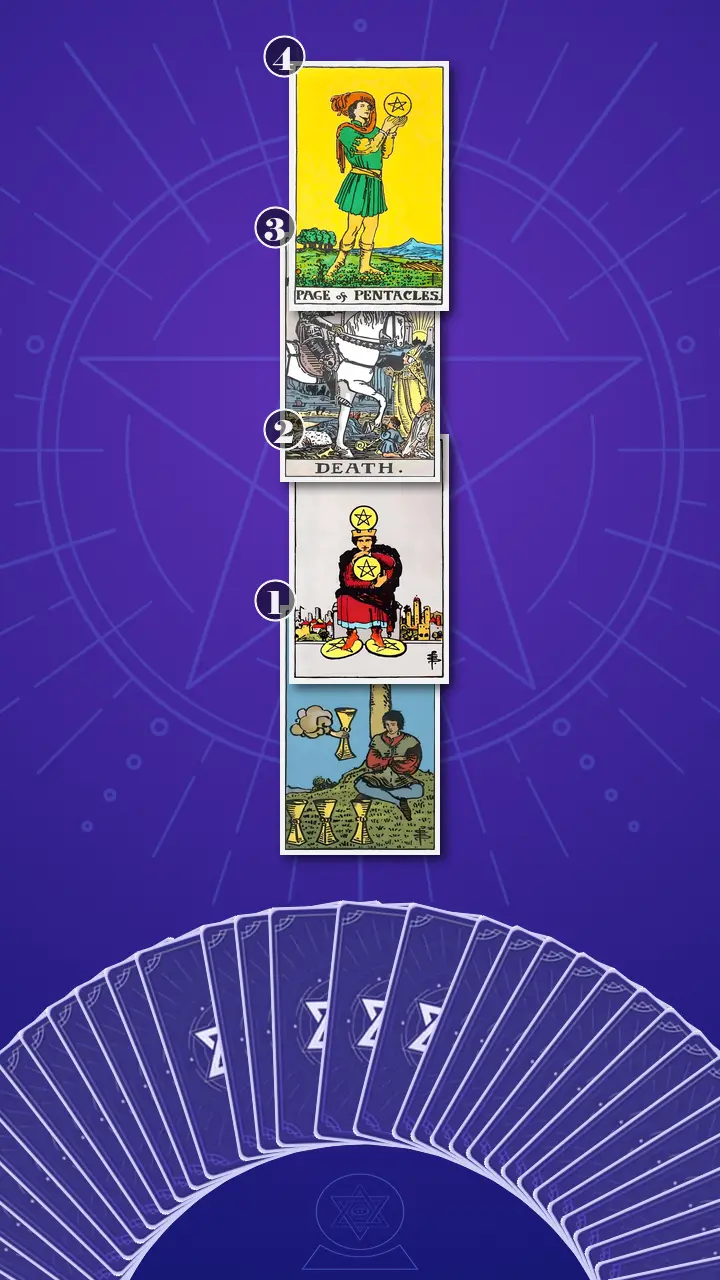
For this reading, I used the Four-Layer Insight Ladder tarot spread. It is the smallest established structure that follows this question all the way through: visible hollowness, protective attachment, transformative perspective, and a practical experiment. A broader spread such as the Celtic Cross could add external variables Jordan had not asked about; this one keeps the reading focused on self-awareness, agency, and actionable advice.
"The bottom card shows the visible symptom: the surface experience that first asks for attention," I explained. "The second reveals the protective root, the belief or fear keeping the pattern in place. The third is the key transformation, where the relationship to the familiar choice can change. The top card gives us grounded integration: one realistic practice, not a permanent answer."
I arranged the four cards in a vertical ladder so the eye could travel upward from the repeated routine, through the grip beneath it, toward release and then a usable form of self-trust. This is how tarot works in this room: the images provide a structured language for card meanings in context, while the decision remains Jordan's.
The First Rung: When the Routine Stops Nourishing
The Four of Cups: The Option Already Within Reach
Now turned is the card representing the visible symptom: the moment Jordan feels emotionally flat inside a predictable routine yet continues repeating it. The card is the Four of Cups, in upright position.
In the RWS image, the seated figure crosses their arms beneath a tree while three cups rest on the ground and a fourth is offered from a cloud. I connected that scene directly to Tuesday at 9:40 p.m.: several plausible jobs and courses were open on Jordan's laptop, but exhaustion and emotional flatness made even a low-risk opportunity feel unconvincing. The routine no longer nourished them, yet the alternatives felt like more work.
"I have options, so why does every option feel like work?" I asked. Upright water here is not absent; it is held still. The energy is blocked by disengagement, not because Jordan lacks intelligence, ambition, or viable choices, but because their emotional access to interest has narrowed. The card asks what the flatness is communicating before anyone interprets it as ingratitude or proof that nothing will help.
"That is a little brutal," Jordan said, giving a short, bitter laugh instead of nodding. "I keep telling myself that if I were serious, I would apply. Maybe I am just being lazy."
"I do not see laziness here," I said. "I see the difference between having options and having enough available energy to meet them. It is a bit like the split in Severance: you are highly functional inside the work system while feeling increasingly disconnected from the life organised around that functionality."
For a moment, I watched three things happen in order: Jordan's breath paused and their fingers stopped over the edge of the card; their gaze went unfocused, as if replaying the previous night's tab-closing ritual; then a low exhale left their chest and their forearms released against the table. That was recognition, not a verdict.
The Grip Beneath the Relief
The Four of Pentacles: When Security Becomes a Closed Door
Now turned is the card representing the protective root: the attachment to safety and control that makes the familiar choice difficult to question. The card is the Four of Pentacles, in upright position.
In the RWS image, one pentacle is pressed against the figure's chest, two are fixed beneath their feet, and another is balanced on the crown while a city sits behind them. I saw the modern version in the Friday Teams message Jordan had described: at 4:36 p.m., a manager offered another familiar assignment, and Jordan replied, "Happy to take this on." Their shoulders dropped with relief, but the calendar space that might have held one small experiment disappeared at the same moment.
The upright earth energy is excessive here. Security has hardened into rigid control. The coin against the chest becomes the paycheque and Jordan's reliable identity; the coins beneath the feet become recurring commitments that provide footing but leave no room to step. The card is not saying stability is the problem. It is showing what happens when a limited test is mentally inflated into a threat to rent, competence, and the whole structure of adult life.
"If I loosen one part, what stops the whole structure from falling?" Jordan said. I let the question remain practical. I was not asking them to gamble with income or pretend that Toronto rent is a symbolic detail. "Relief is not the same as interest," I said. "The relief tells us uncertainty has gone quiet. It does not automatically tell us that the assignment is what you want."
Jordan pressed two fingers lightly to their sternum, then looked down at the coins on the card. "I have been treating every small experiment like quitting," they admitted. Their chest tightened, their eyes moved to the calendar on their phone, and then their grip on the phone loosened. The fear had become specific enough to work with.
When Death Opened the Sky Beyond the White Rose
Death: Letting a Useful Identity Reach Its End
The room seemed to quiet as I turned the third card. Even the radiator's clicking faded beneath the pause. This was the Catalyst in the spread: not a command to leave, but the point where the pattern could change shape.
Now turned is the card representing the key transformation: the perspective that allows Jordan to release a completed relationship with the familiar choice without treating it as a personal failure. The card is Death, in upright position.
In RWS tradition, Death signifies an ending, transition, and renewal rather than a literal prediction. The skeletal rider carries a black banner with a white rose, while the sun rises between two towers. For Jordan, the image became an honest distinction: the version of them who chose this dependable role needed predictability, practice, and proof of competence. Those needs were valid. They do not have to operate as a permanent contract.
I translated the card into a browser action: archiving an old version of a resume without deleting the experience inside it. The work remains true, but it no longer has to define every role Jordan considers. A choice can have protected you and still be complete. You do not need to put your past choice on trial before letting its role in your life change.
This was the moment for my signature lens, Decision Timing Calibration. I asked a more useful question than "Should you leave?" I asked whether the current cyclical environment was structurally sound for a high-stakes crossroads decision. Then I used Cyclical Variable Filtering: rent, income, health, and current commitments belonged in the structural facts column; LinkedIn comparison, Tuesday exhaustion, and the fear's demand for a guarantee belonged in temporary friction. I was not erasing the friction. I was stopping it from pretending to be the whole sky.
At 9:40 p.m., the laptop was warm, the TTC rumbled below, and twelve promising tabs remained open. Jordan reread them until their stomach tightened, then closed everything and added one more familiar task to tomorrow's calendar.
You do not have to keep carrying a choice simply because it once protected you; let a completed role change shape and walk toward the sunrise beyond Death's white rose.
Jordan went very still. First, their breath caught and their fingers hovered above the edge of the card. Then their pupils widened; their gaze moved from the black banner to the white rose as if replaying every time they had called delay responsible planning. The resistance arrived before the relief. "But does not that mean I was wrong to stay?" Their voice sharpened, then broke at the end. I answered, "No. The choice can have been right for the person you were and no longer be required to direct the person you are becoming." A crease held between their brows. Their shoulders lowered by degrees, their clenched hands opened on the table, and a faint redness gathered at the rims of their eyes. When they spoke again, it was quieter: "I thought I had to prove it failed." A breath came out of them, shaky and almost amused, and the room seemed to make space around it. That was the new permission: not an exit, but an honest change in relationship. Now, use this new perspective to revisit last week: was there a moment when you could have treated relief as information rather than a command to repeat the old choice?
That was the first step from restless dissatisfaction and certainty-seeking stasis to evidence-based self-trust and grounded clarity. The shift was not sudden confidence. It was permission to let a past choice remain valid without allowing it to control the next orbit.
The Apprentice's One-Tab Experiment
The Page of Pentacles: Evidence You Can Put Down
Now turned is the card representing the grounded integration: one modest, reality-based experiment that rebuilds self-trust without requiring a final decision. The card is the Page of Pentacles, in upright position.
The Page studies one pentacle in open hands while standing in a fertile field, with mountains visible in the distance. I connected that image to one saved option already open in Jordan's browser: a 45-minute sample lesson at the library, the first paragraph of an application at home, or a small task typical of the role. The Page does not cross the mountains before learning from the ground directly in front of them.
Upright earth is balanced here. It becomes practical curiosity, careful study, and beginner-level self-trust rather than rigid holding. The goal is not to discover a perfect career direction in one session. It is to gather first-hand evidence about what feels energising, difficult, and unexpectedly manageable. The next step owes you information, not certainty.
Jordan's hand moved toward their calendar, then stopped. "I am not declaring a new identity," they said. "I am learning one thing about my response." Their shoulders stayed lowered. They opened a blank note, wrote "one tab, 45 minutes," and looked at me with the tentative curiosity of someone willing to become a beginner without making a public announcement.
The One-Tab Evidence Sprint
Together, the Four-Layer Insight Ladder gave me a clear causal story. The dependable role had given Jordan a paycheque, competence, a reliable reputation, and a workable daily structure. The Four of Cups showed the emotional cost once those benefits stopped producing interest. The Four of Pentacles showed why the cost did not lead to movement: practical security had become an auto-renewing subscription, useful when first purchased but quietly charging Jordan in delayed self-trust. Death interrupted the repeated fours by allowing the old definition of safety to become complete. The Page of Pentacles returned to earth in a healthier form, turning the need for certainty into one contained experiment.
I named the cognitive blind spot directly: Jordan was confusing relief with interest, treating research as movement, and inflating a reversible test until it looked like a threat to rent, competence, and the entire future. The transformation direction was not from stability to chaos. It was from treating comfort as a permanent contract to treating it as useful information, then testing what feels more alive while keeping practical boundaries intact.
"Stability can fund the experiment without owning the future," I said. I offered Jordan three small next steps, each designed to create evidence rather than force a verdict.
- Name what the role has finished givingDuring Monday lunch, open the Notes app and set a seven-minute timer. Write no more than three bullets under "What this role has genuinely given me" and "What it no longer has to provide forever." Then rewrite one stale contract, such as "A responsible person stays once a choice works," as "This choice can remain useful while I test whether it still fits," and keep the note beside your laptop for one week.Use the minimum version if the language feels dramatic: write one thing the job gave you and one thing you are now allowed to need. You do not have to resign, spend money, or announce a pivot.
- Run one one-tab, 45-minute career testBefore Sunday, select one option already open in your browser and choose one location, one tab, and one task: try a sample lesson at the library, draft an application paragraph at home, or complete a small task typical of the role. Afterward, record three observations in Notes: "energising," "difficult," and "unexpectedly manageable," plus an interest score from zero to five.Cap the test at 45 minutes. The ten-minute version is enough if that is all you can offer. Do not turn one session into a complete career-pivot project; spending money, sharing publicly, and submitting an application are optional.
- Put a boundary around the familiar choiceCreate a note titled "My experiment boundary" with three conditions, such as no resignation decision this month, a maximum spend of $25, and no more than one evening per week. For a non-urgent familiar assignment, use my Orbital Pause Strategy: ask for up to 72 hours before replying, then rate relief and interest separately during the pause. If 72 hours is not practical, use the shorter version and ask for 20 minutes.A pause is not a refusal, and observation is not a promise to leave. If workplace norms make even 20 minutes difficult, say, "Can I confirm in ten minutes?" Keep the boundary around one optional commitment so the experiment protects your stability instead of becoming another source of pressure.
None of these actions required Jordan to prove that the current job was bad. They only changed the question from "Can I guarantee the next choice?" to "What can I learn safely, directly, and soon?"

A Small Proof on a Toronto Morning
Four days later, I received a message from Jordan: "I did the 45-minute lesson. It was harder than I expected, but I liked the problem-solving part. I am not applying yet. I just know what to test next." That was not a dramatic career pivot. It was first-hand evidence, and it had begun to rebuild trust in their own attention.
On Thursday, Jordan finished the test at a library and walked into drizzle with no grand revelation. They slept through the night, yet woke Friday with "What if I am wrong?" in mind. This time, they smiled, wrote the question down, and opened the one-tab note.
I saw the value of the reading in that small distinction. The cards had not chosen a destination or made the familiar role disappear. They had helped Jordan separate relief from interest, temporary friction from structural reality, and a permanent declaration from a reversible experiment. The path toward clarity had started when Jordan stopped demanding certainty before allowing curiosity to speak.
When Sunday evening makes your stomach tighten, it is hard to admit that the same routine calming your fear of losing control is also leaving your arms too heavy to reach for what might feel more alive. If comfort could be useful information instead of a lifelong contract, what tiny, reversible one-tab curiosity might you let yourself imagine following next?