When Banter Crosses the Line

Explore a friendship teasing boundary, related tarot cards, and reading insights for moments when jokes stop feeling mutual.

Friendship Banter Boundary
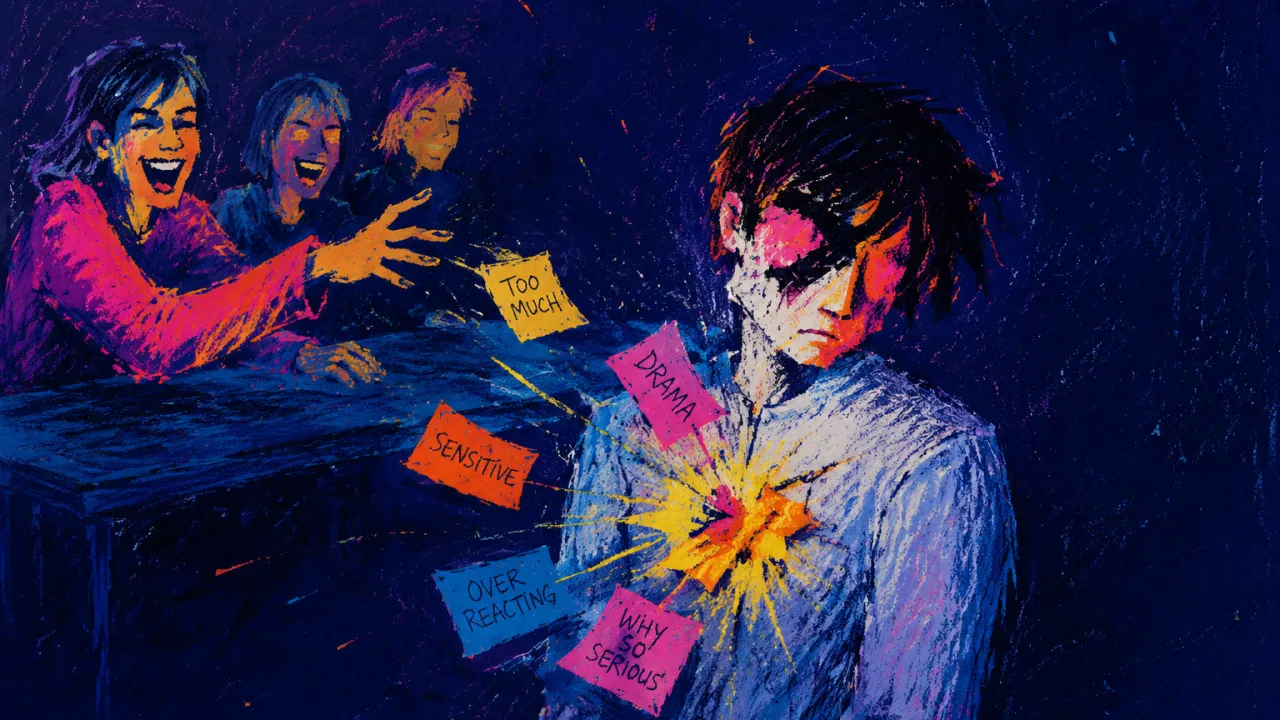
A solitary figure leaning back as laughing hands flick paper tags toward the chest, pale marks gathering in indigo space

What is this situation?

Friendship Banter Boundary — you're in the group chat, at pre-drinks, on a gaming call, or sitting around a table with people who are supposed to be your safe people, and the jokes start landing a little too close to the part of you they know is tender. At first it sounds harmless: a nickname, a callback to something embarrassing, a dig about your dating life, your clothes, your money, your voice, the thing you said once and now can't seem to escape. Everyone laughs, so the room decides it was funny before you get to decide whether it was okay. If you go quiet, someone says you're being weird; if you push back, someone says, "Relax, it's just banter"; if you laugh along, the joke gets permission to come back next time. The power sits in the group because the group controls the tone: who gets teased, who gets protected, who is allowed to say "not that one" without being accused of killing the vibe. You start editing yourself before you arrive, checking the chat before you open it, rehearsing a reply that sounds firm but not dramatic, casual but not weak, clear but not awkward. The exhausting part is not one joke; it's the repeated moment where your limit has to compete with everyone's desire to keep the room easy, much like the figure on the Seven of Wands, standing on uneven ground while several raised staffs push up toward his space.

Why it's not you?

The issue isn't that you're too sensitive or bad at taking a joke; it's that the joke keeps using you as the target after you've shown where it lands. Banter stops being mutual when one person pays the social cost for everyone else's laugh. A friendship circle can feel familiar and still mishandle your limit.

Friendship Banter Boundary in Tarot Cards

Friendship Banter Boundary is the moment where casual teasing turns into repeated social pressure, especially when the room laughs before anyone checks whether you're still in on it. The tight chest you feel after typing and deleting a reply is not random; it points to an environmental, structural dynamic where the group gets to decide whether your limit is "too much." The cards below don't judge the friendship or tell you what to do with it. These Tarot Cards reflect the shape of having to defend your space inside a circle that still calls itself friendly.

Justice
Reversed
The scales and raised sword sit between two rigid pillars, presenting impact and judgement as matters that require both evidence and accountable decisions. Reversed, those instruments remain visible but lose their fair alignment, mirroring a friendship group that lets the people enjoying the joke adjudicate whether the target was allowed to be hurt. Your discomfort is treated as weaker evidence than the joker's intent, the room's laughter, or the group's desire to avoid awkwardness. The blocked function is accountability: the reversed structure shows a social rule being applied unevenly, because everyone else may define the joke as harmless while you are denied equal authority over access to your own vulnerabilities.
Three of Cups
Reversed
Three figures raise their cups inward above a shared harvest, forming a tight circuit of celebration and mutual recognition. Reversed, that same closed formation can preserve togetherness for the majority while excluding the one reaction that does not match the toast. This reflects a friendship group that treats shared laughter as evidence that the joke was acceptable, even when you have signalled otherwise. The reversed social bond shows access being blocked at the point of reciprocity: familiarity is present, but protection is distributed according to who will keep participating in the group's preferred version of fun.
Five of Swords
Upright
A foreground figure gathers the swords while two others turn away toward the water, leaving additional swords on the ground beneath a turbulent sky. The arrangement turns interaction into a visible win-loss structure: one person keeps the status of having landed the line, while others carry the relational cost. That is the architecture of banter when the joke-teller's laugh matters more than the target's withdrawal. You may be confronting a friendship pattern in which pushing back is framed as losing, but the upright image exposes the hidden price of that victory: the group can preserve the joke only by making safety and mutuality expendable.
Eight of Swords
Upright
A blindfolded, bound figure stands inside an uneven enclosure of eight swords, with wet ground underfoot and a distant structure behind her. The barriers capture a socially manufactured double bind: every visible response carries a penalty, yet the group presents those responses as freely chosen. If you stay quiet, the group can call you strange; if you object, it can call you sensitive; if you laugh, it can treat the joke as approved. The upright image exposes that constraint without making it absolute: the sword enclosure is incomplete, so naming how the friendship has pre-priced each response can restore clarity about where the restriction actually sits.
Five of Wands
Upright
Five figures raise crossing staffs in the same crowded space, with no shared rhythm and no visible referee. The image captures friendship banter that may begin as mutual sparring but lacks an agreed mechanism for recognising when one participant has stopped playing. That absence of coordination matters when every attempt to object becomes another opening for a joke. You may be dealing with a friendship culture that mistakes constant escalation for closeness; the upright scene makes the friction public enough to distinguish reciprocal play from a contest where one person repeatedly absorbs the impact.
Seven of Wands
Upright
The lone figure stands on uneven ground, gripping one wand while six others push up into his space. The asymmetry makes the boundary visible: one person must defend a limit against a group whose combined energy defines the atmosphere. That structure mirrors friendship banter when a joke survives because everyone else finds it easy. You may be trying to keep the friendship without surrendering the right to mark one subject off-limits; the upright stance shows that the line can remain clear even when the room does not immediately reward it.
Nine of Wands
Upright
The bandaged figure looks sideways while holding a staff in front of a rigid line of eight more. His posture makes the psychological cache visible: earlier jokes remain active in the body of the next interaction, even before anyone has said anything new. You may be rehearsing the ideal response, scanning for the callback, or limiting personal disclosures so the group has less material. The upright image keeps a distinction available between useful memory and endless readiness; what looks like private overthinking is anchored in a friendship environment that has repeatedly failed to retain your limit.

Friendship Banter Boundary in Tarot Card Reading Insights

Friendship Banter Boundary shows up in readings when the joke has started costing more than the closeness it was supposed to create. Others have brought this same group-chat tension, party-table teasing, and "can't you take a joke?" pressure into their readings. Tarot Reading Insights from sessions where friendship and limits meet.

Psychological Contexts Related to Friendship Banter Boundary