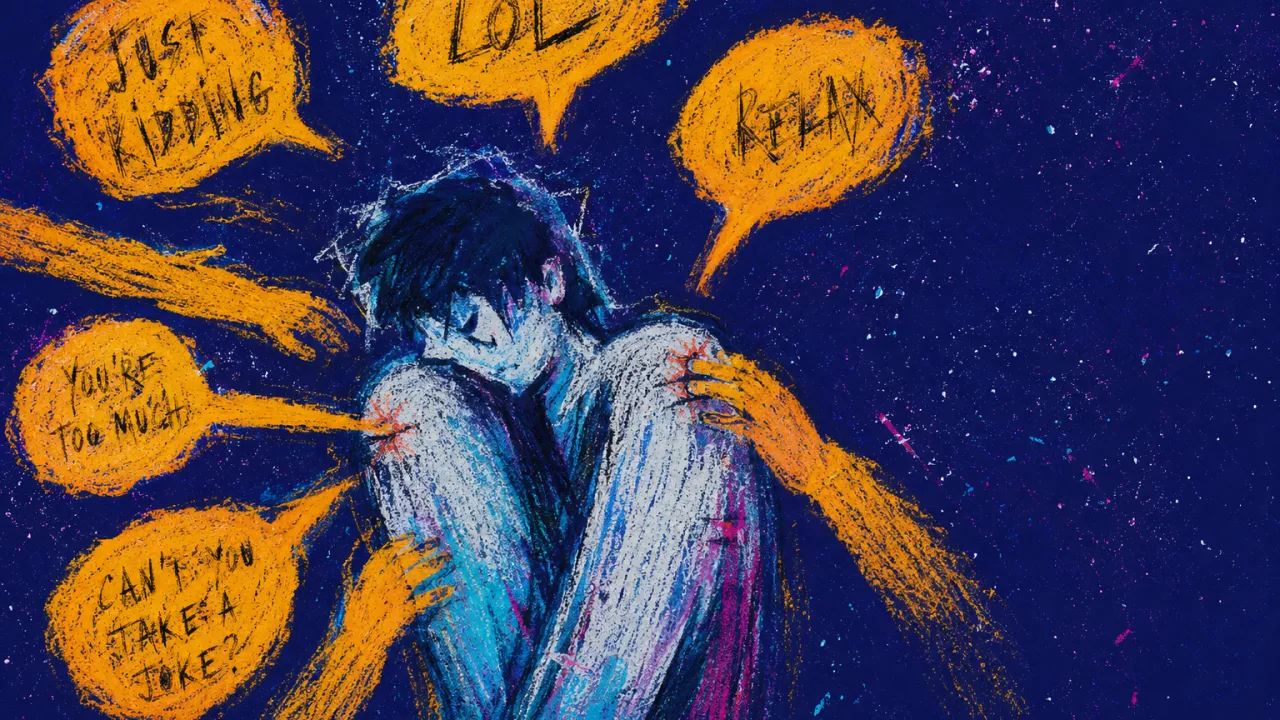
A grounded look at boundary-crossing workplace jokes, related tarot cards, and reading insights from similar office dynamics.
Workplace Banter Boundary
What is this situation?
Workplace Banter Boundary — you step into a team that sells itself as relaxed, and at first the jokes seem like the price of belonging. A comment in the meeting about your dating life gets a laugh, then someone brings it back in the group chat, then your weekend, your clothes, or the way you phrase things become material for the room. When you try to move the conversation on, a coworker says they're only kidding; when you stay quiet, the manager smiles along and lets the thread keep running. The power sits in the group, not in any single punchline: everyone can claim it was nothing, while you're the one deciding whether to laugh, push back, or risk being labeled difficult. By midweek you start editing what you share before anyone asks, reading Slack messages twice, keeping answers flat, and feeling your jaw lock and your shoulders rise when a casual "quick question" turns into another setup. The work itself may be manageable, but the daily cost is having your personal line treated like office entertainment, much like the figure in the Seven of Wands holding one staff while six others rise toward them from every side.
Why it's not you?
The issue isn't that you don't have a sense of humor; it's that the room keeps using humor as a pass to test your limits. Repeated personal jokes, group chat pile-ons, and "we're only kidding" replies are not neutral workplace banter. They create a setup where your boundary becomes the problem instead of the behavior crossing it.
Workplace Banter Boundary in Tarot Cards
Workplace Banter Boundary shows up when office jokes stop being background noise and start crossing the personal line you have to defend. The jaw-lock and raised shoulders from those Slack threads and meeting-room comments are part of how the environment lands on the body. This is an environmental, structural dynamic: the group gets to call it harmless while you are made responsible for keeping the mood smooth. The Tarot Cards below reflect that shape: the incoming pressure, the boundary line, and the effort of standing your ground.
Between an upright sword and balanced scales, the seated figure holds enforcement and evaluation together. Those fixed instruments form a direct counter-image to a team culture where every personal jab is minimized separately and the cumulative pattern is never weighed. When a manager smiles along or coworkers answer with "we're only kidding," the standard can become uneven: their comfort is treated as ordinary while your response is treated as excessive. Justice brings the structure into view by separating a group's preferred story about itself from the observable pattern of whose privacy, focus, and professional standing carry the cost.
Beneath the raised central figure, two people wear loose chains that visibly connect them to a shared arrangement. The scene captures a social system that does not need overt force to hold: the attachment persists because the cost of stepping outside the role is made conspicuous. In workplace banter, the chain can be the expectation that you prove you are easygoing by laughing when your private life becomes the subject. The upright image names the coercive logic in that exchange while preserving its practical reality: the group may call the tie casual, but the social consequence of refusing it can still shape how freely you participate.
Three figures stand in a tight circle with cups raised, their shared gesture turning connection into a visible ritual. Reversed, that closed formation can expose the underside of a bonded group: mutual reinforcement, gossip, and a celebration that becomes difficult to enter on equal terms. When personal jokes keep returning through the group chat, the issue is not simply whether any one coworker likes you. You are encountering a social loop in which the room gains cohesion by treating your boundaries as material for collective reaction, leaving you to calculate whether quietness, laughter, or pushback will alter your place in the circle.
A figure gathers three swords while two others walk away across the shore, leaving two more swords behind. The visual arrangement captures an interaction where one person or subgroup gets the social payoff while others absorb the loss of ease, voice, or connection. At work, a recurring personal joke can function less like humour than a small public win: someone gets the laugh, the room avoids accountability, and you manage the after-effect. The upright scene makes that exchange visible without reducing it to intent, showing why a pattern can be professionally costly even when each participant says they were only kidding.
Blindfolded and loosely bound inside eight upright swords, the figure stands in a terrain where every direction appears unsafe. The surrounding blades form a visual map of constrained choice: the threat is not one unavoidable obstacle but a field of anticipated consequences that limits movement before it begins. In a workplace where "only kidding" can follow every objection, you may feel pushed toward a false set of options between performing comfort, withdrawing, or accepting a difficult label. The upright scene makes that narrowing visible without treating it as fixed: the bindings and sword formation show how social framing can obscure room for a more defined response.
Five figures swing their wands into the same crowded space, with no clear leader containing the motion. The scene shows friction that is open, performative, and self-reinforcing: each participant can call it play while the combined activity still creates a hostile working atmosphere. When a team keeps turning a "quick question" into a setup, the workload includes monitoring who will add the next line and whether the manager will intervene. The upright visibility of the clash helps separate observable group behaviour from the convenient claim that nothing happened because no single comment looked decisive.
Standing on a rise with one wand braced against six wands rising from below, the figure occupies a visibly uneven contest. The clustered staffs turn a single line of defence into a clear image of group pressure, where several people can each contribute a small push while no one person carries the whole pattern. In a workplace that calls personal joking "relaxed culture," you can be left holding the boundary alone while colleagues, chat replies, and managerial smiles gather on the other side. The upright figure's stable footing frames the boundary as professionally legible: the social pressure is real, but it does not make personal access a condition of competent participation.
The bandage on the figure's head and the barrier of eight wands make prior contact visible in the present stance. The picture does not show someone reacting to nothing; it shows vigilance accumulating around a boundary that has already had to do repeated work. When Slack pings or casual questions make your jaw tighten, the internal load can be understood as a cache of unfinished social calculations. The upright figure still holds a staff and remains on their feet, making the protective function of that alertness visible while also naming the ongoing energy it consumes.
No cards available for this filter.
Workplace Banter Boundary in Tarot Card Reading Insights
When workplace banter keeps crossing a boundary, other people often bring the same meeting-room comments, group chat pile-ons, and "we're only kidding" moments into readings. The focus shifts from the card list to what comes up when someone sits with that workplace pattern in front of a spread. Explore Tarot Reading Insights from sessions where workplace humor stopped feeling casual.