Purpose-Loss Procrastination: Splitting the Verdict Into Two Tracks

The 10:40 p.m. Purpose-Loss Procrastination Spiral
If you can handle customers through an entire part-time shift and still develop heavy limbs in front of one coursework brief, I would not assume you need another planner. Deadline paralysis lands differently when the task seems tied to a future you no longer want.
At 10:40 p.m., Alex (name changed for privacy) joined our call from the kitchen table of their west-end Toronto apartment. Rain ticked against the window, and a streetcar ground around the corner with a metallic complaint. When Alex shared their screen, I saw the assignment brief beside a polished semester dashboard, three alternative careers in a spreadsheet, and a draft whose title had already changed twice. The laptop was warm beneath their wrists. The section worth the most marks was still blank.
“Why do I keep putting off coursework for a degree I’ve outgrown?” Alex asked. “I keep calling it procrastination, but the work feels like evidence for a life I no longer want. Finishing sounds responsible, and staying feels dishonest.”
I watched their fingers drift toward their phone and stop. Their stomach had tightened visibly beneath a held breath. The dread sat on their body like a wet winter coat they could not remove indoors: heavy at the shoulders, clammy at the cuffs, and impossible to ignore each time the course portal flashed amber.
Alex was not avoiding one assessed section as though it were only an assessed section. Their body was reacting as though drafting it meant signing an auto-renewal contract for the next five years. So they called the problem poor discipline, then built study schedules, fixed references, searched career forums, and scrolled through LinkedIn graduate announcements to avoid asking the more unsettling question: what if the degree had completed one role in their life but no longer deserved to define the next?
“I’m not going to use tarot to tell you whether to stay or leave,” I said. “That choice belongs to you, and it deserves academic, financial, emotional, and real-world evidence. What I can do is help us separate the layers. Let’s make a map of this fog so one assignment stops carrying the weight of your entire future.”
I have spent twenty years listening to stories over coffee, and I have learned not to confuse a cluttered surface with a simple problem. What looked like ordinary coursework procrastination was carrying guilt about tuition, resentment toward an outgrown identity, exhaustion after customer-support shifts, and the fear that changing direction would turn previous years into proof of bad judgment. I named it carefully: purpose-loss procrastination, not a character flaw and not a verdict about what Alex had to do next.

Choosing the Four-Layer Insight Ladder
I asked Alex to place both feet on the floor, let their exhale last a little longer than their inhale, and hold one question in mind: “What is this delay protecting me from facing?” I shuffled slowly. The pause was not a mystical performance; it was a clean transition from reacting to observing.
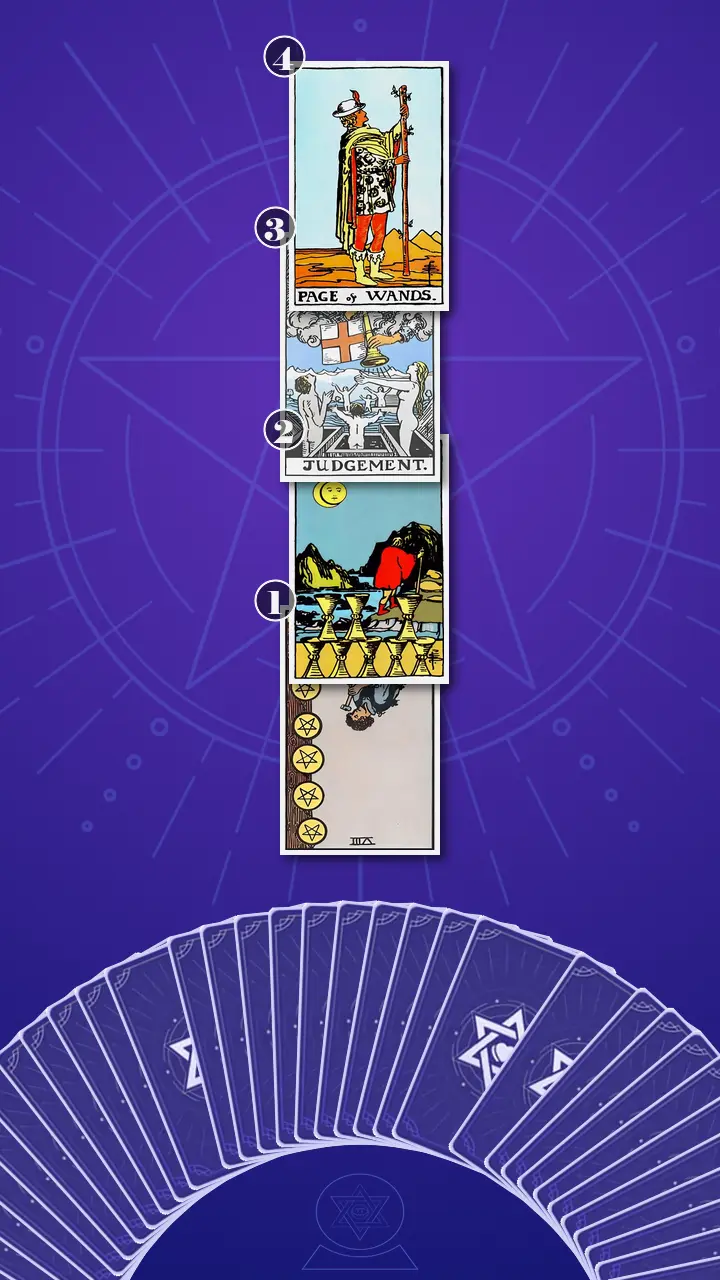
I chose the Four-Layer Insight Ladder tarot spread. I use this four-card structure when a visible habit is being sustained by a deeper identity conflict. For anyone wondering how tarot works in a grounded consultation, I treat the spread as an externalised cognitive map. The symbols give us enough distance to examine assumptions, emotional information, and available choices without pretending the cards can issue an objective command.
The first position would show the visible coursework behaviour and the stagnant energy beneath it. The second would reveal the emotional truth sustaining the delay. The third, our transformation position, would challenge the belief that reassessment makes past effort worthless. The fourth would translate that insight into a bounded action and a low-stakes experiment.
I arranged the cards in one vertical line, like an ascending ladder. We would move from behaviour to root, from root to honest review, and from review to action. It was deliberately smaller than a Celtic Cross. Alex did not need ten competing angles or a prediction about the future; they needed a clear sequence through a problem already generating too much mental noise.
The Workshop That Stopped Building a Future
Position 1: The Busy Desk and the Blank Centre
“The card I am turning over now represents the diagnosis-level behaviour,” I said. “It shows the low-value planning, editing, and browsing that surround the central coursework task without advancing it.” I revealed the Eight of Pentacles, in reversed position.
In the traditional image, an artisan sits at a bench beneath a vertical row of completed pentacles. Upright, the card often describes skill built through patient repetition. Reversed, the same workshop can become scattered, perfectionistic, or mechanically busy without producing meaningful progress. It was an exact visual translation of Alex’s screen: completed credits behind them, coursework tools everywhere, and no felt connection between tonight’s labour and a wanted future.
I brought the card into Alex’s daily life. At 10:40 p.m., the semester dashboard looked organised. Citation spacing was corrected. The draft had a respectable file name. A six-hour weekend study block had been planned. Yet the section carrying the most marks remained untouched. From across the room, the activity might have looked diligent; up close, it resembled a progress bar animated by formatting changes while the actual file had not begun uploading.
“The sentence underneath this card sounds like, ‘If I were more disciplined, I would draft the argument, so let me first rebuild the schedule that will finally make me disciplined,’” I said. “The substitute task creates short-term relief. Then the deadline tightens, urgency takes over, and the exhausted rush becomes fresh evidence that you cannot trust yourself.”
I read the reversed card as blocked Earth energy with an excess of low-value effort. Alex was not deficient in the ability to work; they could meet academic requirements when urgency removed every other option. The blockage appeared when ordinary task discomfort became fused with a crisis of meaning. A harsher six-hour schedule would overcorrect the visible symptom and leave the purpose conflict untouched.
I also used my Study Environment Auditing lens. On Alex’s screen I could see the coursework document, career spreadsheet, phone, planner, and notification badges competing for the same narrow strip of attention. Each object offered a tiny escape route. The physical and digital clutter was not causing the degree conflict, but it was quietly draining the psychological bandwidth Alex needed to distinguish normal academic effort from work that felt disconnected from purpose.
Alex gave a short, bitter laugh instead of nodding. “That’s painfully accurate. I reorganise everything except the part worth marks. Even hearing it said out loud feels a little brutal.”
“Accurate does not have to mean accusatory,” I replied. “The card is showing us the mechanism, not assigning you a moral grade. If better planning were the missing answer, the latest rebuilt system would have changed which section stayed blank.”
Position 2: The Part of You Already Walking
“The card I am turning over now represents the mechanism underneath the delay,” I said. “It asks what your attention may already be withdrawing from, and what you have not yet given yourself permission to name.” The second card was the Eight of Cups, upright.
The cloaked figure in this card walks away from eight carefully arranged cups. Nothing has been smashed. The cups remain standing as evidence that the past contained effort, learning, and value. Yet one visible gap suggests that the arrangement is no longer emotionally complete.
I connected that image to the moment Alex saw a deadline, closed the course portal, and opened tabs for UX research, policy, customer success, and community work. Their attention had already started walking toward an undefined horizon. Because they had not named what they wanted to move toward or created criteria for reviewing the degree, that emotional departure kept appearing as delay.
“This is not the card declaring that you should leave,” I said. “It is the card asking whether some part of you has already disengaged. There is a difference. Procrastination can carry information without being allowed to make the decision.”
I read the upright Cups energy as a balanced emotional signal caught inside a blockage of expression. The feeling itself was not wrong or excessive. The problem was that Alex could not acknowledge it without imagining an immediate, irreversible withdrawal. Unspoken, the information leaked into every assignment. Named carefully, it could become one piece of a wider review.
“What are you hoping to move toward when you open those career tabs?” I asked. “Not a job title yet. Do you want more direct problem-solving, visible impact, collaboration, creativity, a different pace, or simply a version of your day that does not feel split from you?”
Alex looked past the laptop toward the rain-dark window. Their thumb stopped rubbing the edge of their mug. “I don’t want the last few years to be worthless,” they said quietly. “But I can’t make myself want the future everyone assumes the degree points to.”
The Split Screen Between Two Eights
I placed the first two cards side by side for a moment. The repeated Eights mattered. This was not beginner-level laziness. Alex had enough experience to know how to complete coursework and enough accumulated evidence to sense the limits of repetition without alignment.
I described the pair as a split screen. On one side, Alex remained seated, correcting references beneath a tower of completed credits. On the other, Alex walked through career pages toward a horizon they had not tested. The inner sentence was simple: “I know how to do the work; I no longer know what I want the work to build.”
The split screen landed in three small movements. Alex’s breath paused. Their eyes lost focus as though replaying several Sunday nights at once. Then their shoulders lowered by a fraction, and a long exhale moved through their chest.
“So it isn’t that the procrastination is secretly making the decision for me,” they said. “It’s showing me that I’ve delayed making one consciously.”
“Exactly,” I said. “Appreciation does not create permanent obligation. Past effort can remain valuable even when its job in your life changes.”
When Judgement’s Trumpet Unmuted the Real Question
Position 3: Review Without Self-Condemnation
The radiator clicked once and fell quiet. Even the rain seemed to soften as I reached for the third card. “The card I am turning over now represents the transformation layer,” I said. “It challenges the fear that reassessing the degree invalidates your past and moves us from passive delay into an honest, evidence-based review of fit.”
I revealed Judgement, upright, the key card of the reading.
The image showed an angel sounding a trumpet while figures rose with open arms from grey coffins. I did not read the trumpet as an external authority ordering Alex to quit or finish. I read it as information Alex had been muting: their interests had changed, their energy had changed, and the degree’s future meaning required a current review rather than an old promise.
Upright, Judgement brought balanced energy of honest self-evaluation, accountability, and self-authorship. Accountability here did not mean punishing Alex for choosing the degree or forcing completion at any cost. It meant reviewing what remained true, what had changed, what the degree still enabled, and what continuing currently cost. It also meant refusing to let late coursework make the larger decision by default.
Seeing the card, I thought of twenty years of marked-up syllabi spread beside cooling cups of coffee. I have watched one line item expand in a person’s mind until it becomes a verdict on intelligence, identity, and the next decade. On paper, the line item is usually much smaller. The emotional contract attached to it is what makes the page feel enormous.
I used my Syllabus Deconstruction lens to separate those scales. The assignment contained mechanical parts: identify the assessed section, draft three rough topic sentences, attach one supporting source, and stop when the timer ended. None of those actions could decide whether Alex should build a career around the degree. The dread had taken a bounded academic task and promoted it into an identity referendum.
I brought us back to 10:40 p.m.: the brief open, the title changed twice, and three career tabs glowing beside a blank draft. Alex’s stomach had tightened because one paragraph felt less like coursework than a renewal notice for a future they no longer wanted.
You do not have to keep performing an expired identity to prove your worth; answer Judgement's trumpet by reviewing the path honestly and responding with one conscious step.
I let the sentence remain between us. A streetcar bell sounded once beyond the window, clear and brief.
Alex’s breathing stopped first. Their index finger hovered above the trackpad, and the muscles around their mouth held completely still. Then their eyes moved from Judgement to the blank section on the shared screen, as though the same memory were being replayed with a new caption. Their pupils widened. Moisture gathered along the lower rim of their eyes, but their shoulders had not yet relaxed.
“But doesn’t that mean I was wrong for the last three years?” they said, sharper than before. Their hand closed around the mug. “If the identity is expired, what was I doing all that time?”
I kept my voice level. “It means you have information now that you did not have then. A revised assessment is not evidence that your original choice was foolish. It is evidence that you are still allowed to learn. The skills, credits, friendships, and proof of capability do not disappear because their future role changes.”
Their grip loosened finger by finger. A breath left them with a slight tremor. Their shoulders finally dropped, followed by a brief, almost dizzy blankness. I could see relief arrive with a new vulnerability: if the assignment was no longer in charge of the future, Alex would have to take conscious ownership of the larger review.
I named the practical translation as plainly as I could:
An assignment is a bounded task, not a referendum on your future. Delaying it cannot decide whether the degree still fits; only an honest review and real-world evidence can do that.
“I call that the Task-Not-Referendum Split,” I said. “Right now, the assignment and the degree decision are like two browser tabs that keep crashing because you are treating them as one process. Tonight’s deadline is a local notification. It does not have administrator access to your entire identity.”
I invited Alex to test the new perspective. “Now, think back to last week. Was there a moment when this insight could have made you feel different?”
Alex looked down. “Tuesday. I needed to write the opening paragraph, but I started searching whether UX research would survive automation. If the paragraph had only been a paragraph, I probably could have written a bad version and gone to bed.”
I placed a blank sheet beside Judgement and gave Alex an eight-minute exercise. I asked them to write two headings: Tonight’s Task and Bigger Degree Question. Under the first, they wrote, “Draft three rough topic sentences for the section worth the most marks.” Under the second, they wrote, “Find out which roles use my research and customer-support skills without making this degree my entire identity.”
“Stop when the timer ends,” I said. “This page does not commit you to finishing or leaving the degree. If the discomfort spikes, shorten it to one sentence under each heading. You are gathering distinctions, not forcing a verdict.”
This was the emotional crossing point of the reading: not instant certainty, but movement from dread-driven avoidance and sunk-cost shame toward proportionate boundaries and evidence-based self-trust. Alex had not solved their career crossroads. They had recognised that a coursework session and a life-direction review could be related without being identical.
Position 4: The Beginner Who Does Not Need a Five-Year Plan
“The card I am turning over now represents action and integration,” I said. “It shows how this review can enter daily life through one bounded coursework response and one reversible exploration.” I revealed the Page of Wands, upright.
The Page stood in a wide, unfinished landscape, studying a staff with fresh leaves growing from it. The figure was curious, not credentialled. The Page did not need mastery before contact, and the open landscape did not demand that every route be mapped before the first hour of exploration.
I translated the card into Alex’s Saturday café pattern. Instead of opening twenty job descriptions, salary guides, personality quizzes, and Reddit threads, Alex could choose one field that produced a genuine flicker of interest. They could spend one hour on a beginner workshop, a tiny sample project, a volunteer task, or an informed conversation, then record what engaged and drained them.
“The experiment is evidence, not an announcement,” I said. “You are not choosing your next identity. You are testing one live question. A one-hour field sample is a beta test, not a product launch.”
The Page brought balanced, available Fire energy after the blocked Earth of the first card. It did not promise that the first experiment would reveal the perfect career. Its value was smaller and more reliable: direct contact could replace some of the decision fatigue created by endless comparison. Curiosity was allowed to produce information before it was forced to produce certainty.
“You are asking browser tabs for certainty that only contact can provide,” I told Alex. “Which one-hour test feels possible without turning it into a career pivot announcement?”
Their mouth lifted at one corner. The smile carried relief and embarrassment in equal measure. “I’ve had a message drafted to someone who moved from customer support into UX research,” they said. “I keep deleting it because I don’t sound informed enough.”
“The Page is not asking you to sound like an expert,” I replied. “Ask one honest question as a beginner. The card is not choosing UX research for you. It is restoring your right to learn from contact with the world.”
Two Browser Tabs, Two Decisions
I read the spread back to Alex in four verbs: build, feel, name, test. The Eight of Pentacles reversed showed practical effort that had stopped building a wanted future. The Eight of Cups revealed that emotional attention was already moving away, even while the accumulated cups remained valuable. Judgement asked Alex to name the changed conditions without prosecuting their past self. The Page of Wands returned movement through one small encounter with reality.
The cognitive blind spot was the belief that completing coursework meant recommitting to the degree as a lifelong identity, while reassessing the degree meant declaring the previous years wasted. That false binary made responsible finishing and honest redirection seem mutually exclusive. It left no room for completing a bounded task, exploring another field, pricing the remaining term, seeking academic advice, or deciding later with better evidence.
The transformation direction was a Two-Track Degree Review. One track would handle current academic obligations proportionately. The other would examine degree fit in daylight, away from the pressure of an amber deadline tile. Tarot had not decided whether Alex should finish, pause, or redirect. It had exposed the assumptions that were preventing Alex from making that decision consciously.
I gave Alex three pieces of actionable advice. Each was deliberately small enough to begin without pretending a small action could settle the entire future.
- The Desktop Reset Ritual and One Central Block On the next available evening after work, spend 15 minutes at the kitchen table clearing cups, loose notes, notification badges, career tabs, and every document except the assignment brief. Place a sticky note beside the laptop that says, “This block completes a task; it does not decide my future.” Highlight the single section worth the most marks and work only on it for one 25-minute timer. Stop when the timer ends. Tip: Formatting, inboxes, and career research stay closed. If 25 minutes is unrealistic after a customer-support shift, use 10 minutes or draft only three rough topic sentences. Stopping on time is allowed.
- The Moving Away and Moving Toward Note In a private note, set a 10-minute timer and make two headings: “What I am moving away from” and “What I may be moving toward.” Under the first, name one repeated degree experience that drains meaning. Under the second, name one quality you want more of, such as direct problem-solving, visible impact, collaborative creation, or a different pace. End with one neutral sentence about what the degree has already given you. Tip: This records emotional information; it does not authorise an immediate decision or require an explanation to classmates, family, or an employer. Use one phrase under each heading if 10 minutes feels loaded.
- The Daylight Degree-Fit Review Schedule 30 minutes in daylight, separate from any deadline. Make three columns: “What the degree still enables,” “What continuing currently costs,” and “What has changed in me.” Add one completion criterion and one reconsideration criterion. Finish by sending one message to an academic adviser, careers service, financial-aid office, or person working in a field you want to test. Bring three factual questions; keep the right to reject anyone else’s recommendation. Tip: Do not require a final decision in the same session. One fact in each column and one sent message count as completion. Evidence comes before identity.
I asked Alex to notice the scale of the plan. None of it required a six-hour redemption session, a dramatic withdrawal, or a polished five-year career story. It required a clearer desk, one central coursework action, one honest review, and one piece of live evidence. The smallness was not a compromise; it was how Alex would regain control from a problem inflated by fused decisions.

A Week Later: The Quiet Proof
Six days later, I received a message from Alex. It did not announce that their degree question had been solved. It said, “I did the almost stupidly small version. I cleared the table, wrote three rough topic sentences, and stopped after 25 minutes. The degree question was still there, but it wasn’t sitting inside the paragraph anymore.”
They had returned the next evening and developed those sentences into the central section. More importantly, they had completed the daylight review without turning it into a case for either prosecution or defence. Their columns contained costs, retained skills, changed interests, and questions that still needed answers. Uncertainty remained, but it had become specific enough to investigate.
On the morning after the review, Alex’s first thought was still, “What if I’m wrong?” They smiled at the familiar question, made coffee, and sent the informational-interview message anyway.
I recognised that as the Page of Wands in its most useful form. Not certainty. Not a new identity assembled overnight. Just tentative curiosity surviving long enough to make contact with another human being.
I did not credit the cards with changing Alex’s life. The cards gave us a structured language for seeing the loop, but Alex cleared the desk, wrote the sentences, reviewed the evidence, and sent the message. The agency was theirs before the reading, during it, and after it.
That was our Journey to Clarity: a shift from coursework dread and sunk-cost shame toward proportionate task boundaries, honest self-review, and a first experiment in what might come next. Clarity did not arrive as a perfect answer. It appeared when two decisions that had been crushing each other were finally allowed to stand apart.
If opening one assignment makes your stomach tighten as though you are signing away the next five years, ordinary coursework and the fear of having chosen wrong can blur into the same amber notification. I want you to remember that noticing this fusion means you are no longer entirely trapped inside it.
If tonight’s assignment did not have to decide your future, what small piece would you choose to handle now, and what one-hour Page of Wands experiment could give the bigger question real evidence later?