Coursework Feels Pointless: One Purpose Line Opens a Work Block

The Immaculate Study Plan and the Meaning-Loss Procrastination Loop
I recognized Jordan (name changed for privacy) as the 22-year-old non-binary university student who could build an immaculate study plan, yet the second an assignment felt pointless, productive procrastination took over before the first answer existed. I had seen this form of meaning-loss procrastination in university coursework before: the work was not simply being avoided; it was being asked to justify itself before Jordan would touch it.
At 8:47 p.m. on a Tuesday, Jordan sat at a narrow desk in a downtown Toronto apartment, reading the same essay prompt for the second time. The laptop fan hummed against the quiet, cold coffee left a bitter film on their tongue, and their phone felt warm in their hand as they changed the document margins, checked messages, and moved the same study block from 8:30 to 9:00. Their jaw was tight. Their legs had the heavy, restless weight of wanting to leave the desk while still needing to finish enough to quiet the guilt.
Jordan looked at me and said, “If this matters, why does it feel so empty? I keep waiting for a reason strong enough to make me start.” I heard the central contradiction clearly: they were torn between finishing coursework to preserve their current options and giving another evening to work that no longer felt connected to who they were becoming. The disengagement sat in them like wet sand packed into every joint, while guilt and resentment pressed from underneath.
“You are not avoiding nothing; you are avoiding a question the assignment cannot answer for you,” I said. “We can look at that question without forcing the course to become meaningful or treating your uncertainty as a personal failure. Today, our Journey to Clarity is simply to draw a map from the visible loop to one choice you can make without waiting for total conviction.”
I explained that I use tarot through a Jungian psychological lens: not as a verdict, a prediction, or a substitute for Jordan's own judgment, but as an objective symbolic tool for making patterns easier to see. The cards could not decide whether the degree still fit. Jordan remained the person with the right to reassess, continue, pause, or change direction.

Choosing a Shadow Map, Not a Verdict
I asked Jordan to take one slow breath and hold the question in plain language: “Why do I keep putting off coursework that no longer feels meaningful?” Then I shuffled slowly. The small ritual was a transition into focused attention, not a supernatural test; it gave the hands something steady to do while the mind stopped chasing every possible explanation.
“Today I am using The Shadow Spread,” I told Jordan. “It is a four-card classic structure designed for this kind of inner excavation. It moves from the visible behavior to the hidden mechanism, then to a conscious reframe and a practical action. That makes it the smallest sufficient map for this question. A broader spread could add external influences and long-range factors, but it might distract us from the loop you can actually observe tonight.”
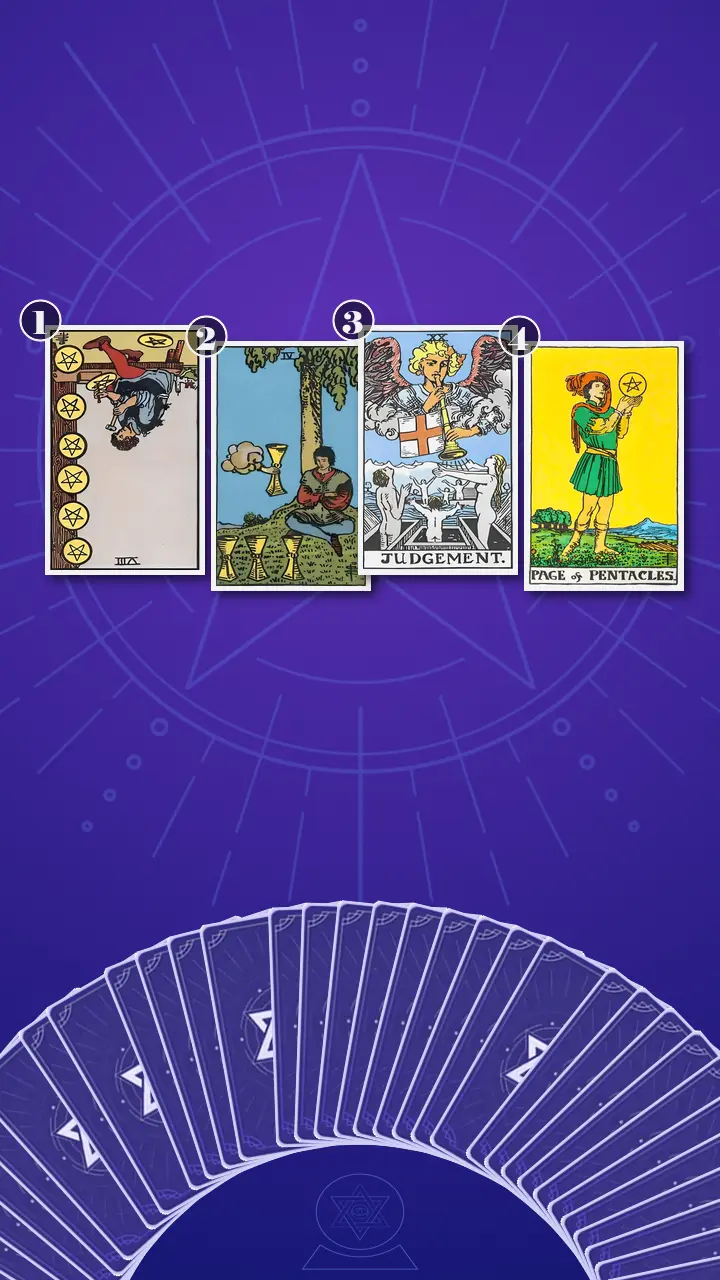
I placed the cards in a horizontal line across the desk, leaving the third position at the visual center. The first card would show the Presenting loop, the procrastination pattern and stagnant energy demanding attention. The second would show the Underlying root, including the protective waiting and self-worth fear beneath the delay. The third would hold the Key transformation, the conscious re-evaluation that could return choice to Jordan. The fourth would offer Grounded action, one modest study behavior that did not require forced passion.
This is how tarot works in this reading: each card supplies a symbolic image, and I connect that image to observable behavior, language, body tension, and actual choices. The point is not to prove that the cards know Jordan better than Jordan does. The point is to make the familiar pattern visible enough for Jordan to question it.
The Work That Looked Like Work
Presenting Loop: The Craftsman with a Blank Answer
“Now I am turning over position one, the Presenting loop: expose the observable procrastination pattern and the stagnant emotional energy around coursework that no longer feels meaningful.”
The card was the Eight of Pentacles, in reversed position. In its upright form, this card speaks to apprenticeship, repeated practice, and attention to craft. Reversed, its Earth energy was blocked and misdirected: effort was still present, but it was circling the real work instead of entering it. The craftsman bent over one pentacle and the completed pentacles displayed behind him became a precise image of visible productivity without contact with learning.
At position one, Jordan opened the course portal and created a fresh document, but spent twenty minutes changing the title, heading style, tab order, and playlist before checking the deadline again. The effort was real. The effort simply never reached the first rough answer. I could almost see the Notion dashboard becoming more polished than the assignment it was meant to support.
“The inner monologue here sounds like this,” I said. “I am technically working, but if I touch the actual question, I will have to feel how little I care. So I will prepare for the work until I can approach it without feeling exposed.”
I brought in my Draft Paralysis Deconstruction lens. I use it to identify perfectionism as a subconscious defense mechanism that protects a student from potential academic criticism. If Jordan never writes the first imperfect sentence, no tutor, mentor, or classmate can evaluate that sentence. The protection briefly lowers the risk, but it also guarantees that the assignment remains emotionally untouched. Looking ready is not the same as making contact.
Jordan did not nod. They gave a short, rueful laugh and said, “Okay, that is uncomfortably specific. I can spend an hour setting up a system and still tell myself I have not had the right conditions to begin.” Their hand stopped above the trackpad, and for a moment the immaculate margins looked less like preparation than a locked door.
“That is why I am not going to call this laziness or a lack of discipline,” I said. “The card shows a protection that has become expensive. We can respect what it was trying to prevent while deciding whether it still gets to choose your evening.”
Underlying Root: The Cup That Cannot Answer Everything
“Now I am turning over position two, the Underlying root: reveal the emotional withdrawal, protective waiting, and deeper self-worth fear beneath the delay.”
The card was the Four of Cups, in upright position. Its Water energy was stagnant rather than absent. The seated figure's crossed arms, lowered gaze, and three cups on the ground showed attention fixed on dissatisfaction. The fourth cup offered from the cloud represented a smaller available reason to engage, but one that could not answer the whole question of whether the course still belonged in Jordan's future.
At position two, Jordan read the prompt, felt the familiar hollow irritation, and began listing every way the assignment seemed repetitive or disconnected from their future. A modest reason to begin was available: understanding one concept, protecting a course option, or reducing tomorrow's pressure. But because none of those reasons could restore complete meaning, Jordan treated them as if they meant nothing. It was the coursework version of leaving a message on read because no available reply could express the entire relationship.
“The waiting says, If this cannot give me the full reason I want, I do not want to give it even twenty minutes,” I said. “That stance protects you from discovering that you can finish a piece of work and still remain uncertain about the larger path. It also turns temporary disengagement into a verdict: maybe I cannot care, so maybe I chose wrong, so maybe something is wrong with me.”
Jordan's breathing paused first. Their gaze went unfocused, as if a series of deadline reminders were replaying behind the laptop screen. Then their fingers tightened around the cold coffee cup and slowly released it. Finally, they let out a long breath from the centre of their chest and looked down at the fourth cup on the card.
“I hate that I can recognize the protection,” Jordan said. “If I admit that one small reason might be enough for tonight, I lose the excuse to keep waiting for the perfect reason.”
I let the silence stay kind rather than rushing to make it optimistic. “Imperfect meaning is not the same as no meaning,” I said. “You can question the course honestly and still choose one bounded purpose for one block of time. Those two truths do not cancel each other out.”
When Judgement Broke the Autoplay Loop
Key Transformation: The Trumpet in the Notification Noise
The room became very still when I reached for the third card. Even the laptop fan seemed to recede beneath the sound of rain tapping the Toronto window.
“This is position three, the Key transformation: identify the conscious re-evaluation that can separate meaningful choice from avoidance and restore agency.”
The card was the Judgement, in upright position. The angel's trumpet, the figures rising from their enclosed coffins, and the red-cross banner all pointed toward awakening, evaluation, and a response chosen in the present. Its energy was clarifying Fire and voice. It did not command Jordan to stay in the degree. It asked Jordan to stop letting either the algorithm of distraction or the deadline make the decision by default.
My Performance Anxiety Decoupling lens usually helps separate core self-worth from exam results, peer comparisons, and mentor evaluations. Here I applied it to a quieter performance test: I asked Jordan to separate worth from enthusiasm, and enthusiasm from the larger question of degree fit. A flat response to coursework could be information about the course, the season of life, or the assignment itself. It did not have the authority to grade Jordan's value.
The Question Before the Answer
At 8:47 p.m., the prompt was open, the document margins were immaculate, and Jordan's jaw was tight. They were still waiting for the assignment to explain why it deserved their effort before risking an imperfect first sentence. The deadline badge hovered like a verdict they had not agreed to accept.
Do not wait for the coursework to feel fully meaningful before acting; let Judgement's trumpet call you to evaluate its present purpose and take one conscious, bounded step.
For a second, Jordan's breathing stopped. Their face went still, and their eyes fixed on the red portal badge as if it had suddenly lost its power to define the night. Then their attention moved back to the card, to the figures rising from enclosed boxes, and their shoulders dropped by a fraction. Their mouth tightened with a flash of resistance before softening. “But doesn't that mean I was wrong to wait?” they asked, their voice low and slightly unsteady.
“No,” I said. “It means waiting was doing a job. Now you can decide whether that job still serves you.” Jordan's fingers, which had been curled against their palm, opened one by one. A breath came out with a small tremor, not quite relief and not quite grief. It was the sound of discovering that the larger question was still there, but no longer sitting in the doorway of every smaller task.
I wrote the central insight on a sheet of paper: “Loss of meaning is information, not a verdict on your worth.” This was the first movement from emotionally flat, guilt-driven, deadline-only action toward present-purpose engagement and steadier self-trust amid unresolved degree doubt. I asked, “Now, use this new lens to remember last week. Was there a moment when you were asking one assignment to prove whether your entire direction was right, and what might have changed if you had allowed it to serve only one honest purpose for twenty minutes?”
Jordan did not answer immediately. They looked at the blank document on their laptop, then at the Four of Cups, then back to Judgement. “I still don't know whether this path fits,” they said. “But I can decide what this paragraph is for.”
A Single Pentacle, Not the Whole Semester
Grounded Action: One Paragraph Held at Eye Level
“The final card is position four, the Grounded action: translate the new perspective into one small, practical study behavior that does not require forced passion.”
The card was the Page of Pentacles, in upright position. The Page held one pentacle at eye level while the green field showed visible furrows and the distant mountains remained unsolved. The Earth energy was balanced and available. It offered a student-apprentice stance: give attention to one tangible object, create a modest work rhythm, and let contact produce evidence before making a verdict about the entire landscape.
At position four, Jordan could choose one paragraph, one problem, one reading section, or one rough discussion response. The task would be written on a sticky note beside the laptop. A twenty-minute timer would mark both a beginning and a permitted stopping point. Rough content would come before formatting, citations, headings, or another round of method research. The paragraph would not be asked to prove that the degree was meaningful. It would only be asked to show what became clearer through contact.
“I am not deciding my whole degree tonight,” Jordan said, testing the sentence. “I am finding out what happens when I work on this one piece for twenty minutes.” Their shoulders lowered again. I watched their eyes settle on one imaginary paragraph while the rest of the semester moved outside the frame.
“Exactly,” I said. “Do not decide the whole path from inside one unfinished paragraph. Let the paragraph be evidence, not a trial.”
Finding Clarity in a 20-Minute Block
When I placed all four cards together, the sequence answered the question of why this keeps happening. The reversed Eight of Pentacles showed effort redirected into formatting, planning, and the appearance of readiness. The Four of Cups showed the hidden meaning gap and the protective resentment beneath the scrolling. Judgement interrupted the closed loop by returning the decision to the present. The Page of Pentacles grounded that decision in one visible piece of work.
I described the whole pattern as a stalled cart being pushed uphill. Whenever the route stopped explaining why the cart mattered, Jordan stopped pushing, waited for meaning or urgency to return, and then used the deadline to force the cart forward in a painful burst. The cognitive blind spot was treating the loss of meaning as a reason to postpone all action, then treating the resulting delay as evidence of failed character or a wrong degree choice.
The key shift was smaller and more honest: separate “Does this still feel meaningful?” from “What does this bounded task serve right now?” A four-card Shadow Spread for meaning-loss procrastination in university coursework does not produce a final answer about the future. It can make the present decision specific enough to test. Jordan retained the right to reassess the degree separately, without making tonight's assignment carry that entire burden.
I then introduced the action framework I call the Inner-Critic Mute Protocol. It is not a demand to become positive or passionate. It is a short pre-study cognitive exercise that places the inner critic outside the first twenty minutes, where it can no longer turn every rough sentence into a referendum on worth.
- Mute the verdict and name the purposeBefore one study block this week, open the current assignment and type, “For the next 20 minutes, this task serves ___.” Then type, “The smallest visible piece is ___.” Fill the blanks with an honest present purpose such as protecting an option, learning one concept, or reducing tomorrow's pressure. Finish with, “This block is not a verdict on my worth, my degree, or my future.”If self-criticism sharpens, stop after the two lines and close the document. The exercise is an experiment, not a test of discipline, and you can return when you choose.
- Run the One-Paragraph PentacleChoose one paragraph, problem, reading section, or discussion response and write its name on a sticky note beside the laptop. Set a 20-minute phone timer, use Focus mode, and write rough content before changing formatting, citations, headings, or the document layout. When the timer ends, record two facts: “I produced ___.” and “Contact with the task clarified ___.”If twenty minutes feels inaccessible, use five minutes or one rough sentence. Stop at the chosen time unless you actively choose another block; a clear stop rule is part of the practice.
- Park the bigger fit questionCreate a phone note titled “Bigger fit question.” When thoughts about changing direction, the value of the degree, or what classmates seem to know appear during the assignment, place them there instead of requiring the current paragraph to solve them. When a deadline badge appears, ask, “What am I deciding about this task today, and what am I postponing by waiting to feel convinced?”Read the note at a separate time, such as Sunday afternoon, and review the evidence without making a verdict about the whole degree from one difficult session.
I emphasized that these were next steps, not obligations to finish at any cost. The larger question could remain open. The purpose was to stop asking one piece of coursework to settle it, and to let direct contact replace some of the speculation.

A Small Proof, Not a Final Verdict
Three days later, Jordan texted me from a library table: “I wrote the purpose line, drafted question one, and stopped at 7:50.” They slept through the night; the first morning thought was still, “What if I'm wrong?” This time, they smiled and opened the separate fit-question note.
I did not call that a solved degree or a permanent return of motivation. It was better evidence than a dramatic promise. Jordan had moved from deadline-only action toward a present-purpose experiment, and the choice had come from them rather than from panic. The cards had not supplied permission. They had helped Jordan notice the permission that was already there.
That is the quiet shape of finding clarity: not certainty about every future path, but enough room to meet the next real thing without handing it the power to define you. A rough paragraph can be unfinished. A degree can remain under review. Self-trust can begin as one chosen stop time.
When the prompt is open, your jaw is tight, and every part of you wants to leave the desk, the hardest weight may be the fear that neither finishing nor walking away will finally prove that you are enough.
If uncertainty could stay open without deciding your worth, what is one small piece of this task you might be willing to meet on your own terms, like the Page of Pentacles holding one paragraph in view for twenty minutes?