One Confusing Paragraph, One More Video, Then Ten Minutes of Study

The Bright Shortcut on Line 1
'You are a Toronto undergrad coming off a retail shift, and the moment Quercus shows a dense reading, your thumb opens Reels before your bag is fully off your shoulder: study procrastination guilt, right on schedule.' I said it gently, because recognition should feel like a lamp switched on, not a spotlight turned into an interrogation.
Alex (name changed for privacy) gave me a tired half-smile. At 8:47 p.m. on a Tuesday, they were riding Line 1 home after work, a wet coat folded against their knees while fluorescent lights buzzed overhead. Their phone was warm in their palm, a TTC delay notification glowed beside the course PDF, and their shoulders had climbed almost to their ears before they had finished reading the first paragraph.
Alex told me they genuinely cared about the subject. They had highlighted the title, reached one unfamiliar term, and opened a message because the thought of asking a tired brain to stay with the paragraph felt suddenly enormous. 'I keep saying I will start after one more video,' they said. 'Then it is midnight. If I really cared, I would be able to start.'
I could hear the conflict in the way their restless fingers pinched the phone case and released it: the long satisfaction of learning on one side, the immediate softness of a video, snack, message, or low-stakes bit of organizing on the other. Their guilt did not look like an abstract emotion to me. It looked like heavy eyelids, a tight jaw, and a hand returning to the screen as if the screen had become the nearest exit from a locked room.
'Quick comfort is not proof that you do not care,' I said. 'It is often the fastest available exit from feeling exposed. We can look at the pattern without turning it into your identity. Our job tonight is not to force a perfect study session. It is to draw a map of the fog, find the choice point, and return the steering wheel to you.'

Choosing a Ladder for the Fog
I asked Alex to put the phone face down and take one ordinary breath, not a ceremonial one. I shuffled slowly while they held the question in mind. To me, this kind of ritual is a practical transition: it gives the nervous system a small pause between an automatic reaction and a deliberate observation. Nothing in the cards could overrule Alex's choices.
'I am using a spread called the Four-Layer Insight Ladder - Context Edition,' I explained. 'It is a focused tarot reflection for how tarot works in context: we start with the visible behavior, examine the belief beneath it, identify the inner resource that can interrupt the loop, and finish with one grounded action.'
I chose this spread because Alex was not asking me to predict an academic outcome or decide between two courses. The issue was a repeated self-regulation pattern involving quick reward, avoidance, and self-worth. A broader spread could have sent us into external circumstances and imagined futures. This smaller structure kept every card close to the actual chain: surface behavior, hidden mechanism, transformation, and integration.
I showed Alex the vertical arrangement. The first card would name the quick-comfort loop when meaningful study became difficult. The second would reveal the fear or mental rule that made the task feel threatening. The third would act as the hinge, showing the quality that could loosen the pattern without self-punishment. The fourth would translate the insight into a practical study start. I wanted the ladder to lead upward from automatic relief toward deliberate attention, one rung at a time.
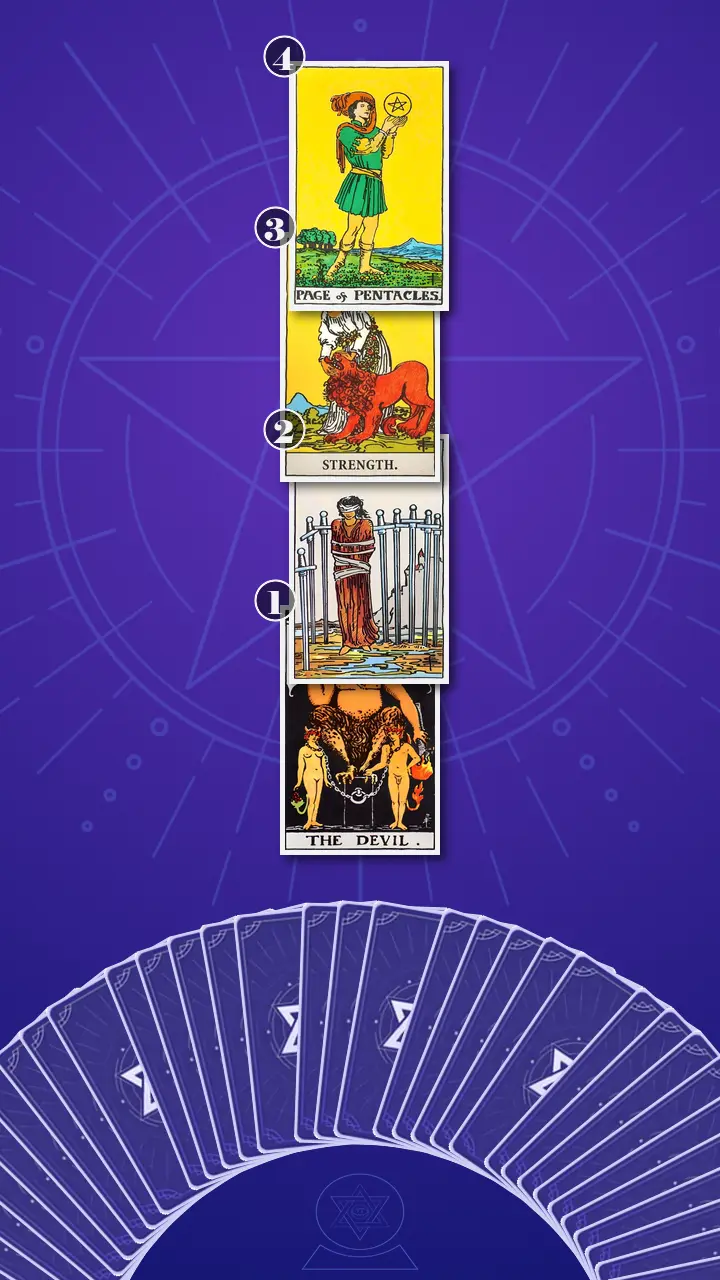
Reading the Map: From Appetite to Attention
Position 1: The Autoplay Chain
Now I turned over the card representing the observable current pattern identified in the diagnosis: reaching for quick comfort when a valued study task became effortful. It was The Devil, upright.
In the Rider-Waite-Smith image, the horned figure is imposing, but I directed Alex's attention to the loose chains around the two people at the base. The lowered flaming torch pointed toward sensory pull, while the chains suggested an attachment that felt compulsory without being completely unexamined. The card did not call Alex bad, weak, or incapable. It showed the captive appetite: an immediate reward becoming so familiar that it began to impersonate inevitability.
The modern-life version was painfully specific. Alex opened the assigned PDF after a retail shift, reached the first demanding paragraph, and told themself, 'I only need a few minutes of relief, and then I will start.' The phone warmed their palm. Reels supplied moving images, messages supplied a socially acceptable interruption, and a snack supplied something easy to finish. The study task remained physically untouched while the recommendation algorithm optimized for the next thirty seconds and ignored what Alex wanted from the semester.
That is the excess in this upright Devil: immediate sensory relief had more force in the present moment than the distant value of learning. The block was not comfort itself. Alex might truly need food, rest, or a message answered. The block was the unexamined transition in which a chosen break became an automatic escape, followed by lost time and a harsher self-story. I asked, 'What promise does the phone make at the exact second the paragraph becomes difficult? And what ten-minute study action would keep the choice visible?'
Alex did not nod. First, their thumb stopped above the Reels icon. Then their eyes moved to the untouched PDF as if replaying the same evening in fast-forward. Finally, they gave a small, bitter laugh. 'That is almost too accurate. I say it is only a break, and then somehow I am asking why it is suddenly midnight.'
'I am not asking you to make comfort immoral,' I replied. 'I am asking you to separate the relief from the command. The card is describing a loop, not issuing a sentence about who you are.' Their hand moved away from the phone, though it stayed on the table. The first attachment had become visible enough to question.
Position 2: The Blindfold Called Ready
Now I turned over the card representing the hidden belief or psychological mechanism beneath the surface pattern: the fear that difficulty or imperfect performance might expose a lack of self-worth. It was the Eight of Swords, upright.
I saw the blindfold before I saw the swords. In the image, the bound figure stands in muddy ground, surrounded by upright blades, with a castle in the distance. I connected the blindfold to the rule Alex had been living by: I have to feel focused, capable, and properly prepared before I begin. The swords became rigid conditions for acceptable performance - enough time, perfect concentration, a guaranteed understanding, and no visible struggle.
Alex described the laptop screen from the night before: the course outline, twelve open tabs, an untouched lecture PDF, a blinking cursor, and a Notion dashboard that had been reorganized twice. I watched their shoulders rise as they remembered it. The reading list looked too long, so the mind declared that a shortened session had no value. Forty-five available minutes became no time at all. One paragraph was present, but the all-or-nothing rule made the first move temporarily invisible.
I asked Alex to finish the sentence that seemed to arrive before the phone: 'If I start and struggle, then maybe...' They looked down. 'Then maybe I am not capable of the work I say I value,' they said. That was the hidden mechanism. Confusion was being treated as evidence about intelligence instead of ordinary information from difficult material. The mental air around the task had become constricted before Alex had gathered any real evidence.
'Difficulty is a sensation, not a verdict on your ability,' I said. 'The question is not whether the swords are imaginary. The question is whether they are describing the whole room, or only the rules you have placed around the first step.'
Alex went quiet. Their chest tightened for a moment, and their eyes returned to the line connecting a difficult paragraph with personal ability. I waited rather than filling the silence. I wanted the distinction to arrive as recognition, not as another productivity rule. After a few breaths, Alex said, 'I keep waiting to feel ready before I let myself begin. I thought that was responsible.'
'It was probably meant to protect the quality of your work,' I said. 'But a protection can become a gate. The next card will show whether there is a way to stay near the gate without demanding that fear disappear first.'
When Strength Held the Lion
The room became unusually quiet when I placed the third card at the hinge of the ladder. Outside my window, a streetcar bell sounded once and faded. I turned over the card representing the key inner resource that can challenge the limiting pattern: staying present with discomfort through compassionate courage rather than self-punishment. It was Strength, upright.
The Rider-Waite-Smith figure did not conquer the lion by force. One hand rested gently at its jaws; an infinity symbol hovered above her head; the white robe and flower garland made the scene feel steady rather than theatrical. I explained that Strength was not a command to overpower instinct. It was a different relationship with instinct. Alex could notice the appetite for relief, acknowledge the tight shoulders and restless hand, and still keep one chosen action available.
At 9:18 p.m., the reading is still open at page one while Alex's thumb moves through short videos. The radiator clicks, the phone warms their palm, and the guilt grows because this subject actually matters to them. I watched the old bargain make difficulty sound like a verdict before the work had even begun.
Alex does not need to overpower discomfort to prove commitment; they can meet it with patient courage, like Strength gently holding the lion instead of fighting it.
For half a second, Alex's thumb hovered above the familiar app. Their breathing paused, and the expression on their face went still. Then their gaze lost focus, as if the crowded laptop and every unfinished reading from the past month had replayed behind their eyes. A small frown followed. 'But if I can choose,' they said, 'does that mean I have been doing this to myself?' I told them choice was not blame; it was the first place where a different response could become possible.
Alex loosened their grip on the phone, then noticed the change and looked almost surprised by it. Their shoulders lowered by a fraction. A breath came out in a shaky, quiet exhale, and the hand that had been ready to scroll settled beside the card instead. Their eyes grew bright, not with a dramatic release, but with the sting of realizing how much effort had gone into defending against one difficult paragraph. The old impulse was still there. That mattered. Strength was not promising its disappearance. It was showing that an urge could be present without choosing the next screen.
I asked, 'Now, using this new view, can you remember a moment last week when this distinction might have made the evening feel different?'
Alex thought of a Sunday night when they had closed an article after one confusing sentence and spent an hour searching for better study systems. 'I could have said, This feels exposing, and I only need to stay for ten minutes,' they replied. The sentence sounded fragile, but it had edges they could hold.
The Audit of What the Rule Actually Yields
At that point, my old Wall Street habits supplied a useful professional echo. I remembered staring at a high-stakes thesis where every assumption had been tested for its strategic yield. I brought in my signature lens, Academic ROI Auditing, and made clear that I was auditing the study strategy, never Alex's worth or the value of their degree.
'Let us evaluate the return on the rule that you must feel ready before you begin,' I said. 'What does that rule actually produce? It promises better work, but its measurable yield is often zero completed paragraphs, more avoidance, and a larger fear of returning. The ten-minute start has a better immediate return: it produces evidence. It tells you what the material asks, where the confusion is, and whether another ten minutes makes sense.'
This was the bridge I wanted Strength to make. Academic ROI Auditing did not turn learning into a cold transaction. It gave Alex a neutral way to inspect the strategy that had been consuming their attention. The question shifted from Am I disciplined enough? to Is this response helping me participate in the work I value? The answer could be gathered through experience, one small study block at a time.
I named the emotional movement plainly. Alex had started with conflicted guilt, automatic relief-seeking, and the fear that performance would reveal inadequacy. Strength offered the first step toward grounded self-trust: discomfort could remain a temporary signal while curiosity entered the room. It was not a solved semester. It was the moment Alex stopped treating the feeling of difficulty as evidence that they should leave.
Position 4: The Page's One-Object Start
Now I turned over the card representing the practical way to embody the insight and integrate it into daily life. It was the Page of Pentacles, upright.
The Page held one pentacle at eye level with both hands, standing on green ground while distant mountains waited beyond the field. I read this as devoted beginner energy: not instant mastery, not a heroic burst of motivation, but sustained attention given to one real object. The Page did not need to understand the whole mountain before examining the coin in front of them.
I connected it to a scene Alex could perform without redesigning their life. They would place the phone across the room, open one assigned section, define completion before starting, and set a ten-minute timer. The task could be pages 12-14, one practice problem, one lecture timestamp, or one paragraph with a question marked beside it. At the end, Alex would write one sentence: I understood..., I noticed..., or My next question is...
'Your first ten minutes do not have to prove your future,' I said. 'They only have to become real participation. If the timer ends and you are hungry, depleted after work, or genuinely distressed, you can meet that need. If you want to continue, continue. If you want the break, choose it. The point is that comfort comes after a small start as a conscious option, not as a verdict on whether the subject matters.'
Alex imagined the phone across the room and made a small movement with their hand, as though placing it there. Their face did not become suddenly confident. Instead, their attention narrowed in a useful way. 'Pages 12-14 is less frightening than study for the midterm,' they said. 'It is almost embarrassingly small.' I told them that small was exactly why it could produce evidence.
From the Reading to a Real Study Start
When I gathered the four cards into one story, I saw a system rather than a character flaw. The accumulated quick-comfort loop began whenever valuable study became physically and mentally effortful. The Devil named the immediate relief of the phone, the snack, or the low-stakes setup. The Eight of Swords showed the hidden readiness rule that made anything less than a perfect session seem useless. Strength changed the relationship to the urge. The Page of Pentacles gave that change a stable surface: one visible task, one bounded period, one piece of evidence.
The core metaphor was a locked study door beside a brightly lit shortcut. Alex had been standing at the door and assuming that the shortcut's brightness proved something about their values. The cards suggested another explanation: the shortcut had simply been optimized for the next thirty seconds, while the meaningful work required several visible steps. The problem was not a lack of care. It was a narrowed field of choice at the moment the first step felt personally exposing.
I named the cognitive blind spot directly. Alex had been assuming that meaningful study should be possible without discomfort, and that the ability to work through discomfort without a reward was evidence of worth. That rule made ordinary learning friction look like an identity threat. The transformation direction was therefore not harsher discipline. It was compassionate self-regulation: notice the urge, let it exist, make a small start, and choose comfort afterward without using either the study block or the break as a grade on the self.
I also adapted a framework from my communication toolkit, the Research Sunk-Cost Audit. I normally use it when an academic research project has stalled and someone is tempted to pour more effort into it only because effort has already been spent. For Alex, I scaled the same logic down to an evening study block. I asked three questions: What is the smallest testable unit? What evidence will I record when it ends? What choice will I make with the new information?
That kept the ten-minute practice from becoming another elaborate system. Alex did not need a colour-coded dashboard, a dopamine detox, or a perfect focus playlist. They needed a neutral experiment that protected actual rest while making the first contact with meaningful coursework easier to enter.
- The Gentle Lion PauseAt the next planned study block after a class or retail shift, keep the required course material open, place the phone face down, take one ordinary breath, and say or write, I want quick relief because this part feels difficult. If the first confusing sentence appears, keep the page open for sixty more seconds and underline only the exact phrase that caused the discomfort.Implementation tip: Reduce the practice to one breath and one neutral sentence. If hunger, exhaustion, or an important message is the real need, meet it deliberately before returning.
- The One-Object Study StartBefore one study session this week, write a single completion line such as, For ten minutes, I will read pages 12-14 and mark one question. Put the phone across the room or inside a bag, open only the required PDF or problem set, and set a ten-minute timer on the laptop or a basic clock.Implementation tip: Define the task so another person could tell whether it happened. If ten minutes is too much, use five or two. A smaller completed start still produces useful evidence.
- The Deliberate Comfort ChoiceBefore the evening study block, choose one post-timer comfort option, such as tea, a snack, one saved video, or ten minutes of messaging. When the timer ends, ask aloud, Continue, switch tasks, or take the break? Then choose without grading the quality of the study block.Implementation tip: If the break is digital, set its end point before opening the app. When it arrives, make another conscious decision. A timer is a boundary, not a punishment.
I reminded Alex that the cards were not taking ownership of the outcome. I was offering a way to see the mechanism clearly, but Alex would decide whether to study, rest, ask a tutor a question, message a classmate, or stop for the night. The practical aim was not endless productivity. It was a more honest relationship with choice.

The Return That Counts
Four days later, I received a message from Alex while sunlight was moving across my desk. They had placed the phone across the room, read pages 12-14 for ten minutes, written one question about the unfamiliar term, and then taken a tea break without calling the break a failure. Later, they returned for another ten minutes because curiosity, not guilt, had brought them back.
The next morning, Alex still woke with the old thought: What if I am wrong about my ability? I heard the question in their voice when we spoke. This time, they smiled at its familiarity, opened the saved paragraph, and treated the question as information rather than a verdict. The change was quiet, incomplete, and real.
I told Alex that this was the first evidence of the journey to clarity: not a transformed personality, not a guaranteed grade, and not the disappearance of every urge to scroll. It was a return. Self-trust grows in the return, not in never drifting. Each small act of participation allowed Alex to build a relationship with learning that did not require comfort to be forbidden or difficulty to be defeated.
When the first hard paragraph tightens your shoulders and sends your hand toward the phone, it can feel safer to lose an evening than to risk letting the work say you are not good enough. I have seen that protective move clearly now, and I know that seeing it with compassion is already the beginning of finding clarity.
If the next difficult moment were only a cue for ten minutes of curious attention, what tiny piece of the work would you want to meet first?