Planning Instead of Studying Until One Reading Revealed What Came Next

The 8:15 p.m. Freeze When an Asynchronous Course Has No First Step
If you are an undergraduate in a mostly asynchronous program, you may know this version of study procrastination: the deadline is obvious, the module contains six plausible starting points, and nobody has named the first click.
I met Maya, a 22-year-old undergraduate in Toronto, over video on a Tuesday evening. At 8:15 p.m., she shared her screen with me. Friday’s deadline glowed red in the corner of the learning portal. Six module headings sat inside a colour-coded Notion dashboard, already rearranged twice, while the first recorded lecture remained paused at 00:00.
Through her microphone, I could hear the small mechanical hum of her laptop fan. Cold streetlight slipped through the blinds behind her, striping the bedroom wall. She turned her phone over in one restless hand; the screen was still warm from the class group chat.
“Three people replied,” she said. “One started with the reading, one watched the lecture, and one did the quiz first. So now I’m even less sure.”
I watched her cursor travel from the lecture to the article, then to the quiz instructions, without clicking. Her shoulders had risen almost to her ears. The confusion seemed to sit on her body like a packed TTC carriage at rush hour: every direction looked possible, but there was no room to move without bumping into another choice.
“The work isn’t even that hard once I’m in it,” she told me. “If someone gave me the first task, I’d probably be fine. I keep making study plans instead of studying.”
I heard the contradiction clearly. Maya wanted to study independently, but every self-chosen starting point felt like a test of whether she could be trusted to manage her own learning. She was not waiting because the work was impossible. She was waiting because choosing among several valid options felt dangerously close to choosing wrong.
So she scanned, reordered, asked the group chat, and called it preparation until preparation had used the time meant for studying.
“I’m not going to tell you that you’re lazy or that you need a more aesthetic productivity system,” I said. “I think you’re trying to protect your limited time from a bad decision. The problem is that the protection strategy is consuming the time itself. Let’s use the cards to map that loop and find a starting point you can actually own.”
Five Cards Across an Unmarked Staircase
I asked Maya to place her phone face down and take one slow breath while holding the question in plain language: “Why do I keep delaying studying when no one tells me where to start?” I shuffled slowly, treating the pause as a transition from reacting to observing, not as a mystical performance.
I chose the Five-Card Problem-Solving Spread. It was the right tool because Maya’s difficulty formed a compact, self-reinforcing system rather than a vague motivation problem. Missing direction activated fear of choosing wrongly; comparison and planning briefly restored control; the untouched material then made her feel even less capable of starting without outside direction.
This is how tarot works in my practice. I do not use it to forecast a grade or hand authority to a card. I use the images and positions as an external cognitive map, making a loop visible enough that the person sitting with me can decide how to interrupt it.
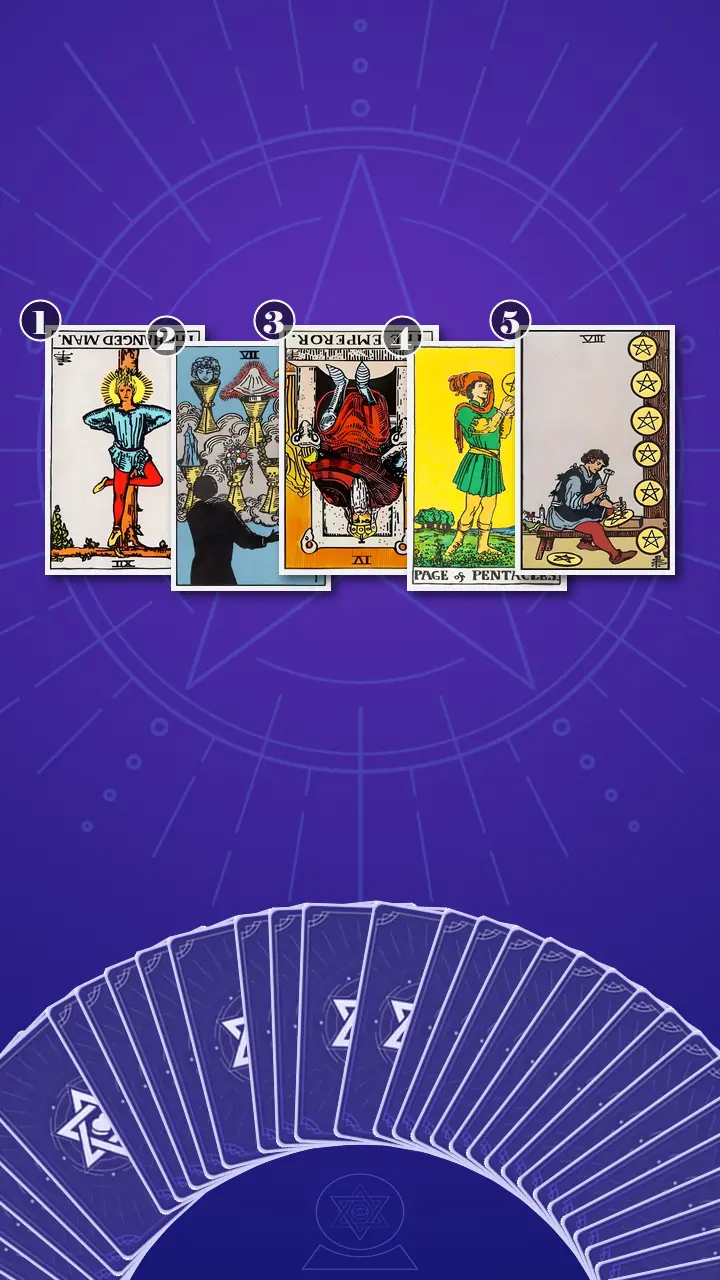
I placed five cards in a horizontal line. The first would reveal the visible delay at Maya’s desk. The second would identify what kept that delay active. The third would expose the structural root beneath it. After a slightly wider gap, the fourth would show a practical shift, and the fifth would explore how that shift could become a repeatable study process.
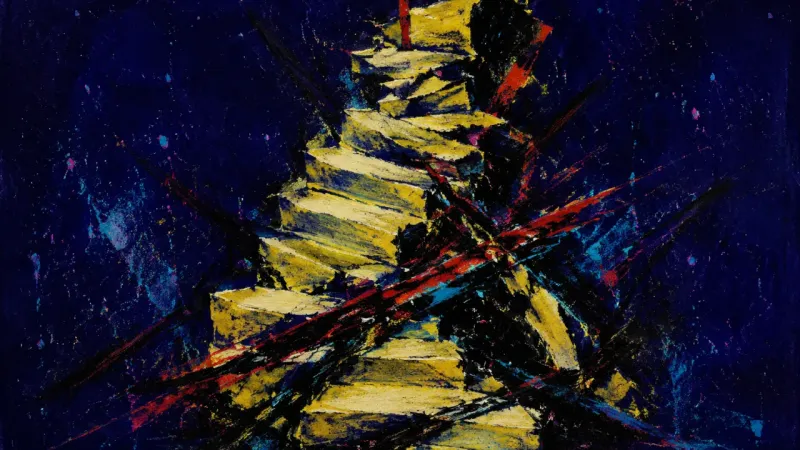
The layout resembled five stepping stones across the unmarked staircase Maya had described. We did not need to see every landing. We only needed to understand why her foot remained suspended and what could make the next step solid enough to test.
Reading the Loop Behind Planning Instead of Studying
The Hanged Man Reversed: When Orientation Becomes the Whole Session
I first turned the card representing Maya’s presenting behaviour: opening the materials, waiting for a definitive entry point, and ending the study session without completing a task.
It was The Hanged Man, reversed.
I pointed to the suspended figure, whose attention remained concentrated even though his body had no contact with the ground. Upright, this stillness can create perspective. Reversed in this position, the energy was blocked. A useful pause for orientation had stopped producing new information and become a condition Maya believed she had to complete before she could begin.
“This is your 8:15 p.m. ritual,” I said. “The weekly module is open. Your cursor moves among the readings, recordings, and quizzes. You tell yourself, ‘I’m not avoiding the work; I’m just trying to find the right way in.’ Five minutes of surveying quietly becomes forty-five minutes, even though nothing on the portal has changed.”
I did not frame the pause as a failure. Orientation is useful when it has a boundary. The blockage appears when waiting is asked to produce certainty that only contact with the material can supply.
“You are not stuck on the work,” I told her. “You are stuck on authorising the first move.”
Maya gave a short laugh, but there was no humour in it. Her fingers stopped above the trackpad, then curled into her palm. “That is so accurate it’s kind of brutal,” she said.
“Accurate does not have to mean condemning,” I replied. “We’re naming a mechanism, not assigning you a character flaw. If the mechanism is observable, it can be changed.”
Her hand loosened. She looked back at the lecture still paused at 00:00.
Seven of Cups: When Every Tab Wears a Start-Here Badge
I next turned the card representing the immediate obstacle: several plausible course resources becoming equally urgent when no sequence is supplied, so comparison replaces selection.
It was the Seven of Cups, upright.
Seven cups floated in clouds before a silhouetted figure, each holding an incompatible promise or threat. I translated them into Maya’s actual screen: the recorded lecture, assigned article, quiz page, discussion prompt, study guide, Notion dashboard, and productivity video.
“They all matter,” Maya said quietly, “so choosing one feels like neglecting six.”
That sentence captured the card’s excess. Possibility was not deficient; it had flooded the decision. Every resource appeared potentially useful, so Maya treated a low-risk study choice as a high-stakes verdict on the entire module. Evaluating all routes began to feel more responsible than testing one.
“When every task is ‘step one,’ comparison becomes the whole session,” I said. “The question is not which option reveals the perfect route through the course. The useful question is which option is required, concrete, and small enough to give you feedback.”
I asked her which three resources had competed most strongly the previous evening. She named the reading, lecture, and quiz. As she listed them, she pressed her fingertips briefly against the centre of her chest. Then she nodded once, slowly, as if the seven cloud-borne cups had become ordinary browser tabs she could finally see from the outside.
The card did not accuse her of lacking discipline. It showed a selection problem. More options, more analysis, and more StudyTok advice would not resolve it. The spread contained no Swords and no Wands, which mattered to me: Maya did not need another intellectual framework or a dramatic burst of motivation. She needed something grounded enough to touch.
The Emperor Reversed: The Teacher-Approved Order That Never Arrives
I then turned the card representing the structural root and underlying fear: a self-chosen starting point might be wrong, so Maya sought external confirmation or replaced it with increasingly elaborate planning.
It was The Emperor, reversed.
The stone throne looked unstable in reversal. I saw the architecture Maya expected the university to provide: one official sequence, clear time estimates, and an authorised first click. When that structure was absent, she either waited for it or tried to build a minute-by-minute timetable so rigid that one late dinner could collapse the entire week.
“This card contains both a deficiency and an overcorrection,” I explained. “The course is genuinely short on scaffolding. You are not imagining that. But because an external structure is missing, you try to manufacture total control before doing any work. Then your own plan feels illegitimate because no instructor confirmed it.”
I compared it to waiting for an admin account to approve a calendar she was already allowed to edit. The Wizard of Oz pattern was there too: the hope that an external authority might grant a capacity that could only develop through taking the journey’s real steps.
“If nobody authorised this order, how can I trust it?” I said, giving voice to the belief beneath the planning.
Maya’s breathing paused. Her eyes drifted from the card to the red deadline badge, as though she were replaying every announcement she had opened in the hope that it would contain a hidden sequence. Her jaw tightened before she spoke.
“I delete plans that would probably work because someone in the group chat picked a different order,” she said. “It makes mine feel fake.”
“That is the blind spot beginning to show itself,” I replied. “You’ve been treating official and useful as if they mean the same thing. They don’t. A temporary structure can be useful without being official.”
I was careful not to turn self-direction into a rule against asking for help. My Institutional Resource Leverage approach treats lecturers, teaching assistants, tutors, and university networks as strategic resources. The distinction is in how they are used. A bounded question such as, “I began with the reading and found this concept unclear; is lecture three the relevant prerequisite?” gathers specific information. “Please decide my first move so I cannot choose wrongly” transfers authority over the entire session.
Maya looked down at the three diagnostic cards. I could see recognition in her face, but also a small grief. The missing roadmap was real, and accepting that she could build a local scaffold meant giving up the fantasy that one more announcement might remove all uncertainty.
When the Page Held One Thing Still
The Page of Pentacles: A First Step That Produces Evidence
The room seemed to narrow around the fourth position. From Maya’s side of the call, I heard the radiator tick and, farther away, the brief bell of a streetcar. The sounds were plain and physical, a fitting counterpoint to the clouds of the Seven of Cups.
I turned the card representing the key behavioural shift: creating one temporary, concrete first task and using direct engagement with it to generate further direction.
It was the Page of Pentacles, upright, the key card and catalyst of the reading.
The Page stood firmly in a green field, holding one pentacle at eye level. Distant mountains remained visible, but he was not trying to climb all of them at once. His energy was balanced: practical curiosity, beginner’s self-trust, and sustained attention placed on one real object.
In Maya’s life, the pentacle was one required reading held full-screen while every unrelated tab stayed closed. It could also be twenty minutes of one lecture or one low-stakes practice question. The choice did not need to function as the teacher-authorised gateway to the whole module. It needed to produce a completed section, a specific question, or enough evidence to identify what should happen next.
I brought in a tool from my own work called Academic ROI Auditing. I usually use it to evaluate the strategic yield of a degree, major pivot, or expensive research direction, but here I reduced it to the scale of one study block. ROI did not mean turning education into money or grading Maya’s worth. It meant asking what useful information a bounded investment of time could return.
“Don’t ask which resource is globally correct,” I said. “Ask three smaller questions. Is it required? Can you open it now? Could twenty minutes with it reveal a knowledge gap, a prerequisite, or a next action? If yes, its academic ROI is already higher than another twenty minutes spent comparing tabs.”
The first task was not a lifelong commitment. It was closer to a small product prototype: valuable because it generated feedback, not because it claimed to be the final system.
At 8:15 p.m., six module headings sat in Notion while Friday’s deadline glowed on the portal. Maya reordered the list, checked the group chat, and felt her shoulders rise, but the first lecture still had not begun.
You do not need the whole study map before beginning; choose one concrete learning object and hold it as steadily as the Page holds the pentacle.
I let the sentence remain between us. Maya’s breath stopped first; her fingers stayed suspended above the trackpad, perfectly still. Then her gaze slipped out of focus, and I watched her replay something she had not yet named. Her eyebrows pulled together. Instead of relief, a flash of anger crossed her face.
“But doesn’t that mean I’ve been doing it wrong this whole time?” she asked. “Like, I wasted all those evenings trying to be responsible.”
“It means the strategy protected you from one fear while creating another cost,” I said. “That is different from saying you were foolish. Planning gave you temporary control when the course gave you very little structure. We are keeping that intelligence and changing where you apply it.”
Her jaw unclenched, then her shoulders lowered in two uneven movements. She released a breath that trembled at the end. Relief appeared, but so did the brief, exposed look that comes when a person realises the next choice is genuinely theirs.
“Now, using this new perspective, think back to last week,” I said. “Was there a moment when this insight could have made the session feel different?”
She remembered opening a fifty-page article, closing it because the lecture might explain it better, then opening the quiz because it might reveal what mattered. “I could have read one page,” she said. “Not because the article was definitely first. Just to find out what I didn’t understand.”
“Exactly. A first step does not have to prove that you know the route. It only has to be real enough to show you what comes next.”
This was the spread’s central emotional movement: from confused, externally directed option paralysis toward grounded self-trust in a provisional study process. It was not certainty. It was the willingness to gather evidence without demanding that the first choice prove competence or control.
I asked Maya to make the insight physical before we moved on. Within ten minutes, she wrote three lines on a scrap of paper: “Now: read pages 12 to 16.” “For: 20 minutes.” “Next visible action: ______.” I reminded her that five minutes was a valid minimum and that she could pause, shorten, or leave the experiment if the material became inaccessible or distressing. The scaffold belonged to her, including the right to adjust it.
Eight of Pentacles: Leaving Tomorrow a Starting Point
I turned the final card representing potential integration: a repeatable study rhythm in which each completed task defines the next visible action.
It was the Eight of Pentacles, upright.
A craftsperson worked on one pentacle at a bench while completed pieces remained arranged nearby. The energy was balanced and cumulative. It did not promise that Maya would suddenly feel motivated every evening. It showed how visible practice could become the structure her course did not provide.
I translated the row of pentacles into a plain study log: a date, the exact item completed, and one physical continuation point. Read pages 12 to 16. Look up the unfamiliar term. Attempt question one. Check its explanation. The course could remain imperfectly organised while the work itself created a usable local sequence.
“Think of it as a Git commit history for studying,” I said. “Each completed piece records where the work actually went. You don’t reopen the entire architecture tomorrow because tonight’s work has already left a marker.”
Maya glanced at the blank third line on her scrap paper. Her mouth lifted slightly, though uncertainty still flickered in her expression.
“So tomorrow doesn’t need a fresh map because tonight leaves the first click,” she said.
“Right,” I replied. “Leave tomorrow a starting point, not another map to build.”
The Hanged Man had shown attention without contact. The Seven of Cups had shown options without selection. The Emperor reversed had shown authority that felt unavailable unless it came from outside. The Page and Eight of Pentacles did not solve those problems through stronger willpower. They introduced earth: one bounded task, one visible result, and one repeatable continuation point.
The Three-Line Scaffold That Can Survive Tuesday
I gathered the cards into one coherent account. Maya’s course genuinely lacked a recommended sequence, so her wish for structure was reasonable. The difficulty began when that missing structure fused with the fear that a self-chosen start would waste time and expose a lack of control. Scanning and planning then created short-term relief, but the untouched material made outside direction seem even more necessary.
The spread replaced one work surface with another. Maya had been waiting for the reversed Emperor’s monumental throne to become stable and issue a complete roadmap. The cards pointed instead to the Eight of Pentacles’ modest craft bench, where structure is produced through contact, feedback, and repeated work.
I named the cognitive blind spot directly: Maya assumed clarity had to arrive before action and that more planning reduced the risk of a wrong start. In this situation, the missing information could not be planned into existence. It had to be generated by reading a page, watching a segment, or attempting a question.
“Clarity is not always the entry ticket,” I told her. “Sometimes it is the receipt from work already done.”
We turned that shift into three deliberately small next steps. None required her to become perfectly organised, and none treated productivity as a measure of personal worth.
- The One-Object Study Test Before one study session this week, choose the smallest required item you can open immediately. Close every unrelated tab, place that reading, lecture segment, or practice question full-screen, set a 20-minute phone timer, and write: “What does this task tell me I need next?” When another resource occurs to you, add it to a one-line “later” note without opening it. Tip: If twenty minutes feels unrealistic, use five minutes or one paragraph. The task is a test that gathers information, not a declaration that every other route is wrong.
- The Research Sunk-Cost Audit If Maya noticed herself rebuilding Notion or comparing classmates’ plans for ten minutes, I asked her to run my Research Sunk-Cost Audit in miniature. She would ignore the effort already invested in perfecting the plan and ask: “Has this planning produced information I genuinely need before starting?” If not, she would pivot to the three-line scaffold: “Now,” “For 20 minutes,” and “Next visible action,” using a specific verb and object such as “watch lecture three from 00:00 to 20:00.” Tip: The scaffold only has to hold the current session. If a real prerequisite is missing, use a lecturer or teaching assistant strategically by naming what you tried and asking one bounded question.
- The Next-Visible-Action Chain At the end of each study block, record the date, the exact item completed, and one next physical action in a paper notebook or plain phone note. Bookmark the next page, pause the recording at the next timestamp, or place the next practice question at the top of the document so the following session begins with contact rather than navigation. Tip: Keep the closing note to one action. Do not map the rest of the module or turn streaks into a judgement about your worth.
I made the limits explicit. These were experiments, not commands from the cards. Maya remained free to shorten a block, change an inaccessible task, ask for support, or decide that the course design required a broader conversation with faculty. The reading offered actionable advice, but the authority to use, revise, or reject it stayed with her.

A Week Later, One Tab Was Open
Six days later, Maya sent me a photo taken at 8:21 p.m. The same desk was there, but the portal and Notion dashboard were closed. One required reading filled the screen. A twenty-minute timer sat beside the laptop, and beneath Maya’s palm was the scrap of paper with its three lines.
Her message read: “I still thought I might be starting in the wrong place. I did five minutes anyway, then stayed for twenty. Pages 12 to 16 showed me that I need the lecture section on sampling next. I left it paused at the exact timestamp.”
She had not solved the semester. The course still lacked a complete roadmap, and her first thought the next morning was, “What if I chose wrong?” She told me she had smiled at the thought, opened the timestamp she had left herself, and continued.
That was the quiet proof I looked for. Tarot had not manufactured motivation or predicted academic success. It had helped Maya separate a missing external scaffold from a supposed personal failure. She created the first task, completed it, and allowed visible feedback to supply the next step. The agency was hers.
For me, that is the real Journey to Clarity: not seeing every future landing, but becoming able to place one foot on a provisional step and learn from the weight it holds.
When nobody names step one, many of us feel our shoulders rise as every option begins to look like a test of whether we can be trusted with our own learning. If that happens tonight, simply noticing the test means you are no longer fully trapped inside it.
If your first choice only had to reveal a little more of what comes next, which one reading, lecture segment, or practice question would you be curious to hold as steadily as the Page held the pentacle?