Six Study-Method Tabs Buried the PDF; One Question Brought It Back
The 38-Minute Detour of Advice-Driven Procrastination
“You sit down for a 45-minute study block and spend 38 minutes learning how to study.” I said it gently, and Jordan (name changed for privacy) gave me the exhausted half-smile of someone hearing their browser history read aloud. At 22, they were balancing lectures, a part-time campus job, TTC delays, and study windows that arrived in narrow gaps between everything else.
Jordan described one Tuesday at 8:47 p.m. in Robarts Library. Their coffee had gone cold. The fluorescent lights buzzed above a laptop warm beneath their wrists, while six tabs compared active recall, blurting, Cornell notes, Anki, and different Pomodoro ratios. Their assigned PDF was open behind them, still on page one.
“I wanted to understand one chapter,” they told me. “But first I thought I needed to work out the best method. Then the library closing announcement came on, and I had basically done nothing. I keep preparing to learn instead of learning.”
I heard the central conflict clearly: Jordan wanted learning that felt personally meaningful, yet the vulnerability of choosing what mattered kept sending them toward externally approved methods. Their frustration felt less like simple indecision and more like trying to turn a key while a dozen invisible hands kept replacing it with a newer, shinier one.
“I call this advice-driven procrastination,” I said. “That is a description of a protective loop, not a judgment of your character. You keep preparing to learn because preparation cannot expose an imperfect learner. Let us use the cards to draw a map of the loop, identify the point where it can be interrupted, and return the decision to you.”

Choosing a Map for the Crowded Screen
I invited Jordan to put both feet on the floor, take one unforced breath, and hold the question in mind while I shuffled. I treat this small pause as a change of attentional gear, not as a mystical test. It gives the nervous system a moment to arrive before analysis begins.
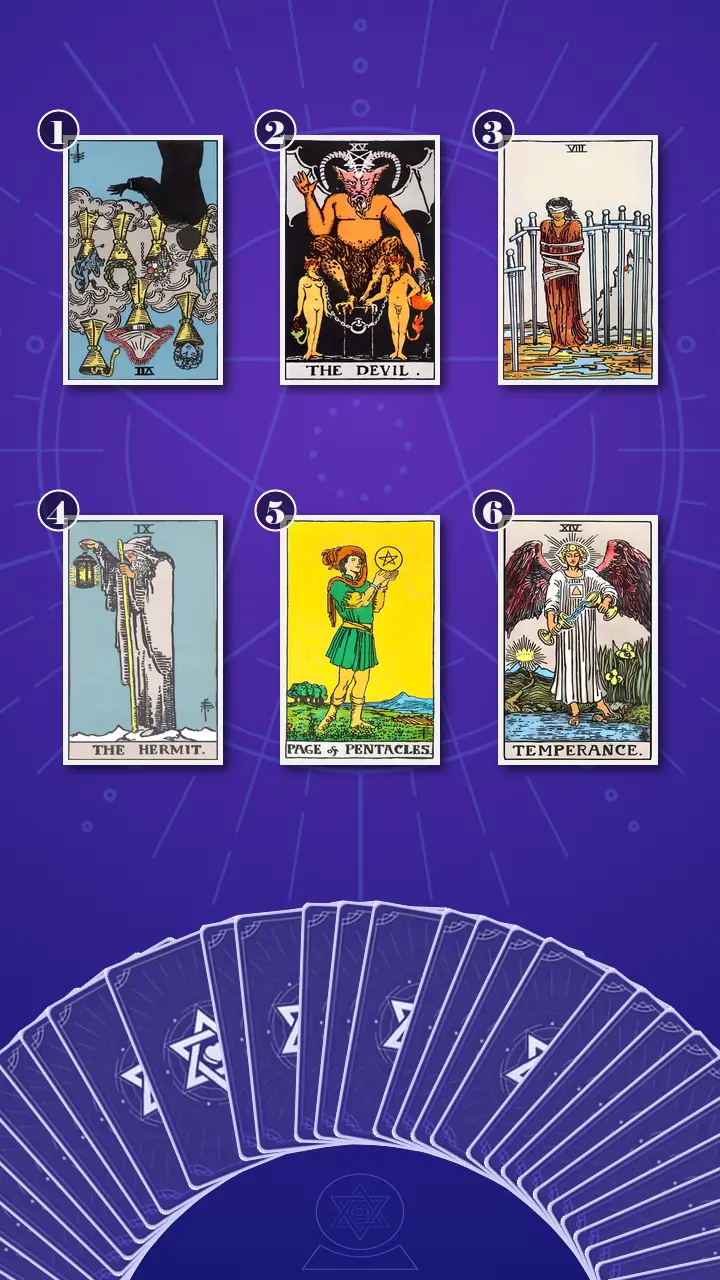
I chose the Four-Layer Insight Ladder · Context Edition, a six-card tarot spread arranged in two rows of three. I use this layout when a problem behaves like a system rather than a single decision. Jordan did not merely need to choose between flashcards and highlighting. They needed to see why comparing methods had become more rewarding than testing any method against actual learning.
The upper row would map the observable study-tip loop, the immediate psychological payoff, and the underlying belief. The lower row would reveal the catalyst, a practical experiment, and a sustainable form of integration. In other words, I was not asking the cards to predict Jordan's academic future. I was using card meanings in context to externalise a pattern that had become difficult to inspect from inside it.
I placed the cards so the first row felt close and crowded, like a browser window compressed by too many tabs. I left more space around the second row. The layout itself showed the intended movement: from overload and enclosure toward selective attention, direct practice, and measured review.
When Preparation Became the Loop
Position 1: Seven Cups in a Browser Window
“The card I am turning over now represents the observable surface loop: opening study-advice tabs, comparing methods, and postponing the actual reading or problem.” I revealed the Seven of Cups, reversed.
I pointed to the seven vessels floating in cloud. Reversed in this position, the image was Jordan at a Toronto library desk with the course PDF buried behind twelve saved resources. Active recall, Cornell notes, blurting, Anki, and time blocking each appeared to contain the missing answer. Yet because none had been tested against the material, Jordan kept filtering and refiltering until the study window ended with better-organised possibilities and no contact with the chapter.
I described this as an excess of options combined with a blockage in practical filtering. The card was not advising Jordan to reject every study tool. That would only turn overload into an all-or-nothing reset. It was asking which learning task would still matter if no creator were available to recommend a technique.
Jordan released a short, brittle laugh and looked away from the spread. “That is so accurate it is almost cruel,” they said. Their fingers tightened around the paper cup, then loosened. I let the recognition settle without turning it into shame. The missing choice was not between seven perfect methods. It was between collecting methods and touching one real page.
Position 2: The Loose Chain of “One More Search”
“The next position reveals the immediate payoff that keeps the procrastination pattern active.” I turned over The Devil, upright.
I asked Jordan to remember the second after a difficult paragraph made their jaw tighten. Their hand opened YouTube “just to check the best approach.” Confusion was immediately replaced by novelty and temporary control. Thirty-five minutes disappeared, the paragraph remained untouched, and the shame afterward became tomorrow's sales pitch for another system.
I read The Devil here as an excess of short-term relief that blocked long-term agency. The advice feed had become like an algorithm trained on hesitation: every anxious search generated more content capable of rewarding the next anxious search. But I drew Jordan's attention to the loose chains in the Rider-Waite-Smith image. The pattern was persuasive, not inescapable. The loose chain marked a repeatable choice point between feeling confused and opening another tab.
“I know I am avoiding the task,” Jordan said quietly, “but the search feels responsible.” Their shoulders lifted as they spoke, then dropped on a slow breath. I told them that this was precisely why the habit deserved curiosity rather than moral condemnation. It offered real relief, even though it charged for that relief in attention.
Position 3: The Rule Written Inside the Cage
“This position exposes the root belief beneath the visible loop: the fear that choosing imperfectly will reveal weak judgment or say something final about your worth.” I placed the Eight of Swords, upright, beside The Devil.
I translated the blindfold and surrounding swords into Jordan's actual situation. They might have 40 minutes, clear assignment instructions, and enough information to attempt a rough answer, yet decide movement was impossible until the subject felt unquestionably meaningful and the method felt correct. The observable fact was, “I do not understand this yet.” The enclosing prediction was, “If I choose badly or struggle, I will prove I cannot direct my own learning.”
This was blocked Swords energy: thought had stopped helping Jordan investigate uncertainty and started using uncertainty as a prohibition. I asked which limit was physically present and which was a rule they had written themselves.
“The deadline is real,” Jordan said after a pause. “The idea that I have to feel certain before I start is not.” Their eyes lost focus for a moment, as if they were replaying several Sunday nights at once. I nodded. “Uncertainty is information, not a stop sign. A difficult paragraph can tell you where understanding is incomplete. It cannot issue a verdict on your worth.”
When The Hermit Lit Only the Next Page
Position 4: The Catalyst of One Honest Question
The room seemed to become quieter when I reached the lower row. Rain tapped softly against the window, and a lamp beside the spread cast a narrow pool of light across the next card. “This position identifies the catalytic shift that can interrupt the competing study-advice spiral,” I said. I revealed The Hermit, upright.
I asked Jordan to picture 8:47 p.m. again: cold coffee, six method tabs glowing beside the untouched PDF, fingers moving restlessly, shoulders tight. They had arrived to learn one thing, but searching for the right way had consumed the whole window. The Hermit's lantern did not illuminate the entire course, career, or future. It illuminated the next few steps.
I explained that The Hermit represented balanced, self-directed discernment, an energy Jordan had been outsourcing to creators and systems. In daily life, it looked like closing the advice tabs without waiting for an authority to approve the perfect method, writing one meaningful question on a blank page, and spending a bounded period in direct contact with the material.
I let the lantern sharpen the reading into a single instruction: “The method is not your permission slip. Choose one honest question, meet the material directly, and let contact, not confidence, show you what matters.”
Stop using another study tip as the permission slip to begin; choose one meaningful question and follow The Hermit's lantern through a quiet, bounded study block.
For a second, Jordan did not breathe. Their fingers remained suspended above the cup, and their pupils widened slightly as they stared at the lantern. Then their gaze drifted past the table. I could see the thought travelling backward through saved videos, abandoned Notion dashboards, and rushed assignments. Their mouth tightened before their eyes began to shine.
“But doesn't that mean I have been doing all of this wrong?” they asked. The words came out sharper than anything they had said before. “I have spent so much time trying to fix myself. If I did not need the perfect method, what was all that for?”
I did not hurry to convert the anger into optimism. “It means you found a sophisticated way to protect yourself from a choice that felt exposing,” I said. “That protection cost you time, but it was not proof that you were foolish. You were trying to create certainty with the tools available. Now you can choose a tool that creates evidence instead.”
Jordan's jaw unclenched first. Then their shoulders descended, their grip opened, and a breath left them with a faint tremor. Relief was there, but so was the momentary dizziness of realising that clarity creates responsibility. No system could make the meaningful choice on their behalf. That was more vulnerable than receiving another tip, and more powerful.
“Now, with this new perspective, think back to last week,” I said. “Was there a moment when this insight could have changed how the situation felt?”
Jordan remembered a statistics paragraph that had sent them to Reddit. “I actually wanted to understand why a larger sample changed the confidence interval,” they said. “I lost that question while trying to find the best way to study maths.”
That sentence brought my own professional instinct into focus. On archaeological digs, I learned that the topmost layer is not necessarily the most important one. A trench can fill with later debris while the load-bearing structure waits beneath it. I use Academic Stratigraphy in much the same way: I separate accumulated methods, protective rules, and outside commentary until the enduring intellectual question becomes visible.
Jordan's statistics question was the underlying stratum. The videos, dashboards, and timer debates were later deposits. My Research Bottleneck Analysis also changed the meaning of the block. The spike in method-searching was not evidence of a defective student. It was a signal that a genuine question had become buried beneath high stakes and self-evaluation. The work was not to excavate the whole academic future. It was to expose one question carefully enough to follow it.
This was the first movement from restless advice-seeking toward evidence-based self-trust. I proposed a concrete test: choose one meaningful learning question, complete one bounded direct-study block with one simple method, and review the method only afterward. For the smallest version, Jordan could minimise every advice tab, set a 10-minute timer, read one relevant paragraph, and write one sentence about what had become clearer. They remained free to stop when the timer ended.
Position 5: The Apprentice Leaves Evidence
“The fifth position translates the shift into a practical one-week experiment.” I turned over the Page of Pentacles, upright.
I showed Jordan how the Page held one pentacle steadily at eye level. In modern terms, this was a basic timer, a blank page, and one question from the reading attempted before any new method research. When the timer ended, Jordan would judge the block by a concrete trace: one paraphrased concept, one worked step, one rough diagram, or one precise confusion.
The Page brought in grounded Earth energy that had been deficient in the earlier cards. Jordan had plenty of concepts about learning, but little recent evidence produced by learning. The card restored the dignity of apprenticeship. Jordan did not need to perform the identity of a polished, perfectly organised student. They needed to become an ordinary beginner in contact with one real object of study.
“So the goal is not to prove I am good at studying,” Jordan said, looking at the Page. “It is to leave the block with one piece of evidence.” I nodded. “Exactly. Let the work produce evidence before the advice produces another plan.”
Position 6: Temperance Reviews the Tool After Practice
“The final position shows how the lesson can become an ongoing practice without turning into another rigid system.” I revealed Temperance, upright.
I read the measured stream between the two cups as feedback moving between direct learning and method choice. Jordan would complete the study block first, then review the tool. They might keep the two flashcards that exposed a genuine gap, drop the colour-coding that consumed attention, and make one small adjustment instead of rebuilding the entire dashboard.
Temperance represented balance rather than prohibition. I was not asking Jordan to delete YouTube, reject StudyTok, or pretend that all advice was useless. The problem was sequence and proportion. A method could remain helpful after the material had produced a specific need. It no longer had to function as the gatekeeper to beginning.
“Keep the tool that serves the question; release the system that wants to become the question,” I said. Jordan looked across the full spread, from seven floating possibilities to one lantern, one pentacle, and two cups. Their fingertips stopped moving. The cards had not supplied a perfect system. They had made the architecture of the existing one visible.
The One-Lantern Study Block
I gathered the six cards into one coherent account. The Seven of Cups showed the visible crowd of methods. The Devil revealed why the crowd remained attractive: searching purchased temporary certainty. The Eight of Swords exposed the deeper rule that uncertainty meant Jordan was not allowed to begin. The Hermit recovered a personally meaningful question, the Page converted that question into evidence, and Temperance placed method review after practice.
The cognitive blind spot was the belief that more comparison would eventually provide the evidence that only direct study could produce. Jordan had been treating clarity as an admission requirement when clarity was more likely to emerge through contact. The transformation was therefore not from “bad student” to “perfect student.” It was from borrowed certainty to self-directed curiosity, then from curiosity to small, observable evidence.
For the action plan, I adapted my Thesis Stratigraphy Framework, which I usually use when an argument has been buried beneath disconnected notes. Jordan's meaningful question would be the bedrock. A completed paragraph, problem step, or explanation would form the evidence layer. Study tools would remain on the surface, where they could support the structure without replacing it.
- The One-Lantern BlockBefore one study window this week, at Robarts, the kitchen table, or between a shift and class, write: “What am I actually trying to understand here?” Choose the first relevant question, place the material full-screen, block YouTube, TikTok, Reddit, and productivity newsletters, and use one basic method for 25 minutes.Treat this as an experiment, not a permanent commitment. If 25 minutes feels unrealistic, use 10 minutes, one paragraph, and one sentence about what became clearer.
- The Three-Layer Practice ReviewImmediately after the block, spend two minutes recording three layers in a phone note: the question you followed, the visible evidence you produced, and one part of the method to keep, change, or drop. Make only one adjustment before the next block.Judge the session by the trace left in the work, not by how focused or impressive you felt. Keep saved study tips in a “Review after practice” folder and open it only for a specific problem revealed by completed work.
I made the boundary explicit: these were experiments, not obligations and not another productivity identity to maintain. Tarot had helped us inspect the pattern from a little distance. It could not choose Jordan's question, complete the paragraph, or determine what deserved their continued attention. That authority remained with Jordan.
A Week Later, Pencil Marks on the Page
A week later, Jordan messaged me from Robarts. They had completed one 25-minute block and paraphrased a stubborn statistics paragraph. Their first morning thought was still, “What if I am doing this wrong?” This time they smiled, reopened the page, and started anyway.
The screenshot they sent was visually unimpressive: one question, several crossed-out sentences, and a rough explanation in their own words. That was precisely why it mattered. The proof was not an aesthetic dashboard or an academic comeback montage. It was direct evidence that confusion could be encountered without immediately outsourcing judgment.
I thought of the reading as a Journey to Clarity, but not because the cards had removed uncertainty. Jordan had moved from method-focused overanalysis toward calmer commitment by making one imperfect choice and allowing the work to answer back. The cards provided the map; Jordan took the step.
I know how common the moment is: the page that matters is open, the hand still reaches for another study tip, and the tightness in the shoulders carries the fear that one imperfect choice might say something final about personal worth. Clarity is not always the final answer. Sometimes it is the first thinning of the fog, when one honest question becomes visible beneath all the accumulated advice.
If you let one honest question become The Hermit's lantern for the next 25 minutes, what would you be curious to learn from the page before anyone else told you how?