Three Note Templates, a Paused Lecture, Then One Task Carried to Done

The 8:10 p.m. Tab Spiral
I recognized the pattern immediately: if you are a Toronto university student fitting coursework around retail shifts and a shared kitchen table, solo-study procrastination may look less like doing nothing and more like spending forty minutes building the perfect way to begin.
Alex (name changed for privacy) sat at the kitchen table at 8:10 p.m. on a Tuesday, with a lecture paused on its opening slide, three note templates open, and a freshly colour-coded weekly plan beside the laptop. The fluorescent light buzzed above us, the laptop fan whirred against the quiet apartment, and cold tea pressed against Alex's wrist whenever their restless hand reached for another tab. I watched their shoulders creep upward as their fingers moved between Notion, Google Docs, and a video about active recall.
Alex looked at me and said, 'I keep preparing to study instead of actually studying. Why do I keep falling behind when I study alone?'
I heard the contradiction clearly: Alex wanted to keep pace through independent study, but every solo session became a search for the perfect method, and the assigned reading or practice set remained unfinished. To me, the frustration looked like trying to run one slow lap while repeatedly rebuilding the starting line beneath both feet. Every adjustment offered a few seconds of control, but the finish moved farther away; guilt and apprehension gathered around the untouched lecture like extra weight.
I said, 'You are not doing nothing; you are spending real effort beside the task that would count. We can look at what that effort is protecting, without turning it into a verdict about your discipline. Our aim today is simple: to draw a map through the loop so you can decide what to do with it.'

Choosing the Shadow Spread
I asked Alex to put both feet on the floor, take one ordinary breath, and name the question without trying to solve it first. I shuffled slowly while Alex held the image of the kitchen table, the overdue modules, and the next unfinished piece of coursework in mind. The preparation was a way to narrow attention and mark a transition from reacting to observing, not a test of belief.
I chose a classic four-card Shadow Spread. This is how tarot works in my practice: I use the images as structured cognitive prompts, then test their symbolism against observable behaviour, language, and choices. The cards do not predict whether Alex will pass a course, and they do not prove a fixed personality flaw. They help us examine a pattern from more than one angle.
This spread suits an Inner Self question because the visible performance problem is being maintained by a hidden belief and a protective control strategy. A larger spread, such as a Celtic Cross, would add external influences and future positions that could pull attention away from the specific cycle of preparation replacing practice. The four-card structure holds the sequence we need: visible shadow behaviour, hidden fear, protective strategy, and conscious integration.
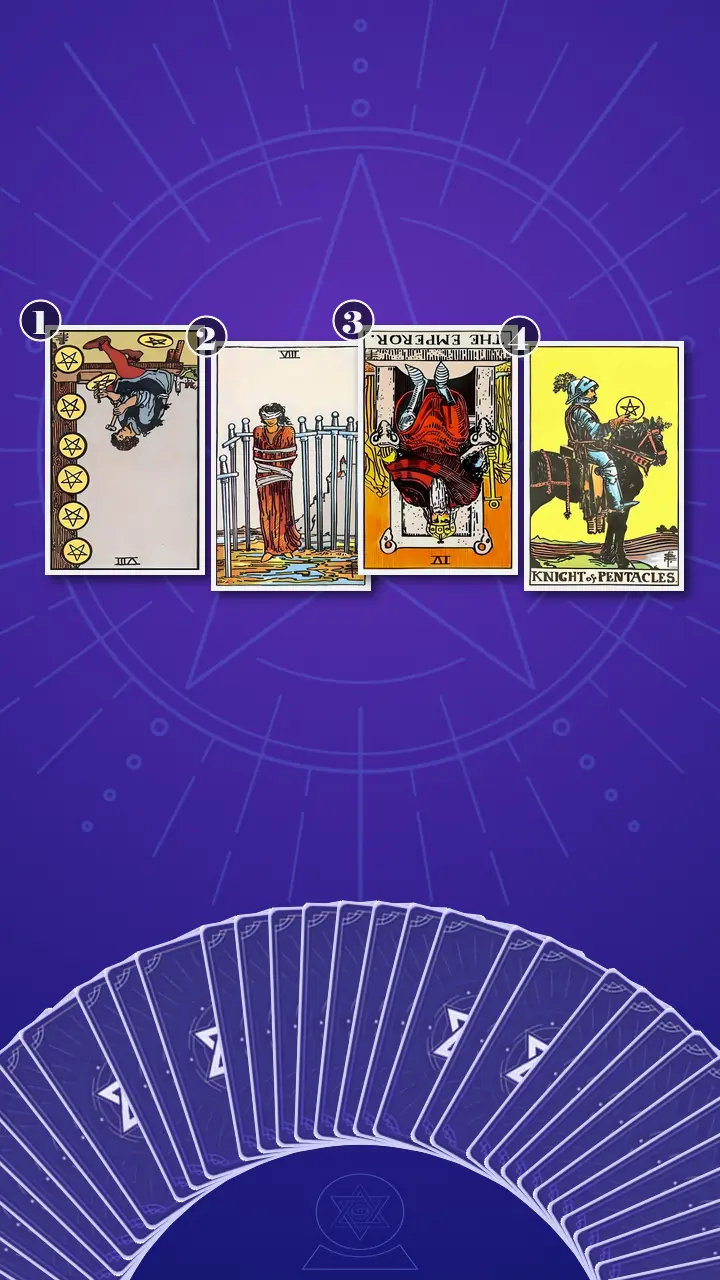
I laid the cards in a straight line, like a desk cleared one section at a time. The first position showed the diagnosis-level behaviour: reorganizing, switching resources, and ending a solo session without completing the assigned material. The second revealed the belief beneath it, especially the fear that falling behind alone proved a lack of personal control. The third examined the strategy that tried to restore control through rigid planning. The fourth pointed toward a grounded practice that could turn insight into repeatable action.
The Workbench Before the Work
Position 1: The Polished Workbench
Now I turned over the card representing the diagnosis-level behaviour: reorganizing, resource-switching, and ending a solo study session without completing the assigned material. It was the Eight of Pentacles, in reversed position.
The RWS craftsperson is bent over a workbench, repeating a skill with hammer and chisel while the completed pentacles line the wall. In Alex's life, the scene became a paused lecture, a beautifully formatted title page, a redesigned weekly dashboard, and three study-method tabs. Forty minutes of genuine effort had gone into improving the workbench, but no full section of the assigned material had reached completion. The distant town in the card felt important: the work was visible, but its connection to the destination of finished coursework had weakened.
Reversed, the earth energy of practice was not absent; it was scattered. Attention was being spent on setup, formatting, and method comparison instead of meaningful repetition. This is the difference between preparation and practice, and it is why productivity procrastination can feel so confusing. Alex was active, technically engaged, and still not moving the task that would count.
I used one of my diagnostic lenses here, Draft Paralysis Deconstruction. I explained that perfectionism can operate as a subconscious defence against academic criticism: if the method remains under construction, the actual attempt has not yet had the chance to look incomplete. The preparation is real, but it also postpones the vulnerable moment when the work itself can be evaluated.
I asked, 'When you tell yourself, I am technically working, so why is nothing getting finished, what would count as the first meaningful repetition?'
Alex's fingers froze above the trackpad. Their eyes moved from the polished dashboard to the lecture still paused on slide one, as if a recent evening had begun replaying in the room. Then Alex gave a small, rueful laugh and said, 'That is exactly what I do before the work I am avoiding. It is a little cruel.'
I answered, 'I am not asking you to stop planning or making good notes. I am asking us to notice when the workbench has become a safer place to stay than the assignment itself.' Alex's hands settled flat on the table. The recognition was uncomfortable, but it did not need to become shame.
The Backlog Behind the Blindfold
Position 2: The Blindfold and the Gaps
Now I turned over the card representing the mechanism beneath the behaviour, especially the belief that falling behind alone proves a lack of personal control. It was the Eight of Swords, in upright position.
The blindfolded figure stood among eight swords, with loose bindings and visible gaps in the enclosure. I connected the image to the moment Alex opened the course portal and saw several red deadline badges at once. The screen displayed a workload, but Alex's mind converted that fact into a conclusion: 'If I cannot solve all of this, maybe I cannot manage any of it alone.' A five-page reading, one practice question, or twenty minutes of a lecture became difficult to see because the entire backlog had filled the field of attention.
The air energy here was overactive and enclosing. The restriction was emotionally real, but it was not absolute. The swords represented repeated conclusions becoming a mental structure, not an unavoidable future. I said, 'The backlog is a list of work, not a verdict on your ability to work alone.' The purpose of the card was not to deny the deadlines or pretend that one small task erased them. It was to separate the factual workload from the judgement attached to it.
Alex's breath paused. Their jaw tightened, and one hand closed around the edge of the cold mug. Their gaze went unfocused for a moment, as though they were back on the Line 1 train after a retail shift, seeing three approaching deadlines and a classmate's completed-assignment message. Then they looked at the open space between the imaginary swords.
I asked, 'When the whole backlog cannot be controlled tonight, which single option is still available?'
Alex did not answer immediately. After a long exhale, they said, 'I could read five pages. But that feels almost insulting when there are three deadlines.'
I replied, 'The size of the action is not a statement about the size of the responsibility. It is a temporary focus boundary. You are not pretending the other work does not matter; you are choosing one place where agency is still visible.'
When the Timetable Turns to Armour
Position 3: The Stone Throne That Cannot Bend
Now I turned over the card representing the defence strategy and blind spot: the attempt to restore control through increasingly rigid plans before doing the work. It was The Emperor, in reversed position.
The upright Emperor can offer order, boundaries, and dependable authority. Reversed, that structure becomes brittle. I saw Alex on a rainy Sunday at 4:18 p.m., assigning every remaining hour a task, adding app blockers, and writing rules for every possible distraction. When a housemate needed the kitchen table for dinner and the start moved back by twenty minutes, the timetable became unusable. Alex erased the whole plan and began rebuilding it instead of using the remaining window.
The stone throne and the concealed armour made the protective strategy clear. The exact schedule was armour: hard enough to feel authoritative, but too rigid to move with an ordinary shift change, commute delay, shared-space interruption, or tired evening. Structure was present in excess, while flexibility was blocked. The short-term payoff was a brief feeling of command. The long-term cost was that one late start appeared to cancel the entire day.
As I looked at the throne, I had a brief professional flash from my Jungian work: when uncertainty feels unsafe, a protective image can begin acting like a ruler. I did not read the Emperor as Alex's identity. I read it as a strategy that had taken authority because adaptable self-guidance did not yet feel trustworthy.
I said, 'A plan that cannot survive a late start is not reliable structure. It is a demand for perfect compliance.'
Alex exhaled and gave another rueful laugh. Their shoulders rose first, then dropped. 'It is already 7:18, so the 7:00 plan is broken and I need a new one,' they said. I could hear the precise moment the thought had converted a delay into a ruined day.
I placed my finger between the third and fourth cards, the visual hinge in the line. 'The question is not how to make the throne harder,' I said. 'It is how to keep enough structure to begin while allowing the day to remain a day.'
When the Knight Makes Progress Measurable
Position 4: The Patient Builder
The room became quieter as I reached for the final card. Even the fluorescent hum seemed to recede, and the refrigerator clicked off just as the image appeared. Now I turned over the card representing the conscious attitude and grounded practice through which the shadow could be integrated. It was the Knight of Pentacles, in upright position.
The Knight holds one pentacle at eye level. The dark horse stands firmly in cultivated fields, not charging toward a dramatic finish. I translated the image into a scene Alex could actually perform: close every unrelated tab, write one task such as watch lecture minutes 0-20 and capture three points, set a twenty-five-minute timer, stay with that unit, and record what was completed. The Knight did not ask Alex to feel motivated or to solve the entire backlog before beginning.
The earth energy that had been scattered in the reversed Eight of Pentacles returned here in a balanced form. The stationary horse was not failure or delay; it was deliberate attention. The pentacle was not a grade, a productivity screenshot, or proof of superiority over classmates. It was one voluntary commitment held steadily enough to complete.
This was the moment I used my Performance Anxiety Decoupling lens. I separated Alex's core self-worth from exam results, peer comparisons, mentor evaluations, and the visible size of the backlog. A completed interval could provide evidence about a practice, but it could not pronounce a verdict on Alex as a person. The task was data. The self was not on trial.
At 8:50 p.m., the lecture was still paused on slide one, three note templates glowed on the kitchen table, and Alex's shoulders were tight. Alex had spent real effort getting ready, yet the task that would move the work forward had not begun.
You do not need a perfect system to prove you can study alone; carry one pentacle-sized task at a time and let the Knight's steady practice become the evidence you trust.
I let the sentence remain between us for a moment. Then I gave Alex the practical form of the same insight.
You build trust in your ability to study alone by finishing small units under imperfect conditions, not by finally designing a plan you can follow perfectly.
Alex's first response was physical: their breathing stopped for one beat, and their fingers hovered above the phone as if reaching for another planning tool. The second response was cognitive: their eyes lost focus, then returned to the single blank line on the sticky note, and I could see a recent memory being replayed with a different ending - the late start, the abandoned timetable, the hour that might still have held one small task. The third response arrived as feeling. Alex's mouth tightened, the eyes grew slightly bright, and both hands slowly opened. Their shoulders lowered, followed by a shaky breath that sounded less like triumph than the release of a responsibility carried too tightly. There was relief, but also a brief, vulnerable blankness: if the perfect system was not required, the next choice belonged to Alex. The clarity did not remove uncertainty; it made uncertainty smaller and more workable.
I asked, 'Now, use this new perspective to think back to last week: was there a moment when this insight could have made you feel differently?'
Alex looked at the one pentacle in the Knight's hand and said, 'The night I spent forty minutes rebuilding the schedule. I could have just done one question. I still might have been behind, but it would not have meant I was incapable.'
I told Alex that this was the first bridge from frustrated tension, guilt, and self-doubt toward cautious relief, repeatable self-trust, and grounded confidence. The emotional transformation was not a sudden personality change. It was the first time the evidence could come from a kept, realistically sized promise rather than from a flawless plan.
A One-Pentacle Route Through the Backlog
I gathered the cards into one story. The reversed Eight of Pentacles showed real effort diverted into refining the workbench. The Eight of Swords showed the backlog becoming a closed mental room, where falling behind was interpreted as proof that independent progress was impossible. The reversed Emperor showed the attempted rescue: a brittle timetable, overloaded with rules, that collapsed under normal life. The Knight of Pentacles returned to the same practical earth as the first card, but changed its quality from scattered preparation to measured repetition.
The core contradiction was never simply a lack of discipline. Alex wanted to keep pace alone while fearing that an unfinished solo session would expose a lack of control. The cognitive blind spot was treating preparation as neutral even when it had quietly replaced practice. The key shift was from designing the ideal solo-study system to completing one predefined twenty-five-minute task before changing the plan.
I said, 'The whole backlog does not have to become your unit of action. One completed repetition can tell you more about your current capacity than another hour spent predicting the perfect week. Studying alone is becoming a trainable practice, not a test of personal adequacy.'
For the next few days, I offered Alex small experiments rather than a new identity to maintain.
- The One-Pentacle Study BlockBefore the next solo session at the kitchen table or in the library, open Canvas, D2L, or Brightspace and write one bounded task on a sticky note: read pages 42-47 and mark three key claims, watch lecture minutes 0-20 and write three bullet points, or answer one practice question. Close unrelated tabs, put the phone in a bag or across the room, and use the built-in timer for one twenty-five-minute interval. At the end, record one factual completion line.Make smallness the design requirement. On a low-energy day, use five minutes, one page, or one question. The experiment is the completed interval, not forcing yourself beyond your energy, sleep, work, or other commitments.
- The Inner-Critic Mute ProtocolBefore starting the timer, take ninety seconds to write the inner critic's prediction in one place and the factual task in another. For example, write the fear that choosing the wrong chapter will prove you cannot manage alone, then write the observable instruction: read pages 42-47. Name the prediction as a thought, not a study command, and begin the factual task without debating the thought.Do not turn the protocol into another elaborate tracker. One note, one sentence, and one interval are enough. The goal is objective, fearless focus for the next unit, not permanent silence from the inner critic.
- The Late-Start Restart RuleFor three days, choose one flexible study window, such as beginning one task between 7:30 and 8:00 p.m., instead of scheduling the entire evening in half-hour blocks. Write the restart rule beside it: if I start late, I do the minimum task from the current time; I do not rebuild today's schedule. Keep a library seat, headphones, or another shared-space option ready in case the kitchen table becomes unavailable.A plan that can survive an interruption is more reliable than an impressive plan that demands perfect compliance. The window must leave room for meals, work shifts, rest, accessibility needs, and ordinary changes in shared space.
I reminded Alex that choosing one next move did not mean ignoring the rest of the deadlines. It meant keeping the full list available while refusing to let every item compete for attention during one bounded interval. Self-trust could grow through a factual completion log: Tuesday, pages 42-47 read; three claims marked. No grade. No comparison. No performance review.

One Task in the Done Column
Five days later, I received a message from Alex: 'I watched twenty minutes of the lecture before opening Notion. I wrote down what I completed, and I did not redesign the week.' The sentence was modest, which was exactly why I trusted it. It described an action, not a promise to become perfect.
The following morning, Alex slept a full night, but the first thought was still, 'What if the next session goes badly?' Alex smiled, wrote the next one-line task, and left the kitchen table before rebuilding the schedule. The relief was real; so was the uncertainty. The new evidence simply had somewhere to go.
I do not call this a solved backlog or a permanent guarantee. I call it a quiet proof that the pattern can be interrupted. The Journey to Clarity moved from frustrated tension to cautious relief because Alex stopped asking the cards, the timetable, or another person's presence to certify their worth. The cards offered a map; Alex chose the route.
When the overdue count glows on your screen and your shoulders lock, it can feel as though choosing the wrong first task will confirm the fear that you cannot keep yourself moving without someone beside you. I hope you remember that seeing the difference between a workload and a verdict is already a movement toward clarity.
If your next solo session only had to hold one small promise rather than prove your entire discipline, what one pentacle-sized task would you be willing to place in front of you?