Delayed-Reward Study Procrastination: 18%, Then Two Real Rows Appeared
Finding Clarity at the 8:15 P.M. Progress Bar
You open an asynchronous analytics lesson at 8:15 p.m. after a full workday, check how many months remain before the qualification might help your career, and reach for your phone because one exercise feels too insignificant to count. I recognized that exact form of adult learner procrastination when Maya (name changed for privacy) joined my video call from her Toronto rental near Yonge and Eglinton.
She sat at a small kitchen table beside a half-finished dinner, with the course dashboard open at 18 percent. The refrigerator hummed through her microphone, her laptop fan climbed in pitch, and a warm phone rested under her palm while she changed the colours in a Notion study tracker. Each time the cursor passed over LinkedIn, her shoulders sank another fraction.
“I know it matters, just not enough tonight,” she said. “I keep waiting for a version of me who wants to do it. Then I see how much is left, and twenty-five minutes feels like pretending to be productive.”
What her intake form called frustrated reluctance looked, from where I sat, like wearing a wet winter coat indoors: every movement technically possible, every small task made heavier than its actual size. Maya wanted the future competence a data analytics certificate might build, but closing the lesson gave her something the distant career benefit could not provide—relief now.
“I don’t think you’re lazy, and I’m not going to use the cards to frighten you into discipline,” I told her. “A study session can be real even when it does not feel impressive. Let’s use the reading to map what happens between opening the course and closing it, then find one choice small enough to remain yours.”
Four Cards Rising Through the Fog
I invited Maya to take one slow breath and hold the question in plain language: “Why do I keep putting off study that only pays off later?” I shuffled while she noticed her shoulders, jaw, and phone-reaching hand. The pause was not a mystical test; it was a transition from reacting to observing.
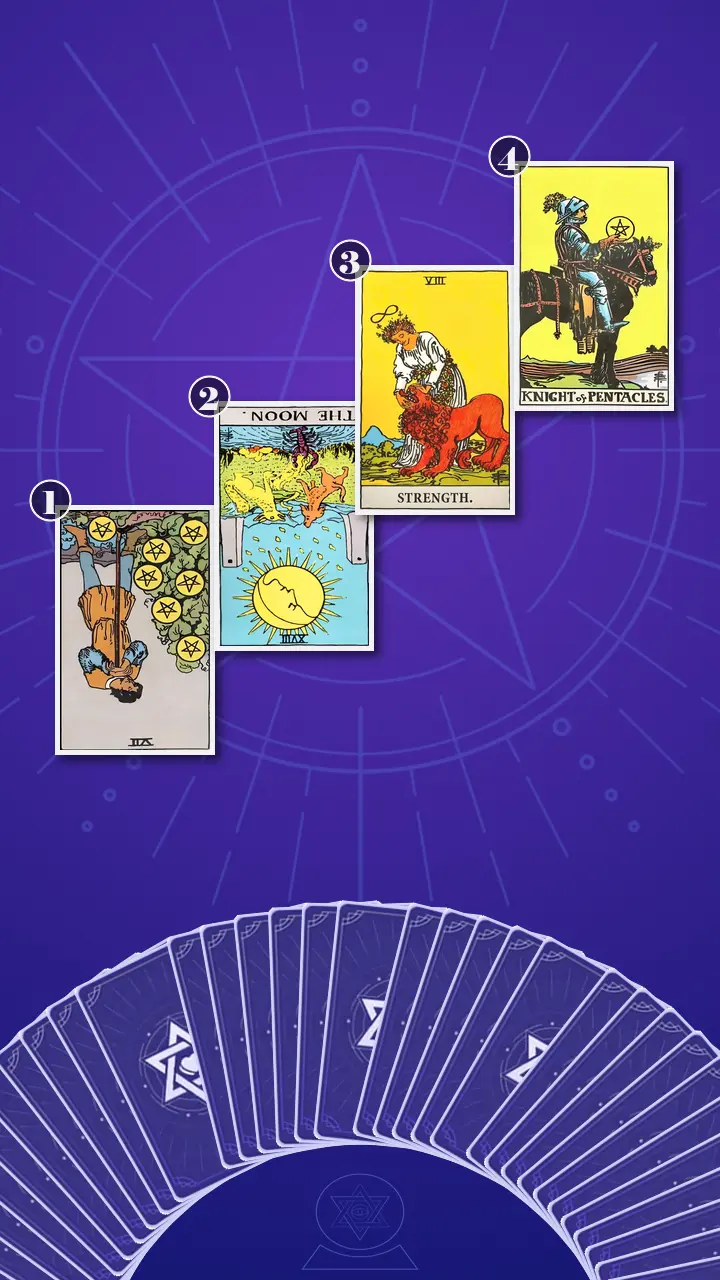
I chose the Four-Layer Insight Ladder, arranging four cards like an ascending staircase. For anyone wondering how tarot works in a situation like delayed-reward study procrastination, I use the spread as a structured cognitive map rather than a prediction. It separates a tangled experience into observable behaviour, the belief beneath it, the inner capacity that can alter it, and the practical form that change might take.
The first position would show the blockage Maya could already see: opening the lesson, measuring the distant payoff, and leaving before finishing the exercise. The second would excavate the uncertainty and control-related fear maintaining that behaviour. The third would identify the transforming quality, while the fourth would turn that quality into a repeatable study appointment. A larger spread would have added context Maya did not need; these four positions were sufficient to answer why the pattern persisted and what she could test next.
I also reminded her that none of the cards could certify that the course would lead to a promotion or even tell her that she must continue it. Their job was more modest and more useful: to make the current mechanism visible enough for her to choose how to respond.
The Digital Harvest and the Moonlit Tabs
Position One: The Harvest Under Audit
The card I turned over in the first position represented the observable blockage: what happened after Maya opened the study material, saw the distant reward, and left before completing the next exercise. It was the Seven of Pentacles, reversed.
In the traditional image, a worker pauses over a vine already carrying pentacles. Upright, that pause can support patient assessment. Reversed, the assessment has become stalled accounting. The crop exists, but because it is not ready to harvest, the worker begins treating unfinished growth as failed growth.
In Maya’s life, this looked exactly like her 8:15 p.m. dashboard ritual. She opened the analytics course, stared at the completion percentage and the months before the certificate might affect her career, then redesigned the tracker instead of attempting the assigned exercise. The vine became a progress bar: something could be developing without producing a polished LinkedIn milestone yet.
The earth energy of the card was blocked by an excess of return-on-investment evaluation and a deficiency of patient participation. Maya was not failing to value the future. She was asking the whole future to justify one small evening before the evening had produced any evidence. It was like refreshing a Google Analytics dashboard every five minutes and declaring the campaign unsuccessful before enough data had arrived.
“When you see that long module list, what do you do in the next five minutes?” I asked. “Not what the ideal schedule says—what do your hands actually do?”
Her breathing caught for a second. She looked from the card to the tracker still glowing behind our call, then gave a short laugh with a bitter edge. “I change the plan, check LinkedIn, and tell myself I’m preparing. That’s so accurate it’s almost rude.”
I smiled, but I did not soften the point into a motivational slogan. “The card is not accusing you. It is locating the exact moment when evaluating the investment replaces making it. Do not audit the harvest while the next exercise is still open.”
She rubbed the rim of her water glass and admitted that one missed session often led to a planned four-hour weekend catch-up block. That overcorrection was the same reversed card in a louder form: if a modest unit seemed too small to count, only an exhausting marathon appeared serious enough. Halfway through, depletion supplied fresh evidence that studying was punishing.
Position Two: The Path Google Cannot Fully Light
The card I turned over in the second position represented the root mechanism: the belief that effort might be unsafe or pointless when its value could not be verified immediately, along with Maya’s fear that she could not control whether sustained work became worthwhile. It was The Moon, reversed.
The Moon’s winding path is visible only in sections. The distant towers mark a passage, but they do not offer a guarantee about what lies beyond it. Reversed, the uncertainty can turn inward, becoming a private demand for complete visibility before movement.
For Maya, the modern version was a browser filled with LinkedIn posts, Reddit threads, salary ranges, course reviews, and certificate-versus-degree debates. When she could not see a reliable line from tonight’s beginner exercise to a future analytics role, she searched for enough certainty to make the effort feel safe. The next course section was already available, but she kept asking the internet to illuminate the entire career path.
This was unsettled water held in a blockage: an excess of certainty-seeking disguised as useful research. The card did not say Maya had chosen the correct course, and it did not ask for blind faith. It asked her to distinguish a genuine information need from the moment research became an exit from direct experience.
“What exact uncertainty are you trying to settle before you give the course another evening?” I asked.
She pressed her lips together. Her eyes moved briefly toward the dark window, where the kitchen light reflected her own face over the Toronto skyline. “I want to know it’ll be worth it,” she said. “If I put in all these hours and nothing changes, then I gave up evenings I could have enjoyed. Other people already have proof they’re moving.”
There it was: beneath the apparently rational calculation sat the fear of investing without control over the return. The course percentage was not merely a number. It had become a request for reassurance that no dashboard could provide.
“You are not waiting for motivation; you are waiting for proof,” I said. “But the proof you’re demanding belongs to a future job offer, while the task in front of you can only produce a solved problem, a short summary, or a completed quiz. Those are different scales of evidence.”
Her jaw tightened before it released. She closed one of the course-review tabs behind our call. I made sure she heard the boundary as well as the challenge: “Research is allowed. Leaving the course is allowed. Changing direction is allowed. The Moon only asks whether you want uncertainty to make every small decision on your behalf.”
The phone, I told her, was offering relief—not a verdict on her future. Closing the lesson removed discomfort for a few minutes, and that immediate release trained the next evening’s escape. It did not prove that she lacked ambition or that the qualification was pointless.
When Strength Placed a Hand on the Lion
Position Three: Resistance Without a Fight
As I reached for the third card, the laptop fan on Maya’s side quieted. On my table, the edge of the card caught the amber light from my desk lamp, and the room seemed to narrow around the next turn in the staircase. This position represented the key transformation from punitive motivation and certainty-seeking to compassionate self-regulation during one small unit of study.
I turned over the reading’s central card and antidote: Strength, upright.
I directed Maya’s attention to the woman’s hands resting calmly around the lion’s mouth. The image was not a victory pose after combat. The lion had not been shamed, injured, or erased. Its force remained present, but it was held in relationship with a steadier kind of power.
In Maya’s evening, Strength looked like noticing her thumb move toward Instagram, naming the impulse as “I want relief,” putting the phone in her tote, and setting one short timer for one assigned exercise. She did not need to insult herself, summon a heroic mood, or prove that she could endure four hours. The urge to leave could be present without being in charge.
For an instant, the card took me back to an archaeological trench where an impatient trowel kept striking a hard seam of clay. The seam had not meant the site contained nothing; it had told us that the method and scale of excavation needed to change. That memory sits at the heart of what I call Research Bottleneck Analysis: a creative or intellectual block is not automatically a personal failure. It is information about where the current process has become too narrow, too forceful, or poorly scoped.
Maya’s bottleneck was not a lack of intelligence or concern for her future. It was an oversized proof threshold. Before one exercise could begin, it had to justify an entire certificate, career pivot, and set of sacrificed evenings. Strength reduced the opening: one question, one timer, one tolerable encounter with uncertainty.
As I described the calm hands at the lion’s mouth, I could see Maya translating the card into another demand: be stronger, try harder, never reach for the phone. The old trap was quietly trying to recruit the new insight and turn compassionate regulation into another test of character.
I stopped before that interpretation could harden. “The payoff does not have to feel real tonight,” I said. “The practice only has to leave one piece of evidence behind.”
You do not need to overpower your resistance; guide it into one manageable repetition, just as Strength guides the lion without violence.
For one beat, Maya’s breathing stopped; her right hand, which had been resting over the phone, froze with two fingers lifted. Then her focus moved past the card and toward the dark kitchen window. I watched recognition arrive not as a smile but as a replay: last Wednesday’s timer, the tracker, the lesson she had closed before attempting the first question. Her pupils widened, and a line appeared between her brows.
“But doesn’t that mean I’ve been doing it wrong this whole time?” she asked, sharper than before. Her eyes shone, partly angry and partly hurt. I told her that replanning had not been stupidity; it had been a fast way to reduce uncertainty. We did not need to prosecute an old protection in order to choose a better one. Her fist loosened against the tabletop, then her shoulders dropped. A long breath left her, followed by a small, unsteady laugh—the relief of setting down a weight and the brief dizziness of realizing that the next choice would now be hers.
I asked, “Now, with this new perspective, think back to last week. Was there a moment when this insight might have made you feel different?”
She remembered opening a data-cleaning exercise on Wednesday, seeing a formula she did not understand, and checking course reviews within seconds. “I could have said, ‘I want relief,’ instead of ‘This course is probably useless,’” she replied. “Maybe I could have copied the first question onto paper before deciding whether to stop.”
That distinction mattered. Strength did not promise that she would continue for twenty-five minutes every time. It restored the ten seconds in which she could name the urge, reduce the task, choose one more question, or make a deliberate exit without self-insults. This was compassionate self-command in practice: resistance remained real, but it no longer had to become a judgment of her worth.
I asked her to imagine a ten-minute experiment. She would open the assigned exercise, write the first question on paper, and then decide whether to continue toward the full twenty-five-minute unit. When she stopped, she would record whatever existed—one attempt, one note, one answer, or one point of confusion. If the task felt unsuitable or too activating, she retained the right to close it deliberately. A smaller experiment was still evidence.
This was the reading’s decisive emotional movement: from auditing the distant future and fleeing into immediate relief toward calm, repeatable study that could create grounded confidence through visible evidence today. It was not certainty. It was the first workable form of trust.
Position Four: One Pentacle, One Finished Unit
The card I turned over in the fourth position represented practical integration: a predefined twenty-five-minute study unit, a consistent start cue, and one recorded piece of evidence after completion. It was the Knight of Pentacles, upright.
The Knight sits on a stationary dark horse and holds one pentacle at eye level. I explained that the stillness was not stagnation. It was deliberate pace. Behind the Knight, the field had been cultivated through ordinary repetition rather than spectacle.
In Maya’s life, the card became a specific scene: she would begin at the same evening cue, place her phone outside reach, open one assigned analytics exercise, and finish or deliberately close that unit before reconsidering the wider plan. Afterward, she would log a solved problem, three-line summary, completed quiz, or unresolved question in Google Sheets. The single pentacle was today’s artifact.
The Knight restored balanced earth after the Seven’s blocked earth. The Seven looked at an entire harvest and asked whether it was enough; the Knight held one responsibility and completed it carefully. The question shifted from “Does tonight matter enough to transform my career?” to “Can I carry this one practical commitment to its honest stopping point?”
“What exact unit could you put in front of the Knight this week?” I asked.
Maya glanced at her dashboard rather than the full tracker. “The five questions in the data-cleaning practice,” she said. “Not the whole module. Just those questions, and I could log whichever ones I actually finish.”
Her voice was quieter, but it no longer had the compressed sound of someone negotiating with an impossible weekend. I heard the inner sentence forming before she said it: “I don’t have to prove the whole future tonight. I only have to finish this unit.”
The spread ended where useful tarot should end—not with a command from outside her life, but with an action she could accept, adjust, or decline. The Knight offered a protocol. Maya remained the person who would decide whether it fit.
The One-Pentacle Study Protocol
I gathered the four cards into one story using my Academic Stratigraphy approach. On an archaeological section, scattered finds make sense only when their layers and relationships are preserved. I read Maya’s pattern in the same way: the visible surface was progress-bar auditing; beneath it lay uncertainty about whether effort would pay off; Strength formed the stabilizing layer of compassionate self-command; and the Knight provided a usable floor of routine and evidence.
The history mattered too. After full days spent responding to other people’s priorities, Maya arrived home with limited energy and no urgent course deadline. Closing the study tab reduced pressure immediately. The habit loop began to behave like a recommendation algorithm trained by her clicks: discomfort led to the phone, the phone supplied quick relief, and each successful escape made the same option easier to serve the next evening. That loop explained the behaviour without turning it into a character flaw.
The spread’s elemental movement reinforced the same conclusion. Blocked earth in the reversed Seven wanted measurable return. The Moon’s unsettled water could not guarantee it. Strength introduced warm, regulated courage, and the Knight returned the energy to stable earth as a completed exercise and a visible record. No Swords card appeared. More explanation was not the missing ingredient; contained action had to create information that another evening of comparison could not.
Maya’s cognitive blind spot was subtle: she believed she was measuring progress, but she was measuring the distance to the final reward before allowing the next unit to exist. She had been digging up the seed each evening to check whether the roots were working. The more she inspected the distant outcome, the less uninterrupted time the practice received.
The transformation direction was therefore not “be more disciplined.” It was to move from outcome fixation to process stewardship: complete one predefined unit, record one artifact immediately, and evaluate the larger course only after practice has supplied direct evidence. If that evidence eventually suggested the course was unsuitable, Maya could reconsider it. The reading did not require loyalty to a path that no longer served her.
When I proposed the twenty-five-minute block, she raised a practical objection. “Some nights I honestly don’t have twenty-five minutes in me after the commute. If I miss it, I’ll turn the whole thing into another failed system.”
“Then the system must include your limits,” I replied. “Five minutes, one copied question, or a deliberate no-study evening can all belong to an honest structure. Consistency is not permission to override yourself. It is a way to make the next choice easier to see.”
I adapted my Thesis Stratigraphy Framework, which I normally use to help a core argument pierce through layers of academic clutter. For Maya, the central thesis became the one job for tonight. The working layer was a contained timer. The supporting evidence was the artifact left afterward. Progress percentages, LinkedIn comparisons, and wider career questions became material to examine later rather than debris allowed to bury the exercise.
“Make today’s proof smaller than your doubt,” I told her. Then we wrote two experiments—not rules for becoming a perfect student, but options she could test for one week.
Two Small Experiments for the Next Seven Days
- The One-Pentacle Appointment On Tuesday and Thursday at 8:20 p.m., after dinner in her kitchen, Maya will place her phone inside her work tote, open the next assigned analytics exercise, and write: “The only job tonight is the five data-cleaning questions.” She will set a twenty-five-minute timer and will not open the full module list until it ends. Tip: If twenty-five minutes feels unrealistic, begin with five minutes or one question, then choose freely whether to continue. The unit may end without a penalty block or a larger weekend catch-up plan.
- Evidence Before Evaluation Immediately after each session, Maya will add one row to a simple Google Sheet: date, unit, and evidence. The evidence can be one solved problem, a three-line summary, a completed quiz, or one clearly written point to revisit. On Friday, she will review those rows before checking the course percentage or anyone else’s LinkedIn milestone. Tip: The record documents what happened; it does not score her value. A missed session receives no red mark and no punishment—only the next available start cue.
I asked Maya to repeat the plan in her own words. “Phone in the tote, one exercise, one row of evidence,” she said. “And I’m allowed to stop when the unit ends instead of adding more work to prove I’m serious.”
That final sentence told me the insight had reached the practical layer. Strength was no longer an attractive idea on a card. It had become a boundary around the task and a kinder way to remain present inside it.
A Week Later: The Quiet Proof
Six days later, I received a message from Maya. On Tuesday she had put her phone in the tote and completed three of the five data-cleaning questions. On Thursday she had finished the remaining two, written down one formula she still did not understand, and stopped when the timer ended rather than expanding the session into a late-night catch-up block.
Her message did not announce a total personality transformation. It read: “The course is still at 18 percent, which annoyed me. But my sheet has two rows now, and those rows are real.”
That night she slept through. Her first thought the next morning was still, “What if this never pays off?” She looked at the saved exercise, smiled once, and left for the TTC.
I considered that the right kind of proof: clear but still vulnerable, modest enough to trust. The future outcome had not changed in a week. Her relationship to the present unit had.
The Four-Layer Insight Ladder had not predicted a promotion, guaranteed the value of the certificate, or supplied motivation by magic. It had exposed the layers of a reinforcement loop and shown where Maya’s agency could re-enter it. The cards provided the map; she chose the study unit, placed the phone in the tote, and created the evidence.
When the future benefit is still months away, your shoulders may tense over one unfinished exercise and your hand may close the course before you learn whether the effort will matter. Part of you may simply be trying to avoid investing deeply in something you cannot control into becoming worthwhile. Seeing that protective tension clearly does not make you weak, late, or broken. It means you are no longer standing at the very beginning of the fog.
If the future payoff could remain uncertain for now, what one “pentacle”—one solved problem, one short summary, or one completed quiz—might you let be complete simply because it leaves today’s evidence behind?