Vagueposting Instead of Healing: From Viewer Checks to Direct Support

The 12:40 a.m. Close Friends Loop: Vagueposting Instead of Direct Support
After fifteen years as a perfumer, I have learned that boundaries can be sensed before they are explained. Some scents stay close to the skin; others travel through an entire room and make everyone breathe them in. I recognised the same difference in Maya, a London junior content coordinator who could write a clean brand caption before breakfast but froze over the sentence, “I felt hurt when...” at 12:40 a.m.
In the bedroom of her shared flat, Maya typed, deleted, and rewrote a Close Friends story over a black background: “Interesting how people show you who they are.” Her phone felt warm against her palm. The radiator clicked in the quiet, and yesterday’s takeaway still left a faint salty smell in the room. She posted the line, then refreshed the viewer list six times while the journal beside her bed remained shut.
When she sat across from me, she asked, “Why do I keep vagueposting instead of healing for real? I want them to know I’m hurt without having to explain the whole thing.” She could make a feeling visible to everyone who might understand it while still avoiding the one sentence that would tell someone how to help. Her longing to be seen felt like a notification lodged behind her sternum: impossible to ignore, impossible to open.
I did not hear a fake feeling or a moral failure. I heard a real need trying to travel through a channel that could provide attention without requiring a direct request. “Your pain is real before the viewer list loads,” I told her. “We can respect the wish to be seen while looking honestly at what the post is being asked to do. Today, we’ll draw a map from the signal back to the feeling, then toward one small act of care. That is our Journey to Clarity.”
Choosing a Map That Comes Back to You
I asked Maya to place her phone face down, feel both feet on the floor, and take three unhurried breaths. I shuffled slowly while she held the question in mind, not as a request for a prediction but as a way to move from the feed’s noise into a more focused conversation.
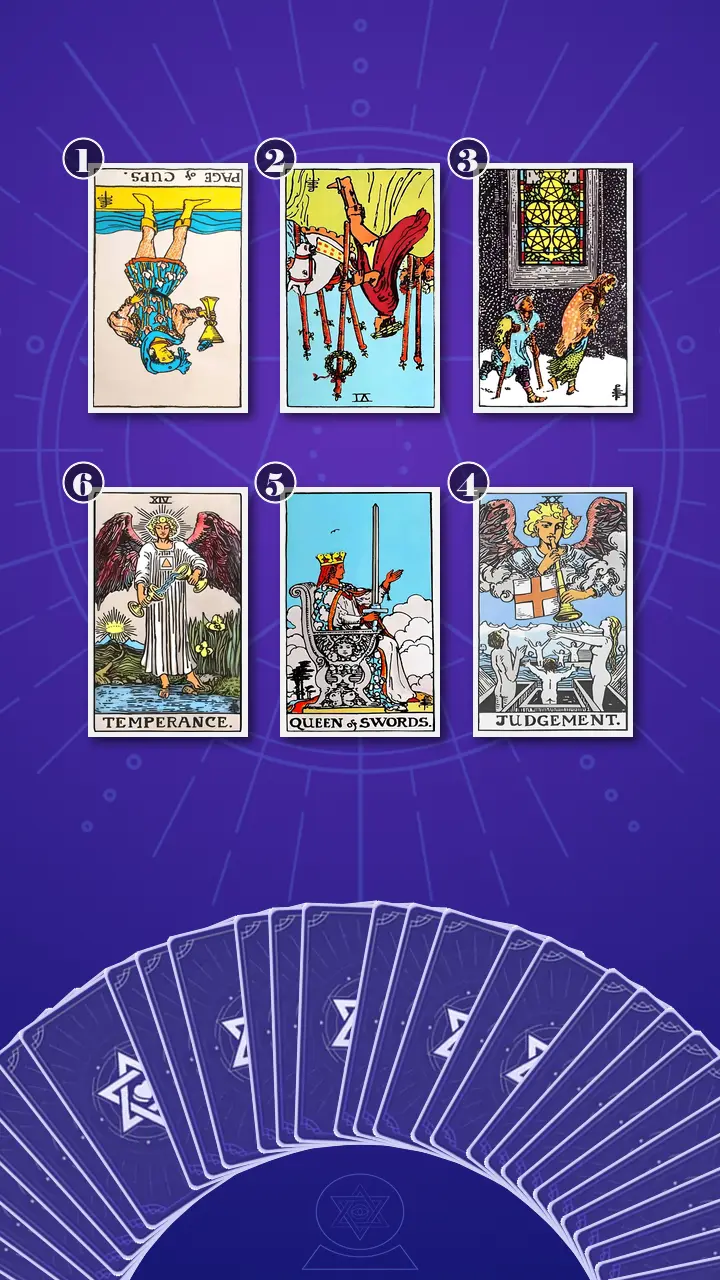
For this reading, I chose the Transformation Path Grid · Context Edition, a six-card tarot spread for mapping vagueposting, validation seeking, direct communication, and emotional integration. I chose it because Maya’s pattern was not one isolated post; it was a self-reinforcing system. A feeling became a cryptic message, the message was measured through reactions, silence was interpreted as exclusion, the resulting fallout stayed unresolved, and the cycle began again.
This is how tarot works as an objective reflection tool in my practice: the cards provide distinct positions and symbolic evidence, while the person in front of me tests those images against observable behaviour. A classic Shadow Spread might uncover a hidden need, but it would not map the public feedback loop and its replacement process clearly enough. A Celtic Cross would add more influences than this question needed. The six-card grid gives us the minimum useful route: current behaviour, active blockage, deeper root, turning point, direct action, and integration.
I arranged the cards in two rows of three. The upper row would show how the signal moves outward: the visible behaviour, the recognition loop, and the belonging fear beneath it. Directly below the root, the lower row would bring attention back: honest review, precise communication, and a sustainable rhythm. I told Maya that the fourth card was the focal hinge, not because it would dictate her future, but because it could reveal where choice had been waiting inside the pattern.
Reading the Map, One Signal at a Time
The Fish in the Cup and the Unsent Sentence
Now I am turning over the card for the observable current-state behaviour: turning an unprocessed feeling into an ambiguous public post and treating expression as if it were healing.
Page of Cups, in reversed position.
After an unanswered message or a tense conversation, Maya feels a genuine emotional wave but reaches for an Instagram lyric before opening her journal. She posts enough for the intended person to recognise themselves, keeps the meaning deniable, and checks for a response. The fish unexpectedly rising from the Page’s cup becomes that sudden wave of hurt, poured into a clever Close Friends story before the feeling has been translated into a clear sentence.
Reversed, the Page carries blocked Water. The emotion is not childish, dramatic, or invented; it is a real message trapped in an unclear container. The blockage appears when the post performs several jobs at once: it expresses pain, identifies a possible culprit, asks for care, protects Maya from having to ask, and tests whether one person is watching. Attention briefly replaces the slower work of finding out what would actually help.
Maya gave a short, bitter laugh. “That is painfully accurate. I make it specific enough for one person to recognise, vague enough for me to deny, and then I stare at the viewer list like it can answer the conversation I avoided.”
“I’m glad you said that plainly,” I replied. “The card is showing a protective strategy, not assigning you a character flaw. Before the next personal post, try asking what the message would say if it did not need an audience. Would it name an event, a feeling, a person you actually want to contact, or a response you need?”
Her fingers stopped worrying the edge of the card. She looked from the fish to the black screen of her phone, with recognition and a little embarrassment sharing the same expression.
The Viewer List as an Unstable Scoreboard
Now I am turning over the card for the immediate mechanism keeping Healing Stagnation in place: monitoring recognition and using audience response to determine whether the pain matters.
Six of Wands, in reversed position.
I asked Maya to remember 8:47 p.m. on the Northern line home from work. She had held her phone above a damp coat while the train windows blurred into dark reflections. The brakes squealed. Blue light fell across her fingers. One particular person had viewed the Close Friends story but had not messaged, and Maya’s inner monologue had run like a failing campaign dashboard: “If they saw it, why did they not reply? If they did not reply, what does that say about me?”
The laurel wreath on the rider’s head, the second wreath tied to the raised wand, and the surrounding crowd all echo visible markers of recognition. Reversed, that Fire is blocked and unstable. A view gives Maya a short lift, but a missing reply turns the same post into evidence of unimportance. She widens the audience, drafts a follow-up, or asks a mutual friend to act as an audience analyst. The crowd’s response becomes a live score for belonging, even though no metric can confirm whether a relationship is repaired.
“A reaction is data, not repair,” I said. “A view can tell you that a story was seen. It cannot tell you whether the person understands what happened, has capacity to respond, or is willing to have the conversation you need.”
Maya’s stomach dropped before she could answer. Her thumb hovered over the imaginary refresh gesture, then curled into her palm. “I’m not checking whether the post landed,” she said quietly. “I’m checking whether I matter.”
I let the silence stay kind rather than filling it with advice. “That makes sense as a search for reassurance,” I said. “It also explains why the relief cannot last. The viewer list is being asked to regulate a need it was never designed to hold. We can create a little distance from the metric without banning social media or treating public expression as inherently wrong.”
The Lit Window She Did Not Knock On
Now I am turning over the card for the belonging fear beneath Performative Vulnerability: the expectation that a direct request may expose Maya to rejection or confirm that support is unavailable.
Five of Pentacles, in upright position.
At 6:18 p.m. in the narrow kitchen of her London flat, the WhatsApp group chat had gone quiet after friends discussed weekend plans. The kettle clicked off. Rain tapped the window. The overhead light made the counter look too bright. Maya saw a friend post happily from a restaurant, felt heat rise into her face, and drafted, “Some people only remember you when it is convenient.” A flatmate was in the next room. A trusted friend was active on WhatsApp. Still, a direct question felt like knocking and hearing the door stay closed.
The Five of Pentacles brings the pattern down into Earth: a deficiency story about support, belonging, and the imagined cost of a definite answer. The illuminated stained-glass window suggests that connection may be visible without being guaranteed. I could not promise Maya that every person would respond well, and I would never use a card to promise that. The useful observation was smaller and more honest: the fear of refusal was making indirect visibility feel safer than a clear request.
“Vagueposting leaves the address off the message, then asks the crowd to find the door,” I said. “That does not mean the message is worthless. It means the people who might care are being asked to guess which door to open and what they are meant to carry inside.”
Maya’s gaze moved toward the kitchen wall, where the sound of her flatmate rinsing a mug came through the thin plaster. Her jaw tightened, then released. “If I ask directly and they say no,” she said, “I’m scared the no will become proof that I was never really part of anything.”
“A no can tell you about someone’s capacity, timing, or willingness,” I said. “It cannot measure your worth. We can practise making a consent-based request so that the answer gives you information without requiring you to hand over your entire sense of belonging.”
When Judgement’s Trumpet Cut Through the Feed
The Call Beneath the Caption
The room seemed to settle around us when I reached for the fourth card. Even the traffic outside sounded farther away. This was the focal hinge of the grid, the place where visibility could become information and information could become a chosen response.
Now I am turning over the card for the critical interruption to the vagueposting cycle: an honest review of what each post sought, what fallout it created, and which healing step it displaced.
Judgement, in upright position.
Judgement is the card of awakening, self-review, accountability, and a conscious response after a repeated pattern becomes visible. The angel’s trumpet is not a punishment bell. It is an unmistakable call to stop treating every post as a separate mystery and look at the whole sequence.
I asked Maya to open her post history as if she were reviewing a content calendar after a campaign. For each of her last three vagueposts, I asked: What triggered it? What did you want one specific person to notice? What response briefly soothed you? What private processing, support, or repair step remained undone? The point was not to prosecute the person who had wanted care. It was to gather evidence about what the strategy produced.
We could see the pattern in a single line: trigger, cryptic signal, viewer check, mixed reaction, shame, social fallout, and another signal. I mentioned The Truman Show carefully, not to shame Maya for being online but to name the difference between living as though an audience must author the truth and choosing a more self-authored inner life. Being watched can make a moment visible. It cannot decide what the moment means.
At this point, I used the diagnostic lens I know best. I call it an Aura Permeability Diagnosis. In perfumery, I notice how a scent crosses a room; in emotional work, I ask which atmosphere is crossing a person’s boundary. Maya’s attention had become porous to the feed’s crowd. Views, blue ticks, silence, and a mutual friend’s question entered her inner room as if each carried a verdict. This was Sensory Overload Management in an everyday form: too many social signals absorbed by a body already holding one unanswered need. I was not declaring an aura as a supernatural fact or predicting anyone’s intentions. I was giving the pattern a sensory name so Maya could decide what to let in.
At 12:40 a.m. in the London bedroom, Maya’s warm phone, shut journal, and six viewer-list refreshes had formed a loop that felt safer than asking who she wanted to care. She was still trying to make the right person notice first, hoping their reaction would make a direct request unnecessary.
A vague signal can make your pain visible, but it cannot tell you what the feeling needs. The shift is not from sharing to silence; it is from testing whether the crowd cares to naming one feeling and choosing one accountable act of processing, support, or repair.
Your pain does not need a public echo to become real; answer Judgement’s trumpet by naming what needs attention and taking one accountable step toward it.
For one beat, Maya froze. Her breath stopped halfway in, and her thumb hovered between the familiar Instagram icon and the Notes app. Then her eyes lost focus as though a small screen had opened behind them: the unanswered message, the black story, the unexpected view, the guarded question from a friend, the deletion, and the next caption she had nearly posted. Finally, her clenched hand loosened. Her shoulders dropped, but the release brought a faint dizziness, the vulnerable blankness of seeing a path where she had expected only fog. Her eyes grew wet. “But if I can see the pattern,” she said, voice low and unsteady, “does that mean I should have stopped it sooner?” I shook my head. “It means you can choose what happens next. Awareness is a beginning, not a demand for perfect hindsight.”
“Now use this new perspective to think back to last week,” I invited. “Was there a moment when seeing the sequence, rather than judging one post, could have helped you feel or act differently?”
Maya unlocked her phone, opened Notes instead of Instagram, and wrote three words: seen is not settled. That was the first movement from audience-driven validation seeking and indirect distress signals toward private emotional clarity, consent-based support, and intentional public sharing. The card had not taken control from her. It had returned the pattern to her hands.
The Sword With an Open Hand
Now I am turning over the card for the practical response that can give the feeling a clear channel: distinguish fact, feeling, interpretation, and request, then communicate directly in an appropriate private space.
Queen of Swords, in upright position.
The Queen’s vertical sword represents exact language. Her open left hand represents receptiveness with discernment. Together, they show that honesty does not require total exposure. Maya does not have to give every follower access to a tender situation in order to tell the relevant truth to an appropriate person.
I translated the card into a message she could actually use: “Fact: the conversation ended abruptly. Feeling: I felt hurt. Interpretation: I assumed you did not care. Request: could you clarify what happened or talk for ten minutes?” Before sending it, she could ask, “Do you have capacity for a short conversation about something that landed badly for me?” An actual yes would matter. So would a no, because consent makes the channel clearer without turning either person into a mind-reader.
Maya traced the four lines with one finger. “Direct does not have to mean exposed to everyone,” she said.
“Exactly,” I replied. “Clear communication can have a boundary around it. If the person is unsafe, unavailable, or unwilling to engage respectfully, private processing or another support route may be the wiser next step. Tarot can help identify a choice; it cannot make another person become capable of the conversation.”
Her posture became more upright, though not fully relaxed. The change was modest: less performance in her face, more attention in her eyes.
Two Cups, One Steadier Rhythm
Now I am turning over the card for the integrated state that becomes possible when the earlier insight and practical response are repeated with patience: private processing, consent-based support, direct repair, and intentional public sharing each receiving a distinct role.
Temperance, in upright position.
Water moving carefully between two cups gives healing a rhythm rather than a dramatic finish. One foot on land and one in water joins practical reality with feeling. For Maya, a difficult evening could begin with naming the feeling privately, continue with checking whether a trusted person has capacity, move toward a specific repair or clarification conversation, and only then ask whether a public post adds anything useful.
Temperance is not a command to become silent, perfectly calm, or endlessly self-contained. Public sharing can still be expression, connection, humour, art, or community. The difference is intention. A post becomes one communication option instead of the primary test of whether the pain is valid or whether belonging is secure.
Maya looked at the six cards as a path rather than a verdict. “I think I’ve been asking one story to be my journal, my friend, my apology, and a lie detector,” she said. “No wonder it keeps failing.” A small smile arrived, but it carried a trace of grief for how long she had been trying to make a crowded platform provide a private kind of care.
From Reaction Metrics to a Clear Channel
I gathered the reading into one plain story. A real wave of hurt rose first, like the fish appearing unexpectedly from the Page’s cup. The reversed Six of Wands then sent that feeling toward the crowd, turning views and replies into unstable evidence of significance. The Five of Pentacles revealed the cold assumption underneath: direct support might be unavailable, and a clear knock might produce a door that stayed shut. Judgement interrupted the loop by making the sequence visible. The Queen of Swords supplied language and consent. Temperance showed how those choices could become a repeatable form of care.
Maya’s cognitive blind spot was not that she wanted attention. The blind spot was asking visibility to perform every function at once: prove the pain was real, identify the responsible person, summon reassurance, invite repair, and protect her from the risk of asking. That is too much responsibility for one black-screen story. The transformation direction was smaller and more humane: move from broadcasting ambiguous distress to naming one concrete feeling and one direct, consent-based request in private before deciding whether to share publicly.
I explained that this did not mean replacing one rigid rule with another. The goal was not “never post about difficult feelings.” The goal was to notice the purpose of the post. Expression, connection, repair, and a reaction test are different requests. Naming which one is present gives the feeling somewhere to go before the feed starts interpreting it.
The Four-Line Feeling Request
I gave Maya three low-pressure experiments. Each one was deliberately small enough to begin during the familiar moment when her chest tightened and her hand reached for the phone.
- The Ten-Minute Four-Line RewriteOnce this week, open the Notes app after the next emotional trigger, or copy the last cryptic post into a private note. Write: “Fact: ___.” “Feeling: ___.” “Interpretation: ___.” “Request: ___.” If you want to contact someone, ask first, “Do you have capacity for a short conversation about something that landed badly for me?”If four lines feel too exposed, write only the Feeling and Request lines. The note can remain private; a direct message is optional and should go only to an appropriate person who has said yes.
- The Two-Hour Reaction BoundaryAfter any emotional story, set a two-hour timer before opening the viewer list. During the pause, write one sentence about what a reaction would change and what it would not change. A view may show that the story was seen; it cannot confirm that the relationship is repaired.Move Instagram off the first screen or use Focus mode. If two hours feels unrealistic, start with ten minutes. This is a delay on metric-checking, not a ban on social media or public expression.
- The Scent Bubble ProtocolWhen the urge to vaguepost arrives, put the phone face down and out of reach for three minutes. Feel both feet on the floor, place one hand over your sternum, notice a familiar ordinary scent such as tea, hand cream, or clean fabric, and imagine a clear bubble of air around your attention. Say, “This feeling is mine; the feed can wait.” Then label the post’s purpose: expression, connection, repair, or reaction test.This is a visualization and somatic anchor, not a claim that other people’s feelings are literally energy. If the body exercise feels activating, skip it and name one observable event, one feeling, and one hoped-for need in plain words instead.
The Scent Bubble Protocol was my way of translating Temperance into Maya’s actual nervous system. A boundary is not a wall against every outside influence; it is a chosen amount of permeability. The three-minute pause gives her enough space to notice whether the feed is helping her communicate or simply adding more sensory overload to an already crowded inner room.
This is the practical value of the six-card Transformation Path Grid: it traces the behaviour, blockage, root, trigger, action, and integration without turning any card into a sentence about who someone is forever. I use the spread to help a person find actionable advice and next steps, then I hand the authority back. The cards can illuminate the route; Maya remains the person who decides whether to pause, write, ask, repair, share, or wait.

A Week Later, the Quiet Proof
Four days later, Maya texted me: “I did the ten-minute rewrite and asked Jess if she had capacity.” She slept a full night, then woke with the familiar thought, “What if I’m wrong?” The question stayed, but she smiled before reaching for her phone.
That was enough evidence for me. Not a cinematic reconciliation, not a sudden life without social media, and not proof that every direct request would receive the answer she wanted. It was a small, clear act: she had let the feeling exist before it earned a public reaction, chosen a willing channel, and allowed uncertainty to remain uncertainty rather than converting it into another coded signal.
I think of that as the first quiet turn in a Journey to Clarity. The cards did not heal Maya, and they did not decide her relationships. They gave her a structure for seeing the feedback loop, and she used that structure to reclaim authorship from the audience. Being witnessed can soothe a moment; being specific gives the feeling somewhere to go.
When your chest is tight and your thumb keeps refreshing the viewer list, leaving your hurt in a shop window can feel safer than knocking on one door. Wanting to be seen is not the same as being ready to be known, and neither makes you wrong.
If you let one feeling be real before it earns a public echo, what small, private sentence might you want to say to yourself or to one trusted person?