When Pushback Feels Like Rejection: Holding the Original Limit

The 10:40 p.m. No That Became a Maybe
I recognized the boundary backlash immediately: Morgan, a 27-year-old customer success coordinator in Toronto, could say no clearly in a Notes app but rewrote it the moment a friend objected. I had seen that particular split before, the clean answer existing safely in private and disappearing as soon as another person's disappointment entered the room.
At 10:40 p.m. on a Tuesday, Morgan sat on the edge of the bed beneath the blue light of a phone. The radiator clicked in the quiet apartment, and the screen felt warm against their palm. A friend's message waited there: "I thought you would be there for me." Morgan's thumbs deleted a simple "I can't tonight," then replaced it with three apologetic paragraphs offering a midnight call, a rearranged weekend, and more emotional energy than they had to spare.
"I had a good reason to say no until they sounded disappointed," Morgan told me. They wanted to protect a real limit around time, money, and energy, but they feared the pushback that followed when another person challenged it. Their apprehension moved through the body like a smoke alarm wired to every typing indicator: a tight throat, shoulders braced beneath the ears, and a quick urge to answer before the other person could become more upset. Guilt and self-doubt arrived first; resentment waited until after the agreement was sent.
"Why does their discomfort feel like my emergency?" they asked.
I let the question sit between us. I have spent a decade guiding people through their personal cycles, and I do not use tarot to predict whether a friend will forgive someone or whether a relationship will survive a difficult text. I use the cards as a structured way to see what is happening before a familiar reaction takes the wheel. "You did not lose your boundary because you lacked clarity," I said. "You lost contact with it when someone else's reaction became louder than your own capacity. Let us draw a map through that moment and see where your choice can become yours again. That is our journey to clarity."

Choosing a Ladder Instead of a Verdict
I asked Morgan to place both feet on the floor, take three unhurried breaths, and name the question without trying to improve it. Then I shuffled slowly. The movement was a practical transition from reacting to observing, not a performance of mystery: a few minutes in which the nervous system could stop treating the next message as an immediate task.
"I am using the Four-Layer Insight Ladder · Context Edition," I explained. "For anyone wondering how tarot works in a question about boundaries, this spread is small enough to keep the pattern visible. It does not ask us to guess what the other person secretly means. It traces your observable response, the belief underneath it, the perspective that can interrupt it, and one practice that lets you collect new evidence."
The reason this spread fits the question is that the issue is relational but the mechanism is repetitive and internal. A larger relationship spread might invite speculation about someone else's motives. This ladder keeps the focus on the sequence that Morgan can actually change: the visible concession, the root fear, the transformative lever, and the grounded practice.
The first card would show the surface pattern: the moment Morgan abandoned a stated limit after pushback. The second would reveal the root mechanism, the belief that another person's dissatisfaction left no safe option. The third would offer the key transformation, a way to separate personal responsibility from another adult's reaction. The fourth would turn that clarity into a low-stakes experiment rather than a demand for perfect assertiveness.
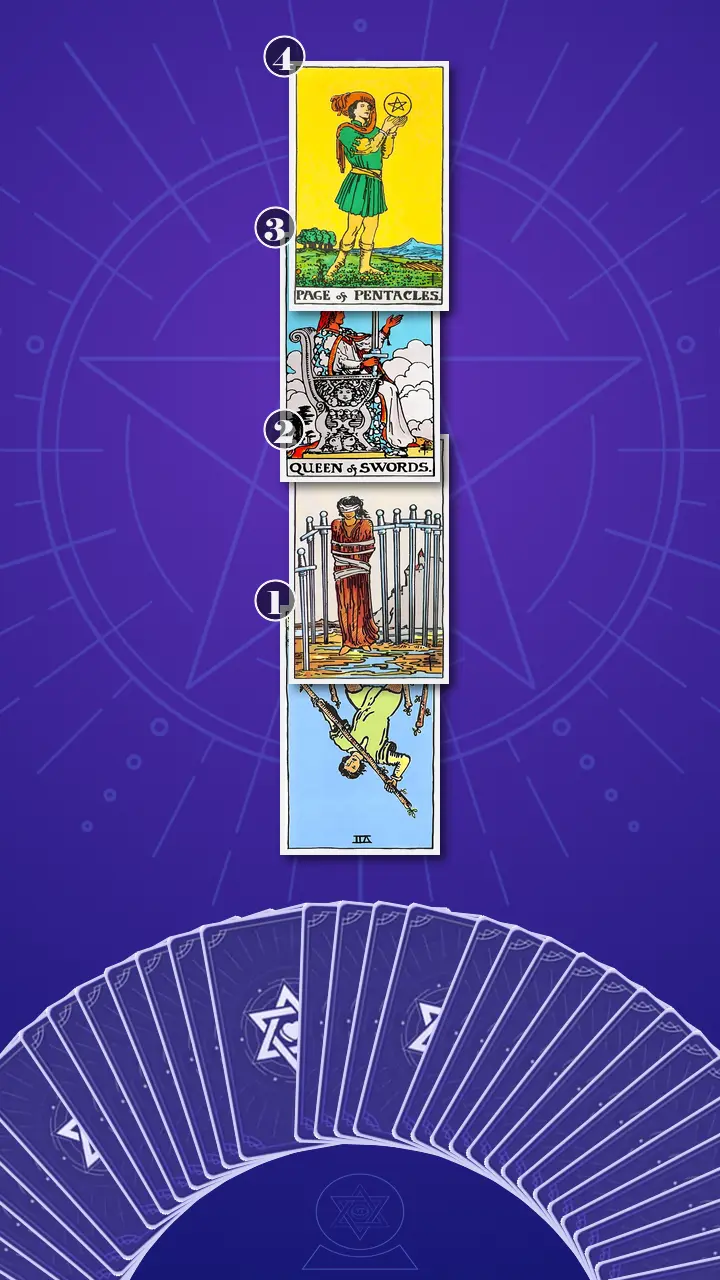
The Ground They Keep Giving Away
Position 1: The Reversed Seven of Wands
I turned over the card representing the surface pattern: the observable moment Morgan abandons a stated limit after a friend, partner, or colleague pushes back. It was the Seven of Wands, in reversed position.
In the card, one figure stands on higher ground with a wand raised against six wands rising from below. The mismatched footwear makes the stance look unstable, as if the figure has been asked to defend the hill before finding solid footing. I saw the modern version immediately: Morgan has already checked the calendar and knows they cannot take on another task or plan. Then one disappointed reply arrives, and the conversation feels like a six-against-one debate. A simple capacity statement becomes a case they have to win.
Reversed Fire shows blocked resolve rather than an absence of care. Morgan's will is present at the beginning; it loses ground when opposition appears. The energy shifts from stating "I cannot do this" to defending the right to have a limit, then to adding context, alternatives, and a fresh promise. The boundary backlash is not caused by the original no. It is maintained by the instant pushback turns a capacity decision into a referendum on whether Morgan is kind.
"I was clear until they pushed back," Morgan said. "Now I have to prove I care." They gave a short, bitter laugh instead of nodding. Their fingers curled around the edge of the chair, and their eyes dropped to the cards as if the picture had caught them mid-message.
I did not ask them to become harder. "The question is not whether you should stop caring," I said. "It is whether caring has to include surrendering the decision you already made. You can acknowledge a reaction without reopening the negotiation. In a group chat, one sad-face emoji can feel socially enormous, but it is still one reaction to one limit, not proof that the limit is wrong."
Morgan looked back at the raised wand. The first recognition was quiet but physical: their shoulders lowered a fraction, while the rest of their body remained ready to type. I let the image stay visible. Before we changed the pattern, I wanted the pattern to be accurately seen.
Position 2: The Rope That Was Never Tight
I turned over the card representing the root mechanism: the belief that another person's dissatisfaction means Morgan has no safe option except to accommodate. It was the Eight of Swords, upright.
The modern-life scene belonged to the Line 1 streetcar ride home after work. Morgan rereads an unread message from a disappointed teammate while fluorescent lights buzz overhead and the phone reflects in the dark train window. Their stomach drops. Replying now might invite more pressure; waiting might look cruel; repeating the no might risk rejection; explaining more might still fail. The options are technically present, but fear has made each one feel unavailable.
The blindfold becomes the habit of treating tone as evidence. The loose ropes become the pause button, the mute function, the right to answer tomorrow, and the possibility of repeating the original limit. The gaps between the swords matter too: the situation looks sealed, but the mind has not actually proved that there is no exit. This is constricted Air, an algorithm that keeps recommending the same worst-case interpretation until every response looks dangerous.
"If they are upset, I must have handled it wrong," Morgan said. Their voice had gone low. "If I wait, they will think I am cruel. If I explain, maybe I can make it okay."
I asked what consequence was observable and what consequence was a forecast. I also made the distinction carefully: a pause is not automatically safe in every workplace, relationship, or power dynamic, and no exercise should ask someone to ignore material risk. But in the ordinary low-stakes situations Morgan described, another adult's disappointment had become an emergency before Morgan had even checked what was actually being requested.
First, Morgan's breath stopped halfway in; one hand hovered above the phone without touching it. Then their gaze unfocused, replaying the friend text, the Slack question mark, and the long explanations they had sent before. Finally, their fingers loosened against the chair and a slow exhale moved through their chest. The release was small, but it made one overlooked choice visible: they could wait before replying.
"Their disappointment is a reaction to the limit, not a verdict on whether the limit is valid," I said. "The work is not to predict every interpretation. It is to notice when fear has taken a possible consequence and presented it as a fact."
When the Queen Cut the Courtroom Brief
Position 3: The Upright Queen of Swords
The room grew still when I turned over the card representing the transformative lever: the form of clarity Morgan needs to separate personal responsibility from another adult's reaction. It was the Queen of Swords, upright. Outside the window, a streetcar bell sounded once and faded, leaving the apartment unusually quiet around the clean vertical line of her sword.
The Queen's modern scene was a last-minute Slack request near Union Station. Morgan is sitting at a shared desk after an already full day, feeling the familiar urge to write a complete explanation of the week. Instead, they place both feet on the floor and type, "I can't take this on today, but I can review it Monday." The open hand acknowledges that the request may be disappointing. The upright sword keeps the capacity statement precise. There is no apology that turns the limit into a moral defence and no replacement favour offered to purchase approval.
This is balanced Air: thought refined into language that can carry truth without becoming cold. The Queen is not detached from feeling. She simply refuses to confuse another person's feeling with her own obligation. Her alert gaze asks Morgan to answer the actual request, not the imagined accusation underneath it. "I can be humane without making my capacity negotiable," I said.
At this point I used one of my signature tools, Cognitive Spiral Mapping. I mapped the loop in five turns: pushback, rejection prediction, courtroom-length explanation, surrendered limit, and resentment. Morgan's stuckness was not evidence that they were incapable of change. It was a compressed orbital slingshot, a phase in which the mind kept circling the same question until the pattern could be seen clearly enough to redirect its momentum.
Then I used Gravity Well Identification. The downward pull was not Morgan's friend or teammate; it was the obsolete rule that said, "If they are disappointed, I must repair the feeling before I am allowed to keep my answer." That habit had become so familiar that every new message fell into it. Naming the gravity well gave Morgan something more useful than blame: a place to stop mistaking emotional pressure for a command.
I could see the old scene returning in Morgan's mind: it was late in the Toronto apartment, the phone was warm, and a clear "I can't tonight" had already been written. Then one disappointed sentence arrived, their shoulders braced, and their own answer began to feel like evidence in a trial. The pattern was not asking for a better defence; it was asking for a different relationship to the pause.
You do not have to soften a true limit to earn connection; like the Queen of Swords, state it plainly and let her upright sword separate your responsibility from someone else's disappointment.
For a second, Morgan's thumb froze above the imaginary send button. Their pupils widened, and their gaze moved past me as if the last several over-explanations were replaying on the apartment wall. A flash of anger tightened their jaw: "But doesn't that mean I was wrong all those times?" I waited. Their fists slowly opened, their shoulders dropped, and a shaky breath left them. The anger did not disappear; it softened into grief for the energy they had spent trying to buy belonging. Then their voice steadied. "Maybe I was trying to make their reaction smaller by making my life smaller." The radiator clicked again, no longer sounding like a countdown. I placed the Queen beside the Eight of Swords and watched Morgan's hand move from a clenched fist to an open palm.
"Now, use this new perspective to recall whether there was a moment last week when it could have felt different," I invited. Morgan named a Slack request, then a Sunday voice note. They did not claim the new view would guarantee a pleasant response. They only noticed that directness and cruelty were not the same thing.
This was the key crossing in the emotional transformation: from fear-driven boundary surrender and emotional over-responsibility toward calm discernment. It was not the end of guilt, and it was not a promise about any particular relationship. It was the first moment another adult's discomfort could remain real without automatically becoming Morgan's repair assignment.
The First Small Rung into Open Air
Position 4: The Page of Pentacles
I turned over the card representing the grounded practice: one repeatable, low-stakes way to hold a concise limit long enough to collect new evidence. It was the Page of Pentacles, upright.
The Page holds the pentacle at eye level in a cultivated green field, giving it full attention while mountains remain distant. I translated that image into a small experiment: before opening a shifting group chat or a non-urgent Slack thread, Morgan checks actual time, energy, and budget, writes one realistic sentence, and observes what happens. The practice is deliberately ordinary. Boundary-setting becomes a skill built through repetition, not a personality test that must be passed during the hardest conversation.
"I keep waiting to feel confident before I use the script," Morgan said. "But maybe confidence is what I collect after I use it." They picked up their phone, opened the Notes app, and wrote, "I can't take that on this week." Their thumb still hovered over the group-chat icon, but this time it did not rush forward. I saw the Page's concentrated attention arrive before the action itself.
The sequence now had somewhere to go: blocked Fire had shown the retreat, constricted Air had shown the belief that created a no-exit feeling, the Queen had supplied clear language, and Earth offered repetition. A small boundary experiment could become the first evidence that a limit may remain humane without being renegotiated.
The Orbit Expansion Strategy
When I gathered the four cards into one story, I saw why Morgan kept asking, "Why do I abandon my boundaries when people push back?" The reversed Seven of Wands showed the visible concession: a clear limit became a debate as soon as resistance appeared. The Eight of Swords showed the root: fear translated disappointment into a prediction of rejection and made every available reply feel unsafe. The Queen of Swords supplied the missing distinction, while the Page of Pentacles made the distinction testable in an ordinary conversation.
The cognitive blind spot was not a lack of knowledge about boundaries. Morgan already knew their limits mattered. The blind spot was treating emotional repair as proof of care, then treating the temporary relief after surrender as proof that surrender had been necessary. The transformation direction was responsibility separation: I can care about another adult's feeling without taking the feeling home as a task, and I can let my capacity speak before I start performing generosity.
I used my Orbit Expansion Strategy to make that direction practical. I asked Morgan to imagine three rings rather than one crisis: the inner ring contained actual capacity; the middle ring contained the other person's request and reaction; the outer ring contained the next small action Morgan could choose. This macro view helped them see that the goal was not to escape every relationship or win every disagreement. It was to move out of the old cognitive gravity well by giving each responsibility its correct orbit.
- Capacity Before CareBefore opening one low-stakes group-chat plan or non-urgent coworker request this week, spend five minutes checking your actual calendar, energy, and budget. Write one realistic sentence, such as "I can't take this on today, but I can look at it Monday," before you enter the conversation.Choose the smallest honest example. A low-stakes beta test is enough; the goal is to collect evidence, not to prove anything about another person's character.
- The 30-Minute Boundary PauseWhen pushback arrives, mute the thread and set a 30-minute timer. Then send the original limit without adding an apology, a courtroom explanation, or a replacement offer. The minimum version is ten slow breaths followed by the same sentence.A pause is not a rejection; it is the space where your original answer gets to remain yours. If the situation involves safety, serious employment consequences, or a power imbalance, choose the communication and support that protect you rather than treating this exercise as a rigid rule.
- Facts After FearWithin two minutes after the exchange, write three notes: what you said, what the other person actually did, and what you predicted would happen. Label "They will reject me" as a prediction rather than a fact, then record only observable information.The urge to reread will be strong. Keep the log brief, close the app, and do one grounded task for ten minutes. Self-trust is built in the few seconds when guilt arrives and you do not immediately negotiate against yourself.
I reminded Morgan that another person's reaction might provide useful information about a relationship, but it would not automatically provide an instruction. The cards had not promised that everyone would respond well. They had shown that Morgan could stop making their own capacity disappear before learning what the response meant.

A Week Later, the Message Stayed Short
Six days later, I received a message from Morgan while rain silvered the windows near Union Station: "I waited thirty minutes, repeated the original no, and they were disappointed. I didn't add a second favour." Morgan had slept through the night, though the first morning thought was still, "What if I got it wrong?" This time, they noticed the thought, smiled at it, and made coffee before answering anything.
I did not read that message as a perfect ending. It was a small, bright piece of evidence: one clear limit had remained intact while another adult had a feeling about it. The journey from bracing for disapproval to steady self-respect had begun in a single pause, not because the cards had taken over Morgan's fate, but because Morgan had used the map to hear their own capacity again.
When a disappointed message makes your throat close and your thumbs rush to rewrite a clear no, it can feel safer to give away the limit than risk being seen as difficult; the resentment afterward is often the cost of trying to purchase belonging. Clarity is not a verdict handed down from a deck. It is the moment the lower rung, the upright sword, and your own lived capacity line up.
If you let one clear limit remain unchanged for the next few minutes, without explaining it into something easier for someone else, what might you notice about your own capacity as you climb from the ladder's lower rung toward the Queen of Swords' open air?