Putting Three Decisions on One Page: From Shame to Useful Data

Finding Clarity on the Northbound Line
When Jordan (name changed for privacy) joined my call on a grey Saturday afternoon, the scene they carried into the reading was from 8:47 p.m. on Line 1. They were 29, working strategy at a Toronto tech company, and had reopened a career-change spreadsheet after seeing a former colleague’s “Thrilled to announce” promotion post. On the crowded train northbound from King, fluorescent lights buzzed overhead, their phone warmed inside its case, and their jaw tightened whenever the signal dropped. They could explain why this role was uniquely complicated, yet their body recognised the decision process before they did.
“I can explain every decision,” Jordan said, pressing their thumb into the side of their mug, “but I can’t explain why the same feeling keeps coming back. I want to see the pattern, but I’m scared that seeing it will prove I can’t trust my judgment. So I guess my question is: what belief keeps me overlooking the pattern in my big decisions?”
I heard the conflict beneath the question: the desire to recognise a repeating decision pattern against the need to keep each career crossroads in a separate, defensible file. The apprehension seemed to sit inside Jordan like a train braking hard behind the ribs while the mind kept racing to the next station. I told them, “I’m not going to use tarot to declare that your past choices were wrong or predict which option you must take. We’re going to place the process outside your head, where we can examine it together. Let’s draw a map through the fog and see which rule keeps travelling with you.”
A decision can be well explained and still be shaped by an old rule.
Choosing the Ladder Out of the Loop
I invited Jordan to put both feet on the floor, take one slow breath, and notice what happened first in their jaw, chest, and hands when they pictured comparing their last three major choices. I shuffled slowly while they held the question in mind. I treat this pause as an attentional threshold, not a supernatural performance: it helps the nervous rush of decision fatigue settle enough for observation to begin.
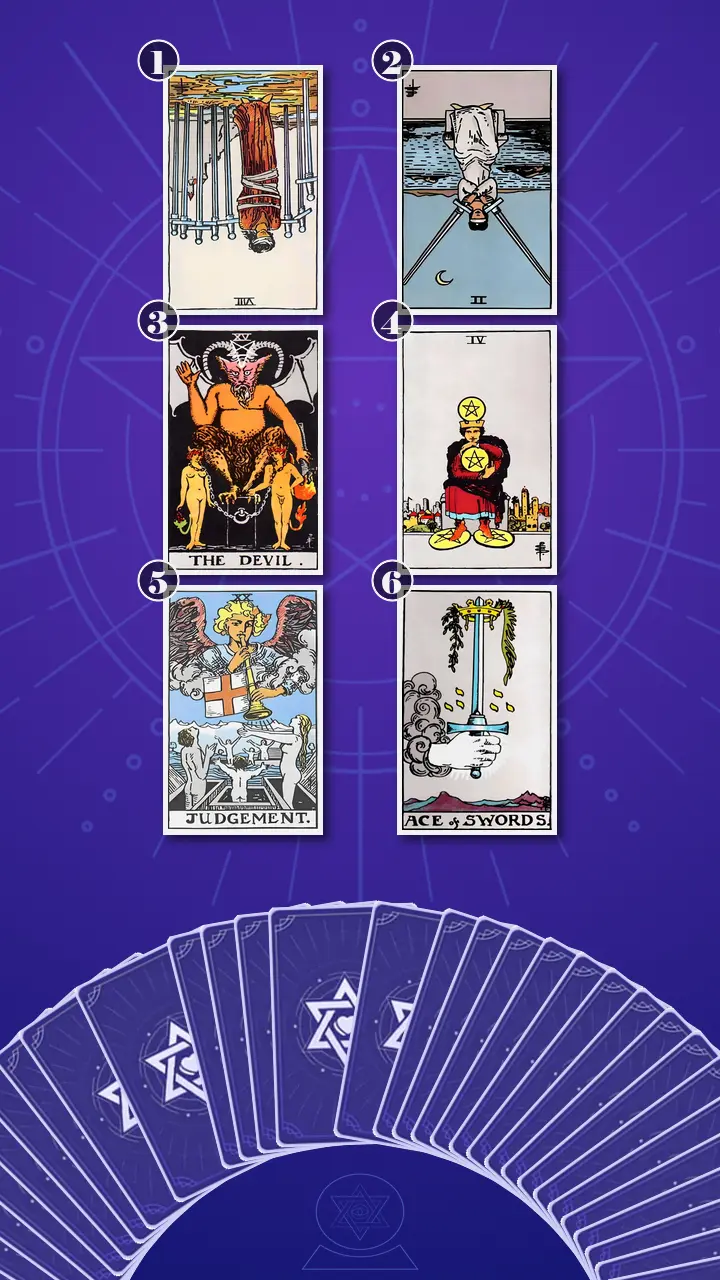
I chose the Four-Layer Insight Ladder · Context Edition, an original six-card tarot spread arranged as a two-column, three-row grid. For anyone wondering how tarot works in a decision reading, I use the cards as structured prompts. Their symbols externalise assumptions, defences, and resources so card meanings in context can be compared with real behaviour. They do not remove uncertainty, establish facts, or make the decision for the person sitting with me.
This spread suited Jordan’s question because a broader predictive layout would have introduced outcomes and outside influences before we had understood the loop itself. The upper pair would show surface repetition and the blind-spot trigger. The middle pair would expose the belief beneath the loop and its protective payoff. The lower pair would reveal the pattern interruption and turn it into an integration and next step. I angled the cards towards the camera. The layout looked like a staircase leading from a crowded room towards a clear exit.
The Blindfold and the Hidden Formula
Position 1: Surface Repetition
I turned over the card representing surface repetition: the observable decision behaviour and physical pressure recurring across Jordan’s big choices, including their habit of analysing every situation separately. It was the Eight of Swords, reversed.
The blindfolded figure stood within a ring of blades, but the bindings around the body were visibly loose. I connected that image to a night when Jordan opened a brand-new decision spreadsheet at 10:40 p.m. and studied every visible difference between the current job question and the previous one while leaving the old files closed. Salary, title, commute, risk, and LinkedIn optics were all visible. The formula beneath those categories was not.
“The inner logic sounds like this,” I said. “‘I can see every option, so I must be seeing the whole problem.’ But option-level visibility is not the same as process-level visibility. This is like maintaining six spreadsheet tabs that all use the same hidden formula while studying only the displayed numbers.”
The reversed card showed blocked Air beginning to release. Jordan’s attention had been narrowed, but they already suspected that the restriction did not live entirely in the external options. The loose bindings mattered: the old files could be opened. I also cautioned against overcorrection. Becoming aware of a blind spot did not mean every familiar option was wrong, nor did it justify making a sudden choice merely to prove they were free.
Jordan gave a short, bitter laugh. Their lips tightened first; their eyes moved towards an unopened folder on their screen; then their thumb stopped rubbing the mug. “That’s too accurate,” they said. “Almost rude.”
“Accuracy can sting without becoming an accusation,” I replied. “This card is not calling you incapable. It is showing that your attention has been trained on differences between options rather than similarities between decision processes. The reversal says that wider attention is already available.”
Position 2: The Stalemate Inside the Final 48 Hours
I turned over the card representing the blind-spot trigger: what happens when a major decision demands commitment and Jordan’s thought process blocks comparison with previous choices. It was the Two of Swords, reversed.
I pointed to the blindfold and the two swords crossed protectively over the figure’s chest. At the commitment point, Jordan kept two explanations alive through alternating Slack drafts, job listings, advice messages, and competing spreadsheet tabs. The decision actually required that week became tangled with every uncertainty that could possibly arise later. “I can’t decide until every doubt is resolved” sounded responsible, but it allowed the more uncomfortable question to remain untouched: which option had felt safer before the evidence was complete?
Here, Air was scattered and blocked. Research had moved beyond useful discernment into an A/B test left running forever because naming the success metric might reveal which result Jordan was afraid to measure. The card did not argue for impulsiveness. It asked for a boundary between what genuinely had to be decided now and what could be tested later.
I asked, “In the final 48 hours before your last big choice, what did you do instead of naming the belief beneath it?”
Jordan’s fingers opened as if mentally counting browser tabs. Their gaze shifted away from me, then returned. “I asked four people what they’d do. I spent more time comparing their answers than working out what information could actually change mine.”
“That distinction is the doorway,” I said. “You do not need a perfect answer to run a reversible test. Uncertainty can inform the process without receiving veto power over every next step.”
The Agreement Buried Beneath Common Sense
Position 3: The Belief Beneath the Loop
I turned over the card representing the belief beneath the loop: the limiting rule that made repetition feel rational, necessary, and safer than recognising it. It was The Devil, upright.
I kept my voice level. In self-exploration, The Devil is not an omen of punishment or an outside force waiting to take control. I read it as an attachment that has acquired more authority than it deserves. The loose chains around the two figures suggest an agreement maintained through repetition rather than a prison locked from outside.
Across Jordan’s career, housing, and education choices, the agreement sounded remarkably consistent: “The option I can defend most thoroughly is the safest and most responsible option.” Breaking that rule risked criticism, regret, or the discovery that fear had shaped an earlier choice. Because the rule promised protection, it kept narrowing Jordan’s agency while presenting itself as mature common sense.
I asked, “If you chose something harder to explain but more aligned with what you want, whose criticism becomes loudest?”
Jordan inhaled and held it. Their eyes lost focus as though a private panel of judges had assembled just beyond the screen. “Mostly future me,” they said at last. “And an imaginary version of everyone at work. I need the choice to survive a cross-examination before I’ve even made it.”
The Devil showed attachment in excess: not too much intelligence, but too much authority granted to defensibility. The belief had become a default setting protected by admin permissions. Familiarity can sound exactly like common sense when fear has written the brief.
Looking at the loose chains, I remembered an archaeological trench where a later wall had been built directly over an older foundation. From the surface, the structure looked inevitable. Only a change in soil colour revealed that two eras were occupying the same ground. Jordan’s present reasoning was real, but an older governing rule was running underneath it. The task was not to demolish every structure. It was to identify which foundation still belonged in the next era.
Position 4: The Relief That Poses as Proof
I turned over the card representing the protective payoff: the immediate relief and concrete defence that kept the repeating process in place. It was the Four of Pentacles, upright.
The figure held one pentacle against the chest, stood on two more, and kept the city at a distance. I connected the image to Jordan choosing an internal transfer, lease renewal, or familiar professional path because it produced the quickest feeling of control. Their shoulders would drop, the comparison tabs would close, and the silence after weeks of research would feel like confirmation.
“That release is real,” I said. “It simply may be measuring the end of uncertainty rather than alignment with your current values. Relief is data; it is not automatically proof.”
The Four of Pentacles carried useful Earth energy: stability, financial care, and respect for practical constraints. In excess, however, that stability became a grip. Jordan was protecting certainty as though it were a scarce asset, even when a low-cost experiment could have widened the view without putting their livelihood at risk.
At that moment, the HVAC on Jordan’s side of the call clicked off. The sudden quiet made the card’s promise of immediate control almost audible. Jordan’s shoulders dropped on reflex, then lifted again as they noticed themselves doing it. Their hand pressed flat against their sternum before falling to the table.
“Oh,” they said, the word arriving from somewhere deeper than analysis. “I’ve been treating the first drop in tension like a five-star review of the option.”
“Exactly,” I said. “We do not have to distrust relief. We only have to ask what produced it before appointing it as evidence.”
When Judgement Made the Old Files Speak
Position 5: Pattern Interruption
I turned over the card representing pattern interruption: an honest review capable of exposing the decision blind spot without turning recognition into shame. This was the spread’s catalyst, Judgement, upright.
The atmosphere changed. A streetcar bell reached Jordan’s microphone just as I revealed the angel’s trumpet, and for a moment the room seemed to organise itself around that clear sound. I centred the card’s rising figures: histories that had been sealed in separate compartments were being brought into one field of awareness.
Jordan had already glimpsed this possibility at the Toronto Reference Library. At 3:14 p.m. on a Saturday, with a printer clicking behind them and espresso drifting up from the café, they had found versions of the same sentence in two old decision documents: “This is the choice I can justify.” Their stomach had dropped, and they had immediately listed all the reasons the contexts were different. Judgement invited them to reopen those files, add a third decision, and ask what triggered the phrase, what it protected, and what it cost.
The card carried honest self-review, accountability without shame, and a willingness to answer evidence. It did not call Jordan to prosecute the past. It called them to hear the repeated sentence across it.
I brought Jordan back to 8:47 p.m. on Line 1: phone warm, signal dropping, comparison sheet reopening, jaw tightening. The role looked uniquely complicated, but below the details the old demand was already running: make this choice impossible to criticise.
The pattern stays invisible when every crossroads is treated as a unique emergency; compare the cue, belief, and relief, and familiarity stops masquerading as evidence.
I let the sentence settle before introducing the diagnostic lens I call Cognitive Paradigm Excavation. I asked Jordan to treat the bottleneck not as proof that their mind had failed, but as the necessary fracture of an obsolete intellectual era. The old era had one governing law: a trustworthy person makes choices that can survive every possible criticism. Judgement was the crack through which a new law could be examined: a trustworthy person can compare evidence, name fear, preserve practical safeguards, and still take a measured step without universal approval.
Then I gave Jordan the card’s central invitation.
You do not have to treat every crossroads as a unique emergency; let Judgement's trumpet call you to compare the repeated cue, belief, and payoff before taking your next deliberate step.
For several seconds, Jordan did not move. Their breath stopped, and their index finger hung halfway between the table and the mug. Their pupils widened slightly; then their gaze went soft and distant, as though old meetings, lease renewals, and programme applications were replaying behind their eyes. Their jaw shifted once. The fist resting near the laptop slowly opened, but the release was followed by a flash of heat across their face. “But doesn’t that mean I was wrong all those times?” they asked, sharper than before. “Doesn’t it mean all that careful reasoning was just fear?” The question left them on a trembling exhale. Their shoulders finally lowered, yet the new space seemed to make them briefly unsteady, as if putting down a heavy box had revealed how long they had used its weight for balance.
“No,” I said. “It means a protective rule may have continued operating after you stopped reviewing it. Some past choices may still have been sound. Some may have involved compromises you would now make differently. We are examining the process, not retroactively invalidating your life. The pattern is not a verdict. It is a dataset.”
I asked, “Now, using this new perspective, think back: was there a moment last week when this insight could have made you feel different?”
Jordan looked down. “After my manager sent that vague message about a growth opportunity, I texted three friends before asking what the role actually involved. The internal move felt safer almost immediately because I already knew how to explain it. I thought the relief meant I wanted it.”
To keep the insight from becoming another elegant abstraction, I proposed the minimum review encoded in the card: set an eight-minute timer; make three rows for the last three big decisions; add only one trigger, one belief, and one short-term payoff to each. Use neutral language. Stop if the exercise becomes punitive. One decision or one completed column counts.
This was the pivotal movement in Jordan’s Journey to Clarity: from apprehensive hyper-analysis and shame-based self-doubt towards non-punitive pattern clarity. They did not yet have certainty about the job. They had something more useful at this stage: permission to compare the process without using the comparison as evidence against their worth.
Position 6: One Sentence, One Test
I turned over the card representing integration and the next step: a small, self-directed practice for testing the newly visible belief during a future decision. It was the Ace of Swords, upright.
The upright sword emerged cleanly from a cloud, crowned against a clear mountain range. I read it as Air restored to balance: thought becoming discernment rather than enclosure. Its modern-life translation was intentionally simple. Jordan would write, “I assume the most defensible choice is the safest choice,” separate observed facts from predictions and fears, and choose one reversible experiment such as an informational interview or a commute-time neighbourhood visit.
The card did not select Jordan’s future. It gave the old rule a fair test against present evidence. Six crowded dashboards could become one clean page: one belief sentence, two evidence columns, and one action capable of producing information. The inner statement shifted from “I must decide my entire future” to “I am testing whether this rule still deserves authority.”
I asked which experiment could produce information about the current role without committing Jordan to it. Their hand rested flat beside the laptop now, no longer gripping the pen.
“I could ask my manager what decision-making authority and budget the role actually has,” they said. “Not ask my friends whether it sounds impressive. Ask for facts.”
I nodded. “That is the Ace of Swords in practice. Clarity is not the absence of unknowns. It is a cleaner distinction between what you know, what you predict, what you fear, and what you can test.”
The One-Page Manifesto for the Next Crossroads
Viewed as one story, the spread was coherent. An older rule had taught Jordan to make each major choice criticism-proof. At the surface, that produced fresh spreadsheets and isolated analysis. At the decision point, competing explanations prolonged the stalemate. The Devil revealed the buried agreement that defensibility equalled safety, while the Four of Pentacles showed why the agreement survived: familiar choices produced fast control. Judgement brought the old decisions into one field of view, and the Ace of Swords turned recognition into a testable sentence.
The cognitive blind spot was not a lack of intelligence or research. It was the habit of evaluating every decision in isolation, then treating quick relief as evidence while never comparing the cue, belief, and payoff across time. The transformation direction was equally specific: shift from defending each choice separately to comparing the last three big decisions and testing whether the familiar rule still fits current values.
I used my Core Philosophy Stratigraphy lens to separate bedrock from historical debris. Jordan did not need to abandon prudence, evidence, financial stability, or responsible planning. Those values could be carried forward. What could remain in the past was the claim that responsibility requires a decision to survive every imagined criticism. We shaped that distinction into a compact version of my Paradigm Shift Manifesto: a statement of the old governing law, the values worth preserving, and the new law Jordan was willing to test.
- The Three-Decision Pattern Review On Monday evening at home, set a 20-minute phone timer and open one Google Sheet. Make three rows for the last three major decisions and three columns labelled “Trigger,” “Belief,” and “Short-term payoff.” Search old Notes, Notion pages, or Drive files for repeated words such as “sensible,” “safe,” “responsible,” or “hard to criticise.” Highlight one repeated sentence, rewrite it as a neutral hypothesis, and add one line called “What was genuinely different?” If the full review brings a rush of explanations or shame, compare only two decisions for eight minutes and write one phrase per column. Stop if the exercise becomes punitive; usable data does not require self-punishment.
- The Paradigm Shift Manifesto and Reversible Evidence Test In the Notes app, write the old law: “The decision I can defend most thoroughly is the safest decision.” Beneath it, write the proposed new law: “A responsible decision separates current facts from inherited fears and allows one measured test.” Create headings for “Observed facts” and “Predictions or fears,” sort five current claims, then send one factual question to the person who can answer it, such as a manager, recruiter, landlord, admissions contact, or partner. Complete that step within 48 hours without requesting another general opinion first. Use the five-minute version if needed: sort three claims, mark uncertain items as “unknown,” and draft one question. The manifesto is a working constitution for the next chapter, not another standard you must perform perfectly.
I was explicit about the boundary. Neither exercise could tell Jordan whether to accept the role, change companies, move, study, or stay. The purpose was to produce actionable advice and next steps without outsourcing authorship. Tarot supplied the questions and visual structure; Jordan would decide which values governed the answer.

A Week Later, One Clean Line
A week later, I received a message from Jordan. They had found versions of “the choice I can justify” in notes about a previous job, a lease renewal, and a graduate programme. They had placed the three decisions on one page, labelled the repeated rule as a hypothesis, and sent their manager a direct question about the proposed role’s authority and budget. The reply exposed a practical limitation Jordan had not been able to research through friends or Reddit.
Jordan had not solved their career in seven days. They had gathered one fact that genuinely changed the comparison, closed the saved advice threads when their 48-hour boundary ended, and written their own preference before opening the group chat.
That night, Jordan slept straight through. Their first thought in the morning was still, “What if I get this wrong?” They told me they smiled at it, opened the single-page note instead of twelve tabs, and made coffee.
I think of that as the quiet proof of this reading. The cards did not rescue Jordan from uncertainty, and I did not hand them a verdict. Jordan used the images to recover evidence they already possessed, name the rule beneath it, and take one reversible step. That is what finding clarity looked like here: not perfect certainty, but evidence-based self-trust beginning to replace shame-driven defence.
If your spreadsheet is still open at 1 a.m. and your jaw is tight, I want you to remember that the hardest part may not be a lack of reasons. It may be the fear that the same reasons will reveal how fiercely you have been protecting certainty. Noticing that possibility does not put you back at the beginning. It gives you a place to start looking with more kindness and precision.
If your last three choices were data rather than a verdict, which repeated cue, belief, or burst of relief would you be curious enough to let Judgement’s trumpet call into the same room?