Career Transition Paralysis: Turning an Unsent Message Into Evidence
When Career-Transition Paralysis Hits at 10:47 p.m.
I recognise a particular kind of late-night freeze. A career pivot can live in a beautifully organised Notion board while its only reality-facing task remains in Drafts. When career-transition paralysis appears because no clear path is visible, the screen often looks busy even though nothing has made contact with the outside world.
Morgan (name changed for privacy), a 28-year-old freelance UX writer in Toronto, joined my video call from a narrow desk at 10:47 on a Tuesday night. Six career tabs crowded one side of their shared screen. Roadmap v4 occupied the other. A streetcar shrieked against the rails outside, and Morgan rubbed the wrist resting beside their laptop. "The fan is basically cooking me," they said, with the flat humour of someone who had been at this too long.
The cursor blinked over an unsent informational-interview request. Morgan had rewritten the first milestone for the fourth time, but their chest tightened whenever they looked at the Send button. Their breath stayed high and shallow. Their legs felt packed with wet sand, as if one uncertain click had turned the floor beneath the desk into a steep shoreline.
"I can handle a hard path better than no path at all," Morgan told me. "I keep waiting for the missing piece that will make the first step obvious. Toronto rent is real, my contracts are short, and I don't want one random move to make everything worse."
I heard the core contradiction clearly: Morgan wanted movement toward a sustainable professional chapter, but they treated movement as unsafe unless the route beyond it could be proved in advance. I did not tell them to take a leap or trust the universe. I said, "Let's slow this down. We are not asking the cards to choose your career. We are going to use them to map the mechanism of the freeze, find the next visible rung, and recover a little clarity without pretending the fog is gone."

Four Rungs Emerging Through Fog
I asked Morgan to put both feet on the floor, take one unforced breath, and hold the question in plain language: "Why do I keep freezing when a transition has no clear path?" I shuffled slowly. The pause was not a mystical performance; it was a deliberate switch from frantic problem-solving to focused observation.
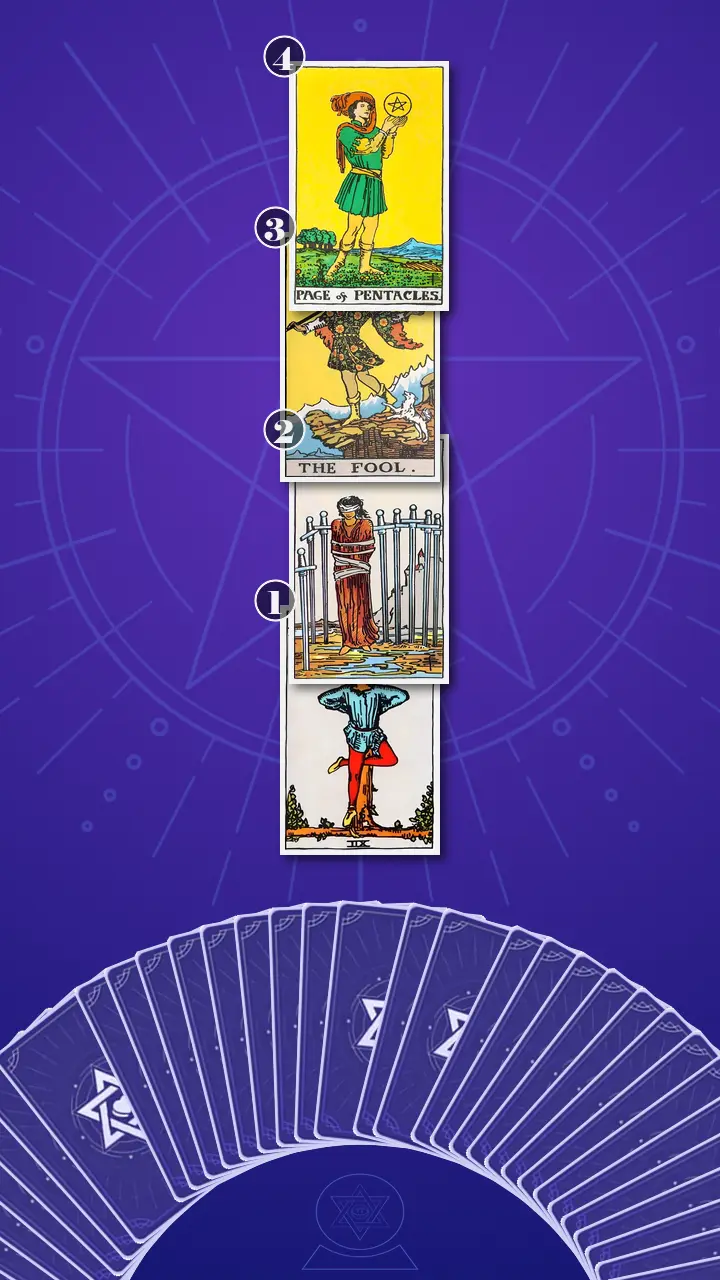
I chose the Four-Layer Insight Ladder, a four-card RWS tarot spread moving through current state, root, transformation, and action. For anyone wondering how tarot works in a career reading, I use it as a structured cognitive mirror rather than a prediction device. Card meanings in context can separate observable behaviour from the belief sustaining it, then turn an abstract insight into a testable next step.
This was the smallest complete spread for Morgan's question. A ten-card Celtic Cross could have introduced future outcomes and environmental influences, but Morgan did not need more branches. They needed a clean causal chain. The first rung would show the visible planning freeze. The second would uncover the belief that turns uncertainty into incapacity. The third would reveal the energy capable of interrupting that loop. The fourth would translate the reframe into one small, practical experiment with a review date.
I arranged the cards vertically like a ladder disappearing into mist. I told Morgan, "You do not need to see the top. We are only looking for the relationship between the rung under your hand and the one immediately above it."
When Preparation Became Suspension
Position 1: The Halo Above Roadmap v4
I turned over the card representing the current layer: the observable freezing behaviour, where repeated planning and research had replaced one reversible step whenever the route remained incomplete. It was The Hanged Man, reversed.
I drew Morgan's attention to the figure hanging by one foot and to the halo still glowing around the head. The halo mattered. It suggested that useful insight had already arrived. Morgan knew that short contracts were no longer providing the structure they wanted. They knew they were curious about adjacent content-strategy work. They also knew which message had survived every version of the roadmap. What had not changed was the posture.
At 10:47 p.m., Morgan was still revising the first milestone in Notion while six open tabs failed to answer whether the work itself would feel sustainable. The unsent request remained one click away. The pause had once helped them understand what was not working; now it had become behavioural suspension because the entire route could not be proved.
In energy terms, I read the reversal as a Blockage of movement created by an Excess of suspension. Reflection was no longer producing new information, but Morgan kept extending it because preparation temporarily protected them from being wrong. The hidden sentence beneath the habit sounded like this: "I am still preparing, because if I can make the plan complete, I will not have to risk discovering that my first step leads nowhere."
"Research becomes avoidance when it can no longer change the next test," I said. "That does not make research bad. It gives it an expiry condition."
Morgan let out a short, bitter laugh. "That's so accurate it feels a little cruel." Their fingers tightened around the mug beside the laptop, and their eyes stayed on the reversed figure.
I adjusted rather than pushing past the reaction. "Then let's make the distinction precise, not punitive. Planning helped you name what was unsustainable. It had a real purpose. The question is whether Roadmap v4 is still teaching you anything that Roadmap v3 could not."
I use a diagnostic lens called Pseudo-Growth Eradication for moments like this. The name is deliberately blunt, but the purpose is protective: I strip away the appearance of personal development and audit the actual return. What new fact did the fourth rewrite create? What behaviour changed? How many reality-facing tests were completed? Morgan's planning had generated language, categories, and temporary relief, but its recent information return had fallen close to zero. Its execution rate on the one useful experiment was also zero. That audit did not shame the pause; it showed that the pause had completed its job.
I asked, "What is the exact question your planning can no longer answer?"
Morgan looked toward the message and said, "Whether I would actually like the ordinary day-to-day work, not the polished job description."
Position 2: Eight Swords and One Unblocked Gap
I turned over the card representing the root layer: the learned belief that uncertain effort cannot create meaningful influence, along with the fear that one unguided move will expose a lack of control. It was the Eight of Swords, upright.
I pointed to the blindfold, the loose bindings, and the incomplete ring of blades. The card did not tell me that Morgan's constraints were imaginary. Toronto rent, freelance income, access needs, time, and professional reputation all deserved serious consideration. The card showed me something more specific: documented constraints and forecasted consequences had been stacked together until they looked like one solid wall.
In Morgan's modern-life version of the card, overlapping tabs had become the swords. Rent, contradictory advice, unclear titles, missing qualifications, and salary comparisons filled the screen. Then the mind added several predictions: one conversation would create expectations, one private exercise would waste scarce time, and exploring an adjacent role would publicly lock Morgan into a new identity. A free 15-minute conversation sat inside the ring, but prediction made it feel as consequential as signing a lease.
The upright card carried air in Excess. Analysis had stopped circulating and become an enclosure. Predictions had effectively been given admin permissions, so every imagined downstream consequence could block the first action before reality had been consulted. The rule sustaining the freeze was simple: "Because I cannot see what happens after step one, step one must be unsafe or useless."
I felt an old professional association rise from my Wall Street years. On a trading desk, a documented exposure and a projected scenario never belonged in the same field. Both mattered, but confusing them produced bad risk decisions. "Rent is an exposure," I told Morgan. "The belief that one unanswered email will prove you cannot change is a forecast. We do not have to replace that forecast with optimism. We only have to stop recording it as a settled fact."
Morgan's breath paused. Their gaze drifted away from the card as if they were replaying a familiar chain of evenings. Then their thumb slowly released the mug handle. "I think I make every possible consequence due immediately," they said. "The email becomes the whole career change."
"Exactly," I said. "The Eight of Swords validates the feeling of restriction while showing that the barrier is not seamless. Your financial boundaries stay intact. The gap is the action that creates information without creating commitment."
I asked them to name one concern in each category. Morgan put "I need reliable income for rent" under documented constraint. Under forecast, they put "If I ask about content strategy, people will expect me to become a content strategist." Their shoulders remained high, but the problem was no longer one undifferentiated wall.
When The Fool Stepped Before the Road Appeared
Position 3: The Bridge from Prediction to Evidence
The streetcar noise outside Morgan's window faded, and the room on my side of the call became unusually still. I turned over the key card, the transformation layer that would shift Morgan from waiting for certainty to using one bounded step as an experiment. It was The Fool, upright.
I centred the forward foot near the cliff, the small bundle on the staff, and the white rose. The Fool was not carrying Morgan's overloaded planning documents. The figure carried only what the next encounter required. The lifted gaze did not deny the drop; it refused to make complete visibility a precondition for movement.
In context, this card looked like Morgan sending one low-stakes message to a content strategist and asking about the least visible part of the work. The request would have a 15-minute limit, no request for a referral, and no implied promise to pivot. It would not settle Morgan's professional identity. It would create firsthand evidence while preserving their freedom to reassess.
The Fool brought a firelike spark into air that had become compressed, but I did not read that spark as recklessness. Its healthiest state was Balance: enough openness to initiate, enough boundary to leave. The card served as the spread's bridge because it changed the function of uncertainty. The unknown stopped being proof of incapacity and became a reason to gather limited evidence.
I ran the proposed message through another lens I use, the Potential Actionability Assessment. I asked three commercial questions. Is the downside capped? Yes: no spending, no disclosure of private financial information, and permission to decline follow-up. Is the move reversible? Yes: a conversation can end after 15 minutes. Is the information yield specific? Yes: Morgan could learn what an ordinary workday contains. The message scored high on actionability even though it scored low on emotional comfort. That distinction mattered.
At that point, Morgan was still caught in the old equation: six tabs meant diligence, a fourth rewrite meant control, and an unsent message meant safety. Their chest stayed tight because any first step still seemed responsible for proving every step that might follow.
Freezing is not proof that no path exists; one deliberate step restores choice, just as The Fool enters the open landscape before seeing where the road will lead.
I left the sentence alone for a moment.
First, Morgan's inhale stopped. Their fingers hovered above the trackpad, and their pupils widened slightly as though the sentence had interrupted an automatic script. Then their brow pulled tight. Colour rose into their face, and they said, more sharply than before, "But doesn't that mean all the planning was wrong? That I lost months doing this to myself?" I told them no. The planning had protected them and produced insight; the problem was not that it existed, but that they had kept paying for it after its information return expired. Morgan looked away. Their eyes shone, not quite with tears, but with the sting of seeing both the protection and its cost. Finally, their clenched hand opened on the desk. Their shoulders dropped by an inch, and a long breath left their chest with a faint tremor. Relief arrived, but so did a brief, exposed silence. If the road no longer had to appear first, Morgan could act, which meant choice was returning with responsibility attached.
I asked, "Now, using this new view, think back to last week. Was there a moment when this insight could have made the situation feel different?"
Morgan recalled a Sunday LinkedIn scroll and a former colleague's "thrilled to announce" promotion. "I saw their finished story and made my email feel like a public declaration," they said. "If I'd treated it as user research, I might have asked one question and closed the app."
"That is The Fool in usable form," I said. "Treat the next step as a question, not a verdict. You do not need the step to prove the route. You need it to answer one question."
I then gave the insight a strict boundary. Morgan could set an eight-minute timer, open the draft, and write three lines: what they were exploring, the one question they wanted firsthand information about, and a request for a 15-minute conversation. They could send it or schedule one specific review time within seven days. The action would not commit them to a career change, paid training, a job application, or sharing anything private. If outreach felt too exposed, the minimum version was a single question tested through a private 20-minute portfolio exercise. They could stop if the discomfort became unmanageable.
A missing map was not the same thing as missing agency. I could see the first movement from contracted apprehension and certainty-seeking paralysis toward experimental courage, grounded momentum, and self-trust built through direct evidence. The uncertainty remained. What changed was Morgan's relationship to it.
The Mountain Could Stay in the Distance
Position 4: One Pentacle at Eye Level
I turned over the card representing the action layer: one small, practical, reviewable experiment capable of interrupting the stagnation without demanding a complete transition plan. It was the Page of Pentacles, upright.
The Page held one pentacle with steady, two-handed attention while mountains remained in the distance. I told Morgan, "The mountains are still real, but they are not today's assignment." Where The Fool restored movement, the Page grounded that movement in observable practice.
In Morgan's life, the card became a seven-day prototype: complete one 25-minute content-strategy exercise or one informational conversation, then record what happened, how their energy shifted, which constraint proved real, and what question appeared next. The goal was not to declare a new career. It was to hold one usable result at eye level and decide on Friday whether to repeat, adjust, or stop.
This was earth in Balance: focused effort, modest scope, and practical feedback. It also corrected the risk hidden in The Hanged Man reversed. Morgan did not need to escape the suspended feeling by grabbing the first highly structured option available. The Page offered structure without premature commitment.
"You are not choosing a permanent identity," I said. "You are collecting one piece of evidence."
Morgan opened Notes while we were still on the call and typed four fields: expected, observed, energy before and after, and next question. Their index finger paused over the calendar, then they added a ten-minute Friday review. I watched their posture change from leaning away from the screen to sitting squarely in front of it. The problem had not vanished, but it had become smaller enough to observe.
The Next-Rung Experiment
I read the spread back to Morgan as one coherent story. Earlier experiences had taught them to expect that effort might not change much. When an undefined transition activated that learned pattern, The Hanged Man reversed appeared as repeated reflection without behavioural movement. The Eight of Swords revealed the mechanism underneath: unanswered questions, real constraints, and feared consequences were fused into one enclosure. Postponement briefly restored a sense of control, but it also prevented new evidence from appearing. The absence of evidence then seemed to confirm that Morgan had no effective influence.
The Fool interrupted that loop with bounded contact, and the Page of Pentacles turned contact into learning. The spread's core metaphor was not a hidden master map. It was a ladder rising through fog. Morgan's cognitive blind spot had been treating the invisible upper rungs as proof that the next rung could not hold them. The transformation direction was simpler: stop waiting for a complete route, choose one small reversible experiment, and set a date to review what reality returns.
I wanted the actionable advice to remain small enough for a tight chest, a freelance calendar, and expensive-city constraints. I also adapted my Evolution KPI Framework, a 30-day execution challenge designed to prevent a philosophical realisation from becoming another saved quote. Its KPIs would not be salary, title, or whether Morgan had discovered the correct career. We would measure reality-facing tests completed, facts gathered, forecasts checked, and review dates honoured. The framework was strict about observation and flexible about direction.
- Run the Fact-or-Forecast Split.At the next planning freeze, divide one page into "documented constraint" and "predicted consequence." Spend no more than ten minutes placing each current concern in a column, then write one fact the pause has already taught you and one question that only action can answer.Tip: Do not argue with a forecast or force optimism. Label uncertain items "unknown," choose an exit condition such as no spending or a 20-minute cap, and close the roadmap when the timer ends.
- Send the Three-Sentence Inquiry.Before Thursday evening, choose one former colleague or reasonably safe second-degree LinkedIn contact. Set an eight-minute timer and write three lines: what you are exploring, the single day-to-day question your research cannot answer, and a request for a 15-minute conversation. Send it when the timer ends or place one specific sending review on the calendar.Tip: State that this is an inquiry, not a request for a job or referral. One reply can be evidence without becoming a five-year plan. If outreach feels too exposed, run one private 25-minute portfolio test instead.
- Build the 30-Day Evolution KPI Log.Create a phone note titled "Seven-Day Career Prototype" with four fields: expected, observed, energy before and after from one to five, and next question. Complete one 15-minute conversation or 25-minute private exercise each week. Log one confirmed fact, one prediction challenged by evidence, and one unresolved question. Use a ten-minute Friday review to repeat, adjust, or stop that test, then select the next bounded experiment for the following week.Tip: The KPI is contact with reality, not a positive result. A low-energy result is useful data, and a missed task does not invalidate the month; record what interfered and reduce the next test.
I reminded Morgan that these were options, not commands from the cards. They retained the right to stop, protect private information, decline follow-up, or decide that an adjacent field was a poor fit. The purpose of the experiment was to increase their authorship, not pressure them into movement for its own sake.

A Week Later, the Quiet Proof
Six days later, I received a message from Morgan. They had sent the three-sentence inquiry at 8:04 on Wednesday morning and held the conversation on Friday. "It didn't give me a career path," they wrote. "It told me I don't want a calendar full of stakeholder meetings, but I do like turning messy product language into a system. Weirdly, that is enough for the next test."
Their evidence note showed an expected energy score of two and an observed score of four. One prediction had also failed: the contact did not assume Morgan wanted a referral or expect a commitment. They answered the question, offered one practical example, and let the conversation end on time.
That night Morgan slept straight through. Their first morning thought was still, "What if this goes nowhere?" They told me they smiled, opened the evidence note, and wrote, "Then I review it Friday."
I did not see tarot choose a future for Morgan. I saw a four-card Four-Layer Insight Ladder make a self-reinforcing loop visible, separate constraints from forecasts, and return the decision-making power to the person living the decision. Finding clarity did not mean seeing the entire landscape. It meant knowing what the next experiment was for and when it would end.
When the next rung is hidden, I know the tight chest and heavy legs are not only about choosing wrong. They can carry the fear that one unguided move will prove you never had control, even while another part of you is desperate to move. Simply recognising that conflict means the fog is no longer the only thing in view.
If your next move only had to be one Page-of-Pentacles experiment for seven days, what tiny question could you place on the next visible rung and let reality answer?