When "I Miss You" Feels Like Repair: Learning to Check the Record

The 11:40 p.m. Message That Restarted the Relationship
I have met people who can handle escalated customer calls all afternoon and still come undone over one notification after work. Alex (name changed for privacy), a 28-year-old customer success specialist in Toronto, described exactly that contradiction when they sat across from me and asked, “Why do I keep returning to a relationship that keeps breaking down?”
They took me to a Tuesday night at 11:40 p.m. The radiator clicked in their dim bedroom while the archived message thread warmed the phone in their palm. They wrote and deleted a boundary, scrolled back to photos from the relationship’s best month, and watched their own thumb hover over Reply as though it belonged to someone moving half a second ahead of them.
“I know the pattern,” Alex said. “My friends know the pattern. I even have a Notes page called ‘Reasons it ended.’ But when I see ‘I miss you,’ the silence suddenly feels worse than everything that went wrong.”
They told me that their shoulders loosened within minutes of replying. Daily texting returned. Hope returned. The unresolved list remained untouched. Their longing seemed to sit behind the sternum like a strong magnet, pulling the restless hand toward the phone while a quieter dread whispered that the same ending might already be waiting.
Alex wanted the relationship to work and wanted to preserve a connection that mattered. At the same time, they could see that each reunion had begun before either person established what caused the last breakdown or what had materially changed. That was the central contradiction: the reunion relieved separation distress, but relief was being asked to serve as evidence of stability.
“I’m not going to use tarot to tell you to stay, leave, block, reconcile, or wait,” I said. “I also won’t claim to know what the other person thinks. I want us to make the sequence visible, because a visible pattern gives you somewhere to exercise choice. Let’s draw a map through the fog and find out where returning stops being inevitable and starts becoming a decision.”

Choosing a Map for the Breakup-Reunion Loop
I asked Alex to place both feet on the floor, turn their phone face down, and take one slower breath. I shuffled while they held a single question in mind: “What happens between the first ache of separation and the moment I reopen the relationship?” The small ritual was not about summoning certainty. It was a transition from reacting to observing.
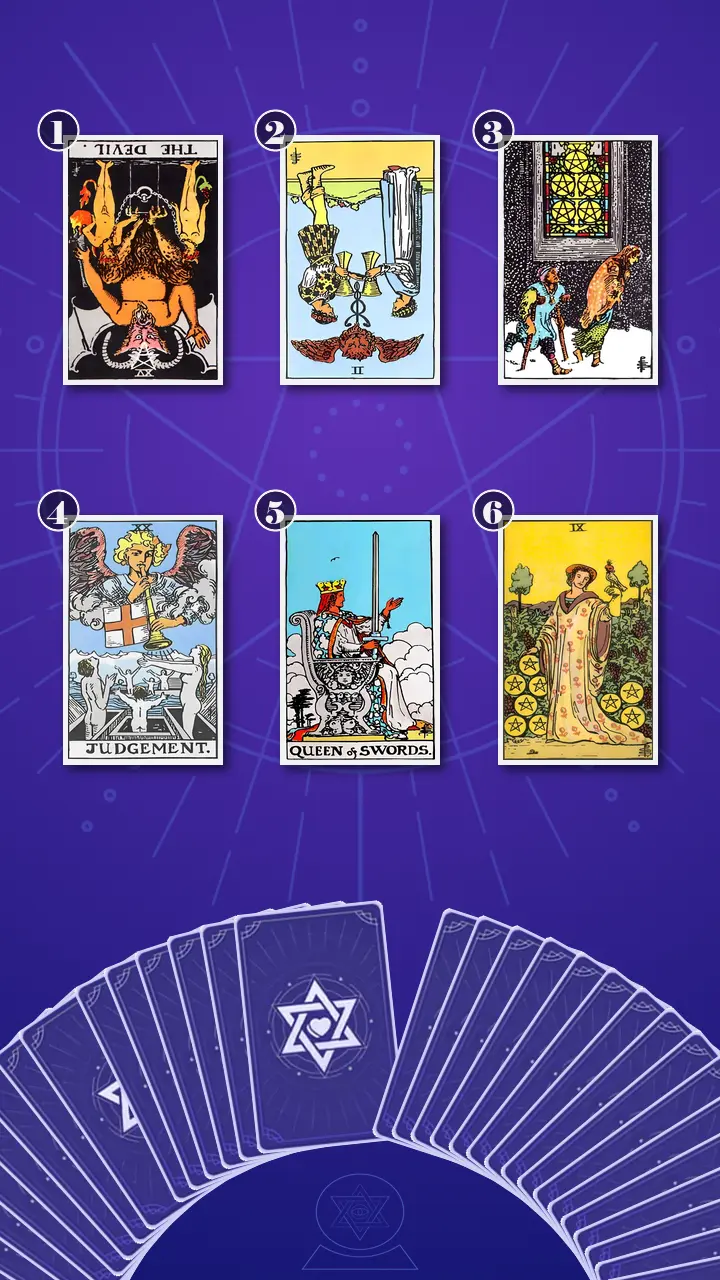
I chose the Transformation Path Grid (6) · Context Edition, a six-card tarot spread for mapping an on-again, off-again relationship loop. I arranged the cards in two rows of three. The upper row would identify the present pattern, its central blockage, and the fear beneath it. The lower row would reveal the catalyst, a practical action, and the grounded capacity that could grow through practice.
I explained that this spread suited Alex’s question because it did not devote positions to guessing the other person’s motives or predicting a reconciliation outcome. Instead, it traced a feedback loop: separation distress, renewed contact, immediate relief, postponed repair, recurring breakdown, and another painful separation. Then it opened that loop at the point where Alex could respond differently.
This is how tarot works best in my practice. The cards do not deliver a verdict from outside the person. Their images slow down a crowded inner narrative, separate its moving parts, and give subconscious patterns enough structure to be examined. The card meanings matter, but card meanings in context matter more.
I pointed to the fourth, fifth, and sixth spaces. “This card will show the leverage point where the automatic return can be interrupted. This one will translate that insight into a boundary you can personally uphold. The final card will show the self-supported ground from which you can decide. It is a developmental possibility, not a forecast.”
The Loose Chain in the Phone-Light
Position 1: The Devil Reversed and the Relief-Seeking Sequence
I turned over the card representing the observable on-again, off-again behavior and the contracted urgency that led Alex to resume contact before examining what had changed. It was The Devil, reversed.
I drew Alex’s attention to the two figures beneath the Devil. Their chains looked powerful, but the loops around their necks were visibly loose. Reversed, the card carried the energy of release in a state of blockage: Alex could recognize the restrictive pattern, yet recognition had not become a reliable interruption. The route out existed, but the short-term reward of replying kept the chain in use.
“This is the exact 11:40 p.m. sequence you described,” I said. “You open the archived thread after several silent days, scroll to the affectionate photos, check whether they are online, and reply before rereading why the relationship ended. Your shoulders release within minutes. The awareness is real, and the repetition is real too.”
I gave the thought inside the card plain language: “I know where this goes, but answering will make tonight easier.” It had the Groundhog Day quality of reaching the same lonely evening and receiving a slightly different notification. The meaningful change would not come from making the notification more persuasive. It would come from changing what happened after the cue.
Alex gave a short laugh with a bitter edge. “That’s so accurate it feels kind of brutal.”
“I understand,” I said. “But the loose chain is not an accusation. It is the card refusing to describe you as powerless. We are locating a repeatable cue, action, and reward, not assigning you a character flaw. Relief is real; it just is not the same thing as repair.”
Their thumb rubbed once across the side of their index finger, then stopped. I watched their shoulders remain high, but their attention moved from the card’s dark central figure to the loose space around the chain.
Position 2: The Two Cups That Could Not Stay Level
I turned over the card representing the co-dependent blockage that made emotional reconnection feel more urgent than assessing reciprocity, repair, and the recurrence of the breakdown. It was the Two of Cups, reversed.
In the upright image, two people hold their cups at equal height. Reversed, the symmetry becomes unstable. I read the emotional energy as imbalanced water: warmth and longing could be abundant while accountability remained blocked and equal participation in repair remained insufficient.
“Within days of reconnecting, you restore all-day texting, pet names, sleepovers, and emotional access,” I said. “Both of you may genuinely feel love or longing. But the conversation about what caused the last breakdown keeps moving to ‘later.’ The couple routine resumes before the conditions of the relationship have been reviewed.”
Alex looked down. “We always say we don’t want to make things heavy as soon as we’re finally getting along.”
“That makes emotional sense,” I said. “The internal line is often, ‘We feel close again, so maybe we don’t need to ruin tonight.’ But chemistry and reciprocity answer different questions. ‘I miss you’ can be completely sincere and still say nothing about what either person will do when the original conflict returns.”
I let the overturned cups hold that distinction before I added, “Being missed is a feeling. Being met requires behavior.”
Alex’s gaze stayed on the space between the figures. Their lips pressed together, then softened. “So the affection might be real, and the repair might still not be happening.”
“Exactly,” I said. “You do not have to deny the bond in order to evaluate its structure.”
Position 3: The Window That Disappeared in the Snow
I turned over the card representing the deeper fear about worth and being unchosen that gave the repetition its emotional force. It was the Five of Pentacles, upright.
I showed Alex the two figures moving through snow beneath an illuminated window. The card held earth energy in a state of perceived deficiency: pain narrowed the field of attention until one unavailable source of belonging appeared to be the only source. The window suggested that support had not vanished, but the scarcity state made it difficult to register.
Alex had already described a version of this scene. On a rainy TTC ride, they had watched an anniversary Reel, looked at a notification-free lock screen reflected in the dark train window, and felt a hollow space open beneath their ribs. Wet coats filled the carriage with a damp wool smell, the brakes squealed, and one sentence arrived: “If they are not choosing me tonight, maybe nobody really is.”
Meanwhile, their roommate was cooking at home. A friend’s coffee invitation remained unread. Their work competence, familiar neighbourhood, and ordinary routines still existed. None of those things cancelled the separation pain. They did show that the pain was not objective proof of total exclusion.
I used my Shadow Projection Analysis here, carefully and without pretending to diagnose Alex’s childhood or the other person’s motives. I separated the observable event from the shadow narrative laid over it. The observable event was, “No message has arrived from this person tonight.” The projected conclusion was, “I am fundamentally unchosen, and staying apart will prove it.” Beneath that conclusion I heard a possible unmet need for reliable belonging and stable worth, but I treated it as a question for Alex, not a fact I could declare.
“Which hurts more,” I asked, “missing them, or what the silence seems to say about you?”
Alex’s breath caught. Their fingers tightened around the water glass; their eyes went briefly unfocused, as though they were replaying several quiet evenings at once. Then their grip loosened and they said, very softly, “What it says about me.”
“Then that is part of what the return has been regulating,” I said. “It does not mean your love is false. It means the urge contains more than love.”
When Judgement Outrang the Notification
Position 4: The Full Record Comes Into View
I reached the card representing the leverage point where Alex could interrupt the automatic return by reviewing the full cycle as evidence rather than reacting only to the latest contact. A streetcar bell sounded faintly beyond the window as I turned it over. The card was Judgement, upright.
The atmosphere changed. The figures on the card rose with open arms toward a trumpet, as though something previously enclosed had finally been called into view. I contrasted that trumpet with Alex’s phone notification. One sound pulled them toward the latest emotional moment. The other summoned the complete record.
I returned Alex to the moment at 11:40 p.m.: the archived chat open, an affectionate message loosening their shoulders, and the Notes list untouched. The relief was real. I asked them to notice how quickly the mind converted that bodily release into proof that this reunion might be different.
Then I laid my Attachment Loop Diagnosis across Judgement’s full-record view. I mapped five linked points: the cue was silence or a nostalgic message; the triggered meaning was “If I do not reply, I will be finally unchosen”; the regulating action was checking, replying, and restoring couple routines; the immediate reward was physical relief and familiarity; the delayed cost was the return of unresolved conflict and another breakdown.
This framework was not a label for Alex or a claim that I knew their attachment style with certainty. It was an X-ray of the sequence. Once the sequence was visible, the latest message could no longer masquerade as the entire relationship.
I thought briefly of the many places I had travelled and the different languages in which I had heard people describe the same human wish: “Please let this new conversation mean the old pain has changed.” A changed vocabulary can still carry an unchanged script. Judgement asked for something more demanding and more compassionate than optimism or blame: an honest review.
I said, “A reunion can end the pain of the pause without ending the pattern. Let the full record, not the latest rush of relief, tell you what has actually changed.”
The old cycle is not proof that you are destined to return; answer Judgement's trumpet by reviewing the full pattern and choosing your next response from evidence rather than immediate relief.
For one beat, Alex’s inhale stopped. Their fingers froze above the table, slightly curled, and their pupils widened before their gaze drifted beyond the cards. I watched recognition move in slowly: first the stillness, then the replay. Their brow tightened as if the last two reunions were passing behind their eyes in reverse order. Their jaw set. “But doesn’t that mean I was wrong every time I went back?” they asked, the words sharper than anything they had said so far. I answered, “No. It means those choices were doing a real job: they stopped pain quickly. Reviewing the cost is not prosecuting your past self.” The anger held for another second, then grief entered it. Their eyes shone; one hand closed into a fist and gradually opened again. Their shoulders dropped with a long, uneven exhale. The release was followed by a brief blankness, almost a slight dizziness: clarity had returned responsibility to them, and responsibility felt more vulnerable than waiting for another person to choose.
“Now, using this new perspective, think back to last week,” I said. “Was there a moment when this insight might have made you feel different?”
Alex looked at Judgement again. “The Sunday voice note,” they said. “I kept asking whether it sounded more self-aware than the last one. I never asked what had actually been different since the last breakup.”
“That is the shift,” I said. “Instead of asking only whether the newest contact feels different, you become the evaluator of what has been different across the whole cycle. The latest message is one data point, not a new relationship chapter.”
I named the emotional crossing plainly. This was movement from relief-seeking reunion and fear of being unchosen toward evidence-based, boundary-led discernment and steadier self-trust. It did not remove longing. It placed a pause between longing and action, where Alex’s judgment could finally enter.
The Sword, the Open Hand, and the Life Still Waiting
Position 5: The Queen of Swords Gives the Boundary a Voice
I turned over the card representing the small boundary practice Alex could apply before couple routines or emotional commitments resumed. It was the Queen of Swords, upright.
The Queen held her sword vertically while extending her other hand. I read her air energy as balanced: discernment was neither excessive nor deficient, and clarity did not require emotional coldness. The sword named the condition. The open hand allowed Alex to listen without surrendering the right to evaluate.
“This card replaces the long midnight negotiation with one behavior-based statement,” I said. “For example: ‘I am open to talking, but I will not resume daily texting or sleepovers before we discuss what caused the last breakdown and what each of us will do differently.’”
I explained that the sentence governed Alex’s participation. It did not diagnose the other person, demand an approved emotional response, or threaten punishment. The other person remained free to decline the conversation. Alex remained free to decide what kind of contact they would participate in if repair continued to be deferred.
“I can care about what they feel and still need a direct answer before resuming this,” Alex said, testing the words slowly.
“Yes,” I replied. “Clarity is not cruelty. A boundary is not a test they must pass; it is a choice you are prepared to uphold.”
Alex began shortening a long draft on their phone. I watched their jaw soften as several paragraphs became two sentences. The card did not make the need smaller. It removed the exhausting requirement to explain the need until someone else agreed it was valid.
Position 6: The Nine of Pentacles Keeps the Rest of Life Live
I turned over the final card, representing the integrated state of self-supported discernment from which Alex could assess the relationship without using reunion to regulate worth or belonging. It was the Nine of Pentacles, upright.
I pointed to the hooded falcon resting on the figure’s gloved hand. Instinct and desire were present, but they were held with trained attention rather than released at every cue. Around the figure, the cultivated garden showed earth energy restored to balance: stability built through meals, sleep, work, movement, friendships, standards, and a home that remained inhabited during uncertainty.
“This is not a prediction that you will be single,” I said. “It is not an instruction to leave or a promise that the relationship will work. It is the capacity to keep Saturday coffee with a friend, eat dinner before opening the thread, protect sleep before a workday, and let your apartment remain a home rather than turning it into a waiting room.”
Alex studied the falcon. “So independence doesn’t mean I have to stop wanting them.”
“Not at all,” I said. “You can want contact without putting the rest of your life on hold. The aim is not emotional numbness. It is the ability to hold desire without automatically releasing every part of your life toward it.”
Their face softened into something that was not quite relief and not quite sadness. They told me they had cancelled coffee with the same friend twice during earlier reunions. This time, they said, keeping the plan felt like a small promise to remain present in their own life while the relationship question stayed open.
The Exit Ramp Hidden Inside the Loop
I gathered the six cards into one story. The Devil reversed showed Alex recognizing the attachment loop while still using contact as its fastest relief. The Two of Cups reversed revealed the central blockage: affection was returning before reciprocal repair had been tested. The Five of Pentacles uncovered the fear that separation meant being globally unchosen. Judgement widened the frame from one hopeful message to the accumulated record. The Queen of Swords translated that review into a boundary. The Nine of Pentacles gave the boundary roots in an ordinary life that could continue during uncertainty.
Because Alex worked in customer success, I used a metaphor from their own world. The relationship had become like a support ticket repeatedly closed after a temporary workaround stopped the alert. Contact reduced the immediate distress, so the system displayed “resolved,” while the root cause remained unchanged. The next breakdown reopened the same ticket with more history and less trust in the process.
The cognitive blind spot was not that Alex failed to know the relationship had problems. They knew. The blind spot was treating the bodily relief of reconnection as proof that the relationship itself had become safer. The transformation direction was therefore not “stop caring.” It was “pause long enough to distinguish the need beneath the urge from observable evidence of changed conditions.”
I also noted that no Wands appeared in the spread. More passion, momentum, or dramatic declarations were not the missing ingredients. The path ran through review, precise language, and practiced self-support. Alex did not need a grand permanent decision that night. They needed small, repeatable actions at the exact point where the old sequence usually took over.
I turned my Projection Detachment Exercise into the first of three practical next steps. Its purpose was to separate what the other person had actually done from the fear-driven internal story activated by that behavior. The exercise did not ask Alex to suppress intuition or excuse harmful conduct. It asked them to give facts, feelings, needs, and interpretations their own lines so none had to impersonate the others.
- Run the 72-Hour Projection Detachment DraftWhen a nostalgic message arrives, place any reply in a dated Notes draft and set a private 72-hour reminder. During the first five minutes, write: “Actual behavior I can verify,” “Triggered story my mind is adding,” “Need beneath the urge,” “Relief I expect from replying,” and “Concrete evidence of change.” Do not send the exercise or use it to decide the entire relationship.If 72 hours feels unmanageable, begin with 20 minutes and one written line. Mute previews for the evening without blocking access. Pausing or seeking support if distress becomes overwhelming is not failure.
- Make the Ten-Minute Full-Record CheckIn a simple phone table, review only the last two breakup-reunion cycles. Use four rows: what caused the breakdown, what renewed contact promised, what changed in observable behavior, and what repeated. Circle one consistently improved condition and underline one unresolved condition; leave a category blank when evidence is absent.Treat the timeline as personal clarity, not prosecution or scorekeeping. Record events rather than guessed motives, write “unclear” when needed, and stop after ten minutes so review does not become another night of hyper-analysis.
- Set the Reconnection-Before-Routine GateBefore all-day texting, sleepovers, or couple routines resume, write one or two sentences stating the conversation or observable condition you need. Ask for one scheduled 30-minute discussion about the last breakdown and what each person would do differently. Decide in advance what contact level you will personally choose if that conversation is repeatedly deferred.Send the boundary during the day rather than in a pressured late-night thread. Keep it focused on your participation, allow the other person to decline, and remember that you do not need their agreement in order for your limit to be real.

A Week Later, the Notification Was Not Alone
One week later, Alex messaged me from a café near Bloor. They had left a nostalgic reply in drafts, kept Saturday coffee, and slept through the night. Their first thought on waking was, “What if I’m wrong?” They told me they smiled, then opened the timeline instead of the chat.
The relationship had not been miraculously resolved. The other person had agreed to a conversation, but changed behavior had not yet been demonstrated. Alex still felt their chest tighten when a notification appeared. The difference was modest and consequential: the notification was no longer the only evidence in the room.
I did not see tarot as the force that created this change. The cards had offered an objective structure through which Alex could recognize the pattern, but Alex had tolerated the pause, written the record, kept the coffee plan, and chosen the boundary. The returner was beginning to become the chooser.
I left Alex with the same truth I would offer anyone caught in an on-again, off-again relationship loop: when silence tightens the chest and draws the hand toward the archived chat, preserving the bond can feel like the only way to avoid proving that you were never truly chosen. Noticing that pull does not make it disappear, but it means the pull no longer has to speak as destiny.
I will leave you with one question: when the next notification tries to become the whole story, what small line from your full record could you place beside it before choosing your response?