A Warm Text After Four Quiet Days—And Letting the Aftermath Count

The 11:40 p.m. Reunion Reset
One affectionate text after four quiet days can make an entire message history seem less convincing. I heard that exact tension when Maya (name changed for privacy) joined my video call from Toronto and asked, “Why do I keep romanticizing an on-again, off-again relationship when I already know it never stays steady?”
She took me back to 11:40 on a Wednesday night. The radiator clicked in her small apartment, streetcar brakes scraped along the wet road outside, and her phone felt hot in her palm. Above the boundary note she had drafted after the last rupture, a new message glowed: “Been thinking about you.”
She opened the note, closed it, and scrolled through sunlit holiday photos instead. Her chest lifted with a bright, buzzy rush, then tightened as if an invisible drawstring had been pulled behind her sternum. The question she meant to ask, What has actually changed?, disappeared beneath the faster relief of sending an affectionate reply.
“I know the pattern,” she told me. “But every reunion feels like the exception. When it is good, it feels too meaningful to walk away from.”
I could hear the core contradiction clearly: she wanted to believe the intensity revealed the relationship's real potential, while another part of her had already noticed that the lived pattern never became reliably steady. What she called longing sounded to me like bass travelling through an apartment wall at midnight: physical, impossible to ignore, and powerful enough to set the rhythm of a room she had not consciously chosen.
“I am not going to tell you the good moments were fake,” I said. “They may have been completely genuine. The feeling can be real without the future being verified. Let us use the cards to separate what you feel, what you imagine, and what the relationship has repeatedly demonstrated. We are not looking for a verdict about whether you should stay or leave. We are drawing a map so that the next choice can actually belong to you.”

Choosing the Compass: The Five-Card Shadow Spread
I asked Maya to place both feet on the floor and take one unforced breath while holding the consultation question in mind. I shuffled slowly, not as a supernatural performance, but as a practical transition from reacting to observing. A focused question gives the symbols something specific to reflect.
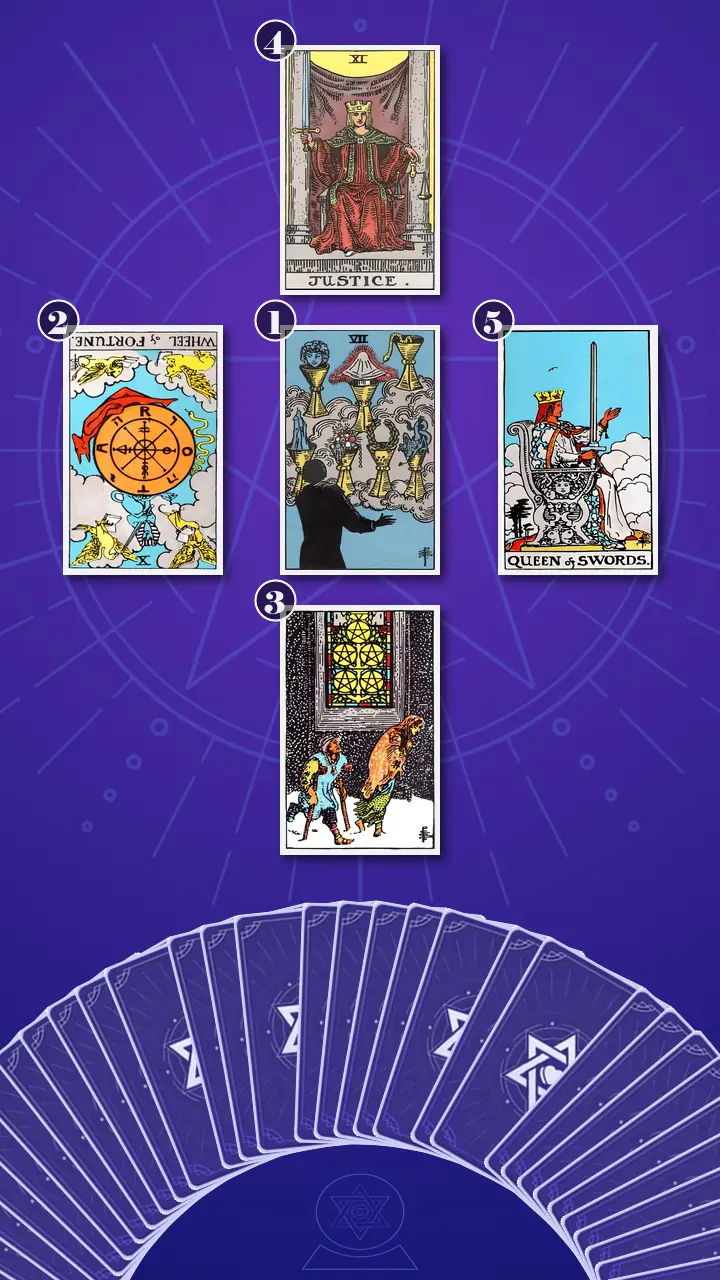
I chose The Shadow Spread, a five-card layout arranged like a compass. For anyone wondering how tarot works in a relationship reading, I use it here as a structured cognitive tool. It does not reveal another person's secret motives or predict a fixed outcome. It organizes attention so that fantasy, repetition, fear, evidence, and personal agency can be examined separately before they are put back together.
This was the smallest spread that could answer Maya's question without adding unnecessary future positions. The centre would show the current shadow behavior. The card to its left would identify the recurring force maintaining the cycle. The lower card would reveal the fear underneath it. Above the centre, the fourth card would show the truth or capacity Maya could reclaim. The final card on the right would translate that clarity into a daily practice.
I told her the layout would move from emotional image, to recurring motion, to the fear of exclusion, then upward into discernment and outward into a boundary. “Think of it as a compass rather than a forecast,” I said. “The cards can show where you are standing and what has been pulling you off course. You still decide where to go.”
Reading the Relationship Highlight Reel
Position 1: Seven of Cups and the Future Outside the Frame
“The card I am turning over now represents the current shadow behavior: idealizing peak moments, reunion energy, and imagined potential while minimizing the recurring lack of steadiness.” I placed it in the centre. “This is the Seven of Cups, upright.”
I pointed to the dark figure facing seven cups suspended on clouds. Each cup contains a different emotionally charged possibility: treasure, victory, danger, mystery, an idealized future. The figure is solid, but the visions are not grounded. In Maya's life, those floating cups looked remarkably like a phone screen filled with a tender new message, holiday photos, a shared playlist, an imagined apology, and several possible explanations for why the relationship might finally work.
“This card does not say the connection is imaginary,” I explained. “It shows imaginal energy in excess. Your attention is taking real moments and rapidly promoting them into evidence for futures that have not yet been tested by sustained behavior.”
I compared it to an algorithm trained only on the posts someone lingers over. Every replayed peak teaches attention to serve more of the romance and less of the aftermath. The camera roll preserves the golden-hour weekend, but it has no photograph of the three nights of disrupted sleep that followed. Like the emotionally intense edit in Normal People, the depth of the connection remains easy to feel while the practical conditions that interrupt steadiness slip outside the frame.
“The last time you reopened the photos,” I asked, “which moments did you replay, and which conversations or consequences did you scroll past?”
Maya gave one sharp laugh. Her thumb stopped rubbing the edge of her phone; her eyes shifted away from the screen as if an old sequence were replaying somewhere beyond it; then a long breath left her chest. “That is so accurate it feels a little brutal,” she said. “I remember the chemistry faster than I remember the aftermath.”
“Accurate does not have to mean accusatory,” I replied. “Selective memory often protects something tender. The work is not to shame yourself for loving the photograph. It is to notice when the photograph starts functioning like a contract.”
I asked her to try one distinction: “The feeling was real. The imagined future is not yet verified.” She repeated it quietly, without sounding fully convinced, but she no longer looked away from the card.
Position 2: The Reversed Wheel and Movement Without Development
“The card I am turning over now represents the recurring force maintaining the shadow: renewed contact being interpreted as a fresh beginning even when the underlying conditions remain unchanged.” I placed the card to the left. “This is the Wheel of Fortune, reversed.”
The figures around the wheel were moving, rising, falling, and returning, but they were not arriving at a stable destination. Reversed, the Wheel showed a blockage: recurrence was producing so much motion that motion itself had begun to feel like relational development.
I brought the symbol into Maya's week. After nine quiet days, the chat becomes affectionate again. By the next afternoon, she is texting between edits to a campaign deck and considering weekend plans. Her body registers relief and restart before either person reviews why the previous phase ended, what consistent contact would mean, or how a rupture would be handled differently.
“It is like reopening the same group chat under a new name,” I said. “The notification looks new, but the participants, expectations, and unresolved issue are still there. Movement is not the same as development. A warm return is not a changed pattern.”
I was careful not to frame the Wheel as fate. “This is not a sentence saying you are doomed to repeat anything. A visible cycle is more workable than an invisible one. The question is simply: what specific condition is demonstrably different this time?”
Maya's shoulders rose toward her ears. She counted silently on her fingers, then lowered her hand. “The message changes,” she said. “Sometimes it is ‘I miss you,’ sometimes it is a meme, sometimes it is an apology. But we never actually define what we are restarting.”
I nodded. “That is the difference between renewed contact and changed structure. You do not need to deny the warmth. You need enough time to see what the warmth is followed by.”
Position 3: The Five of Pentacles Outside the Warm Window
“The card I am turning over now represents the hidden fear beneath the romanticization: the possibility that losing the bond will feel like proof that you were not chosen or were not worthy of lasting care.” I placed it beneath the centre. “This is the Five of Pentacles, upright.”
I showed Maya the two figures moving through snow beneath an illuminated stained-glass window. Their strained bodies make the cold visible. Warmth exists nearby, but from their position it is hard to perceive, trust, or access.
In this position, the card described an over-amplified scarcity signal and a deficiency of felt security. It did not tell me Maya lacked love in her life. It showed why reassurance from this particular person could outweigh support that was steadier but did not answer the same wound.
I returned to a Sunday evening she had described. Her takeaway was cooling by the window. The radiator clicked; TikTok served anniversary edits and “when you know, you know” couple videos; the phone remained dark. When a small affectionate check-in finally appeared, the relief was immediate and physical. For a moment, replying was less like evaluating a relationship and more like getting inside from the cold.
“One incoming notification can work like a portable heater during a cold emotional night,” I said. “The warmth is real, but it does not repair the building. Do you want this specific form of connection in that moment, or do you need the pain of feeling unchosen to stop as quickly as possible?”
Maya's breath caught. Her fingers curled against her sleeve, her gaze softened and lost focus, and then she released a quiet sound from deep in her chest. “Both,” she said. “That is the part I do not like admitting. I miss them, but I also want the message to prove I still matter.”
“Both can be true,” I said. “Naming the second need does not cancel the first feeling. It gives you another way to care for yourself before the relationship becomes the only doorway to warmth.”
The radiator behind her clicked once and fell silent. Against the Five of Pentacles' snow, the small domestic sound felt almost exact: warmth was present in the room, even while her attention had been trained on the window.
When Justice Lowered the Emotional BPM
Position 4: The Scales That Let the Aftermath Count
“The card I am turning over now represents the truth and inner resource you can reclaim: the capacity to weigh the complete behavioral pattern as carefully as chemistry, memory, and hoped-for potential.” I placed it above the centre. “This is Justice, upright, and it is the key card of this reading.”
The figure sat between stone columns, holding balanced scales in one hand and an upright sword in the other. The scales made room for complexity; the sword named what the full evidence supported. Here, the energy was balanced rather than excessive or blocked. Justice did not erase emotion. It refused to let one emotionally vivid category monopolize the assessment.
I named the pressure Maya had been living inside: at 11:40 p.m., the warm message glowed above the boundary note, and her body registered reunion as relief before her mind could ask what had changed. She had been treating that immediate lift as evidence because pausing felt dangerously close to losing the connection.
A reunion can prove that the feeling is real; only a repeated pattern can show whether the relationship is steady.
I let the words settle. A streetcar bell sounded faintly through her window, then the room became quiet enough for me to hear her breathing through the call.
In ten years of studying sound and emotional rhythm, I have learned to listen for dissonance that exists beneath the words. Looking at Justice, I thought of two audio tracks that were beautiful in isolation but never held the same tempo when played together. The reunion language ran fast and bright, almost at 140 beats per minute. The follow-through arrived in another time signature: slower, irregular, sometimes absent.
I call this a Communication Dissonance Audit. I do not begin by deciding which words were false. I listen for whether the emotional tempo of affection matches the practical frequency of availability, repair, kept plans, and explicit agreement. A sincere high note can still sit inside an unstable composition. Justice asks whether the whole piece has a rhythm Maya can actually live inside.
I turned the scales toward the two columns already waiting in her Notes app: chemistry, tenderness, apologies, and future plans on one side; response patterns, follow-through, repair, explicit agreements, and the aftermath of each reunion on the other.
Then I gave her the sentence the entire spread had been building toward.
You do not need to treat chemistry as proof; let repeated behavior carry more weight than imagined potential, as Justice's scales weigh what is actually there.
Maya's breath stopped. Her fingers froze above the keyboard, and for several seconds her face held the blank stillness of someone whose mind had reached a sentence before the rest of the body was ready to follow. Her pupils widened. Her gaze slipped toward the old photos open in another tab, as if she were replaying each reunion with the following week restored to the edit. Then color rose along her cheeks. Her jaw tightened before it trembled, and her eyes filled without spilling over.
“But doesn't that mean I was wrong every time?” she asked, the words sharper than anything she had said so far. “Doesn't it mean I made all of it bigger than it was?”
Her shoulders stayed rigid for one more breath. Then her hands slowly opened on the desk. The next exhale came unevenly, carrying relief and anger together. Her shoulders dropped, but she looked briefly unsteady, almost as if putting down the old explanation had left her unsure what to hold instead.
“No,” I said. “It means you responded to genuine tenderness and then made a prediction the tenderness could not verify on its own. That is not the same as inventing the relationship or being foolish. Justice is not asking you to prosecute your past self. It is asking you to update the standard available to your present self.”
I leaned slightly closer to the screen. “Now, using this new perspective, think back to last week. Was there a moment when this insight could have made you feel different?”
Maya remembered telling a friend that the latest reunion felt unusually honest. Her friend had asked what agreement had changed, and Maya had immediately started explaining the other person's inconsistency instead of answering. “I felt attacked,” she said. “But she was only asking what was different. I did not have an answer.”
“That moment was not proof that your hope was wrong,” I said. “It was an invitation to let the rest of the evidence enter the room.”
I asked her to open a new note and spend seven minutes making two columns: What the reunion makes me imagine and What has repeatedly happened after reunions. She added three items to each. Under imagination, she wrote we finally understand each other, the timing is better, and the intensity means we will find a way. Under repetition, she wrote daily contact resumes before we discuss the rupture, plans become vague after the first week, and I ask for clarity only after I am already deeply re-invested.
I told her she did not have to send the note, contact anyone, or decide the relationship's future. If the exercise became too activating, one item per column was enough, and closing the note was also an acceptable choice. She circled one observable condition: a direct repair conversation before returning to daily emotional closeness.
This was the first visible crossing from reunion-driven longing and selective hope toward evidence-based discernment, grounded self-respect, and steadier boundaries. The clarity did not make her feelings smaller. It made her decision standard larger.
Position 5: The Queen of Swords Sets the Access Level
“The final card represents conscious integration: defining, communicating, and consistently applying your own conditions for steady, reciprocal closeness.” I placed it to the right. “This is the Queen of Swords, upright.”
I drew Maya's attention to the Queen's vertical sword and open left hand. The sword defines a precise standard. The open hand remains willing to receive dialogue and new information. Together, they show that a boundary can be clear without becoming cold, punitive, or controlling.
The Queen's Air energy was available in balance, but Maya had not been using enough of it during the reunion surge. She often replaced one clear sentence with six explanatory paragraphs, hoping that enough context would prevent rejection. The extra language softened her own standard until it sounded like a request for permission.
“The Queen is not asking you to harden,” I said. “She is asking you to set account permissions. Warmth does not require granting someone administrator access to your time, sleep, attention, and emotional energy.”
I offered a possible sentence: “I am open to talking, but I am not returning to daily emotional closeness without a direct conversation about consistency.”
“A boundary defines your participation; it does not control theirs,” I added. “They remain free to respond, decline, or offer something different. You remain free to observe what happens before changing your access level.”
Maya deleted a draft that filled most of her phone screen and replaced it with the single sentence. Her lips pressed together, then softened. She did not send it. She simply read it aloud and placed the phone face down.
That modest gesture matched the elemental story of the spread. Water had flooded the opening through memory and fantasy. Earth had revealed the concrete fear of being left outside. Air had brought assessment and language. Fire was absent, which told me a dramatic confrontation was not the immediate answer. The next useful move was small, deliberate, and hers.
The Whole-Pattern Evidence Check
I gathered the five cards into one coherent story. The reversed Wheel showed the recurring influence: every return generated motion before the conditions of the relationship were reviewed. The Seven of Cups showed the present shadow: Maya's relationship highlight reel turned emotionally true memories into several unverified futures. The Five of Pentacles revealed why the pattern carried so much force: renewed warmth temporarily quieted the fear of being unchosen. Justice restored the full record, and the Queen of Swords translated that record into a standard Maya could communicate and apply.
The cognitive blind spot was not that Maya cared too much. It was that relief had been promoted into evidence, while inconsistency had been demoted into context. She also assumed that letting the aftermath count would somehow invalidate the tenderness. The cards showed a more honest option: chemistry and disappointment could sit on the same scale. Neither needed to erase the other.
The transformation was therefore not from loving to not loving, or from staying to leaving. It was the shift from treating intensity and imagined potential as proof to tracking consistency, reciprocity, repair, and observable behavior before increasing emotional investment. That left Maya free to pause, continue, renegotiate, or step back according to her own values. The tarot offered a map; it did not claim the steering wheel.
I gave her three next steps. Each was intentionally small enough to use during an ordinary workweek, because actionable relationship advice is only useful when it survives contact with a real lunch break, a late-night notification, and a tired nervous system.
- The Seven-Minute Justice Note During one lunch break this week, open Notes and make two columns titled “What I imagine” and “What has repeated.” Add three items to each, using dates, actions, agreements, and outcomes. Circle one observable marker of steadiness, such as kept plans, direct repair after conflict, or communication matching an explicit agreement. Keep the note private and factual. If seven minutes feels like too much, write one item per column and stop. This is a clarity tool, not a legal case against anyone.
- The Syncopation Pause When an affectionate message arrives after silence, place a three-second rest between the notification and your response. Notice the nearest sound, feel both feet, and breathe out before touching the keyboard. Then, if useful, set a ten-minute timer and ask: “What am I feeling? What am I imagining? What has actually changed?” The pause is not a tactic for producing their reaction. It lowers your emotional BPM long enough to hear your own. If ten minutes feels unrealistic, the three-second version still counts.
- The One-Sentence Consistency Boundary Draft one sentence that names your participation choice in behavioral terms: “I am open to talking, but I am not returning to daily emotional closeness without a direct conversation about consistency.” If contact resumes, communicate it once through the channel you normally use, or keep it private until speaking feels useful. Avoid adding follow-up paragraphs simply to relieve the discomfort of waiting. The other person can choose their response; you can choose how much access to offer while you observe behavior over time.
I reminded Maya that none of these practices required an immediate breakup, reunion, confrontation, or final answer. Finding clarity can begin with better information and one changed behavior. A small pause is still a change in participation. A private note is still evidence that the old rhythm is no longer running entirely unnoticed.

Five Days Later: The Quiet Proof
Five days later, I received a message from Maya. Another affectionate check-in had arrived after a quiet stretch. She told me she heard the radiator, used the three-second Syncopation Pause, and noticed three sensations before interpreting the sender's intent: heat in her palm, a lift beneath her ribs, and tension across her jaw.
She waited ten minutes, opened the Justice note, and asked which condition was demonstrably different. She still wanted to answer warmly, so she did. This time, she also used the one-sentence boundary. She did not add the usual six paragraphs, apologize for needing consistency, or turn the reply into proof that the relationship had changed.
The response she received was affectionate but vague. Maya did not call that a failure, and she did not translate it into resolution. She wrote back to me, “I am sad, but I did not abandon my own question just because they were warm.”
She slept through the night. At breakfast, her first thought was still, “What if I ruined it?” She said she smiled, not because the fear had disappeared, but because she could hear it without letting it set the tempo.
That was the quiet proof of her Journey to Clarity. The cards had not changed the relationship, predicted its outcome, or rescued her from grief. Maya had changed the quality of her attention. She let tenderness remain tender, let the aftermath remain visible, and reclaimed the right to decide what conditions made closeness sustainable for her.
When one warm message makes your chest lift after days of silence, it can feel almost impossible to separate wanting that person from wanting proof that you were worth choosing all along. If that happens, I hope you remember that noticing the two needs is already a change in rhythm; you do not have to silence either one to hear yourself more clearly.
If your feelings no longer had to audition as proof of the relationship's potential, what one small, repeatable beat of consistency would you feel curious about letting matter next?