Keeping the 2:18 Break: From Continuous Effort to Steady Return
The 2:18 p.m. Break That Never Happened: The Earned-Rest Trap
If you are an early-career knowledge worker whose calendar contains breaks you never actually take, the earned-rest trap may begin the moment one unfinished Jira ticket makes you click 'Dismiss.' I met Jordan on a hybrid-work Tuesday, and the pattern was already plain: she kept postponing scheduled work breaks until tasks were finished, then wondered why depleted attention made follow-through unreliable.
At 2:18 p.m., Google Calendar chimed for ten minutes. I watched Jordan move her untouched lunch beside the keyboard, feel the heat of the laptop beneath her palm, and open another project ticket while the fan whirred. The dressing in the container had gone cold and faintly acidic; her shoulders had climbed almost to her ears. Her eyes moved across six tabs, but the acceptance criteria on the first ticket remained unfinished.
She looked at me and said, "I know the break would help, but it never feels earned yet. If I stop now, I will lose the whole day." She wanted dependable follow-through, yet believed every pause had to wait until the work was complete. Her guilt-laced urgency felt to me like holding one long breath through an entire calendar block and calling the dizziness commitment.
I did not hear laziness in her story. I heard ambition being asked to operate without oxygen, while LinkedIn wins, green Slack dots, and the cost of living in Toronto quietly turned an ordinary lunch into a private trial about worth. I told her, "You are not here to prove that you can suffer efficiently. Let us look at the pattern with care and draw a map through it. This is our Journey to Clarity: the cards can offer a clear outside view, but you will decide what the next scene becomes."
The Grid Beneath the Unfinished Ticket
I asked Jordan to take one slow breath, notice the question without trying to solve it, and let the shuffle create a small transition between reacting and observing. I use that moment for focus, not for supernatural suspense: it gives the mind a defined doorway into the conversation.
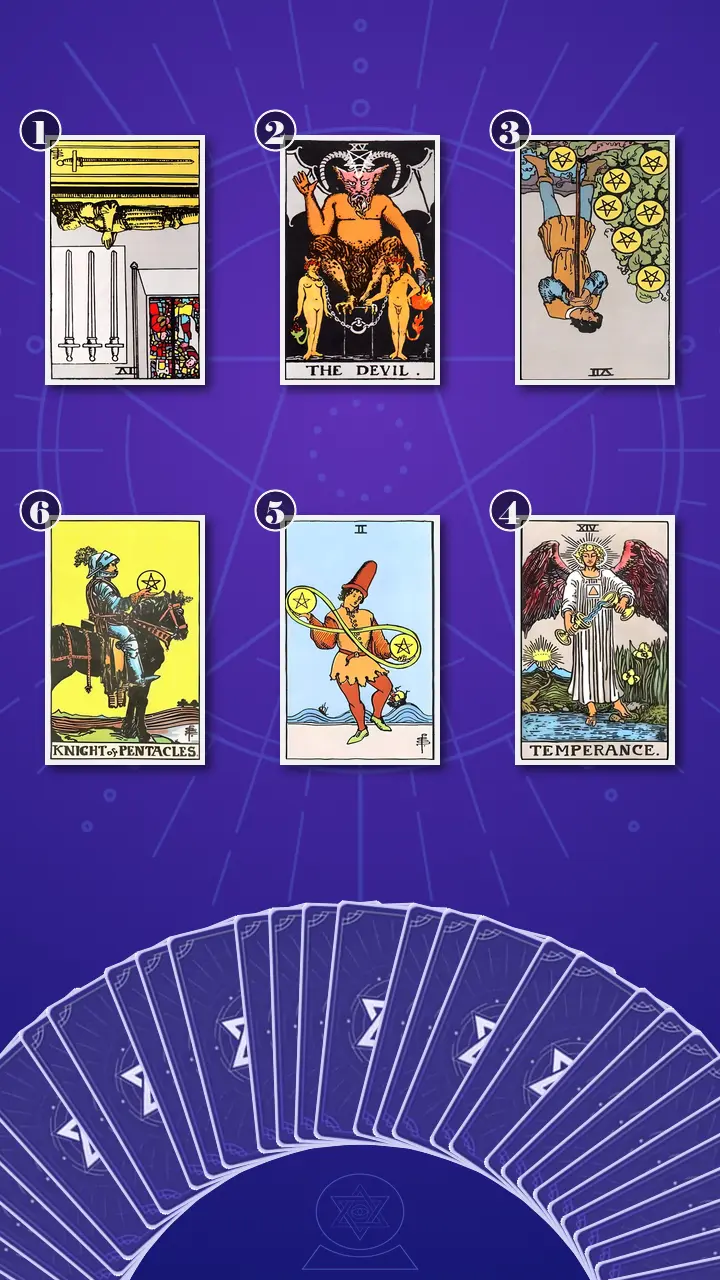
For this reading, I chose the six-card Transformation Path Grid · Context Edition, an RWS tarot spread designed to follow a self-reinforcing loop from symptom to integration. The question was not simply why Jordan skips lunch. It was why postponing rest seems to promise reliable performance while gradually making reliable performance harder.
I explained the rationale to the reader as well as to Jordan. A past-present-future spread would flatten a feedback cycle into a timeline. A shadow spread could reveal the belief, but it would not separately hold the observable behavior, the practical experiment, and the integrated capacity. This six-card grid lets tarot work as an external cognitive tool: the images create distance from a familiar rule, and real evidence from Jordan's workday decides whether the interpretation fits.
The upper row would show the visible symptom, the immediate productivity rule, and the root calculation that keeps the rule alive. The lower row would reveal the catalyst, the practical action, and the potential integrated state. I told Jordan that the fourth position was especially important: it would ask whether rest and execution could become coordinated parts of one process instead of rival claims on the same hour.
Reading the Loop on the Screen
Position 1: The Desk That Refused to Become a Resting Place
I turned the first card and said, "This position presents the observable current-state behavior: dismissing breaks, extending work blocks, and losing the attention required for follow-through." The card was the Four of Swords, in reversed position.
In the RWS image, a figure lies still inside a protected chamber beneath three suspended swords, with one sword held beneath the resting body. Reversed, the chamber becomes a place Jordan can see but cannot permit herself to enter. At 2:18, she remained physically seated at her desk, but the desk was no longer producing restorative stillness. She moved her lunch closer, dismissed the notification, and opened another ticket while her eyes struggled to hold a line of text.
This was blocked recovery and restless overextension, not a lack of commitment. The excess was continued activity; the deficiency was permission to let attention settle. Staying at the desk is not the same as staying effective. The unfinished list keeps moving the finish line for permission to stop, so every new task briefly feels like discipline and quietly extends the depletion.
The scene reminded me of the workplace unease in Severance, where ordinary human limits can be treated as operational inconveniences. Jordan was not split into two selves, but she had begun acting as though the body asking for food belonged to an inconvenient version of her, while the professional version had to remain available.
Jordan gave a short, bitter laugh. "That is too accurate. Almost rude."
I let the laugh stay in the room. "The card is not accusing you," I said. "It is showing the exact moment a useful pause gets relabelled as an unearned reward. For three workdays, we can observe that moment without turning it into another character test." She looked down at the card, rubbed one thumb along the rim of her mug, and exhaled sharply as recognition loosened the first layer of self-blame.
Position 2: The Loose Collar of Continuous Effort
I turned the second card and said, "This position identifies the immediate rule that blocks change: continuous effort is treated as proof of worth, while a pause feels like lost ground." The card was The Devil, in upright position.
The Devil can represent bondage, compulsive attachment, and material preoccupation, but I did not read it as an omen or an external force controlling Jordan. I pointed to the two figures and the collars around their necks. The chains were visible, but the collars were loose enough to remove. That distinction mattered. Toronto rent, career stability, workplace expectations, and comparison pressure were real. Yet the sentence "If I stop before the list is empty, I am unreliable" was not literally written into her employment contract.
Jordan told me that a LinkedIn promotion post at 8:07 that morning had tightened something in her jaw. A creator's before-work run and a green Slack status had made her lunch break feel like evidence that she was not ready for the next level. Her productivity feed had learned what activated her insecurity and kept serving routines that made ordinary limits look like personal failure. The rule offered a short-lived feeling of virtue and control, then asked for another sacrifice.
"A rule can feel compulsory long after it has stopped being useful," I said. "The pressure around you may be real, but we should separate an actual incident or deadline from a command you keep enforcing on yourself."
Jordan's chest tightened first. Her hand moved toward the calendar as if to dismiss another alert, then stopped halfway. She stared at the loose collar and said, "Nobody at work has actually told me to skip lunch. I just feel as if they could notice if I did not." I nodded. "That is the difference we can investigate: external expectations versus participated-in self-surveillance."
Position 3: The Four-Minute Return on Investment
I turned the third card and said, "This position exposes the root calculation beneath delayed gratification: you trust visible effort more than the delayed, less visible return produced by recovery." The card was the Seven of Pentacles, in reversed position.
In the upright image, a worker leans on a tool and studies a crop, allowing time to reveal what the labour has produced. Reversed, Jordan became the worker checking the timer four minutes into a break and deciding the crop had failed. At 3:36, the HVAC had hummed, her coffee had gone lukewarm, and she still felt tired. She ended a planned twelve-minute pause because it had not created an instant feeling of renewal, then spent thirty-five later minutes rereading and correcting a rushed project update.
This was excess impatience and a deficiency of delayed trust. Jordan credited every visible minute at the laptop immediately, while the cost of depleted attention stayed off the dashboard. She measured the break by whether it felt good in the moment, but she did not measure the accuracy, completion, or rework that followed. Recovery fails the test only when you demand its result before the next task begins.
My artist's mind flashed to a rough cut in a film currently in production. I have learned that a scene can look worse when I stop editing it, because the pause exposes all the unfinished edges. But the pause is what lets me see which cut serves the whole sequence. I told Jordan, "You are asking a recovery interval to deliver its review before the next scene has even played. That is not a fair test of the interval."
She went quiet. Her fingers hovered above the edge of her phone, and her eyes briefly lost focus as if she were replaying every break she had ended early. Then she said, "I keep optimizing the schedule instead of following it." I watched her shoulders drop by a fraction. The faulty return-on-investment calculation had become visible, and visibility gave us something practical to test.
When Temperance Poured a Way Back
Position 4: Temperance, Upright - The Antidote
The room grew quieter when I moved to the lower row. I said, "This position introduces the key cognitive transformation: rest and execution become coordinated parts of one process rather than mutually exclusive choices." The card was Temperance, in upright position.
Temperance showed a continuous stream moving between two cups. One foot touched land and the other touched water; behind the figure, a path led toward a bright horizon. I read this as measured self-trust, proportion, patient experimentation, and a deliberate handoff. The card did not ask Jordan to abandon deadlines or become endlessly unstructured. It asked what the next task needed from the pause before it.
I used my signature Hero's Journey Alignment lens here. Jordan was in the classic Refusal of the Call before a major character evolution, but the call was not to work harder or leap into a new identity. It was an invitation to stop proving her worth through strain and accept a new role in the story: the person who protects the conditions that make her promises repeatable.
My Vision Actualization lens sharpened the same point. The limiting narrative said, "I am not ready for the next stage because I cannot maintain constant output." I offered a more useful draft: "I am ready to practice a rhythm that lets me return." The next stage would not begin as a dramatic transformation. It would begin as one planned pause that she allowed to count.
I named the setup plainly: the reminder appears at 2:18 while one project ticket is still open. Jordan dismisses it, moves lunch closer to the keyboard, and promises to stop after one more task. Forty minutes later, the ticket is still there, but her attention is not.
I placed my finger between the two cups and said:
You do not have to earn recovery by emptying the list; build recovery into the method, as Temperance makes progress by pouring continuously between two cups.
I let the silence hold the sentence. Then I gave her the shorter, more portable version: A break is not payment for proving you worked hard enough; it is part of the infrastructure that makes your follow-through repeatable.
Jordan's first response was not relief. Her breath stopped, her fingertip hovered above the card, and her jaw tightened as if she were preparing to defend every skipped lunch. "But does that mean I have been doing it wrong for years?" she asked. I said, "It means the strategy was trying to protect your reliability with the only evidence it trusted: visible effort. We are allowed to update a strategy when its cost becomes clear."
I watched the rest of the reaction arrive in layers. First, her eyes fixed on the two cups while her fingers curled against her knee; for a few seconds, her body seemed to freeze around the old command. Then her gaze moved beyond the card, replaying the 2:18 chime, the cold lunch, the six tabs, and the late-afternoon corrections. She was no longer seeing isolated lapses; she was seeing a loop. Finally, her hand opened, her shoulders sank, and a rough breath left the centre of her chest. She sat taller, though a brief blankness crossed her face, the light dizziness of discovering that a clear path still required her choice. Her eyes shone, and her voice came out low and unsteady: "I could stop without leaving the work behind." Now I asked her to use this new view to remember last week: was there a moment when this insight might have made the next task feel different?
She named Tuesday's product update, where she had spent nearly an hour rereading a sentence she could have drafted in ten focused minutes. That was the first movement from guilt-laced urgency and earned-rest thinking to measured self-trust and sustainable follow-through. The cards had not made the decision for her; they had helped her notice where the decision already lived.
Position 5: The Focus-Pause-Return Loop
I turned the fifth card and said, "This position converts the reframe into a one-week behavioral experiment involving defined focus blocks, protected breaks, and explicit re-entry actions." The card was the Two of Pentacles, in upright position.
The two pentacles were joined by an infinity-shaped ribbon, and ships moved across uneven waves behind the figure. I translated the image into a visible Google Calendar rhythm: focus, pause, re-entry, then repeat as conditions change. The workday would still contain meetings, Slack messages, and shifting priorities. Flexibility did not mean deleting every boundary whenever a wave arrived.
I said, "You do not need a perfect schedule; you need a way back into the task." Jordan looked at her calendar and imagined a thirty-minute focus block followed by ten protected minutes and one clearly named restart. If a genuine priority changed, she could move the cycle deliberately. An unfinished list alone would no longer have unlimited authority to cancel it.
She opened her phone and began typing a sample event. Her thumb paused over the title, then she entered, 'Part of the block: reset and return.' The movement was small, but it changed the break from an optional reward into a visible part of the work method.
Position 6: The Quiet Reliability of the Knight of Pentacles
I turned the final card and said, "This position depicts the integrated capacity you are trying to build: patient, sustainable follow-through that does not depend on remaining continuously active." The card was the Knight of Pentacles, in upright position.
The horse stood still. The knight held one pentacle steadily in view, and cultivated fields stretched across the background. There was no dramatic sprint and no green Slack status glowing like a medal. The stillness was the point: dependable progress comes from surveying real conditions, protecting capacity, and returning by a method that can survive an ordinary workday.
I told Jordan, "The promise is not that you will never stop. The promise is that you know how you will continue." She considered the difference between today's visible intensity and tomorrow's available capacity. The Knight offered a quieter definition of discipline: complete a defined block, take the pause you planned, return at the agreed time, and judge the day by delivered work, reduced rework, and a viable next step.
Jordan nodded once, slowly. I could see that the idea appealed to her and also disappointed the part of her that wanted a dramatic proof of change. A repeatable commute is rarely thrilling, I said, but its value is that it gets you where you said you were going. The same can be true of follow-through.
Finding Clarity in a Method That Lets Work Continue
When I laid the six cards back into their grid, the story became coherent. The reversed Four of Swords showed the symptom: a body seated at a desk but denied recovery. The Devil showed the rule: continuous effort had become a moral bargain, intensified by comparison and career stability anxiety. The reversed Seven of Pentacles showed the faulty calculation: Jordan demanded instant proof from rest while allowing the delayed costs of depletion to disappear. Temperance interrupted the loop by making recovery an input to execution. The Two of Pentacles gave that insight a calendar shape, and the Knight of Pentacles offered the direction of steady return.
I told Jordan that her cognitive blind spot was not simply working too much. It was treating continuous activity as evidence of discipline while treating recovery as suspicious until it could prove its value in advance. The core contradiction was more precise: she wanted reliable follow-through, yet kept withholding the condition that made reliable follow-through possible.
The shift I wanted her to test was simple: before each focus block, schedule a ten-minute break as one required step in completing the block, then record its effect on follow-through during the next task. That is the practical heart of the Transformation Path Grid: a symptom-to-integration map becomes useful only when it produces observable evidence.
I also returned to my Vision Actualization practice and my Character Bible Directive. I asked Jordan to write the psychological and behavioral specifications of the future self she wanted to embody now, not someday after the list was empty. This future self was not more heroic because she never paused. She was the character who could protect a handoff, tolerate a little unfinishedness, and return with a clear next action.
The Two Small Experiments
I gave Jordan two low-friction actions. Neither required rebuilding her life, ignoring a genuine deadline, or pretending that workplace pressure was imaginary.
- Make recovery part of one focus blockOn one recurring afternoon block this week, add a thirty-minute focus event followed immediately by a ten-minute calendar event titled 'Part of the block: reset and return.' At the start, choose one Jira ticket or acceptance-criteria task. When the break begins, leave the laptop in place, take water to another room or office area, and do not use the pause to clear Slack or email. When you return, mark the next task as easier, harder, or unchanged.Tip: If ten minutes feels inaccessible, use a two-minute minimum: stand up, look away from the screen, and return at the time you chose. Move the break only for a real incident or time-critical commitment, not because the unfinished list is visible.
- Leave a handrail for re-entryThirty seconds before stepping away, write one line in the calendar description, a sticky note, or the Jira comment: 'When I return, I will open X and do Y for five minutes.' Then use the Character Bible Directive to write two sentences describing future Jordan's behavior: she ends the block on purpose, and she trusts one clear restart more than six anxious tabs. Repeat this on three ordinary workdays.Tip: Do not build a new Notion system to manage the experiment. The one-line re-entry note is enough. If a meeting disrupts the cycle, move it and continue from the next available block rather than compensating with a harsher schedule.
I asked her to treat the results as information, not a verdict. A break might make the next task easier, harder, or unchanged. All three answers would teach her something. The goal was not to become perfect at resting. It was to learn whether a protected pause and clear re-entry could support sustainable completion better than one long breath held until the end of the day.

A Week Later, the Quiet Proof
Five workdays later, I received a message from Jordan: "I left the re-entry note, took the break, and came back to the acceptance criteria. The next task was easier to name. Not magically easy, just easier to start." I read the message twice. She had not solved her workload or eliminated every urgent afternoon. She had created evidence that her own experience could answer a question that productivity culture had kept turning into a moral trial.
That week, she slept through the night, but woke with the familiar thought, "What if I am wrong?" The question remained. This time she smiled, opened the calendar, and kept the break. The change was clear but vulnerable: a full night's rest, a small doubt, and a chosen return.
I told Jordan that the cards had not rescued her from responsibility. They had helped her distinguish responsibility from self-surveillance, and effort from effective follow-through. The six-card Transformation Path Grid had offered a structure, but Jordan had supplied the observation, the experiment, and the decision. The querent is the one who holds the pen.
When one unfinished task makes your shoulders rise and your lunch go cold, the hardest part is not simply being tired; it is feeling that stopping might reveal you as less reliable, even as refusing to stop makes reliability harder.
If one planned pause could count as part of keeping a promise to your next task, what might you become curious enough to notice when you return - the first acceptance criterion, the tabs no longer multiplying, or the quiet proof that your own rhythm can carry you?