Moving One Lamp: From Home-Change Paralysis to a Usable Corner

The Shared Rental That Stayed in Draft Mode
If Sunday Scaries arrive with a Notes app full of repair reminders, shopping links, and room-reset videos while the same half-unpacked box stays in the corner, the problem can feel less like a lack of ideas and more like a fear of choosing wrong.
When I met Jordan, a 27-year-old communications coordinator in Toronto, it was 6:12 on a Sunday evening. They were sitting at the small kitchen table in their shared rental, scrolling through a list titled “Apartment fixes.” I could hear the radiator clicking through our video call. A delivery flyer crinkled under their wrist, the fluorescent light buzzed overhead, and three narrow shelving units waited in separate browser tabs while two boxes remained open against the wall.
“I keep waiting for the room to feel like mine before I do the thing that might help it feel like mine,” Jordan said. They rubbed one side of their jaw and looked past the screen toward an awkward corner. “I don’t need a perfect home, but I keep acting as if I need a perfect plan.”
The contradiction was painfully clear. Jordan wanted to feel settled through small home changes, yet the uncertainty of the rental made every purchase, repair, or rearrangement feel like a vote on the apartment’s entire future. Their frustration seemed to sit inside their body like a drawer jammed half-open: not dramatic enough to stop the day, but catching on every movement through the room.
I told them, “I don’t hear laziness in this. I hear someone trying very hard not to create another unfinished thing that might feel like evidence against them. Let’s not ask the cards to judge your home or predict whether it will become permanent. Let’s use them to draw a clear map of the loop, then find one place where you still have room to move.”

Choosing a Map for the Procrastination Loop
I invited Jordan to put both feet on the floor, take one unforced breath, and hold the question in plain language: “Why do I keep delaying home changes that could help me feel settled?” I shuffled slowly. The ritual was not about summoning certainty; it was a transition from being immersed in the problem to observing it.
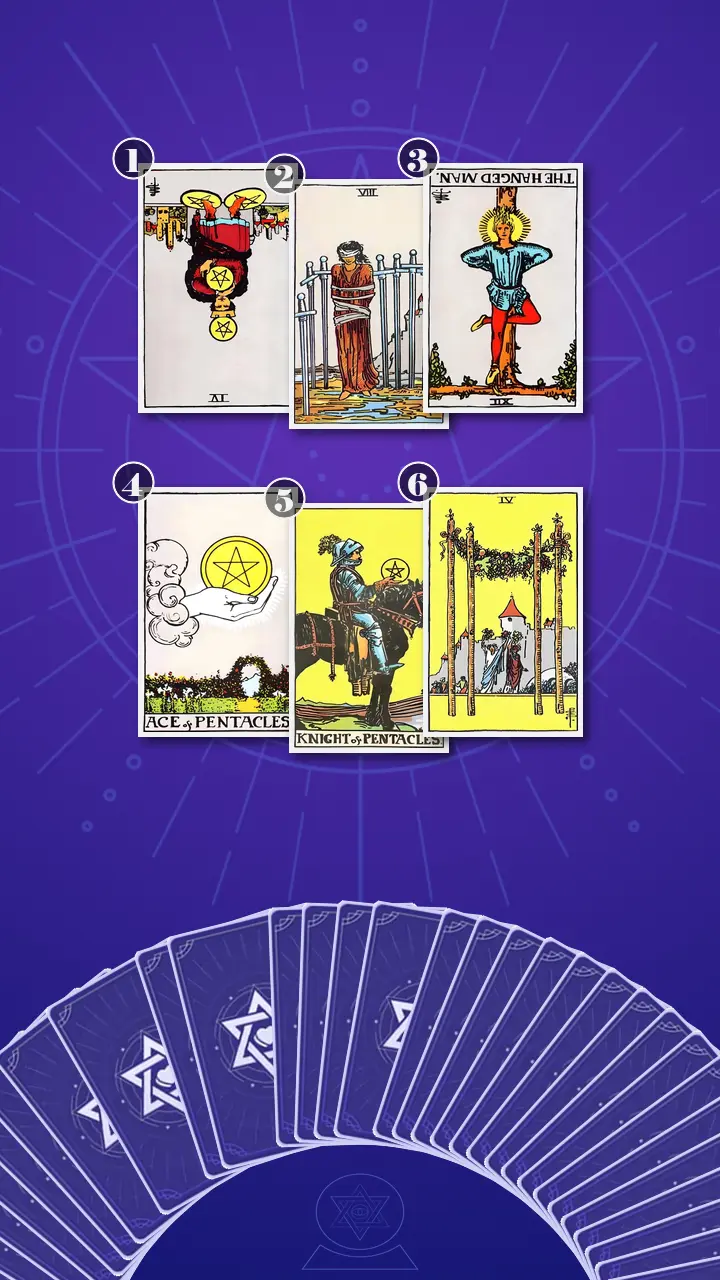
I chose the Transformation Path Grid (6) · Context Edition, arranging six cards in two rows of three. For anyone wondering how tarot works in a situation like this, I use the cards as a structured cognitive tool. I do not use them to prove a hidden truth or issue instructions. The symbols externalize a pattern so I can compare fears, facts, habits, and available choices with the person sitting in front of me.
This six-card tarot spread fit Jordan’s question because the issue was not a choice between two competing options, and it was not a request for a future prediction. It was a self-reinforcing system: instability encouraged protective postponement, postponement preserved the environmental friction, and that friction appeared to confirm that change was too difficult. A larger spread would have added context without necessarily adding clarity.
The top row would show the closed loop. The first position would reveal the visible delay in Jordan’s daily environment; the second would identify the protective procrastination belief; the third would expose the condition Jordan believed had to be met before action was safe. The bottom row would open the route forward: a tangible catalyst, a repeatable method, and the kind of present-tense belonging that might grow through consistent, imperfect care.
I placed my fingertips near the gap between the third and fourth cards. “This hinge matters,” I said. “We’re going to look for the exact point where waiting can become an experiment.”
Reading the Closed Loop
Position 1: Security Kept Everything in “Not Yet”
“Now I’m turning over the card for the current presentation,” I said, “the observable delay and the way the unsettled physical environment keeps entering your daily routine.”
The first card was the Four of Pentacles, reversed.
In the Rider-Waite-Smith image, the figure grips one coin to the chest while two more pin the feet in place. Reversed, the card showed blocked earth energy: Jordan’s understandable attempt to protect material security had become so strained that nothing could settle into a dependable form.
In context, this looked exactly like the shared Toronto rental. A lamp stayed against the wall instead of moving to the dim corner where it was needed. A box remained half-unpacked. Keys, mail, reusable bags, and headphones migrated between the kitchen counter, a chair, and the floor. Jordan checked measurements and prices, but choosing one arrangement felt like surrendering control to a home whose routines might change again.
“Keeping every option open protects you from making the wrong decision,” I said. “But it also keeps every object provisional. The protection is understandable, and it is preserving the very friction you want relief from.”
Jordan let out one short laugh, then pressed their lips together. “That’s so accurate it’s almost rude.” The laugh carried a bitter edge rather than agreement alone.
I nodded. “I hear the sting. The card isn’t calling you careless or bad at adulthood. It is showing the cost of a strategy that once made sense. Your rental may genuinely be uncertain. The question is whether every lamp, box, and landing spot has to carry that uncertainty for you.”
I also named the reversed card’s overcorrection risk. A whole-room reset, an expensive storage haul, or a sudden IKEA run could look like taking control while creating another exhausting, unfinished project. The invitation was smaller: release control over one daily-use surface for twenty minutes or less, then let actual use provide information.
Position 2: Thirty Tabs and No Visible Exit
“The next card represents the blocking loop,” I said, “the belief or protective behaviour that turns one manageable change into something that feels impossible to enter.”
I turned over the Eight of Swords, upright.
The blindfolded figure stood inside a ring of swords, but the bindings around the body were loose. I read this as air energy in excess and under constriction: thought had multiplied faster than evidence, narrowing Jordan’s view of what remained possible.
The modern scene was already open on their phone. Jordan was surrounded by saved organization videos, possible layouts, shopping carts, measurements, and renter-friendly advice. Their inner rule sounded like this: “I cannot start until I know how long I’ll stay, what everything will cost, whether the household routine will change, and whether I can finish the entire setup.” Some constraints were factual. The lease rules, budget, roommate boundaries, and available energy deserved respect. The conclusion that nothing could begin until every variable was solved was an assumption.
“Research feels productive until you realize you are still living around the same problem,” I said. “This is like a browser with thirty tabs open about renter-friendly organization. Every new tab creates the sensation of progress while the original pile remains on the floor.”
Jordan’s fingers stopped rubbing the edge of their phone. Their breath paused, their gaze shifted toward the boxes as if replaying several Sunday evenings at once, and then a long exhale lowered their shoulders by a fraction.
“The landlord rules are real,” they said. “The shared-space stuff is real. But I think I use those facts to make every other choice feel impossible too.”
That distinction mattered. I asked, “Which limit belongs to the rental, and which conclusion belongs to the fear of choosing imperfectly?” Tarot was not removing the real limit. It was helping Jordan stop fusing the limit with a total loss of agency.
I brought in one of the diagnostic lenses I use, Compensatory Routine Decoding. Saving a room-reset Reel after a full day of emails, approvals, and context switching was not simply a discipline failure. Browsing offered short-term relief: Jordan could approach the idea of change without risking a purchase, a message to the landlord, or an unfinished result. The routine was coping with the discomfort of commitment. It only became costly when the relief repeatedly replaced the action it was meant to prepare.
Position 3: The Weekend That Never Became the Right Weekend
“Now I’m turning over the underlying root,” I said, “the fear or suspended condition you believe must be resolved before you are allowed to act.”
The third card was The Hanged Man, reversed.
Upright, The Hanged Man can represent a deliberate pause that creates a new perspective. Reversed here, its energy was blocked. Surrender was deficient, and suspension had continued long after it stopped producing insight.
I connected the single tied ankle in the card to Jordan’s repeated promise to begin when work calmed down, when the household felt more stable, or when a free weekend arrived with exactly the right amount of motivation. A low-effort repair or rearrangement had already been identified, yet the room remained in its temporary setup. The pause no longer served reflection. It had become part of the furniture.
Beside the Eight of Swords, the pattern sharpened. The blindfold turned uncertainty into “I cannot begin.” The tied ankle turned that belief into passive waiting. I returned to the image of Jordan comparing three storage options while the same pile stayed on the floor: “I cannot start until I know the whole layout.” The practical constraint might be real, but the conclusion that no local movement was possible remained untested.
I said, “I don’t think the deepest fear is an untidy room. I think it is this: if you start and cannot finish, the unfinished change might feel like proof that you cannot create safety for yourself.”
Jordan’s jaw tightened first. Their hand closed around the phone, then slowly released it. They looked away from me, swallowed, and said in a quieter voice, “Yeah. One more half-done thing would feel like I can’t get my life together.”
I answered carefully. “An unfinished change is not automatically a verdict on your ability to create safety. It may be information about your available energy, the setup, the timing, or the size of the task. A pause can still be wise, but wisdom needs a reason and a review point. ‘Later’ without a condition is only a loading screen labelled ‘when work calms down.’”
When the Ace Placed One Coin in an Open Hand
Position 4: The Reversible Beginning
The radiator clicked once and went quiet. The sudden stillness made the small kitchen sound wider. I turned to the first card in the lower row, the bridge between analysis and movement.
“This position is the key trigger,” I said. “It identifies the smallest tangible shift that can interrupt procrastination and begin creating a settled feeling without demanding perfect external conditions.”
I turned over the Ace of Pentacles, upright.
I asked Jordan to picture the same Sunday table: the Notes list glowing beside half-unpacked boxes, the room asking for one decision, and their body already braced. Their familiar rule was still running underneath it all: “I must solve the future before I touch the present.”
The card offered the opposite image. One open hand held one coin. Not six organizers, a permanent lease, or a flawless before-and-after. In balanced earth energy, the Ace represented a tangible beginning limited enough to test: one reliable landing spot by the door, one lamp placed where it was used, one low-cost repair, or one daily surface made easier to live with.
I told Jordan that the shift was from treating a home change as proof of competence to treating it as a reversible experiment in self-trust. The question was no longer, “Can I control the entire home?” It was, “What small support can I test here and now?”
You are not required to make the whole home feel settled before acting; plant one visible, practical seed like the coin offered in the Ace of Pentacles, and let the experiment teach you what safety can be built now.
For one beat, Jordan did not move. Their inhalation stopped halfway, and their fingers hovered above the phone without touching it. Their eyes drifted toward the hallway, unfocused, as if they were mentally walking through the door after another Line 1 commute and seeing the unstable stack of mail. Then their eyebrows drew together.
“But doesn’t that mean I’ve spent months doing this wrong?” they asked. The words came out sharper than anything they had said before. Their eyes reddened slightly, and one shoulder rose again as if bracing for a correction.
I let the question stand for a moment. “No,” I said. “It means the planning protected you from a result you were afraid would hurt. We can respect why that protection appeared without letting it run the room forever.” Jordan’s mouth opened, then closed. Their grip loosened. A trembling breath left their chest, followed by a quieter, almost surprised “Oh.” Their shoulders dropped, but the release left a brief blankness in their face. Clarity had removed an excuse and returned a responsibility, and that new room to move felt both lighter and exposed.
I asked, “Now, using this new perspective, think back to last week. Was there a moment when this insight could have made the situation feel different?”
Jordan looked toward the lamp. “Tuesday. I kept researching side tables because I thought the lamp needed a proper setup. I could have just moved it beside the chair for a week. That would have taken maybe three minutes.”
This was where I applied my Psychological Bandwidth Audit. I asked Jordan to account for what had already consumed attention before they reached the apartment: a communications job built around approvals and context switching, the TTC ride, household uncertainty, the self-monitoring that asked whether every choice looked competent, and the open home tasks waiting in the Notes app. The audit was not a clinical score or another productivity metric. It was a way to see how subconscious stress had spent part of the day’s energy reserve before the home task even began.
“Your plan has been designed for the bandwidth you wish you had on Sunday,” I said, “not the bandwidth actually left at 8:47 on Tuesday. The Ace is asking for one bandwidth-compatible unit of change. Moving the lamp is not the lesser version of the project. It is the experiment that tells you whether the corner becomes more usable.”
That distinction shifted the meaning of low energy. Jordan did not need to prove greater discipline before deserving support from the room. They could scale the action to their real capacity, observe the outcome, and revise. This was the first crossing from fear-based postponement and environmental unease toward grounded self-trust and present-tense settledness.
From One Seed to a Livable Rhythm
Position 5: Completion Without the Motivation Performance
“The fifth position is the action plan,” I said. “It shows how the first physical experiment can become a paced, repeatable behaviour rather than another burst followed by a crash.”
The card was the Knight of Pentacles, upright.
The knight sat on a still horse, holding one pentacle steadily above a cultivated field. I read the earth energy as balanced: patient, specific, and reliable. This was not the dramatic energy of a weekend transformation montage. It was a calendar reminder for one defined home task after an ordinary workday.
For Jordan, that could mean ten minutes on Tuesday and Thursday at 7:15 p.m. One session might clear a drawer, tighten a handle, move the lamp, or return keys and mail to the same landing spot. The task would not expand into a full-room reset. Completion, or simply returning at the scheduled time, would matter more than feeling inspired.
“The change is small enough to test, and steady enough to repeat,” I said. “The Ace supplies the seed. The Knight returns to care for it.”
Jordan frowned at the card rather than immediately agreeing. “Some days even ten minutes sounds like a lot after work.”
“Then ten minutes is not the minimum,” I replied. “It is the ceiling. On a low-bandwidth day, the experiment can be three minutes or one object. You can stop if your body is telling you the task is too demanding. Consistency is not obedience to a timer; it is maintaining an honest relationship with your capacity.”
Jordan picked up a pen and wrote “Tues, 7:15: move lamp, max 10” on the back of the delivery flyer. The action was almost comically ordinary, which was precisely why it could survive contact with a real Tuesday.
Position 6: A Homecoming Small Enough to Notice
“The final card represents integration,” I said. “It describes the self-created sense of belonging that can become available through consistent, imperfect action.”
I turned over the Four of Wands, upright.
The garland stretched between four wands while two figures raised their arms in the foreground. I read its fire as warm and balanced, but I was careful with the card’s promise. It did not guarantee a permanent address, a harmonious roommate situation, or a flawless apartment. Tarot could not honestly make those claims.
In Jordan’s life, the Four of Wands looked quieter: coming through the door and putting keys and a transit card in one reliable container; sitting in a corner where the lamp finally gave enough light; using a clear table without first moving a pile. The integration was allowing that ease to register before scanning the room for everything still unfinished.
“Settledness can arrive in usable layers, not as one perfect before-and-after,” I said. “A homecoming can be one moment in which your space meets you instead of asking another question.”
Jordan looked at the cards from the reversed Four of Pentacles to the open-handed Ace, then to the Four of Wands. Their fingertips rested flat on the table now. “So I don’t have to pretend the rental is permanent,” they said. “I just have to let one part of it support me while I’m here.”
“Exactly,” I said. “You are not committing to an imaginary future. You are participating in your present.”
The Loop Redrawn as a Ten-Minute Path
Looking across the full grid, I could see the story in one continuous line. Months of changing household routines had taught Jordan to protect every option. That guarded earth became the reversed Four of Pentacles: objects stayed provisional so no decision could become a mistake. The Eight of Swords turned real rental limits into a mental enclosure. The reversed Hanged Man kept Jordan waiting for certainty, while the unchanged room produced fresh evidence of being stuck. Then the open hand of the Ace offered one physical experiment. The Knight made it repeatable. The Four of Wands asked Jordan to recognize the usable foundation created by those returns.
The core metaphor was a shared-rental setup treated like a draft document with every choice kept editable. That flexibility had value, but Jordan was trying to live inside a document that never reached a usable version. The cards did not demand a final draft. They suggested a small beta release: change one surface, use it, collect evidence, and revise.
Through my Jungian lens, I understood the room as a psychological container, but not as a diagnosis. I briefly remembered temporary rooms I had lived in while moving across cultures, places where one familiar cup or one functioning bedside light created more belonging than an entire aesthetic plan. The psyche often responds to a modest physical symbol because the body can use what the intellect has only discussed. Jordan’s one stable landing spot could become evidence of care without pretending that every external condition was stable.
I named the cognitive blind spot directly: Jordan had been treating settledness as the emotional permission required before making a change, when a small change could help produce settledness. They had also been mistaking an imperfect or unfinished attempt for evidence about personal worth. The transformation direction was to stop waiting for enough certainty or motivation and treat one physical improvement as a reversible experiment in self-trust.
To make that shift practical, I offered two actions. Both were intentionally small, low-cost, and compatible with a shared rental. Neither required Jordan to spend money, alter a shared area without consent, or continue beyond their capacity.
The One-Surface Self-Trust Experiment
- Test one daily-use surface this week. Choose the entryway chair, work table, or another surface you touch most often. Set a 10-minute timer, use only objects already in the home, remove what does not belong, and place keys or mail in one temporary container. Take a private before-and-after photo, use the surface once, then write one factual sentence: “It was easier, harder, or unchanged because…” Tip: Expect the first resistance to sound like “I should compare one more option.” Keep the setup reversible and stop when the timer ends. The smallest completed version counts.
- Use the Ego-Unplugged Knight Routine twice. Schedule one defined task for Tuesday and Thursday at 7:15 p.m., with a maximum of 10 minutes. Before starting, use my Ego Unplugging Protocol and say: “My worth is not being measured by this room. This timer gathers information; it does not grade me.” Move one lamp, tighten one handle, clear one drawer, or return items to the tested landing spot. Mark the return with one checkmark. Tip: The checkmark records contact with the task, not personal productivity. Do not add a larger room project to the appointment. On a depleted day, reduce the task to three minutes or one object, or stop entirely.
I explained why the Ego Unplugging Protocol mattered here. Jordan’s working day was full of deliverables, approvals, and visible measures of completion. Without a boundary, the home had become another performance dashboard. The protocol detached self-worth from the outcome of the room task. A lamp that still needed adjustment was feedback about the lamp, not a delayed performance review on Jordan’s ability to build a life.
“Make one room decision small enough to test, not important enough to fear,” I told them. “The cards are giving us actionable advice, but you remain in charge of whether, when, and how you use it. A tarot spread can reveal the structure of a loop. It cannot take the next step on your behalf, and it should never pretend to.”

One Week Later, the Keys Stopped Wandering
Six days later, Jordan sent me a photo. A bowl they already owned sat beside the door with their keys and transit card inside, and the lamp was finally beside the chair. The half-unpacked box remained in the hallway.
Their message read, “My first thought this morning was, ‘What if this doesn’t last?’ Then I found my transit card without searching and kind of laughed. The room isn’t fixed. It was just easier to leave for work.”
I regarded that ordinary ease as the quiet proof of our Journey to Clarity. Jordan had not solved the rental, eliminated every future delay, or become a different person in six days. They had interrupted one loop and gathered physical evidence that safety could be built in a usable layer. The change was clear but still vulnerable, which made it credible.
I replied that the Transformation Path Grid had done its job as a map: it separated the visible clutter from the protective belief, the factual limitations from the totalizing assumption, and the wish for settledness from the action that could begin creating it. The cards had not rescued Jordan or decided their future. Jordan had chosen the surface, moved the lamp, returned to the bowl, and noticed the result. The agency was theirs.
When I see someone keep stepping around the same box while their jaw tightens at the thought of touching it, I remember that leaving a room provisional can feel safer than risking an unfinished change becoming proof that they cannot create safety. I also remember the Ace’s open hand: awareness loosens the grip, and one reversible act can give inner wisdom somewhere physical to land.
If one imperfect home change could be an experiment rather than a verdict, which surface, lamp, box, or wandering set of keys might you let teach you one small truth about what supports you this week?