Decluttering Procrastination: Forty Minutes of Research, One Boundary

The Closet That Became a Verdict
I began with a recognition trigger I use when decluttering procrastination hides inside an apparently sensible plan: “If you are an early-career hybrid worker in a small city apartment who opens one crowded closet on Sunday and decides there is not enough time to do it properly, your ‘Sunday Scaries’ may be showing up as decluttering procrastination.”
At 3:18 PM on a Sunday in a narrow Toronto apartment, I watched Jordan (name changed for privacy) pull three reusable bags and a stack of old clothes from the hall closet, then sit cross-legged on the floor with a phone glowing in their palm. The radiator clicked beside them, laundry detergent warmed the air, and the phone grew hot while a “declutter with me small apartment” video played. Their shoulders rose toward their ears, and their body seemed to search for an exit from the room.
Jordan told me, “I want less stuff, but I do not want to lose the version of myself attached to it. I keep waiting for a plan that makes every decision feel safe.” They wanted to make home easier through decluttering, but the moment one object required a decision about where to begin or what to release, procrastination and direction stagnation took over. The closet was small. The decision attached to it felt enormous.
I could feel the shape of the overwhelm without reducing it to laziness. It was like standing in a room where every object had become a tiny legal exhibit, and every possible choice seemed capable of proving something final about their judgment. The clutter was visible; the demand for regret-proof judgment was not.
“I am not here to pressure you into a dramatic purge,” I said. “We can use the cards as an objective thinking tool. Today, we are going to find the smallest honest place to begin, and let clarity come from contact with reality rather than from one more perfect plan.”
Choosing the Map for Decision Fatigue
I invited Jordan to put the phone aside, take one slow breath, and name the question exactly as it was: “Why do I keep delaying the declutter that would make home easier?” Then I shuffled slowly. The movement was a practical transition, a way to bring attention out of the scrolling loop and back into the room, not a promise that an outside force would decide what belonged in their home.
I chose the Transformation Path Grid (6) · Context Edition. For readers wondering how tarot works in a situation like this, I explained that the spread was designed to trace a self-reinforcing system rather than predict an inevitable outcome. Jordan’s wish for an easier home led to delaying the first decision; the delay brought short-term relief from regret and pressure; the unchanged space then made daily movement harder and seemed to prove that more preparation was needed.
The six-card Transformation Path Grid tarot spread gave us a clean sequence. The top row would show the presenting symptom, the immediate blockage, and the protective root underneath it. The lower row would show the key catalyst, the practical action pathway, and the integration of repeated small decisions. I wanted the cards to map the pattern clearly enough that Jordan could challenge it, not to choose possessions on their behalf.
That structure suited this question better than a broad ten-card reading. It kept the focus on one visible home area, one mental loop, and the next usable action. We were not asking whether minimalism was morally better, whether Jordan should discard sentimental belongings, or whether the apartment had to become perfectly empty. We were asking what would make one decision possible.
The Cards Beside the Open Door
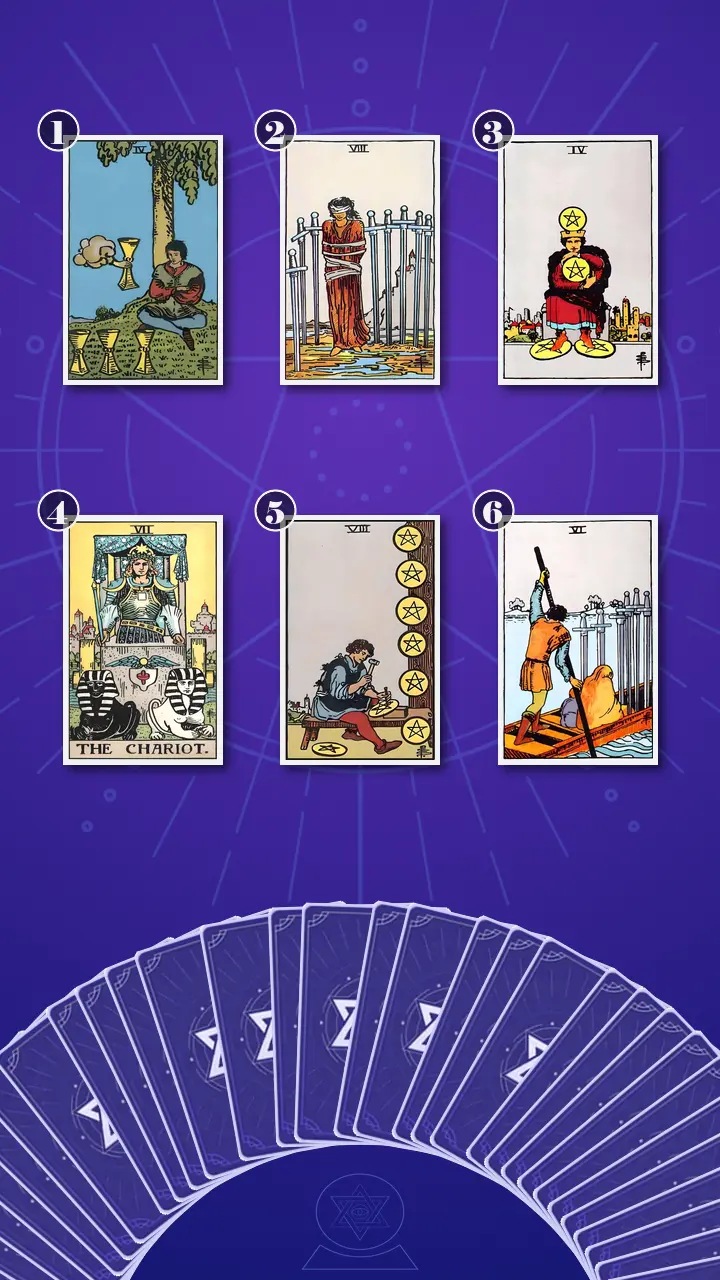
I placed the cards in two rows of three, with the upper row diagnosing how the stuckness had formed and the lower row opening a route through it. I began at the upper left, where the problem was easiest to see.
Position 1: The Presenting Symptom, Four of Cups
I said, “This first position represents the presenting symptom, the way procrastination and direction stagnation are visibly appearing in the home.” I turned the card and showed Jordan the Four of Cups, in upright position.
The crossed arms and lowered gaze immediately brought me back to the hall closet. Jordan was physically beside the available task but emotionally participating through a screen. The modern translation was specific: three bags on the floor, one open closet, a minimalist video, and the next low-stakes object already waiting to be handled. The fourth cup was not hidden. It was the simple decision Jordan kept postponing until the task felt emotionally lighter.
I read the energy as stagnant Water. The feeling had been held still long enough to become a habit of withholding participation. The inner sentence sounded like this: “I want the result, but I do not want to feel what the first decision brings up.” Waiting created temporary relief, but it also kept the clutter and the decision pressure in the same room. This was not a lack of information. It was emotional disengagement beside an available next step.
Jordan gave a short, bitter laugh. “That is uncomfortably specific. Maybe a little rude.” Their arms loosened only after the laugh, and their eyes moved from the card to the bags on the floor.
“I understand why it lands that way,” I said. “The card is not calling you lazy. It is showing the protection inside the delay. If you do not begin, you do not have to experience regret yet. The useful question is not, ‘Why can’t I be more disciplined?’ It is, ‘What feeling is the postponement keeping outside the door?’”
Position 2: The Immediate Blockage, Eight of Swords
I moved to the upper center. “This position identifies the immediate blockage, the mental rule or perceived lack of options that turns the first sorting decision into a reason to wait.” I turned over the Eight of Swords, in upright position.
The blindfold became the belief that no safe option existed. The bindings became the rules Jordan treated as mandatory: “I must know every future use,” “I must choose the correct decluttering method,” “I must finish the whole category,” and “I must not regret anything.” The ring of swords made an ordinary household choice look like a closed system with no permissible move.
I read this as constricting Air. The Four of Cups had held the feeling still; the Eight of Swords gave that stillness a detailed argument. Jordan had been writing complete sorting policies in Notes, comparing storage systems, saving Sunday reset videos, and researching organizers before touching the objects already taking up space. Decision fatigue was wearing an organized outfit. A reversible decision about one cable had been reframed as an irreversible verdict on competence and self-trust.
Jordan’s breath tightened. Their fingers pressed into the edge of the chair, and they stared at the middle sword as if it had become a line of text on a screen. “If I choose wrong,” they said quietly, “then it proves I cannot trust myself to make a safe home.”
I asked, “Which part of the next decision is genuinely permanent, and which part only feels permanent because the rule says you must predict the entire future?” The question did not demand an immediate answer. It gave Jordan a way to separate an actual risk from the imagined sentence attached to it.
Position 3: The Underlying Root, Four of Pentacles
I turned to the upper right. “This position explores the underlying root, what holding onto possessions may be protecting beneath the practical task.” The card was the Four of Pentacles, in upright position.
The pentacle pressed against the figure’s chest reminded me of an identity-bearing object. The coins under the feet suggested backup possessions taking up usable space, while the coin above the head suggested constant monitoring of possible loss. I saw the duplicate charging cables, old marketing notebooks, extra kitchen tools, and clothes from an earlier life stage. Each object was being asked to provide a different kind of insurance.
This was guarded Earth. Jordan was not simply keeping things. They were keeping the possibility that an old notebook might contain an important idea, that a cable might prevent a future emergency, that a jumper might fit again, or that releasing an inherited object might feel like rejecting a person or a shared history. A “maybe” object was carrying a job bigger than the object itself.
I asked Jordan to complete the sentence, “I am not only keeping the object; I am keeping the possibility that…” They looked toward a bag of duplicate cables and then toward a box near the bedroom door. Their grip on the chair softened.
“I am keeping the possibility that I will be prepared,” they said. “Or that I will become the person who needs it again.”
“That distinction matters,” I replied. “Some belongings genuinely serve a present practical or emotional need. The card is not telling you to release everything. It is asking which object serves your current home and which object has been assigned responsibility for an old fear.” Jordan became quiet, not defensive. The moral story around clutter had started to loosen into a more precise awareness of preparedness, continuity, identity, and control.
When The Chariot Found a Lane
The radiator clicked once and then went quiet. I placed my hand beside the lower-left card without turning it over immediately. “This is the turning point,” I said. “The room does not need to become calm before movement becomes possible.”
Position 4: The Key Catalyst, The Chariot
“This position locates the focused direction and self-directed will that can interrupt the pattern without deciding the whole apartment for you.” I turned the card and showed Jordan The Chariot, in upright position.
The black and white sphinxes looked like the two forces Jordan had been trying to eliminate before acting: “I want simplicity” and “I want security.” The armored driver did not make either force disappear. The driver held a direction. The reins were not a perfect answer. They were a boundary strong enough to keep competing impulses from expanding a fifteen-minute task into an apartment-wide referendum.
After fifteen years as a perfumer, I have learned to notice when different atmospheres overlap until no room feels restorative. I call this diagnostic view Spatial Boundary Scenting. In Jordan’s apartment, home, hybrid-work output, storage archive, and comparison with polished minimalist interiors had begun occupying the same air. The radiator, Slack notifications, warm phone, work equipment, and visible bags were not incidental details. Through my Sensory Overload Audit, I could see how these quiet environmental stressors were consuming focus before Jordan had even picked up an object.
The Chariot gave us a different question. Instead of asking, “How do I resolve simplicity and security completely?” I asked, “What boundary lets both concerns remain present without either one steering today?”
I brought Jordan back to Sunday: three bags on the floor, a warm phone in their palm, tight shoulders, and forty minutes of minimalist research. The sort had become a room with no safe exit because every option seemed capable of proving something permanent about their judgment.
Stop waiting for every possession to feel easy to classify; choose a single lane and steer a fifteen-minute sort, using The Chariot's controlled movement to turn direction into practice.
I let the sentence settle, then gave Jordan the shorter line I wanted them to carry beyond the reading:
Direction is not the reward for perfect certainty; it is what starts to appear after you steer one small, bounded pass.
For one second, Jordan did not move. Their fingers hovered above the warm phone, their breath paused, and their eyes fixed on the black and white sphinxes. Then their focus slipped past the card and replayed Sunday: the bag handles, the unopened tabs, the hand returning the clothes. A crease formed between their brows as the old rule became something they could examine rather than obey. Finally, their jaw softened, their shoulders dropped a fraction, and a shaky breath came out almost like a laugh. They sat a little taller, turned the phone face down, and said, “Both concerns can come with me, but neither gets to expand today’s task.” Relief arrived with a thin edge of vertigo. A bounded choice meant there was no perfect plan to hide behind. Jordan asked to photograph the line and named the upper shelf as a lane. I asked, “Now, use this new perspective to look back at one moment last week. Was there a moment when this insight could have made you feel different?”
I gave the insight a small body before we moved on: a seven-minute minimum, one drawer or no more than thirty centimetres of shelf space, three labels marked “stays here,” “rehome,” and “not today,” and only three item-level decisions before the timer ended. Nothing had to leave the apartment. Documents, expensive objects, medication, and highly sentimental belongings were out of scope. Jordan could stop immediately if the exercise became too activating. The point was to make one pass, not a permanent verdict.
I named the crossing clearly. This was the first movement from overwhelmed, regret-avoidant decision paralysis toward bounded self-direction. The cards had not created courage or chosen a possession. They had made the hidden rule visible enough for Jordan to choose a smaller experiment.
Position 5: The Action Pathway, Eight of Pentacles
I turned the lower-center card. “This position translates the transformation into a repeatable household behavior, something that replaces research and postponement with practical learning.” The card was the Eight of Pentacles, in upright position.
The figure at the workbench was not performing a dramatic reveal. They were making one thing, then another, learning through contact with tools and material. I read the energy as practiced Earth. For Jordan, decluttering became a household skill learned through short sessions, not a personality test that would prove whether they were naturally organized or incapable of choosing.
I connected the card to a realistic week: two ten-minute sessions in the same hall closet, starting with exact duplicates, expired flyers, or obvious rubbish before anything sentimental. After each pass, Jordan could write one sentence in a phone note: “The next decision became easier when…” That sentence would record evidence, not performance. The next session would not need a new system, a new video, or a new set of containers.
Jordan’s mouth tightened at the idea of stopping while work remained. “It feels almost too small,” they said. “What if I am just pretending to make progress?”
“Then let the smallness be the experiment,” I said. “The goal is not to create an impressive before-and-after image. The goal is to learn what kind of decision your actual home can support. Repetition builds trust more reliably than a single heroic afternoon.” Jordan picked up their phone and typed the sentence into Notes before looking at any new organizer.
Position 6: The Integration, Six of Swords
I turned the lower-right card. “This position clarifies how repeated small decisions can support a sustainable minimalist transition without requiring a perfect or total result.” The card was the Six of Swords, in upright position.
I read the energy as transitional Air. The boat did not represent an empty apartment or a guaranteed future. It represented passage. The six swords came along as selected lessons, responsibilities, and memories, while the water gradually became easier to navigate. Jordan did not need to erase the past. They needed to decide what supported the present route.
I asked Jordan to walk once from the desk to the front door in their mind. What made that route awkward? Which bag needed to be reachable? Which duplicate item could leave through one chosen rehoming channel? Which meaningful object could stay while its role was considered later? The home became a workable environment rather than a test of perfect judgment.
Jordan exhaled and said, “This pass taught me that duplicates were easier first.” They looked toward the actual hall, where the tote still narrowed the path but no longer seemed to contain the whole problem. I saw the difference between “I finally fixed myself” and “This pass taught me something useful.” That was the beginning of practical confidence.
The One-Lane Chariot Pass: Finding Clarity Without a Perfect Plan
When I connected the six cards, the story became coherent. The Four of Cups showed Jordan sitting beside an available next step while using research to stay emotionally distant. The Eight of Swords revealed the certainty-first rules that turned a reversible household decision into a test of competence. The Four of Pentacles showed why those rules felt necessary: possessions were carrying preparedness, identity, continuity, and protection from regret. The Chariot supplied focused will, the Eight of Pentacles supplied repetition, and the Six of Swords gave the repetition a practical destination, a home that supports ordinary movement.
The cognitive blind spot was treating a limited decision as a permanent verdict. Jordan had been waiting for the entire apartment, every category, and every possible future use to become clear before allowing one object to move. The transformation direction was more grounded: choose one bounded lane, tolerate limited uncertainty, learn from the pass, and let present-day function guide the next decision.
This six-card Transformation Path Grid tarot spread for decluttering procrastination did not point toward a total purge. It traced visible avoidance through mental restriction and protective attachment, then showed how bounded self-direction and repeatable practice could create a more navigable home. The breakthrough was not a magical removal of doubt. It was a move from overwhelmed, regret-avoidant decision paralysis to bounded self-direction, practical confidence, and a more navigable home.
I wrote three pieces of actionable advice for Jordan. Each one was deliberately small enough to test and clear enough to stop.
- The Physical Boundary ProtocolWithin 72 hours, finish one hybrid-work block by closing the laptop, placing it in one marked work spot, switching off the work lamp, and using one comfortable sensory cue to signal that recovery has begun. Nothing from work crosses that physical boundary afterward. Then put the phone on Do Not Disturb, mark only the upper shelf of the hall closet with tape, and run a fifteen-minute sort using three labels: “stays here,” “rehome,” and “not today.”If fifteen minutes feels too large, use the seven-minute version. Keep documents, expensive items, medication, and sentimental belongings out of scope. Nothing has to leave the apartment today.
- The Eight of Pentacles RepeatSchedule two ten-minute sessions in the same upper-shelf zone this week. Begin with an easy category such as exact duplicates, expired flyers, or obvious rubbish. After each session, write one sentence in Notes: “The next decision became easier when…”Stop when the planned time ends, even if you could continue. The boundary is part of the practice, and success means completing the agreed pass rather than reaching an ideal item count.
- The Present-Home PassageWalk once from the desk to the front door and identify the first object that makes the route awkward. Use that observation to choose the next bounded zone, then create one rehoming exit point near the door and schedule one specific donation, recycling, Buy Nothing, or Marketplace handover. For one uncertain object, finish the sentence, “This belongs in my current home because…”Use present routines rather than imagined future identities. A meaningful object may stay. The aim is easier daily movement, not an empty room or a forced release.
I reminded Jordan that these were experiments, not commands and not moral tests. A sensory boundary could protect recovery from work-life bleed, a small lane could protect attention from expansion, and a repeatable pass could teach more than another hour of research. The person making the decisions remained the person in charge.

A Week Later, the Quiet Proof
Four days later, Jordan texted: one shelf edge was clear, the tote no longer caught their ankle, and a note read, “Duplicates were easier first.” The apartment was not transformed; “What if I’m wrong?” still arrived the next morning, but a second ten-minute session was scheduled.
I smiled at the modesty of that evidence. The cards had not cleared the closet. Jordan had chosen a lane, created a boundary, made a few decisions, and learned that uncertainty could remain without stopping movement. That was the Journey to Clarity: not certainty delivered from outside, but self-trust built through a small action that reality could answer.
I know why this is tender: when every object feels like evidence in a trial of your judgment, even a small closet can make your shoulders lock and leave you standing between the home you want and the safety you are afraid to misplace.
If certainty did not have to arrive first, which tiny part of your home might you be willing to approach as practice rather than proof?