Too Many Tabs, One Cancellable Class, and a Life Re-entered
When Ordinary Life Needs a Strategy Meeting
I often meet early-career creatives in London who can make a "good enough to test" decision at work but need seventeen tabs to book a Saturday class. Maya (name changed for privacy), a 28-year-old junior product designer, came to me because she could feel her own life waiting just beyond a screen she could not bring herself to close.
The night before our reading, at 10:40 p.m., she had been in her London flat with the fridge humming behind the sofa and a mug of tea cooling beside her. Her phone was warm from switching between a grocery list, an unopened WhatsApp message from a friend, and two beginner-class booking pages. She reread the cancellation policy, listened to the faint traffic below her window, and kept scrolling while her thumbs moved faster and faster.
"I just need one more day to get my head straight," she told me. "At work, I can decide with incomplete information. But if I book a class, reply to someone, or choose a dentist, it suddenly feels like I am proving whether I can manage my own life."
I could see the effort in the way she held her shoulders just above their natural resting place. Her apprehension was not an abstract cloud. It was like trying to enter a packed Tube train while carrying a glass filled to the rim: every small movement felt capable of becoming a public spill. She wanted to participate in daily life now, but she kept waiting for an internal guarantee because choosing before then felt as though it might expose a lack of control.
I did not see laziness or a lack of character in her. I saw a protective pattern that had become expensive to maintain. "Certainty has become the cover charge for ordinary life," I told her gently. "We are not here to make you force a choice. We are here to draw a map of the moment when life gets put on hold, so you can find your own way back into it."

Choosing a Map for Readiness Procrastination
I asked Maya to place both feet on the floor, notice the weight of her heels, and hold the question without trying to solve it. I shuffled slowly, not as a performance of mystery, but as a small interruption to the speed of her usual mental loop.
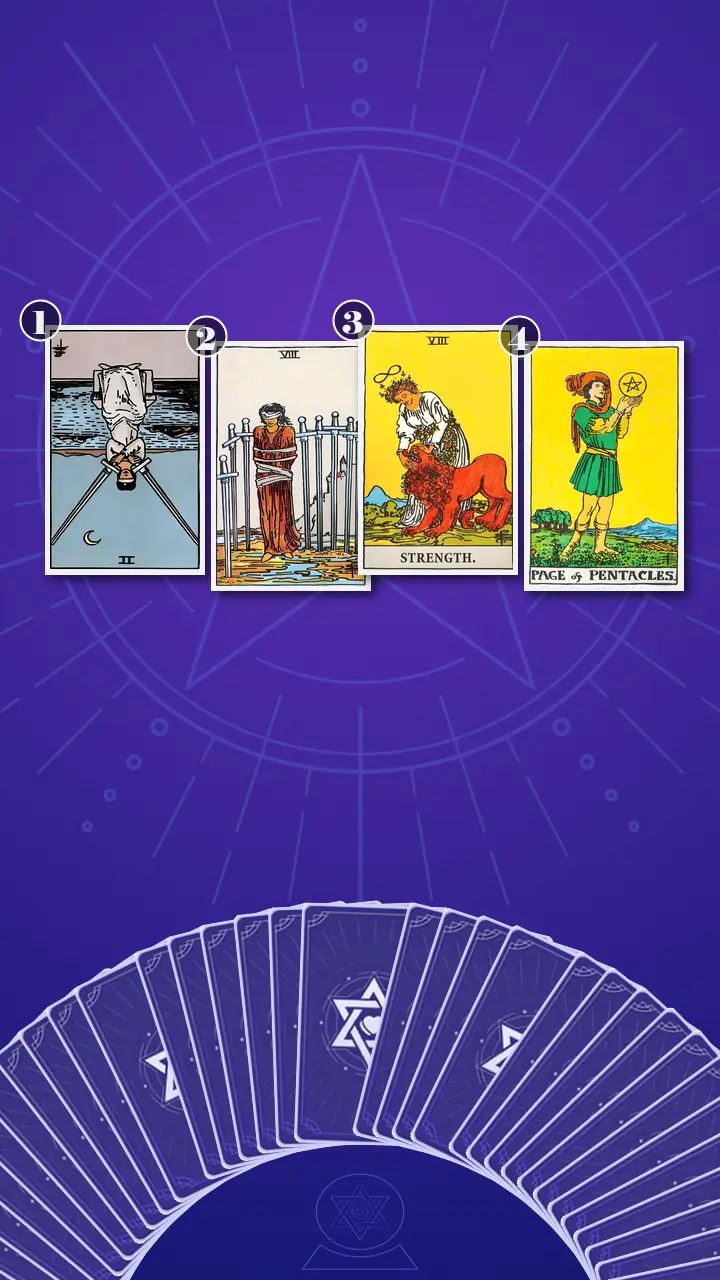
I chose the four-card classic Shadow Spread, a tarot spread for readiness procrastination and self-trust. It was the right size for her question: one card for the visible pause, one for the hidden fear beneath it, one for the inner capacity available to her, and one for the grounded practice that could bring the insight into an ordinary week.
I explained why I had not chosen a larger spread. Maya did not need more categories, more options, or a broader diagnosis. Her pattern already had a clear sequence: a simple task appeared, her mind searched for an internal green light, delay brought a brief hush, and then the unfinished task returned with more weight. The Shadow Spread could follow that exact path from symptom to root, from root to resource, and from resource to a practical next step.
I laid the cards in one horizontal line. The first two would show the contraction: the visible readiness pattern and the hidden fear sustaining it. The third would be the turning point, the inner capacity that could meet uncertainty without demanding certainty first. The fourth would show how to practise that capacity in real life.
From Blindfolded Tabs to an Open Gaze
The Tabs That Will Not Close
Now I turned the card representing the visible readiness pattern: the concrete moment Maya freezes, delays, or keeps researching an ordinary next step. It was the Two of Swords, reversed.
In the Rider-Waite-Smith image, a blindfolded woman holds two swords crossed hard over her chest. Reversed, that defensive balance cannot hold forever. The protection becomes overload. I could see Maya in the image as she had described herself the previous evening: switching between two nearly identical class options, rereading cancellation terms, and refusing to let either choice become real enough to evaluate.
"An open tab can preserve possibility," I said, "but it can also keep your life in draft mode." The card showed Air energy overworked and blocked. Thought was trying to create safety by keeping every option suspended, but each suspended choice was claiming space in her body, her evening, and her attention.
I named the inner argument plainly: "If I wait until tomorrow, I can choose properly; if I choose now, I might expose how unprepared I am." Maya gave a short laugh that caught at the end. "That is painfully accurate," she said. "It is a bit brutal to see my WhatsApp drafts in a tarot card."
"It is not a criticism," I replied. "The crossed swords are a posture of protection. They show that you have been trying very hard not to regret anything. The question is whether that protection is still serving you." Her fingers stopped circling the rim of her cup, though they did not yet relax.
The Rule That Feels Like Reality
Next I turned the card representing the hidden fear sustaining the pattern: the belief that an imperfect action could expose a loss of control. It was the Eight of Swords, upright.
The figure on this card is blindfolded and surrounded by swords, but her bindings are loose. There is open ground between the blades and room beyond them. I was careful with that image. It did not mean Maya had no real constraints. Money, time, access, fatigue, safety, and other people's boundaries can all be genuine limits. It meant that alongside those realities, she had added a private rule: uncertainty must disappear before she is allowed to begin.
I connected it to the application she had kept open for six days. She was qualified enough to submit it, but the lack of total confidence registered as a stop sign. She imagined that applying before another course or another portfolio edit would reveal poor judgment. A thought about readiness had become a rule of reality.
"The rule feels real," I said, touching the gap between the swords, "but that does not make every part of it true. You technically could act, but it does not feel safe enough to count as a real option. That is different from having no option at all."
The room went quiet enough for me to hear rain brush the windowpane. Maya's hands folded into each other, then loosened. "I keep treating a feeling like a permissions setting," she said. "Like my brain has marked the whole task blocked."
I thought of the many seasons I had lived through in the Highlands, when a path could look closed under mist yet still offer one solid step at a time. The mind often wants the whole route visible. The body only needs enough ground for the next footfall.
When Strength Meets the Lion's Jaws
The Capacity to Stay
When I turned the third card, I slowed down. This was the card representing the inner capacity that could meet Maya's fear without demanding certainty first. Strength appeared upright, and the room seemed to settle around the image: a woman in white, one calm hand resting at a lion's jaws, an infinity symbol floating above her steady gaze.
Strength was not telling Maya to become fearless, decisive, or relentlessly productive. It showed patient courage, emotional self-regulation, and a relationship to fear that was neither obedience nor war. The woman does not crush the lion. She does not pretend the lion is not there. She remains present with it.
This was where I used what I call Somatic Fatigue Diagnosis. Before the mind produces another explanation, I listen for the physical friction that tells the truth about the cost of the pattern. Maya's tight chest, raised shoulders, restless hands, jaw clenched over a grocery list: these were not proof that she was incapable. They were signs that her nervous system had been working overtime to keep ordinary uncertainty from reaching her.
"When your hand reaches for another review," I asked, "what happens in your body one second before you open it?"
"My ribs sort of lock," she said. "And I feel like I have to sort it now or I will become the kind of person who cannot sort anything."
At 10:40 p.m., the booking page was open, a friend's WhatsApp message was ageing, and another review promised certainty. Her chest tightened as she waited for tomorrow-Maya to become organised enough to choose. The old bargain was clear: feel safe first, then allow life to begin.
Readiness is not a cage you must unlock before living; like Strength's calm hand and steady gaze, meet uncertainty gently and take the next manageable step.
I left a small silence around the sentence, then added, Readiness is not the feeling that uncertainty has disappeared. It is the self-trust to make one workable move and stay present for what it teaches you.
Her thumb froze against the edge of her phone. Then her eyes lost focus for a moment, as though she were replaying every late-night search and every unmade plan at once. Her brows drew together, not in relief but in anger. "But does that mean I was doing it wrong before?" she asked. "All that planning was meant to help me."
I watched her take in a breath that stayed high in her chest before finally moving lower. "No," I said. "It means a protective part of you learned that a guarantee might keep you from feeling exposed. It was trying to help. Strength does not shame that part or hand it the steering wheel. You can hear the part of you asking for a guarantee, and you do not have to shame it or let it make this choice." Her shoulders dropped, slowly. The release made her blink hard, and for a beat she looked almost unsteady, as though the space left by a familiar burden also carried the responsibility of choosing for herself.
"Now, with this new perspective," I asked, "can you think of a moment last week when this would have helped you feel differently?"
She looked at the class booking still open on her phone. "I could have said, 'I am scared I will hate it,' and booked it anyway. Not because it would prove anything. Just because I could cancel or learn from it."
That was the turn in the reading: from certainty-driven delay and life in draft mode to patient, self-trusting participation in daily life. It was not a promise that every choice would feel easy. It was evidence that Maya could locate control in her ability to respond after an outcome, rather than in her ability to eliminate all uncertainty before it.
One Pentacle, One Real Experiment
I turned the final card, representing the practical integration point: one modest way to re-enter daily life and learn through action. It was the Page of Pentacles, upright.
The Page stands in a fertile field studying one pentacle, while mountains remain in the distance. He is not trying to survey the whole landscape at once. He is giving his attention to one tangible thing that can teach him something.
"This is the personal-life version of an MVP," I told Maya. "Contained enough to test, real enough to give you evidence, and never required to be the final version." At work, she understood that an early prototype was not a verdict on the product or its designer. The Page of Pentacles asked her to apply the same practical generosity to herself.
For Maya, the card became one cancellable beginner class from the options she had already saved. She could add the cancellation deadline to her calendar, attend if it still suited her, and record three facts afterwards: how the journey felt, what she liked, and what she would change. The card's Earth energy was grounded and available. It replaced the first two cards' exhausting mental weather with a single real-world experiment.
She nodded with a different kind of concentration. "This does not have to prove I am good at life," she said. "It only has to give me one piece of information."
"Exactly," I said. "Let one real move collect the evidence your mind cannot generate in advance."
The Reversible Next Step
When I drew the four cards together, their story was coherent. The reversed Two of Swords showed Maya holding daily life at arm's length in order to avoid regret. The Eight of Swords showed the hidden belief beneath that pause: if she made an imperfect move, she might expose herself as unable to stay in control. Strength offered a different form of control, one based on steadiness and response. The Page of Pentacles carried that steadiness into a small, observable action.
The blind spot was not that Maya needed to become less thoughtful. It was that she had been treating the feeling of unreadiness as objective evidence that she should not act. Her inner algorithm had made "feel completely ready" a dependency field, so every ordinary task stayed in Backlog. The transformation direction was simpler and kinder: move from waiting for an internal guarantee to choosing one small, reversible action that creates real information.
I also told her that a body asked to make personal decisions after a full day of work, scrolling, and comparison is not receiving neutral data. My Organic Routine Restructuring begins with respecting biological rhythm over an artificial demand to resolve everything at 10:40 p.m. A task can wait until a better window without becoming another promise to postpone life indefinitely.
I offered Maya two practices, both deliberately small. They were not rules for high-cost, medical, legal, housing, safety, consent, or otherwise irreversible decisions. They were ways to practise self-trust with the low-stakes choices that had been quietly shrinking her days.
- The Grounding Disconnect Protocol Before one delayed WhatsApp reply this week, step outside for sixty seconds, or stand at an open window if leaving is not practical. Put both feet down, place one hand on the face-down phone or closed laptop, take one unforced breath, and say: "I am worried this reply will be wrong, and I can still send an honest two-sentence version." Keep it under a minute. The minimum version is naming the wish for a guarantee without sending anything yet.
- The Eight-Minute One-Pentacle Test For one affordable, reversible pending choice, keep only the two existing options visible and set an eight-minute timer. When it ends, choose one manageable real action: book the cancellable class already saved, send an adequate calendar response, or make the simplest meal from groceries already at home. Afterwards, write one fact the action taught you that research could not. Give the experiment an exit route, such as a cancellation window or a thirty-minute visit. Its smallness is the design constraint, not a flaw.
Neither practice asked Maya to override fatigue or pretend that every option was equally accessible. They simply gave her a way to distinguish a genuine limit from the old reflex to turn uncertainty into a stop sign.

A Week Later: The Quiet Proof
Six days later, Maya messaged me: "Booked the class. Went anyway." Afterwards she sat alone by a cafe window for twenty minutes. The class had not remade her life; the return journey was too late for her taste. Still, she knew that from having gone, not from another review.
I did not take that message as proof that tarot had solved her life. The cards had only held up a mirror to a pattern she was already living. Maya made the change herself: she noticed the fear, gave her body a little room, and allowed one practical action to become evidence.
As I put the deck away, I thought about the clarity we had found together. It was not certainty, and it was not a new demand to become a perfectly decisive person. It was the quieter knowledge that she could participate while still unsure, then adjust from what life actually gave back.
When an ordinary booking makes your chest tighten, it can feel as though one imperfect click will expose that you cannot manage your own life. I have seen how that belief can keep today paused even while you ache to be in it.
Against that old demand for a guarantee, what tiny, reversible part of your life might you be curious to enter with Strength's calm hand?