Deferred-Life Perfectionism: A Saved Sweater Tests the Someday Rule
The Sweater Waiting for a Life Worth Wearing
I have learned that someone can spend all week designing better user experiences, then go home to a small rental and keep the thing she loves boxed while using the worn alternative. At 10:18 on a Saturday morning, Maya (name changed for privacy), a 29-year-old product designer in Toronto, tilted her laptop camera toward a crowded closet shelf. A radiator clicked behind her. Tissue paper crackled as she lifted out a new sweater, and the soft wool folded over her wrists.
She was due to meet a friend for brunch. The forecast was mild, nothing special. I watched her fingers tighten around the fabric before she returned it to the shelf and pulled on the faded hoodie she wore most weekends.
“That is the whole problem,” she said. “I am waiting until I can enjoy things properly. But apparently brunch is not proper enough. Neither is working from home, and taking PTO without a trip feels wasteful. Why am I always saving the good stuff for a someday that never comes?”
She told me about the candle with less than an inch of wax left, the restaurant voucher still sitting in an app, and the boxed notebook she kept protecting from ordinary meeting notes. Whenever she considered using one of them, a practical-sounding committee convened in her head to debate stains, timing, money, weather, and what future Maya might need.
I could see the longing in the small movement of her hands toward the sweater and away from it. It was like standing outside a warmly lit room with the key already in her palm, then deciding her current self was not on the guest list. Putting the object back loosened her fingers for a moment, but the relief was followed by a drop beneath her ribs.
“I am not going to tell you to use everything, spend impulsively, or stop caring about the future,” I said. “Careful budgeting is real, especially in this city. I want to help you separate a genuine limit from the rule that an ordinary day is not worthy of what you already have. Let us draw a map of that rule and see where your choices can re-enter the picture.”

Choosing a Map for the Someday Loop
I invited Maya to place both feet on the floor, take one unforced breath, and hold the question without trying to solve it. I shuffled slowly under an overhead camera. I treat this preparation as a shift in attention, not as a supernatural performance. It gives the mind a clean edge around the issue we are examining.
I chose a five-card Shadow Spread. For readers wondering how tarot works in a consultation like this, I use the cards as structured prompts that make a psychological pattern visible. They do not issue a fixed verdict or predict what Maya must do. Card meanings in context help us distinguish observable behavior, the fear beneath it, the protection that keeps it going, and the resources available for change.
The Celtic Cross would have introduced more context than this focused question needed. A three-card reading could have named a pattern, cause, and action, but it might have collapsed two important distinctions: why postponement feels protective, and what healthy capacity has been pushed aside. The five-card Shadow Spread was the smallest map that preserved the full sequence.
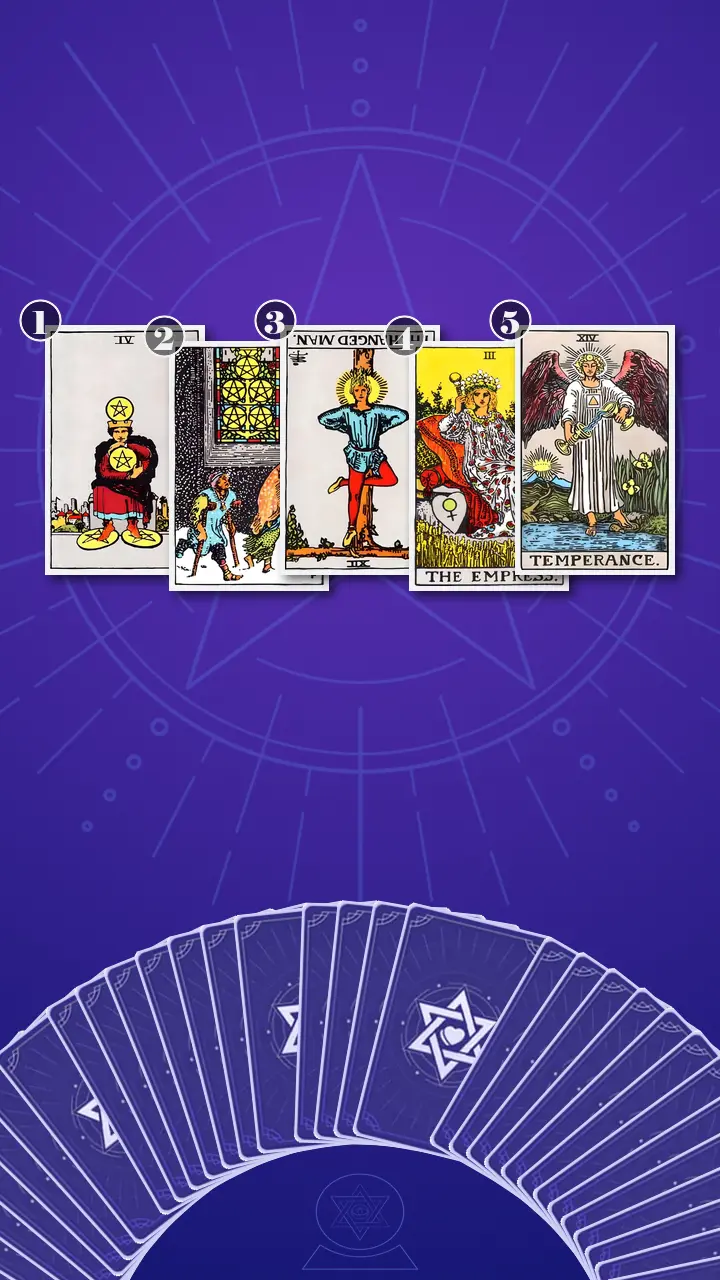
I placed the cards in a horizontal line. The first position would show the behavior Maya could observe directly. The second would reveal the fear beneath the grip. The third, set at the center, would expose how postponement maintained the loop. The fourth would reclaim a hidden capacity, and the fifth would turn that capacity into a sustainable practice. The layout moved visually from a dim corridor toward a lived room, but Maya would decide whether and how to walk through it.
Inside the Private Showroom
Position 1: The Grip That Keeps Value Out of Reach
“The card I am turning over now represents the behavior through which this pattern is visible: protecting valued objects and opportunities so tightly that they cannot support the week you are actually living,” I said.
It was the Four of Pentacles, upright.
I pointed to the figure pressing one pentacle against the chest, balancing another above the head, and pinning two beneath the feet. Conservation was operating in excess. Value was protected, but its circulation and the figure's movement were blocked. The card did not criticize Maya for wanting security. It asked what happened when protection became non-participation.
“This is Saturday at 10:18,” I said. “You take the sweater from the tissue paper, feel the wool at your wrists, and immediately imagine rain, food stains, and a future event that might deserve it more. The bargaining sounds sensible: ‘I want to wear it, but I should wait because brunch is not important enough.’ Then you put it back. The sweater stays safe, but the comfort you wanted from it stays unavailable.”
I asked her what she had chosen instead and what the choice had produced. Maya glanced down at the faded cuff near her wrist.
She gave one short laugh, but there was no amusement in it. “That is so accurate it is kind of brutal.”
“Only if we turn recognition into blame,” I replied. “I see a strategy that once promised control. We are examining its current cost, not putting you on trial for having developed it.”
Her mouth softened, though her thumb continued rubbing the frayed seam of the hoodie. I could see the first layer of defensiveness give way to recognition. The Four of Pentacles was not saying she owned too much or cared too carefully. It was showing her a private showroom where she was both the owner and the person being kept behind the rope.
Position 2: Warmth Visible Through the Window
“The next card represents the worth-based fear beneath that grip: the expectation that present use will become waste, leaving you without enough when a more important moment finally arrives,” I said.
I turned over the Five of Pentacles, upright.
The card showed two figures moving through snow beneath a bright window filled with pentacles. I described this as an experienced deficiency rather than proof of current financial hardship. Warmth was visible and potentially available, yet attention remained fixed on future lack. This distinction mattered. I would never use a tarot reading to erase real budget constraints, workplace rules, disability, or limited access. Maya's question concerned comfort she already owned or time already included in her compensation.
“Think about the candle on that rainy Sunday,” I said. “There is less than an inch of wax left. You already own the remaining burn time, but lighting it feels like moving closer to deprivation. The thought is, ‘If I use the last of it tonight, what will I have when I really need it?’ So the candle stays cold, the harsh ceiling light stays on, and the present evening goes without the comfort you are trying to preserve.”
Her inhale caught. Her eyes moved toward a shelf beyond the camera, remained unfocused for a few seconds, then returned to the card. Finally, she released a low breath from deep in her chest.
“Finishing something feels worse than not using it,” she said. “At least while I still have it, I can imagine the perfect time.”
“That makes emotional sense,” I said. “The option itself has started to feel like security. But preserving pleasure can become a way of practicing deprivation. The Four says, ‘Hold it so you will not lose value.’ The Five reveals the paradox: holding it so tightly can make the feeling of lack happen now.”
I asked her to separate two questions. Was the resource genuinely scarce, sentimental, collectible, or financially necessary? Or was the resource available, while an ordinary version of Maya was being excluded from it? She nodded slowly. The difference did not force an answer, but it gave her a more honest question.
Position 3: The PTO Draft That Decides by Waiting
“The central card represents the mechanism that keeps the loop active: postponement preserves imagined control and prevents you from testing whether the belief is true,” I said.
The card was The Hanged Man, reversed.
The upright figure can represent a purposeful pause that allows a new perspective to form. Reversed here, that pause had become a blockage. Maya already understood the habit intellectually, but understanding was suspended above the ground. No new evidence could arrive because the experiment never began.
I connected it to a Tuesday evening on a crowded southbound Line 1 train. Maya had opened her company's PTO form on a phone warm from use. Brakes screeched, damp coats pressed around her, and she found a quiet Friday that fit the project calendar. Then the conditions began to move: maybe after the launch, maybe when the weather was better, maybe when she had a real plan. She closed the form. By the time she returned, the available date had disappeared beneath meetings.
“It works like a Notion task moved from ‘This Week’ to ‘Someday’ during every monthly reset,” I said. “The rescheduling feels organized, but nothing enters lived time. Someday is not a date until it reaches the calendar.”
Maya's shoulders rose, then remained there. “I tell myself I am waiting for the right day.”
“Let us change one sentence without shaming the choice,” I said. “Instead of ‘I am waiting for the right day,’ try ‘I am choosing not to test this today.’ What changes when waiting becomes an active decision rather than neutral weather?”
Her fingers stopped at the hoodie cuff. Her gaze stayed on the reversed card as though she were watching several closed booking tabs replay behind it.
“That is frustrating,” she said. “Waiting felt safer because I could pretend it was not costing anything.”
“Exactly. The point is not to book every restaurant, open every box, or use all your PTO at once. That would be an all-or-nothing correction, and regret could send you straight back to rigid saving. The hinge is smaller: what if you only need one data point, not a new personality?”
I watched her shoulders drop half an inch. Curiosity had entered beside the frustration. The Hanged Man reversed was still a blockage, but naming its function changed it from an invisible trap into a choice she could test.
When The Empress Let Tuesday Receive
Position 4: The Capacity Hidden Behind the Grip
“The card I am turning now represents the resource that can be reclaimed: receiving care and sensory value without first making the day exceptional,” I said.
It was The Empress, upright, the key card and antidote in this reading.
As the card settled, the radiator behind Maya stopped clicking. A pale strip of late-morning light moved across my table and reached the wheat illustrated at The Empress's feet. I let the room become quiet before continuing.
I brought Maya back to the setup the spread had been tracing: Saturday morning, the sweater in her hands, tissue paper crackling, brunch judged too ordinary, the faded hoodie chosen instead. Relief arrived first. Then came the same small drop beneath her ribs.
The Empress's energy was balanced and available, but Maya had not been allowing herself to use it. I drew her attention to the ripe wheat, the cushioned seat, and the living landscape. This was abundance as participation. Wheat becomes meaningful by feeding life through a season, not by remaining sealed away as evidence that nourishment exists.
The image brought one of my core diagnostic lenses to mind: Rest Phase Legitimacy. After years of reading human lives through the metaphor of planetary cycles, I do not use an orbit to claim that fate is fixed. I use it to remove moral judgment from fluctuation. No body in orbit presents the same face, light, or apparent speed at every point in its cycle. A quieter phase is not a failed phase.
“You have been saving care for a future version of yourself who is more accomplished, energetic, organized, and camera-ready,” I said. “But care is not only a reward for peak output. Your low-energy Wednesday does not have to become a launch event before the good mug can warm your hands. The Empress asks what could nourish the life already in progress, including its ordinary and unproductive hours.”
I added, “The good thing is not wasted when it supports an ordinary day; its value is lost when protecting it keeps it outside the life you are actually living.”
An ordinary day is not unworthy of your best; let enjoyment become present-tense care, as The Empress sits among living wheat rather than storing it for later.
I stopped speaking and let the sentence remain between us.
For one beat, Maya did not move. Her inhale stopped high in her chest, and the thumb that had been smoothing her hoodie cuff froze. Then her eyes slipped away from the card and lost focus. I could almost see her replaying the chipped mug, the cold candle, the unopened notebook, and the PTO tab. Her mouth tightened.
“But does that not mean I have been getting this wrong for years?” she asked. Her voice came out sharper than before, with anger covering something more tender.
I did not rush to turn the anger into gratitude. “It means the strategy protected something important until its cost became visible,” I said. “Seeing the cost now does not make your earlier self foolish. It gives your current self more information.”
Her pupils widened slightly. Her eyes shone, but no tears fell. The fist resting near her laptop opened one finger at a time, and her shoulders descended with a long, uneven exhale. Relief arrived, followed by a brief blankness that I recognized as the vertigo of having choice returned. A fixed rule can feel oppressive, but it also removes responsibility. Clarity gave her room, and for a second that room felt exposed.
“Now, with this new perspective, think back to last week,” I said. “Was there a moment when this insight could have made the experience feel different?”
She looked toward the shelf again. “Sunday with the candle. I kept telling myself a worse night would deserve it more. If I had thought of the candle as support instead of a prize, I could have lit it for ten minutes. I did not have to finish it.”
I told her we would test that insight without forcing it. She could set a seven-minute timer and choose one low-stakes, replaceable item she already owned. Before using it, she would record her predicted regret from 0 to 10 and why. Afterwards, she would note one sensory detail and the actual regret rating. Sentimental, genuinely scarce, collectible, or financially necessary items would remain outside the experiment, and stopping would always be allowed.
This was the reading's central emotional crossing: not instant certainty, but a first move from future-oriented bargaining and anticipatory regret toward present-tense permission, embodied self-trust, and steady appreciation. Owning the good thing was not the same as receiving its value. An ordinary day did not have to audition for Maya's care.
The Water Moving Between Two Cups
Position 5: A Rhythm That Does Not Require a Purge
“The final position translates that reclaimed capacity into an integration practice, balancing present enjoyment with future stewardship,” I said.
I turned over Temperance, upright.
I traced the liquid moving between the two cups. This was balance expressed as deliberate circulation. Nothing was dumped, and nothing was frozen. One foot remained on land while the other touched water, suggesting structure and responsiveness in the same practice.
“This is not a command to open everything tonight,” I said. “It is one recurring thirty-minute calendar block called ‘One Good Thing.’ Each week, one saved object, prepaid credit, or modest piece of available time enters ordinary use. You set the time or money boundary first, and then you record what actually happened. I can use some without using everything. I can care for later without excluding today.”
The modern version of the card looked less like a dramatic self-care montage and more like a sustainable budget category. Maya could move the good mug beside the kettle, wear the sweater for one coffee run, or light the candle for a timed interval. The measured limit protected against an impulsive swing while allowing value to participate in her life.
“Use is not the opposite of care,” I said. “Measured use is one form of care.”
Maya reached for her phone. I saw the familiar hesitation in the way her thumb hovered above the calendar, followed by a more deliberate movement. She did not schedule a perfect day. She created a thirty-minute block on Wednesday afternoon and typed: ‘Good mug. New sweater. Normal workday.’
“That looks almost embarrassingly small,” she said.
“Small is useful here,” I replied. “Small produces evidence without asking your nervous system, budget, or calendar to absorb a personality transplant.”
From Protected Inventory to Lived Value
I read the five cards back to Maya as one connected story. Her years of careful budgeting in an expensive city had made preservation feel responsible and reassuring. The Four of Pentacles showed that sensible instinct tightening into a grip. The Five revealed the feared outcome beneath it: future deprivation, or the possibility that present use would expose her as undeserving. The Hanged Man reversed showed why the pattern endured. Postponement reduced immediate regret, but it also prevented reality from correcting the fear.
The final pair changed the meaning of value. The Empress transformed material security from static possession into lived nourishment. Temperance added proportion so that permission would not become overcorrection. The whole spread moved through a simple sequence: hold, feel deprived, hold harder; then notice, receive, and circulate.
The blind spot was not that Maya cared too much about her belongings. It was that she had been treating preservation as the only responsible form of stewardship and postponement as if it were cost-free. Her private showroom kept proving that she possessed options, but the metric never counted whether those options supported a real day.
The direction of change was equally specific. Maya did not need to declare every Tuesday special. She needed to stop making specialness the entry requirement for care. The key shift was one ordinary, pre-scheduled use of something valued each week, followed by evidence rather than self-judgment.
When I suggested a weekly practice, Maya raised a practical obstacle. “My energy changes all the time. I will schedule it, have a terrible workday, and move it again.”
That was where I integrated Micro-Cycle Energy Mapping with my Lunar Routine Sync. The name does not mean the Moon runs her calendar. It reminds her that personal output naturally waxes and wanes. For one week, she would map her own energy tide, lower expectations during a trough, and let one good thing support that phase rather than waiting for peak energy to justify it.
Two Bounded Experiments for the Next Seven Days
- The Seven-Minute Someday TestOn one work-from-home morning, choose one low-stakes saved item you already own, such as the guest mug, sweater, tea, notebook, or candle. In your notes app, write your predicted regret from 0 to 10 and complete the sentence, ‘I think I will regret this because...’ Use the item for seven minutes without styling the moment, finishing the item, or making the day special. Record one sensory fact and your actual regret rating immediately afterwards.Keep sentimental, collectible, genuinely scarce, or financially necessary items outside the test. If seven minutes feels too activating, try two minutes, or simply move the item into view. Stopping remains a valid result.
- The One Good Thing Lunar SyncFor seven mornings, rate your available energy from 1 to 5 after breakfast and note when your natural peaks and troughs occur. Add one thirty-minute ‘One Good Thing’ block to an ordinary low or middle-energy period. Move exactly one saved object into that block, such as the good mug beside the kettle or the sweater beside your desk. Let it support the hour instead of becoming a reward for completing the hour perfectly.Use an already-owned item and set the money limit at zero for the first week. If your energy changes, shorten or move the block once, but keep it within the same seven-day window. The goal is a usable rhythm, not an unbroken streak.
I reminded Maya that these were experiments, not moral assignments. A high regret score would be information. A decision to preserve something truly scarce would also be information. Tarot had helped us frame the question, but her observations, boundaries, and choices would determine what happened next.

A Wednesday That Did Not Audition
One week later, I received a photo of Maya at her desk, the new sweater visible beneath her headset and coffee steaming in the guest mug. Her message read: “Predicted regret: 7. Actual regret: 2. I still woke up thinking, What if I ruin it? Then I put it on anyway.”
She had not opened every saved object. The candle was still unlit, and she had moved her first calendar block by a day after a draining meeting. But she had moved it rather than returning it to an undefined someday. The wool had been warm at her wrists during an ordinary video call, and the mug had made the coffee feel better without proving anything about the status of her life.
I did not call that a prediction fulfilled. The cards had not worn the sweater, submitted a form, or gathered the evidence. Maya had. The reading's value was the clarity of the pattern and the small structure around her next choice. Her self-trust began in the moment she discovered that discomfort could accompany present enjoyment without controlling it.
I still think about the particular ache in putting the thing you love back on the shelf: your hands relax because it is still safe, while your chest sinks because an ordinary version of you has once again been left outside the good life. If you recognize that ache, noticing it does not mean you have failed at gratitude or responsibility. It means you can finally see the rope around your private showroom, and seeing it places one end back in your hands.
In the next seven days, which small piece of care will you move out of that showroom and into one ordinary hour that no longer has to audition?