When a Body Signal Gets Called Intuition: Test the Hunch Against Facts
The 11:40 p.m. Draft: Decision Paralysis Disguised as Intuition
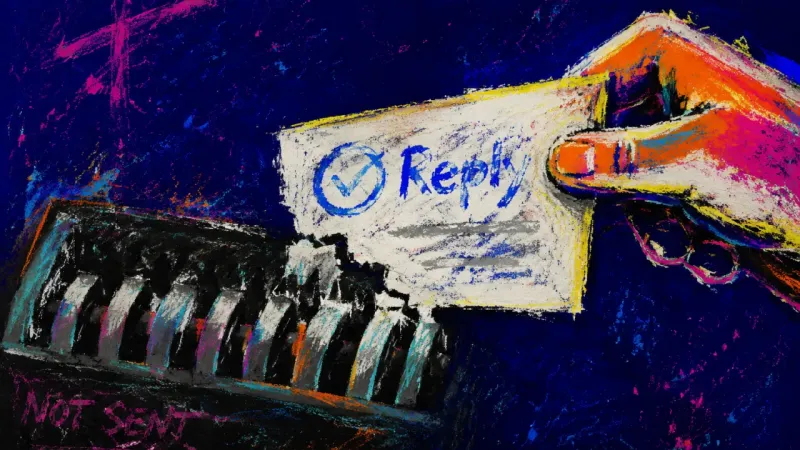
You are a late-twenties freelancer in a high-rent city who can explain every possible meaning of a client offer but still cannot send the reply. That was the exact shape of the evening when Jordan, a 28-year-old freelance UX writer in Toronto, joined my video call from the small desk in their shared apartment. It was 11:40 p.m. Their finished decision email sat in one window, a Notes page titled Signs in another, and saved Instagram posts about alignment glowed across the phone warming their palm. The radiator clicked behind them. Their laptop fan hummed with the strained insistence of a machine asked to keep too many tabs alive.
I watched Jordan press one hand against their chest and fold the other over their stomach. Their breath kept catching high in their ribs, while the hollow feeling below made them lean forward as if bracing for bad news. The six-week retainer met the rate, schedule, and portfolio criteria they had already named. No new information had appeared. Still, the reply remained in drafts.
“The answer feels obvious until I have to act,” Jordan said. “Then I get this no in my body. I just can’t tell whether it’s wisdom or fear. Maybe the fact that I’m confused means it isn’t time yet.”
Their confusion did not look like an empty space where an answer should have been. It looked like trying to read clear road signs through a windscreen covered in condensation, then treating the condensation as guidance to keep driving in circles. The practical evidence pointed toward a provisional yes. Their longing for an unmistakable sign kept widening the question until a six-week contract felt like a verdict on their entire life.
“I’m not going to tell you that your body is wrong,” I said. “A contraction is real information. But the meaning attached to it still deserves examination. Discomfort can be honest without being an instruction.”
I also made my boundary clear. I would not use tarot to choose the contract for them, diagnose the sensation, or promise that one option would produce a perfect outcome. My role was to help Jordan separate sensation, interpretation, evidence, values, and consequence. “Let’s give this fog a map,” I said, “and see whether what you’ve been calling intuition is actually asking for attention, or asking for immunity from an imperfect choice.”
Choosing the Compass: A Five-Card Shadow Spread
I invited Jordan to place both feet on the floor, take one unforced breath, and hold the specific question in mind: “What am I calling intuition when I keep missing the obvious choice?” I shuffled slowly, not as a supernatural performance, but as a deliberate transition from scrolling and reacting into sustained attention.
I chose a five-card Shadow Spread. For anyone wondering how tarot works in a decision reading, I treat a spread as a structured inquiry rather than a fortune-delivery system. Card meanings in context can make a hidden pattern visible, much as a storyboard lets an artist see why a sequence that felt confusing in motion becomes obvious when each frame is placed on the wall.
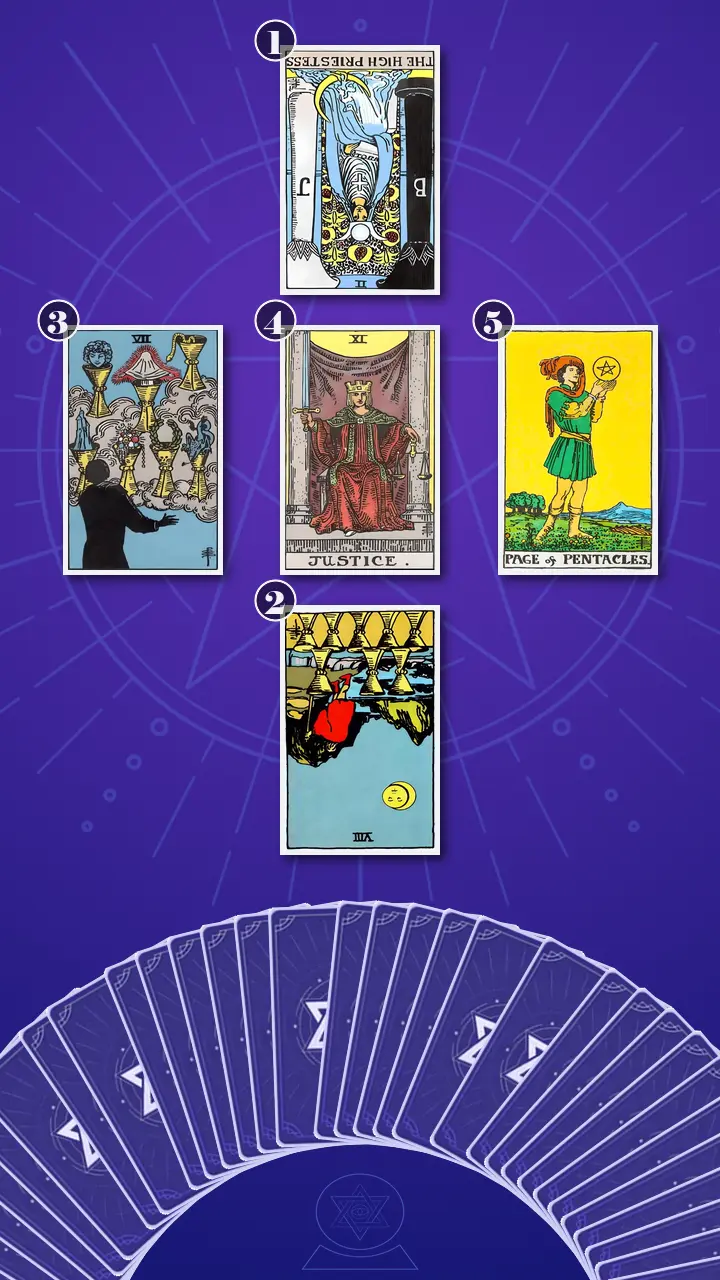
I considered a Celtic Cross, but ten positions would have introduced more context than Jordan’s focused question required. The Shadow Spread was the smallest complete map for this pattern. Its first position would show the conscious story occupying Jordan’s attention. The second would uncover the fear beneath that story. The third would reveal the defensive behavior keeping the loop active. The fourth would identify the capacity Jordan needed to reclaim. The fifth would translate insight into one grounded next step.
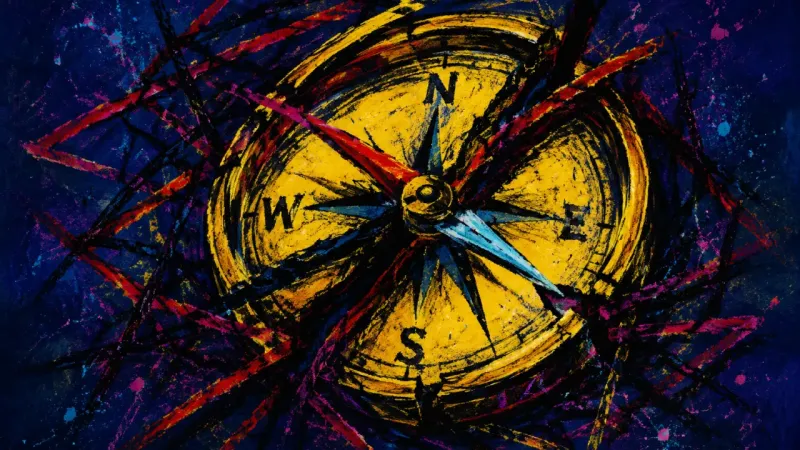
I arranged the cards like a compass coming into alignment. The first sat at the top, with the hidden root directly below it. The defense waited at the left, the integrating truth occupied the center, and the practical action rested at the right. The vertical axis would reveal what Jordan knew and what remained below awareness. The horizontal line would move us from protection to discernment to behavior.
Behind the Veil, the Email Was Already Written
Position One: The High Priestess Reversed and the Story on the Surface
I turned the card representing Jordan’s current symptom: calling interpretive uncertainty intuition while postponing an observable choice. It was The High Priestess, reversed.
I brought Jordan back to 11:40 p.m. The offer was visible. The reply was finished. Then their chest contracted, and their attention moved from the documented rate, scope, and deadline to the Signs note. The sensation may have contained useful information, but the reversed High Priestess showed an interpretive veil between the body’s raw signal and the conclusion Jordan drew from it.
“The sequence sounds like this,” I said. “The sensation is real, so the meaning I assigned to it must be true. But those are two separate frames. Your body reacted. Your mind then called the reaction a no.”
The card’s energy was blocked, not absent. Jordan was sensitive to internal information, but projection and uncertainty were filtering it before it could become discernment. The veil on the card looked to me like the browser layer between Jordan and the finished email: saved posts, symbolic prompts, and preferred interpretations altering the picture like an unlabelled Instagram filter. The black and white pillars also challenged a false binary. Jordan did not have to choose between blindly obeying every feeling and reducing the decision to a spreadsheet.
“What did your body literally do?” I asked. “Not what did it mean. What happened?”
Jordan inhaled and stopped halfway. Their index finger hovered over the phone screen. Their eyes shifted toward the open email, then back to me, and a bitter little laugh escaped. “My chest tightened, my stomach dropped, and then I called it intuition. That’s so accurate it feels a little brutal.”
“I hear that,” I said. “Let’s not turn recognition into another reason to punish you. This interpretation gave you short-term protection from a high-stakes feeling. We’re only checking whether it still serves you.”
Position Two: The Eight of Cups Reversed and the Loss No Sign Could Remove
I turned the card representing the underlying fear: making an accountable choice without a guarantee and accepting an imperfect trade-off. It was the Eight of Cups, reversed.
Jordan had enough information to choose a provisional direction, yet every wave of discomfort sent them back to the same notes. The contract offered useful income and portfolio work, but it would reduce some freedom for six weeks. Refusing it would preserve flexibility, but it would leave their variable income under more pressure. Neither option preserved every cup.
The reversed energy showed a blocked departure. Jordan was not simply staying or leaving. They were using the reopened draft as a third option, one that briefly postponed grief and responsibility while keeping the financial and emotional cost in place. The gap in the card’s stacked cups mirrored the impossible option they kept searching for: a path with every benefit, no loss, and no possibility of regret.
“This card is not ordering you to take the contract,” I said. “It is asking what loss you have been trying not to name. It also warns against overcorrecting by making a dramatic exit just to prove you can move. Accountable choice is neither endless delay nor impulsive escape.”
Jordan rubbed their thumb along the edge of their phone case. Their mouth tightened before they answered. “If I say yes, I lose some freedom. If I say no, I lose predictable money. I’ve been waiting for one option not to hurt.”
“And if the answer only counts when it removes every trade-off,” I asked, “are you waiting for intuition, or for immunity from consequence?”
Jordan looked away from the screen. I heard the radiator click twice into the silence. When they looked back, their shoulders were still high, but their hands had stopped moving.
Position Three: Seven Cups, Six Tabs, and No Definition of Done
I turned the card representing the shadow defense that kept the pattern active: converting discomfort, fantasy, desired meanings, and repeated confirmation into reasons for continued delay. It was the Seven of Cups, upright.
Jordan recognized the scene before I finished describing it. In a Queen West cafe, they had placed the viable contract, imagined future career pivots, a friend’s warning, a hopeful tarot interpretation, and an Instagram post about divine timing into the same color-coded Notion board. Each possibility received equal visual space, so unequal forms of information began to look equally authoritative.
The Seven of Cups was upright, but its imaginative water energy had moved into excess. Wishes, fears, facts, and fantasies floated on the same cloud. Possibility itself had become the defense. The obvious option was no longer being assessed against criteria; it had become one emotionally charged image among many.
“What if the one meaning I leave out is the one that matters?” Jordan said quietly.
I understood the hook. A recommendation algorithm can learn that uncertainty keeps someone scrolling, then serve one more alignment post exactly when a choice becomes uncomfortable. The new post feels meaningful and produces relief, but the relief is not the same as new information. One more sign may soothe the choice without clarifying it.
“Notice what happens after another interpretation,” I said. “Does the evidence change, or does the responsibility temporarily move farther away?”
Jordan’s breath paused. Their gaze lost focus as though they were replaying the cafe, the Notion columns, and three conflicting messages from friends. Then they let out a low “Oh,” and their shoulders loosened by a fraction. “I always zoom in on the person who keeps the question open. I call that listening to different perspectives, but I’m usually looking for permission not to decide.”
I nodded. “That does not make your spirituality fake or your reflection meaningless. It means the search has acquired a protective job. Once we know the job, we can give you protection without giving uncertainty unlimited control.”
When Justice Put the Raw Footage on the Scales
Position Four: The Antidote in the Center
The room seemed to sharpen when I reached the central card. Outside Jordan’s window, a streetcar bell made one clean note, and I turned the card representing the truth Jordan needed to integrate: evidence-based discernment, explicit criteria, accountability, and a fair hearing for every relevant part of the choice.
It was Justice, upright.
I watched Jordan study the level scales, the upright sword, and the figure’s direct gaze. Their question had narrowed. They were no longer asking whether they possessed perfect intuition. They were facing the more vulnerable task of making a fair judgment while uncertainty remained in the room.
Justice carried balanced energy. It did not flatten feeling, and it did not let feeling overrule every other source of information. The scales asked Jordan to place their bodily hunch beside stated values, observable evidence, accepted trade-offs, and foreseeable consequences. The sword supplied a review deadline, the point where comparison would end and a bounded judgment would begin.
As an artist, I thought of an editing room. The same silent shot can look tender or threatening depending on the music placed beneath it. Jordan’s chest contraction was raw footage. Their internal narration had scored it like a psychological thriller: danger is approaching, the wrong click will expose you, and one hidden clue can still save you from the ending.
I call this Internal Monologue Auditing. I asked Jordan to identify the genre their subconscious narration had imposed on an ordinary freelance decision. Once they named it as a thriller, Justice could review the unedited material: the body contracted, the rate met their requirement, the scope was bounded, uncertainty remained, and either option carried a cost. The ominous soundtrack was emotionally persuasive, but it was not another fact.
You do not need a mystical guarantee to choose; weigh the facts, own the trade-off, and let Justice's balanced scales turn a hunch into accountable discernment.
I let the sentence remain between us for a few seconds. Then I gave Jordan its plainest version.
Intuition gets a vote; it does not exempt the choice from evidence, trade-offs, or the consequences that teach you what you can trust.
Jordan froze first. Their breath stopped, and the fingers holding the phone stayed suspended in midair. Then their eyes shifted away from me and went slightly unfocused, as if the late-night desk, the Queen West cafe, and the coworking deadline were replaying in quick cuts. Their eyebrows pulled together. A flash of anger crossed their face before their eyes grew wet.
“But doesn’t that mean I’ve been wrong this whole time?” they asked. Their voice was low and sharper than before.
“It means a strategy that once helped you postpone an overwhelming feeling has been asked to direct the whole film,” I said. “I’m not asking you to condemn the earlier scenes. I’m asking whether you want that strategy writing the next one.”
Their closed hand slowly opened against the desk. Their shoulders dropped, followed by a long breath that trembled at the end. Relief arrived, but so did the slight blankness of suddenly realizing that clarity returns responsibility. Jordan swallowed and gave a small, uncertain laugh. “That feels better and worse,” they said. “Better because I’m not broken. Worse because I still have to choose.”
“Now, using this new perspective, think back to last week,” I said. “Was there a moment when this insight could have made you feel different?”
Jordan remembered the Friday coworking deadline. Their criteria table had already pointed toward a provisional yes, but damp palms and heavy legs sent them into a new tarot search. “I could have said, ‘I may still feel uncertain, and I can still name what is true,’” they said. “The feeling didn’t add any new facts.”
I asked Jordan to divide a note into three columns: Hunch, Evidence, and Values. For eight minutes, they wrote one sentence describing the hunch, two observable facts supporting it, two complicating facts, and the values of financial steadiness, creative integrity, and protected time. Then they named the trade-off: accepting the work would bring income and relevant experience while reducing flexibility for six weeks.
I also offered a minimum version in case the full exercise ever felt too activating: one hunch beside one fact, followed by a pause. No forced answer. No requirement to share the note. The boundary was simply that a pause would not become an unlimited search for new signs.
This was the first visible movement from recursive confusion and self-doubt toward grounded curiosity and steadier self-trust. Jordan did not suddenly feel certain. They became able to hold uncertainty without letting it erase what they knew.
Position Five: The Page of Pentacles and the Seven-Day Beta
I turned the final card, representing a small reversible action through which Jordan could gather real-world feedback and rebuild self-trust. It was the Page of Pentacles, upright.
The Page stood on cultivated ground, studying one pentacle while distant mountains remained distant. Its earth energy was available and balanced: focused attention, practical beginnings, and learning through direct experience. Jordan did not need to decide what the contract meant for their whole career. They could request one paid discovery session, define its scope, and review what the actual work revealed before making a larger commitment.
“A provisional choice is not a permanent identity verdict,” I said. “Think of this as a beta release for the decision. Limited scope. Clear feedback. Permission to revise.”
I asked Jordan to track only three observable signals: what happened, how much time or energy it required, and whether it served the values named under Justice. The Page’s instruction was deliberately small: one thing, one week, one review. No continuous evaluation after every mood change. No five-year identity plan built from the first hour.
Jordan looked at the card, then at their draft. “That sounds almost too normal,” they said.
“Normal is useful here,” I replied. “You’ve been waiting for fire, the sudden conviction that makes action effortless. There are no Wands in this spread. The sequence gives us another order: clarify with air, ground with earth, and let confidence develop after contact with reality.”
Their shoulders lowered again. I saw them open their calendar instead of the Signs note. “I don’t know the whole path,” they said, testing the words as they typed, “but I know what this small step will let me observe.”
The Director’s Cut: Turning Insight Into Two Next Steps
When I read the five cards as one sequence, the story was coherent. The High Priestess reversed showed that Jordan had been placing an interpretive layer over genuine body signals. The Eight of Cups reversed revealed why: choosing would make an unavoidable loss real. The Seven of Cups multiplied meanings until postponement looked like depth. Justice reclaimed the capacity to weigh feelings, values, evidence, costs, and consequences fairly. The Page of Pentacles then moved the decision out of symbolic weather and onto solid ground.
The spread also moved elementally from water-saturated interpretation into the clean air of discernment and finally into practical earth. Jordan had been following mist while ignoring road signs, waiting for motivational fire to appear before moving. The cards suggested a steadier sequence: name what is true, take one bounded action, and allow real feedback to produce momentum.
The cognitive blind spot was not a lack of intelligence or intuition. It was the belief that trustworthy guidance should remove discomfort, regret, and trade-offs before action begins. That standard made emotional relief feel like truth and ordinary uncertainty feel spiritually wrong. The shift was to treat intuition as one source of information, test it against explicit values and observable evidence, accept one honest cost, and let a small reversible action teach Jordan what reflection alone could not.
Before we ended, I introduced The Director’s Cut of Self-Compassion. Jordan’s punitive internal edit said, “If I choose and regret any part of it, I’ll prove I can’t trust myself.” I invited them to pause that version and review the same scene as an objective, supportive director: “I’m choosing from the information available today. Discomfort is present. The trade-off is real. Future regret, if it comes, can be information rather than a verdict.” Self-compassion did not remove accountability. It made accountability possible without turning every imperfect outcome into self-prosecution.
- Run the eight-minute Accountable Intuition Check. At the kitchen table or desk, divide one note into Hunch, Evidence, and Values. Write the hunch in one sentence, list two observable facts for and two against, name up to three relevant values, and complete: “If I choose this, I gain ___ and I may give up ___.” Add a stop rule at the top: “I will reopen this before the review date only if the rate, scope, deadline, consent, or safety conditions change.” Tip: If eight minutes feels heavy, use the two-minute Director’s Cut: one hunch, one fact, and one value. Pause if the exercise becomes overwhelming, but schedule the next review instead of returning to unlimited sign-shopping.
- Launch one seven-day Grounded Apprentice experiment. Within the next 24 hours, send one reversible email, such as requesting a paid discovery session before accepting the full retainer. Put the start date, end date, and one review appointment in the phone calendar. During the test, record only what happened, what time or energy it required, and whether it supported the named value. Finish the review with: “The experiment taught me ___.” Tip: Cap setup at ten minutes and use “one thing, one week, one review.” Do not evaluate continuously unless a prewritten money, safety, scope, or consent boundary changes. Stopping or adjusting after real feedback remains a valid result.
I reminded Jordan that these were tools, not commands. They controlled the criteria, the pace, the boundaries, and the final choice. Tarot had made the decision process visible, but it had no authority to take authorship away from them.

A Week Later: The Quiet Proof of Finding Clarity
Three days later, Jordan messaged me. They had sent the paid-discovery email, then sat alone in a Queen West cafe for an hour, relieved and oddly tender. The next morning, their first thought was, “What if I’m wrong?” This time, they smiled and opened the calendar.
The client had agreed to the smaller starting point. More importantly, Jordan had not treated that response as cosmic confirmation that the entire path was correct. They recorded three plain observations, kept the agreed review date, and left the Signs note closed. The change was not a solved life. It was one sent message where an endlessly reopened draft had been.
I did not see the five-card Shadow Spread give Jordan certainty. I saw it help them separate intuition from certainty-seeking and return a practical decision to its rightful owner. Self-trust became evidence they could collect, not certainty they had to wait for. Jordan was still writing the next act, but the pen was back in their hand.
When the next step is visible but your chest grows restless and your stomach drops, it can feel safer to warm your phone with one more search than to choose without proof that you will stay in control. If that is where you are tonight, noticing the difference between the raw footage and its ominous soundtrack already means you are no longer trapped in the first scene.
If your next hunch did not have to guarantee the ending, what is one small, reversible seven-day beta that could let reality take a seat beside it?