Calling Comfort Healing: How an Unsent Draft Became Lived Evidence

When a Comfortable Life Starts Calling Itself Healing
When I met Jordan, she was a 29-year-old Toronto content strategist with a stable paycheck, a decent apartment, and a version of the Sunday Scaries that felt less like panic than realizing next week would be emotionally identical to last week.
It was 9:08 on a wet Sunday evening. Through my screen, I could see her sitting cross-legged on the sofa, a journaling app open beside a mug of black tea. Her radiator clicked; tires hissed on the street below; the blue light from her phone made her eyes look sore.
“I meditate. I journal. I listen to things that genuinely help,” she said. “But the same project is unopened, the same email is unsent, and Monday still feels like a rerun. Why do I keep calling this comfortable life healing?”
Her limbs seemed weighted into the cushions, while the thought of one exploratory call tightened a small pulse beneath her ribs. Her ambivalence felt like sitting in a warm cinema after the credits had ended: sheltered, reluctant to leave, and quietly aware that the next scene could not begin from the same seat.
I told her that meditation, journaling, stability, and rest were not on trial. They had given her real relief. I only wanted to help her examine what happened after the relief arrived, without shaming the part of her that had needed quiet or forcing her into a dramatic change she had not chosen.
“Relief is real, but relief is not always evidence of movement,” I said. “Let us use this reading to draw a map through the fog. The cards will not decide your life. They can help us see the pattern clearly enough for you to decide what deserves a response.”

Choosing the Six-Card Map Through the Unlocked Door
I invited Jordan to take one slow breath and hold the question in plain language: “What is my comfort restoring, and what might it be postponing?” I shuffled while she breathed. I treat this pause as a way to focus attention and cross from automatic explanation into deliberate inquiry, not as mystical theatre.
I chose the Transformation Path Grid (6) · Context Edition. I laid six cards in two rows of three. The upper row would show the closed loop: the presenting behaviour, the force maintaining it, and the interpretation underneath it. The lower row would show the opening: the recognition that could interrupt the loop, one grounded response, and a sustainable way to integrate rest with movement.
I chose this spread because Jordan was not deciding between two named external options. Her question described a self-reinforcing system: dissatisfaction led to reflection, reflection brought temporary calm, calm was labelled progress, and the lack of action became a reason to seek more reflection. A larger spread would have scattered the focus. A decision spread would have pretended the cards already knew which life choices belonged on the table.
This six-card tarot spread was the smallest map that could move clearly from current pattern to blockage, root, catalyst, action, and integration. Its layout looked like a comfortable room with a visible exit. The first row would help me understand why the room felt safe; the second would show how Jordan might approach the door without rejecting the shelter the room had provided.
This is how tarot works in my practice: I read symbols as structured prompts, then test the card meanings in context against the person's body, language, calendar, and choices. I do not use them as predictions or commands. Jordan would remain the author and director of every next step.
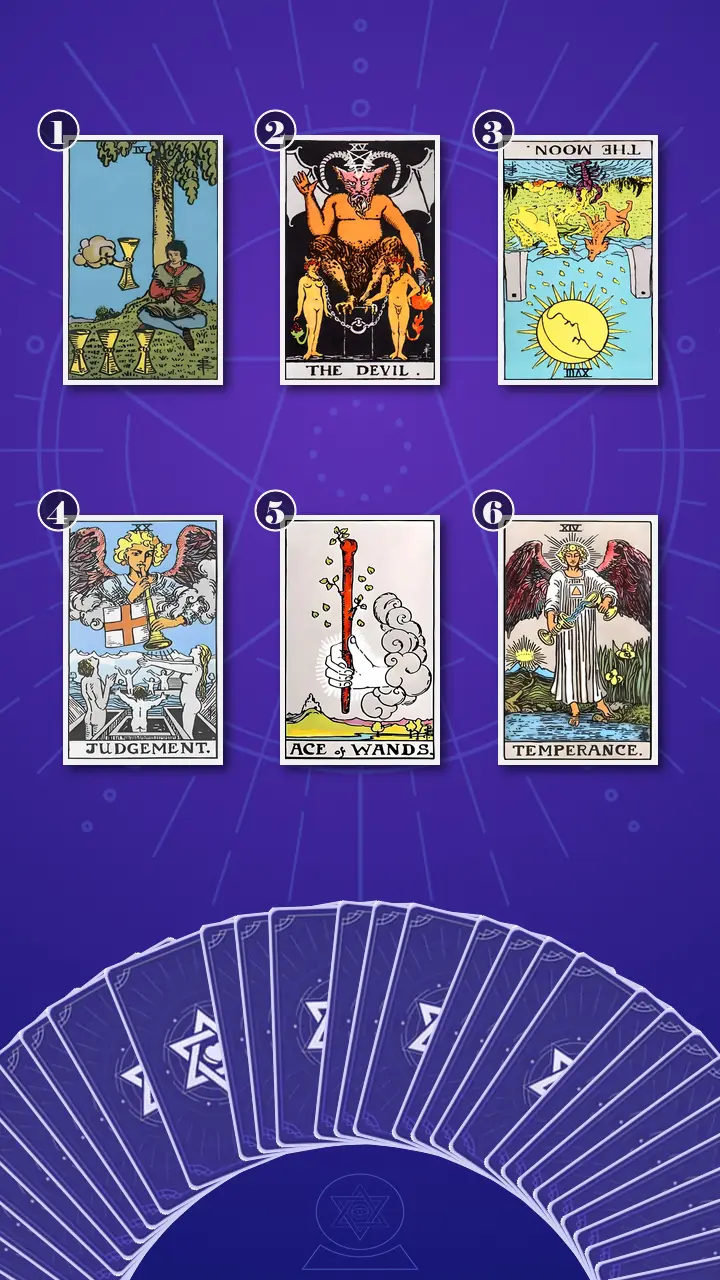
The Closed Loop Behind the Calm
Position 1: The Four of Cups and the Unanswered Draft
Now turning over was the card for the presenting loop: the observable behaviour and emotional flatness through which Jordan called a comfortable routine healing while reflection postponed movement.
I revealed the Four of Cups, upright. The figure sat with crossed arms, turned inward, while a cup was offered close enough to receive and easy enough to ignore.
“This card does not accuse you of resting,” I said. “It asks what your inward focus keeps placing outside the frame.”
I brought her back to 9:08 on Sunday. She had finished writing about surrender. Her tea had gone cold, another wellness episode was queued, and the exploratory email remained unsent. Her breathing was calmer, but the coming week contained no new evidence. The crossed arms looked like the moment she closed her laptop; the offered cup looked like the draft, invitation, application, or creative idea already within reach.
I read the energy as a blockage of response. Contemplation was present in excess, while receptivity to the ordinary opening was underused. The problem was not the meditation or journal. The problem was asking the calm to certify that waiting was still the most useful answer.
“After your last reflective practice, what specific thing was waiting exactly where you left it?” I asked.
Jordan gave a short, bitter laugh instead of nodding. “That is so accurate it is kind of brutal. There is a project tab beside my work calendar. I have moved it into a different Notion dashboard three times without opening the actual file.”
Her shoulders rounded as if the card had replayed footage she preferred to call research. I told her that the recognition did not make her practice fake. A beautifully organised dashboard could reduce noise and still contain no task moved into Done. Both facts could be true.
Position 2: The Devil and the Contract That Auto-Renewed
Now turning over was the card for the maintaining blockage: the real security and short-term relief that kept Jordan's healing question from being tested in daily life.
I revealed The Devil, upright. I directed her attention away from the dramatic figure above and towards the chains around the two people below. The chains were loose. They could be questioned, but their familiarity made them feel fixed.
I asked Jordan what happened on payday. Her jaw unclenched when rent, groceries, and savings were covered. When dissatisfaction returned at work, she listed the respectable title, good benefits, polished apartment, and low-conflict schedule as evidence that the feeling could not deserve a response. The security was real. The blockage appeared when those supports became an unquestionable contract.
“It is golden handcuffs with a wellness rebrand,” she said quietly.
I read The Devil as attachment in excess, not as danger or fate. Jordan technically could investigate other possibilities, but questioning the routine threatened a social character she had learned to maintain: the grateful, self-aware woman who was calmly having a healing season.
I call this a Persona Fatigue Diagnosis. I look for the psychological cost of keeping a polished character on screen when the private self keeps sending different notes from off camera. Jordan was not simply tired from her job. She was tired from continually performing agreement with a life that another part of her wanted permission to examine.
“Which protection do you name first when change becomes concrete?” I asked. “Salary, routine, privacy, identity, or control?”
She pressed her thumb against the side of her mug. “Control. The salary is part of it, obviously. But if I admit I want something different, I cannot keep pretending I already understand where my life is going.”
I nodded. I did not tell her to abandon the stability she had built. The loose chain meant there was room for conscious review, not an obligation to leave. A comfortable life can be a resource without becoming a verdict.
Position 3: The Moon Reversed and the Algorithm of Delay
Now turning over was the card for the underlying root: the interpretation and fear that made admitting healing stagnation feel like losing control over her own direction.
I revealed The Moon, reversed. The winding path, uncertain light, and creatures emerging at the water's edge formed a landscape in which every inner signal could acquire several meanings before Jordan had to choose one.
I described the scene she knew too well. At 10:18 on a weeknight, her calendar, mood, and creative output showed the same pattern they had shown for months. She wrote about energetic timing and needing another layer of clarity. When she tried to type the camera-verifiable sentence, “I have postponed this conversation for six months,” her chest tightened and her fingers stopped.
Reversed, I read the Moon as distorted and partially blocked discernment. The fog was beginning to thin, but Jordan kept replacing visible facts with interpretations that restored uncertainty. Her spiritual language was not false. It was being asked to obscure the point at which an honest sentence might require a choice.
I used one of my most direct tools, Internal Monologue Auditing. I asked her to notice the genre of the film playing under her thoughts. It was not a peaceful wellness documentary. It was a courtroom drama in soft lighting, one where desire was repeatedly called as evidence of ingratitude and every postponed action was defended as wise timing.
I also heard an algorithm trained on avoidance. Each time a concrete choice appeared, Jordan clicked the soothing interpretation. Her inner feed learned to serve more reasons not to test the question. The comfort protected the story, and the story protected the comfort.
“The chain may be loose, but the story keeps tightening it,” I said.
Her breathing paused. Her fingers hovered above the cold mug; her gaze slipped away from the cards as if she were replaying several late-night journal entries; then a low breath left her chest and her hand relaxed. “My exact line is, 'Maybe the resistance means the timing is off,'” she said. “I say it right before I close the draft.”
I reminded her that some resistance does contain useful information. Some pauses are wise, and some risks are disproportionate. The Moon reversed was not telling me that every hesitation was avoidance. It was asking Jordan to separate observable facts, feelings, and interpretations before deciding what the hesitation meant.
When Judgement Interrupted the Script
Position 4: The Trumpet That Asked One Plain Question
The radiator stopped clicking. For a few seconds, the room on Jordan's side of the screen became so quiet that a distant streetcar bell arrived as a single clear note. I turned over the central card of the reading.
Now turning over was the card for the key trigger: the honest recognition that could interrupt the polished spiritual explanation and reconnect Jordan with observable self-assessment.
I revealed Judgement, upright.
I centred the angel's trumpet and the figures rising with open arms. The body language reversed everything in the first row: crossed arms became open arms, fixed sitting became rising, and loose chains gave way to response. I read the energy as previously blocked accountability moving towards balance. This was review without prosecution and awakening without obedience.
“Imagine hearing yourself say 'healing season' to a friend,” I said. “Then replace the whole polished explanation with one question: What became more honest, engaged, or self-directed in the last month?”
I asked her to return to an ordinary Sunday: cold tea beside an open journal, another healing podcast queued, and a safe week waiting to repeat itself. Relief and longing changed places beneath her sternum. She knew that if clarity did not feel perfectly peaceful, she usually sent the question back for more inner work.
Jordan's mouth tightened. “But does this mean I have been doing healing wrong?” she asked, sharper than before. “Because that feels like you are saying I wasted a year.”
I let the anger have room. “No. The quiet may have repaired something real. The practices may have helped you regulate, reflect, and build stability. We are not retroactively turning a useful chapter into a failure. We are asking whether that chapter is still the whole film.”
As an artist, my mind flashed to an edit suite. A colour grade can soften a painful shot, but no editor calls the story advanced if the same frame keeps playing. That professional memory led me naturally into a practice I call The Director's Cut of Self-Compassion.
I asked Jordan to pause the punitive cut, the one captioned, “I fooled myself and lost a year.” Then I invited an objective, supportive edit: “This routine gave me something I needed. Now I have enough safety to review what it can and cannot give me next.” The second cut did not excuse postponement. It removed self-hatred so the evidence could be heard.
I let Judgement's central message stand by itself:
You do not need to make stillness prove that you are healing; let Judgement's trumpet wake you to one honest assessment and one lived response.
After a pause, I made the distinction even plainer:
Comfort can support healing, but it cannot prove healing. The evidence begins with what becomes more honest, alive, and self-directed after the calm arrives.
For one beat, Jordan did not move. Her breath stopped high in her chest, and her fingers froze around the mug. Her pupils widened; then her gaze lost focus as if she were scrolling backwards through a month of identical calendar blocks, saved posts, and unsent drafts. The muscles around her mouth loosened. Her eyes shone, but she did not cry. Her shoulders descended first, then her fist opened against her knee, and a long, unsteady exhale moved through her. The relief was followed by a blank, slightly dizzy look. I recognised the new vulnerability inside it: if the cards were not going to decide for her, the next response belonged to her. “Oh,” she said, almost under her breath. “I do not need to prove the whole year was fake. I just need to stop making the label answer the question.” I asked, “Now, using this new perspective, think back to last week. Was there a moment when this insight could have changed how you felt?”
She remembered Tuesday evening, when a former colleague's career announcement made her stomach drop on Line 1. “I could have treated the reaction as information,” she said. “Not as a command to quit, and not as proof that I am ungrateful. Just information that I miss creative ownership.”
I told her that this was the breakthrough: a first movement from using calm and spiritual meaning-making to protect a stagnant routine towards trusting honest self-review and lived evidence. It was not complete certainty. It was the more durable beginning of self-trust, the knowledge that she could notice, test, stop, revise, and choose again.
The Spark, the Timer, and the Two Cups
Position 5: The Ace of Wands as an A/B Test for Aliveness
Now turning over was the card for grounded action: one small experiment that could help Jordan distinguish restoration from avoidance without allowing tarot to make a life decision for her.
I revealed the Ace of Wands, upright. A hand offered a sprouting wand, alive but not yet developed into a plan, identity, or public announcement.
I translated it into Jordan's professional language. She did not need a resignation, a rebrand, or a five-year strategy. She needed an A/B test for aliveness: one changed variable, a small sample, a defined exit, and new information.
I pictured a Wednesday evening in her apartment. She could set a 20-minute timer, open the creative project she had been describing for months, and make one rough outline. She could draft one exploratory message to a trusted former colleague or place one low-pressure event on her calendar. She would retain the right not to send, publish, attend, resign, or continue.
I read the Ace as initiative becoming available in balance. The spark was not deficient anymore, but it did not need to become excessive fire. Its job was to create contact with reality, not to burn down the life supporting her.
“Do not demand a new identity from one small experiment; ask it for new evidence,” I said.
Jordan raised one eyebrow. “I know myself. Twenty minutes becomes a five-year career plan, and then I panic and watch something about surrender.”
“Then the exit is part of the experiment,” I replied. “You stop when the timer ends. Stopping on purpose is not failure; it is how you prove that curiosity does not get to hijack your safety. The smallest version can be five minutes, one sentence, or one calendar search.”
She opened the Notes app but did not type yet. I watched her thumb rest above the blank screen with a different quality than before. It was still hesitant, but it was no longer waiting for the card to grant permission.
Position 6: Temperance and the Rest-and-Response Rhythm
Now turning over was the card for integrated clarity: a sustainable inner state in which comfort could support healing without substituting for participation, evidence, or self-directed choice.
I revealed Temperance, upright. The angel kept one foot on land and one in water while pouring between two cups. I read the card as balanced energy: reflection flowing into response, response returning to reflection, and neither side claiming moral superiority.
I described a week in which Jordan protected Thursday evening as unmeasured rest and placed one separate 20-minute experiment on Saturday. After both, she could ask what restored capacity and what increased participation. Her calm apartment, income, meditation practice, curiosity, boundaries, and modest action could coexist.
“Rest can remain; it just no longer has to answer every question,” I said. “Comfort becomes one cup. Response becomes the other. Healing is the practice of pouring between them with attention.”
Jordan's shoulders softened again, this time without collapsing forward. “That feels different from being told to leave my comfort zone,” she said. “I do not want to blow up my life. I want to know I am still participating in it.”
“Exactly,” I said. “Temperance is not a dramatic escape. It is proportion. You can keep what restores you and add one measurable act that lets reality join the conversation.”
The Director's Notes for the Next Seven Days
What the Six Cards Had Been Saying Together
I gathered the spread into one continuous story. The Four of Cups showed a posture that may once have offered necessary quiet but had become emotionally narrow. The Devil showed why Jordan maintained it: predictable income, routine, privacy, and control were meaningful protections. The Moon reversed revealed the caption placed over that arrangement, a sophisticated story about timing that kept direct evidence out of frame. Judgement asked for an honest review without condemning the past. The Ace of Wands offered one bounded experiment, and Temperance kept the experiment from becoming an impulsive overcorrection.
In the room metaphor created by the Transformation Path Grid (6) · Context Edition, Jordan was not trapped in a bad room. She was sitting in a well-furnished room with an unlocked door and asking the room itself to prove she never needed to approach the threshold. In the film metaphor I carried as Juniper Wilde, she had bravely stayed in a protective scene a little too long. The next act did not require destroying the set. It required writing one new action into it.
I named her cognitive blind spot plainly: she had been measuring healing by the quality of the explanation and the immediacy of the calm, rather than by whether the calm increased her capacity for honesty, boundaries, participation, or deliberate rest. Because she feared losing control, she demanded complete understanding before contact with reality. Yet some clarity could only be produced after a small, reversible act.
The transformation direction was equally plain. Jordan could move from outcome control towards responsive self-direction. She did not need to know where a message, draft, or calendar hold would lead. She needed to know that she could choose its scale, preserve an exit, observe what happened, and remain free to stop or revise.
Two Small Ways to Let the Journal End With a Verb
I gave her only two practices. Both were small enough to begin, bounded enough to stop, and specific enough to produce information. I reminded her that intentional rest was always a valid outcome when chosen honestly; no action was required to prove courage, gratitude, or healing.
- The Seven-Minute Fact, Feeling, Action CheckImmediately after her next Sunday meditation or journal entry, Jordan would open Notes and write three single lines: one camera-verifiable fact about the past week, one feeling without explaining it, and one reversible action that could begin in 20 minutes or less. An example was: Fact: I did not open the project file. Feeling: flat. Action: outline three rough headings tonight.She would set a seven-minute limit and resist adding a fourth line of interpretation. If capacity was low, the minimum version was one fact and a two-minute action. She could keep any draft private and avoid any conversation or disclosure that felt unsafe.
- The Rest-and-Response Calendar PairBefore the next workweek began, Jordan would protect one evening as unmeasured Rest and schedule one separate 20-minute Response block at home. During Response, she could draft a message, open the project, research one Toronto workshop, or place a tentative event on the calendar. The timer would end the test, and no further commitment would be implied.She would begin with five minutes if twenty felt loaded. At week's end, she would ask: What restored capacity? What increased participation? She would keep one practice from each answer without expanding the experiment as punishment for having waited.
Before we ended, I asked Jordan to read the two practices as options, not assignments. Tarot had helped us expose the reflection-to-action gap and turn spiritual bypassing in ordinary life into observable questions. The authority to act, rest, delay, seek support, or change the scale remained entirely hers.

A Week Later, One Unsent Message Counted
Five days later, Jordan messaged me: she had protected Thursday as rest and used Saturday's twenty minutes to draft the note to her former colleague. She had not sent it. She slept through the night; in the morning, “What if I'm wrong?” still appeared, and she smiled before making tea.
I did not treat the draft as proof that her life was solved or that a career change was destined. The quiet proof was smaller and more useful: reflection had ended with one self-authored response, and Jordan now possessed a piece of lived evidence that no podcast, card, or polished explanation could have generated for her.
That was the heart of our Journey to Clarity. The cards gave us images for withdrawal, attachment, fog, awakening, initiative, and balance. Jordan supplied the honesty, boundaries, and action that made those images relevant. She remained the director of the film still in production.
If a quiet routine loosens your shoulders but leaves your chest dull, I want you to remember what I watched Jordan discover: admitting that comfort may also be keeping a longing unanswered does not erase the shelter it gave you. Noticing the unlocked door is already a change in the frame.
If comfort could remain one cup rather than become the final verdict on your life, what tiny response, bounded by a timer and an exit you choose, are you curious enough to place in the other cup this week?