From Golden Handcuffs to One Reversible Career Test: Pressing Send

The 11:40 p.m. Golden-Handcuffs Loop
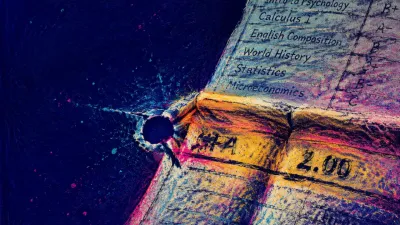
When Alex (name changed for privacy) joined my video call, I met a pattern I recognised immediately: they were twenty-nine, good at their tech job, and paying London rent without panic, yet every promising application ended up beside a spreadsheet until career pivot anxiety talked them out of pressing submit.
Alex told me about the previous Tuesday. At 11:40 p.m., they had been sitting at the kitchen counter in their rented flat with a promising application open on one side of the screen and a salary, commute, flexibility, and risk comparison on the other. The laptop fan hummed into the quiet room. Cold tea left a bitter film on their tongue, and the screen cast a dry warmth across their face while rain hissed over the pavement below.
They wanted a more self-directed life, so they prepared. The possibility became real, so they added one more condition: a spreadsheet column titled “What if it goes wrong?” Then they closed the application, reopened the next morning’s work calendar, and felt their chest loosen almost instantly.
“I’m not saying no,” Alex remembered telling themselves. “I’m just waiting until I know it’s the right move.”
I watched them press both palms against their thighs as they spoke. Their ambivalence seemed to live in the body like standing with one foot inside a Tube carriage and one on the platform as the doors began to close: moving either way felt dangerous, but remaining split was exhausting. The relief after retreat was real. So were the heavy limbs, the private longing, and the frustration that returned by Sunday night.
“Nothing is bad enough to justify leaving,” Alex said. “But I know exactly why change is risky, and I barely know what staying is costing me.”
I let that sentence settle before I answered. “I’m not here to tell you that comfort is wrong, and I’m not going to use tarot to push you into a dramatic leap. I want us to understand why the choice stops feeling like yours at the moment action becomes possible. Then we can give the fog a map.”

Choosing the Map Beneath the Spreadsheet
I invited Alex to take one unforced breath and hold a precise question in mind: “Why does familiar comfort take over when the life I want asks for one concrete step?” I shuffled slowly, using the physical rhythm as a transition from repetitive forecasting into focused observation. There was nothing supernatural to perform. The point was to make enough mental space for the pattern to become visible.
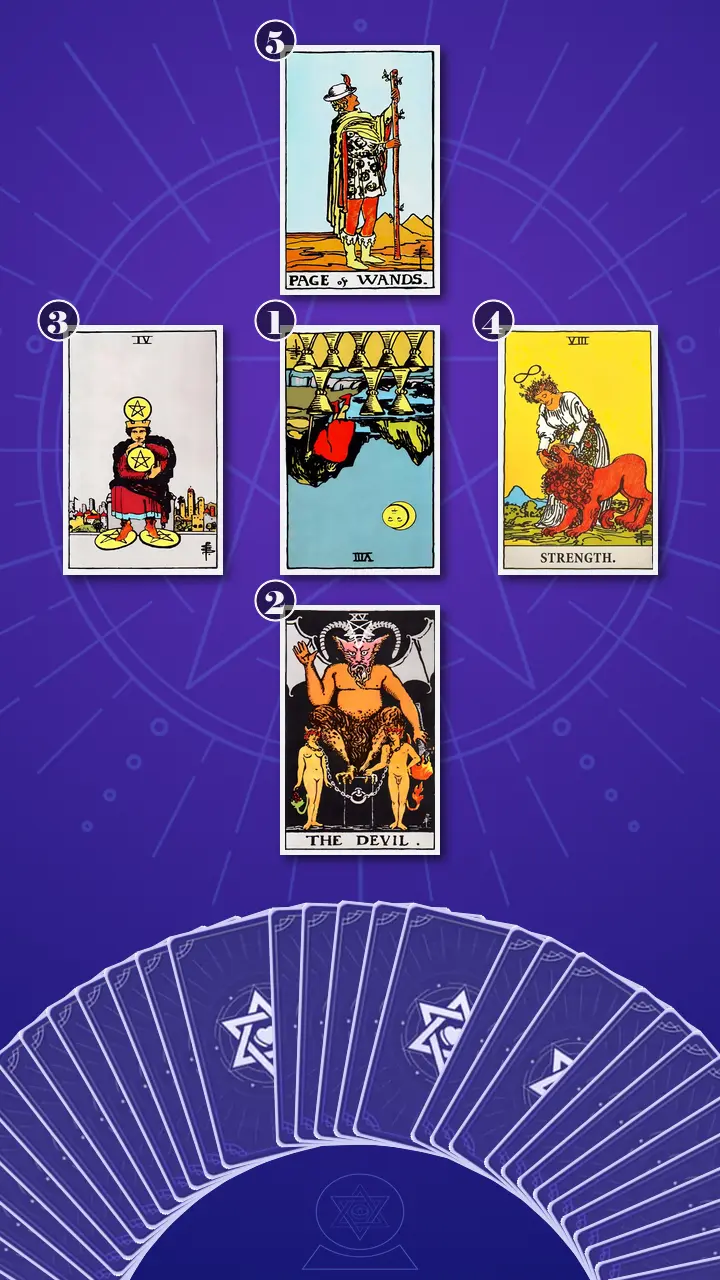
I chose The Shadow Spread · Context Edition, a five-card contextual Shadow Spread for fear of change and repeated retreat. I could have used a Celtic Cross, but ten positions would have scattered our attention across areas that were not driving the problem. Alex did not need more information. They needed a clean view of one self-reinforcing system.
This is how tarot works in my practice: cards do not issue verdicts. Their images help me organise emotional, behavioural, and practical evidence that has become difficult to see from inside the loop. Card meanings in context matter more than dramatic prediction, and Alex would remain the final authority on every interpretation and every next step.
I placed the first card at the centre to show the visible symptom: approaching the desired life and retreating before a real-world test. The second went below it to expose the disowned fear beneath Alex’s rational explanations. The third sat to the left, revealing the short-term protection and long-term cost of returning to comfort. The fourth waited on the right as the capacity that could hold safety and freedom together. The fifth rose above the centre as one bounded action that could produce direct evidence.
On the table, the layout resembled a locked cross beginning to open upward. I would first trace the cage through the centre, lower, and left cards. Then I would follow the possible exit through the right and upper cards.
Reading the Locked Cross
Position One: The Departure With No Timestamp
I turned over the card representing the visible symptom: repeatedly approaching the desired life and returning to familiar comfort before any real-world test could occur.
It was the Eight of Cups, reversed.
I pointed to the stacked cups. The arrangement looked substantial, but one conspicuous gap kept it from feeling complete. Behind them, the traveller’s departure had been suspended by the reversal.
“Your current life contains real value,” I said. “Income, competence, colleagues who trust you, and a progression path are not illusions. The gap is also real. You keep noticing that the role does not offer the autonomy you want, but you demand proof of the destination before allowing yourself to take the first step down the path.”
I returned to the 11:40 p.m. scene. I described the cursor moving towards “Submit,” the application making the possibility external, and the spreadsheet reopening as soon as Alex’s chest tightened. Their private sentence was always some version of: “I am not saying no; I am only waiting until my portfolio, savings, timing, energy, or certainty is better.”
I read the reversal as blocked Water: Alex could feel what was incomplete, but the emotional movement towards change was repeatedly interrupted. The card was not instructing them to abandon everything. In fact, its warning included the opposite risk: after months of feeling stuck, Alex might try to prove their courage through a sudden resignation, creating avoidable instability. The healthier invitation was smaller and more disciplined: find out what one reversible step could teach them about the path.
Alex gave a brief laugh, but there was no amusement in it. “That’s painfully accurate,” they said. “Almost a bit brutal.” Their fingers tightened around the handle of their mug before loosening again.
“The card is describing a loop, not condemning you for being in it,” I said. “Think of the last application, course, project, or conversation you opened and closed. What exact action made it feel real?”
“Contacting an actual person,” Alex answered. “Research is private. A message means someone might respond.”
I nodded. That distinction was our first useful piece of evidence.
Position Two: The Golden Handcuffs Renew Themselves
I moved to the card below the centre, representing the hidden fear or appetite that took control when change stopped being hypothetical.
It was The Devil, upright.
I told Alex that I do not read The Devil as a curse, an external captor, or evidence that something terrible is coming. I centred the loose chains around the two figures. The attachment was consequential, but it was not identical to powerlessness.
Alex had received a salary increase the previous month, just as they had begun considering a career pivot. Their shoulders had dropped when the new figure appeared in the review email. London rent felt covered. Their savings plan looked steadier. Within an hour, they had begun speaking as though the compensation package had made the decision for them.
“Leaving now would be irresponsible,” Alex quoted themselves.
“The salary meets legitimate needs,” I said. “I would never ask you to pretend that money, benefits, housing costs, health, privacy, or energy do not matter. But the quieter question is whether comfort is serving as one resource in your decision or claiming authority over the entire decision.”
The Devil showed an excess of attachment: security had become so persuasive that Alex struggled to distinguish an external limit from a fear-backed agreement they kept renewing. Their situation had acquired a Severance-like split. The competent work-self maintained an office-approved story of success while the private self was allowed to want more only in browser tabs no one else could see.
I described the loop as an algorithm trained on relief. Every time Alex retreated from uncertainty and immediately felt better, the system registered familiar comfort as the winning recommendation. It then served more of the same: another comparison, another prerequisite, another reason to wait. The algorithm was not malicious. It was optimising for the fastest reduction in discomfort, not for long-term alignment.
Alex’s gaze dropped to The Devil’s chains. Their breath left in a slow stream.
“So the job hasn’t made the decision for me,” they said. “I keep granting comfort the final vote.”
“That is closer,” I replied. “And recognising your participation is not blame. It is the point where choice becomes available again. We can examine the bargain without destroying everything it currently protects.”
Position Three: When Security Occupies the Whole Body
I turned over the card representing how the pattern protected Alex in the short term and what it cost in self-trust over time.
It was the Four of Pentacles, upright.
I traced the pentacles in the image: one pressed against the figure’s chest, one resting over the head, and two pinning the feet in place. Security occupied thought, feeling, and movement at once. A distant city remained visible, but the figure could not reach it without changing their grip.
“This is you on a Sunday evening,” I said, “checking your bank balance, tomorrow’s work calendar, and saved jobs in quick succession. Your thoughts calculate risk, your chest guards financial safety, and your practical movement is pinned under the demand to preserve every advantage of the current role.”
Alex’s change spreadsheet had become structurally impossible to satisfy. Each possible role had to beat the current job on salary, flexibility, commute, reputation, stability, benefits, and future potential before Alex would even speak to someone. Whenever their savings reached a previous target, the amount required for a career experiment increased again.
The Four of Pentacles showed Earth in excess. Conservation had hardened into control, and control produced immediate physical relief. But because Alex never gathered new evidence, the fear returned stronger the next time desire surfaced. The strategy that protected them from uncertainty tonight was quietly weakening their belief that they could respond to uncertainty tomorrow.
“Relief can end a feeling without resolving the choice that created it,” I said.
Alex stopped rubbing the mug rim. Their jaw tightened, their eyes shifted towards the rainy window, and then they gave one slow nod.
“If I preserve the salary and routine exactly as they are,” they said, “I don’t have to feel like a beginner. I get to stay competent.”
I asked what movement had been excluded from their definition of safety. After a pause, Alex answered, “Anything that might show me I’m not immediately good at the next thing.”
That was the real cost. The spread was not arguing against stability. It was revealing how thoroughly stability had become fused with identity, competence, and permission to respect oneself.
When Strength Put Its Hands on the Lion
Position Four: The Part That Can Hold Both Truths
The rain outside Alex’s window softened until I could hear the faint click of their radiator through the call. I turned over the card on the right, the hinge between diagnosis and movement. This position represented the capacity Alex needed to acknowledge both the wish for safety and the wish for a different life without being ruled by either.
It was Strength, upright.
I focused on the figure’s calm hands resting against the lion’s jaws. There was no conquest in the image. The lion had not disappeared, and the human figure was not using force. I read the card as balanced power: gentle courage, emotional self-regulation, and a conscious relationship with instinct.
I said, “You know the moment: the application closes, the familiar calendar reappears, and your chest finally loosens. For a few minutes, staying feels like clarity, even though the same unanswered longing returns by Sunday night.”
You do not need to silence the part that wants safety or surrender to the part that fears change; like the figure meeting the lion with steady hands, you can hold both instincts gently and choose one brave, bounded move.
I left a pause around the sentence. The radiator clicked again, sharp in the temporary stillness.
The pattern changes when safety stops holding the final vote and the life you want gets one bounded chance to become real.
Alex’s breath stopped first. Their hand remained suspended halfway between the table and their mug, while their pupils widened as if the last several months were replaying somewhere behind their eyes. Then their expression hardened.
“But doesn’t that mean I’ve been wrong this whole time?” they asked. Their voice came out sharper than before. “That I’ve wasted years pretending I was being responsible?”
I did not rush to turn the anger into relief. “No,” I said. “It means a protective strategy kept working after its costs began to exceed its usefulness. It protected rent, routine, and a sense of competence. You do not have to insult the part that built those things in order to update the strategy.”
The tension held for another moment. Then Alex’s focus returned to the card. Their fingers curled once against the table and slowly opened. Their jaw released; their shoulders descended by a few centimetres; their eyes shone without spilling over. A long breath left their chest with a slight tremor. Relief arrived, but so did a brief, exposed blankness: if fear no longer had the final vote, Alex would eventually have to choose what did.
I asked, “Now, using this new perspective, can you think of a moment last week when this insight might have changed how you felt?”
Alex remembered hovering over “Send” on a message requesting an informational chat. The refrigerator had clicked off, traffic had hissed over wet pavement, and one harmless conversation had suddenly felt like a contract to abandon their whole career.
“I could have said, ‘The part of me that wants safety is here, and the part that wants freedom is still here too,’” they said. “Then I could have sent the message without promising anything beyond the conversation.”
“Exactly,” I replied. “You are not choosing between safety and freedom; you are learning how to stop making either one disappear.”
At that point, an old Wall Street memory surfaced in me: risk was never made manageable by imagining every possible disaster until everyone felt calm. It became workable through position limits, time horizons, explicit costs, and exit conditions. Uncertainty remained, but it stopped being shapeless.
I applied what I call a Potential Actionability Assessment. I test whether an insight can survive contact with a calendar, a resource boundary, and an observable milestone. Strength could not remain a beautiful idea about courage. For Alex, it had to become a specific behaviour: notice the urge to close the application, put both feet on the floor, name safety and freedom without arguing with either, and complete one limited step before analysis reclaimed the meeting.
That was the key crossing in the reading: from restless dissatisfaction and relief-driven avoidance towards cautious curiosity, grounded self-trust, and conscious choice. It did not remove vulnerability. It made vulnerability small enough to work with.
Position Five: The Apprentice Opens a Sandbox
I turned over the final card, placed above the centre. This position represented one bounded next step that could create evidence, clarity, and movement without demanding an irreversible leap.
It was the Page of Wands, upright.
I showed Alex the Page examining a sprouting wand in an unfinished landscape. The Page did not possess a complete route or senior-level mastery. The card’s Fire was emerging in a balanced, exploratory form: enough energy to begin, without the pressure to turn one beginning into a total reinvention.
“This could be one introductory session, one informational conversation, one application, or one hour working on the project you keep organising in Notion,” I said. “The purpose is to learn, not to prove that an entire future will succeed.”
I reframed the informational-chat message as user research rather than a binding product decision. Alex could enter a small sandbox environment where curiosity had sixty minutes, a defined resource cap, and no access to the whole production system.
“The inner sentence is: ‘I am here to learn whether this gives me useful energy and information. I am not here to prove that I should quit my job.’”
The spread contained no Swords, even though Alex’s conscious strategy relied heavily on analysis. I took the missing Air as a practical instruction: the experiment needed a spoken commitment, a written boundary, and a calendar deadline. Otherwise, the research stage would remain infinitely extendable.
“You do not need more imagined evidence. You need one bounded encounter with reality,” I said. “An experiment is not a promise, and curiosity is not consent to continue.”
Alex reached for their phone and opened the calendar. Their thumb hovered for a second, and I saw the old reflex arrive. This time, they did not close the screen.
The Bounded-Life Beta Test
I gathered the five cards into one coherent story. The Eight of Cups reversed showed Alex noticing a real absence of autonomy but stopping each departure before it could create evidence. The Devil revealed the fear beneath the spreadsheets: if Alex tried another path and struggled to sustain it, they feared it would prove they could not create safety for themselves. The Four of Pentacles showed why retreat remained attractive: gripping the current arrangement brought immediate relief and preserved the identity of being reliable, sensible, and competent.
Strength changed the relationship with that fear. Alex did not need to overpower it, obey it, or shame it. The Page of Wands then gave desire a form small enough to become real: a beginner-level encounter with a date, a cap, and an exit condition.
I told Alex that their cognitive blind spot was not a lack of intelligence or planning. It was the belief that clarity had to arrive before experience. In reality, the absence of direct experience kept their risk estimates almost entirely imaginary. They had been living in a well-furnished waiting room, mistaking the absence of crisis for alignment and the relief of postponement for a completed decision.
I also used my Pseudo-Growth Eradication lens to audit the actual return on their personal-development activity. The podcasts, career-change articles, pristine “Next Chapter” Notion dashboard, and comparison sheets were not inherently useless. But their execution rate was close to zero external contact. The current ROI was emotional sedation and temporary possibility, not evidence. Naming that did not make Alex lazy or unserious. It made the difference between preparation and participation measurable.
The transformation direction was therefore precise: replace the search for certainty with one reversible, time-limited experiment. Familiar comfort could remain a resource Alex consciously protected. It did not have to remain a cage they either obeyed forever or destroyed in one dramatic act.
- The 10-Minute Safety-and-Freedom MeetingOn one evening this week, Alex would set a ten-minute timer and write only two sentences: “The part of me that wants safety is trying to protect…” and “The part of me that wants change is asking for…” When the timer ended, the exercise ended.Keep it deliberately small. Insight is optional, and neither sentence creates an obligation to leave or stay. The minimum version is: “Both safety and change matter to me.”
- The Five-Line One-Hour Evidence ExperimentBefore doing more research, Alex would choose one real-world test and write five lines: the question they wanted to answer, one action, a date within seven days, the maximum time or cost, and the exit condition. They chose a sixty-minute informational conversation and placed “Decision closed until review” on the calendar immediately afterwards.Define completion as participation, not confidence or success. Ordinary discomfort goes into a parking-lot note; health, privacy, consent, safety, or exceeding the resource cap always justifies stopping.
- The 30-Day Evolution KPI FrameworkI gave Alex four measurable checkpoints: complete the two-sentence meeting by day three, book and complete one bounded test by day seven, record three observations within twenty-four hours under “energising,” “difficult,” and “still unknown,” and state one conscious next choice by day thirty: repeat, revise, pause, or stop. Alex would send the dates to one trusted friend who only needed to ask whether the test happened.The framework is strict about dates and moving goalposts, but neutral about the outcome. There is no KPI for quitting. Choosing to stay after gathering direct evidence still counts as conscious progress.
I closed the practical section with one boundary: “Make the next move small enough that fear can come along without running the meeting.”

A Week Later: The First External Timestamp
Six days later, I received a message from Alex: “I sent the informational-chat request. The call is Thursday. I still had the urge to close everything, but I kept the one-hour boundary and pressed send.”
They had also completed the two-sentence exercise. The safety-seeking part wanted them to protect rent, recovery time, and the right to decline any follow-up. The freedom-seeking part wanted one honest conversation with someone who had more control over their work. Neither part had been asked to vanish.
That night, Alex slept through until morning. Their first thought was still, “What if I’m wrong?” They smiled once, made coffee, and left the call on the calendar.
I did not read that as a solved life. I read it as the first clean piece of evidence that Alex could feel uncertainty without automatically retreating. The cards had not opened the door for them. Alex had used their own hands.
That is the value I find in a five-card contextual Shadow Spread: it can trace a repeated retreat from its visible behaviour into the fear and relief that sustain it, then return authority to the person making the choice. In Alex’s Journey to Clarity, the destination was not certainty. It was the grounded confidence to test a possibility while protecting legitimate boundaries.
When pressing “close” makes your chest loosen for a moment, it can be hard to admit that the same relief is also keeping the life you want permanently untested. I do not treat that relief as weakness. I treat it as information: a protective part is asking for a boundary, not necessarily the final vote.
If you let one small, reversible experiment count as movement, which saved role, course, city, project, or conversation would you be curious to meet for one hour?