Twelve Open Tabs, One Unchanged Calendar: From Browsing to Testing

The 10:45 p.m. Fantasy-Action Gap
If your Sunday Scaries look less like hating your job and more like spending the weekend building a beautiful Notion plan for another life, the painful trigger may be Monday's unchanged calendar rather than Monday itself.
At 10:45 p.m. on a Tuesday, Maya, a 29-year-old product operations manager in Toronto, joined my video reading from a condo bedroom near Line 1. She tilted her laptop enough for me to see a cold mug beside the trackpad and twelve open tabs glowing in the blue light. The fan whirred beneath our voices while rain made a soft static against the window.
There was a part-time design course, three jobs in other cities, two furnished sublets, and a run of relocation videos. Her fingertips kept moving, but when she opened the familiar grid of meetings waiting for her the next morning, her shoulders dropped as if someone had quietly placed a winter coat full of stones across them.
“My life is fine, so why am I always looking over the fence?” she asked. “I can picture five different lives and commit to none of them. I don't want to wreck something stable just to feel awake again.”
What she described felt like a train idling beneath her sternum: all that contained pressure, nowhere selected to go. The lift she found in researching another life became heaviness when she closed the tabs, and then guilt arrived because she believed a stable salary, benefits, and supportive colleagues should have cancelled the longing.
“A life can be good enough to keep and still not feel fully chosen,” I told her. “I am not here to persuade you to quit, move, or turn dissatisfaction into a crisis. I want us to understand why imagination keeps expanding while your calendar stays still. Then we can give this fog a map and look for one piece of clarity you can test without dismantling your life.”
Choosing the Compass: The Five-Card Shadow Spread
I asked Maya to place both feet on the floor and reduce her question to one sentence: “Why do I keep eyeing a new life from inside a comfortable routine?” I shuffled slowly while she took one longer breath. The pause was not a mystical performance. It was a practical transition from scrolling through possibilities to examining one pattern with sustained attention.
I chose the five-card Shadow Spread. For anyone wondering how tarot works in a reading like this, I use the cards as an external cognitive map, not as a machine for announcing a fixed future. Card meanings in context help us separate behaviours, hidden bargains, protective instincts, and available choices that can otherwise blur together inside one anxious question.
This spread suited Maya because she did not yet have two defined paths that needed a final comparison. A decision spread would have pushed her prematurely toward choosing Toronto or Vancouver, product operations or design, staying or leaving. Her real question was why desire and comfort coexisted, and why every modest experiment carried the emotional weight of a resignation letter.
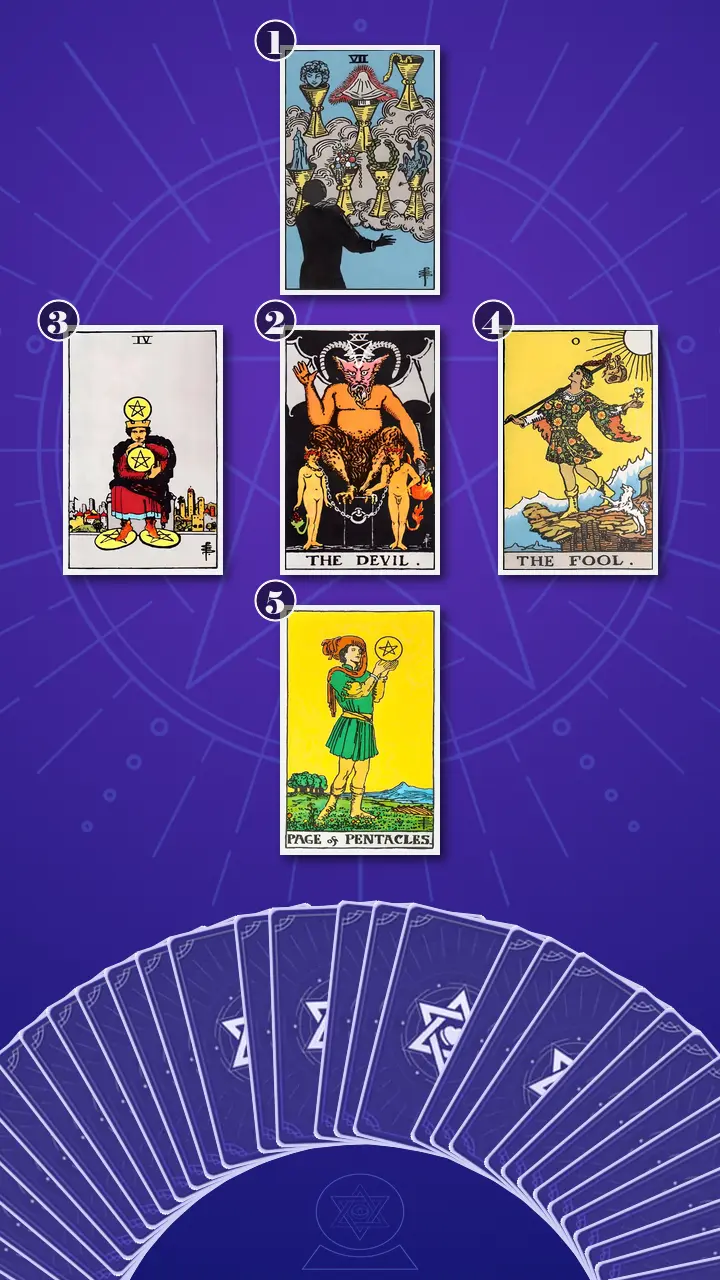
I placed the cards in a cross like a compass whose needle had been held still. The first position would show the visible possibility-scanning pattern. The centre would reveal the attachment beneath it. The left-hand card would explain what that attachment protected. The right-hand card would offer the integrating perspective, and the final card below would turn insight into an embodied practice. The sequence was simple: symptom, hidden attachment, protection, integration, action.
Seven Visions Above an Unmoving Calendar
Position One: The Conscious Pattern
I began, “The card I am turning over now represents the observable symptom: scanning and idealising several alternative lives while remaining physically and practically inactive.” The card was the Seven of Cups, upright.
In the image, seven objects float inside clouds while a silhouetted observer stands below them. I pointed to the gap between the elevated visions and the stationary figure. Maya did not need prior tarot knowledge to recognise the scene. At 10:45 p.m., her jobs, courses, sublets, and travel videos functioned like those suspended cups. Each tab offered a vivid preview of another self, but none was allowed to become ordinary enough for an email, a trial session, or a calendar block.
The upright Seven of Cups carried imaginative Water in excess. Her curiosity was not deficient; it was abundant but uncontained. Action was blocked because every option remained polished by distance. A design course could still promise creative fulfilment because she had not yet encountered an awkward first exercise. A move could still represent total freedom because she had not spent an unremarkable workday in the neighbourhood she saved on Google Maps.
“This is the part that says, 'I can picture five versions of myself, so why can't I choose one?'” I said. “But the number of pictures is not the same as the amount of evidence. Fantasy offers possibility without feedback; direction needs contact.”
I asked which saved possibility she had actually contacted. Maya looked at the tabs, gave one short laugh, and pressed her lips together.
“None,” she said. “That's so accurate it feels a little brutal.”
“Then we will make the accuracy useful, not punitive,” I replied. “The card is not criticising your imagination. Research has been giving you a brief sense of expansion after repetitive workdays. We are only noticing that it cannot perform the job you have assigned to it. It can generate options, but it cannot tell you how your body, attention, and values respond during an ordinary hour of the real activity.”
Her fingers stopped switching between tabs. She left the browser open, but for the first time that evening, she was looking at the card rather than the next possible life.
Position Two: The Loose Clasp of the Golden Handcuffs
I moved to the centre. “The card I am turning over now represents the disowned attachment beneath the fantasy-action gap: the part of you that exchanges some autonomy and aliveness for predictable comfort.” The card was The Devil, upright.
I was careful with the image. The Devil in this position was not a bad omen, a moral judgement, or a prediction that Maya was trapped. I directed her attention to the two figures below the pedestal. Their chains had weight, but the loops around their necks were loose enough to remove.
Maya's modern version of those chains consisted of real advantages: reliable income, benefits, familiar colleagues, and work she could perform competently. After receiving positive feedback, she could open her benefits portal, see that rent was covered, and conclude that even a CAD 60 workshop or a twenty-minute informational interview would be reckless. Aspirational browsing then supplied a private sense of freedom without requiring her to test that conclusion.
The energy here was a blockage created by overidentification with material security. Comfort had moved from being a resource she valued to a condition that seemed to govern what she was permitted to explore. The card did not ask her to condemn stability. It asked whether she was still choosing it consciously.
“The comfort is real,” I said. “So is the part of you that has stopped choosing it consciously.”
When I asked for a recent example, Maya described a crowded northbound train after work. Wet wool coats had brushed her arm while the brakes shrieked into Bloor-Yonge. A former colleague's career-pivot announcement appeared on LinkedIn moments after Maya's director had praised her performance.
“My phone felt hot in my hand,” she said. “I remember thinking, 'If I'm good at this and the benefits are solid, what right do I have to want something else?' By the time I got home, I'd made a list of financial reasons not to do anything.”
Her chest rose and held for a moment. Then she exhaled and rubbed the place beneath her sternum where the pressure had gathered on the train.
I thought of walls I had uncovered on archaeological digs. The same wall could shelter a household and restrict its movement; understanding it required finding the doorway, not declaring the whole structure a prison. Maya's salary and competence were not enemies. The overlooked question was where they already gave her enough room to move.
Position Three: The Calendar That Protected Everything
I turned to the card on the left. “The card I am turning over now represents the pattern's protective function: holding tightly to familiar work, income, time, and identity so uncertainty cannot disturb them.” The card was the Four of Pentacles, upright.
The figure held one pentacle against the chest, carried another above the head, and pinned both feet beneath two more. I read the image as security occupying emotion, thought, and movement at once. In Maya's life, every recurring meeting, savings target, gym booking, errand, and recovery block remained protected. Curiosity received only depleted late-night time.
This was Earth energy in excess. Conservation had hardened into immobility. Maya had never defined a modest exploration budget or a protected curiosity block, so a free lunch-hour information session felt symbolically connected to losing control over her career, finances, and sensible identity.
I asked her to remember the last opportunity she postponed and identify the immediate discomfort that postponement removed.
“There was a free thirty-minute virtual session last Wednesday,” she said. “I had an open lunch slot. I hovered over Register, imagined someone asking why I was interested, and thought I should wait until I could explain what I wanted properly. Then I filled the time with Slack admin.”
Her hand froze around the mug. Her gaze shifted away from the camera as though the empty lunch slot had reopened in front of her. After several seconds, her grip loosened and she set the mug down with a small, careful click.
“I keep saying I'll make room once I know it's worth making room for,” she said quietly.
“And that is the control loop,” I replied. “Holding everything steady removes exposure today, but it also prevents the evidence that could produce direction tomorrow. You are managing a possible life change like a product manager refusing to launch a small pilot until the outcome of the entire rollout is guaranteed.”
I also noticed what the spread had not yet shown. There were no Swords bringing explicit criteria or direct conversations, and no sustained Wands energy carrying desire into scheduled action. Maya did not lack intelligence or motivation. Her thinking was being used to preserve the current system, while curiosity had no sandbox in which to run.
When The Fool Lifted One Foot
Position Four: The Bridge from Fantasy to Evidence
The refrigerator hum behind Maya stopped just as I reached the card on the right, and the sudden quiet changed the scale of the room. “The card I am turning over now represents the integrating quality: the perspective that lets curiosity become a bounded encounter instead of a demand to replace your entire life.” The card was The Fool, upright.
The figure stood beneath a bright sky with one foot lifted, a small bundle over one shoulder, a white rose in hand, and an alert dog nearby. I did not read the cliff as an instruction to leap recklessly. The essential symbols were the raised foot and limited baggage: movement before total certainty, with no requirement to carry a finished identity into the experience.
In Maya's real life, The Fool looked like booking one introductory design workshop, setting a CAD 60 cap, and reserving two Saturday hours. It did not require announcing a career pivot, changing her employment, or demanding that one class reveal a calling. The energy was beginner's courage, a capacity that had been underused rather than absent.
I brought her back to 10:45 p.m.: the tabs made another life feel close enough to touch, then tomorrow's meeting grid appeared, her shoulders fell, and every possibility returned to a labelled folder. She was demanding the correct destination before permitting the smallest departure.
You do not need a guaranteed destination; choose one bounded experiment, and let The Fool's lifted foot turn imagined freedom into lived evidence.
I left a few seconds around the sentence. Rain continued against her window, but the laptop fan had gone quiet.
You do not need a new life plan. You need one piece of lived evidence that imagination cannot give you.
For one beat, Maya stopped breathing. Her thumb, which had been rubbing the edge of her mug, remained suspended above it. Her pupils widened, and then her gaze slipped past the screen as though the previous months were replaying behind it: the unanswered introduction, the missed information session, the Sunday dashboard reorganised instead of used. Her mouth tightened before her eyes began to shine. Recognition arrived first, sharp enough to hurt.
Then her shoulders lowered. Her fingers opened against the desk, but the release brought a moment of visible unsteadiness, the slight blankness that appears when clarity removes an excuse and leaves responsibility in its place. “But doesn't that mean I've been doing this wrong for months?” she asked, with more anger than relief. “And now I actually have to choose something.”
“It means a strategy that protected you has reached the limit of what it can teach you,” I said. “Protection is not proof of failure. You are not choosing your whole future. You are choosing what to learn next. Now, using this new perspective, think back: was there a moment last week when this insight might have made you feel different?”
Maya looked toward the abandoned tabs. “The information session,” she said. “I treated Register like it said Resign.” A breath came from deeper in her chest, followed by a small, uncertain smile. “It was thirty minutes. I could have just learned something.”
I reached for one of my Historical Epoch Analogies. On archaeological sites, the periods that later receive clean names rarely arrived as clean breaks. An old street plan might remain in use while a new workshop, trade pattern, or building practice appeared inside it. People lived through overlapping systems long before a historian drew a decisive line between eras.
“Your stable role is the existing street plan,” I told her. “One workshop is a new activity appearing inside it. You do not have to demolish the city to discover whether the new workshop belongs. A transition can begin as a small layer of evidence long before it becomes an identity.”
I paired that analogy with Core Artifact Excavation, the method I use to identify what must endure even if an old trajectory changes. I asked Maya to name the principles she would want any future life to preserve. She chose financial autonomy, adequate sleep, access to health care, and work with thoughtful people. Those were not chains to break. They were core artifacts to carry forward, criteria against which any experiment could be assessed.
We then took ten minutes and designed a test. Maya selected one introductory design workshop from her saved folder. It would last no more than two hours, cost no more than CAD 60, and end that Saturday. She gave herself permission to leave after the first segment if the setting felt unsafe or too exposing. The experiment did not have to lead anywhere significant. It only had to teach her something reality-based.
I named the crossing I had just witnessed: from restless possibility scanning inside a comfortable routine toward grounded self-trust through bounded real-world experimentation. Trust would not arrive before action as a certificate of certainty. It could grow after Maya watched herself make a limited choice, remain within her boundaries, and review the result honestly.
One Pentacle, One Ordinary Week
Position Five: The Apprentice Replaces the Inspiration Board
I moved to the final card below the centre. “The card I am turning over now represents embodied integration: the practical habit through which this insight enters your calendar and begins producing evidence.” The card was the Page of Pentacles, upright.
The Page held one pentacle at eye level. Behind the figure lay a cultivated field, while mountains remained distant. I contrasted that single object of attention with the seven elevated visions that opened the reading. The Seven of Cups had offered many polished identities. The Page offered one ordinary subject that could be studied.
In Maya's life, this card looked like completing the workshop and spending five minutes recording three observations: What gave me energy after the novelty wore off? What drained me? What would I willingly repeat once? She could then schedule a review date and choose only among three next steps: repeat once, adjust the experiment, or stop.
This was balanced Earth energy, not the constricted Earth of the Four of Pentacles. Structure was no longer being used to prevent movement. A timetable, spending cap, and end date now made movement safer and more observable. The Fool opened the door; the Page gathered data after walking through it.
“The Page does not promise that design is your future,” I said. “It offers apprenticeship instead of reinvention. You are not deciding who you will become. You are noticing what happens when you practise.”
Maya picked up her phone, then paused. “I'm saving only those three questions,” she said. “Not making a dashboard.” She smiled with a trace of embarrassment, but her jaw had softened. Instead of opening another course comparison, she placed the phone face down.
Imagine, Grip, Step, Study
When I read the five-card Shadow Spread as a whole, its story was coherent. Maya's comfortable routine had once built something valuable: financial security in an expensive city, professional competence, and a dependable structure. As curiosity faded, the Seven of Cups supplied imagined movement. The Devil showed why fantasy felt safer than contact, and the Four of Pentacles revealed the daily mechanism: every resource remained protected, so no surprising evidence could enter. The Fool restored voluntary movement, while the Page of Pentacles turned that movement into focused study.
I condensed the sequence into four verbs: imagine, grip, step, study. Maya had been cycling between the first two. She imagined until longing intensified, then gripped the routine until uncertainty subsided. The missing bridge was not a dramatic leap. It was one step small enough to preserve the foundation, followed by enough study to learn what the step meant.
Her cognitive blind spot was the belief that insufficient clarity caused her inaction. The spread suggested the reverse: clarity remained unavailable because she treated every pilot as a full rollout and kept direct experience outside the system. Her personal recommendation algorithm had been trained on longing, so every relocation video generated more polished alternatives. Without an ordinary hour of participation, however, the feed had no lived signal with which to distinguish durable interest from a novelty rush.
The transformation direction was therefore not from stability to instability. It was from static security plus fantasy to flexible stability plus experimentation. Maya did not need to risk rent, health, employment, or rest to prove she was brave. She needed to make those foundations explicit, then stop allowing every familiar preference to disguise itself as a non-negotiable.
Keep the Foundation; Test One Doorway
I turned the reading into two actionable next steps using my Stratigraphic Review. In archaeology, stratigraphy separates layers deposited at different times. In a life transition, the same review can distinguish enduring values from recent social sediment: comparison fatigue, LinkedIn milestone pressure, inherited definitions of sensible success, and routines that remain protected mainly because they are familiar.
- Run a 45-Minute Stratigraphic Review On Saturday morning at her kitchen table or a cafe, Maya would create one phone note with two headings: Foundational Layer and Recent Sediment. Under the foundation, she would record genuine essentials such as her income boundary, health needs, sleep, and no missed work obligations. Under recent sediment, she would place peer timelines, the belief that a class must justify a career change, and recurring commitments that were familiar but negotiable. She would finish with a three-line Stability Floor: a CAD 60 maximum spend, two protected hours, and no change to employment. Tip: Use one note, not a new spreadsheet. If 45 minutes becomes another planning project, do the ten-minute version and write only the three Stability Floor lines.
- Move One Tab into a Bounded Field Test By Thursday, Maya would send one two-sentence message from her personal email to a course organiser or practitioner, asking what the work feels like during an ordinary week. She would then reserve one 60- to 90-minute weekend experiment, with the spending cap and end date written before booking. Immediately afterward, she would take five minutes to answer: What gave me energy after the novelty wore off? What drained me? What would I repeat once? Seven days later, she would choose only repeat, adjust, or stop. Tip: Choose the free, local, or one-session version. Attending for ten minutes and leaving within the agreed boundary still produces evidence. A flat or disappointing result is useful information, not proof that her judgement cannot be trusted.
I reminded Maya that both actions remained invitations, not commands. Protecting her autonomy included the right to stop after one experiment, discover that the fantasy was more appealing than the activity, and choose her current life again with greater awareness. Tarot had clarified the structure of the question; it did not acquire authority over her answer.

A Week Later: Ownership, Not Certainty
Seven days later, I received a message from Maya. She had sent the enquiry, attended the introductory workshop, and archived the other saved lives under a folder called Not Testing This Month.
“Workshop report,” she wrote. “Thirty percent awkward beginner energy, twenty percent software setup, fifty percent wanting another hour. No lightning bolt. I booked one more session.”
The ordinary details mattered. The workshop had not resembled a cinematic career-pivot montage. Some instructions were tedious, and Maya felt exposed when she had to show unfinished work. But after the novelty settled, she remained interested in how people framed problems visually. That was one piece of evidence, modest enough to trust because she had experienced it rather than imagined it.
That night she slept through. Her first morning thought was still, “What if I'm wrong?” She smiled, opened the evidence note, and wrote, “Then I adjust the test.”
I did not regard the workshop as proof that Maya should leave product operations. The quiet proof was that she had made one bounded choice, protected what mattered, tolerated incomplete information, and reviewed the result without turning it into a verdict on her identity. The cards had not moved her life. Maya had moved one tab into her calendar.
That was the essential Journey to Clarity: not certainty about a destination, but ownership of the next observable step. Restless possibility scanning had begun to become grounded self-trust because curiosity was finally allowed to meet reality.
If your chest lifts at the sight of another life while your hand still closes the tab, I know the hardest part may be fearing that one ordinary, imperfect test could expose your judgement as less reliable than the routine keeping you safe. Notice that fear without handing it control of your calendar. A life can be good enough to keep and still not feel fully chosen.
So, among the tabs in your own hall of cups, which curiosity are you willing to give The Fool's lifted foot this week: one message, one hour, or one bounded encounter that can teach you something without becoming a verdict on your whole life?