One Specific Text: From a Blank Saturday to Your Own Weekend Plan

The Blank Saturday Square
When Thursday night arrives and you reread a warm group-chat promise instead of replying to the person who actually named a time, that is not just indecision; it is delayed-reward fatigue dressed up as patience.
Maya (name changed for privacy) sat at her Toronto kitchen counter beneath the blue wash of her phone and the low mechanical hum of the refrigerator. At 8:47 p.m., she reopened the same chat, scrolled past “we need to do this soon,” and checked the one Saturday square she had deliberately left empty. The phone felt warm in her palm. Her shoulders had climbed toward her ears without asking permission.
“I do not want to be the friend who turns every plan into a test,” she said. “But I keep waiting for this friend to make the plan real. Then I see them making definite plans with everyone else, and I feel ridiculous for still keeping space.”
I watched her thumb hover over a softened follow-up. She was not only waiting for a plan; she was waiting for evidence that the friendship would choose her back. The longing sat in her body like a restaurant reservation held under her name with no date, time, or confirmation number. Each vague message gave her a small lift, and each silent day left a hollow place beneath her ribs.
“You are not being dramatic,” I said. “Your Saturday is a real resource after a full hybrid-work week, commuting, rent, and agency deadlines. We can care about this friendship without pretending that ‘soon’ is already a booking. Let’s draw a map through the fog, so the decision stays in your hands.”

Choosing a Compass for a Friendship That Stays Vague
I invited Maya to place both feet on the floor, take one slow breath, and hold the question in a single sentence: How can I care about this friendship and stop organizing my calendar around a promise that has not become concrete? I shuffled slowly, treating the movement as a way to gather attention rather than summon a fixed outcome.
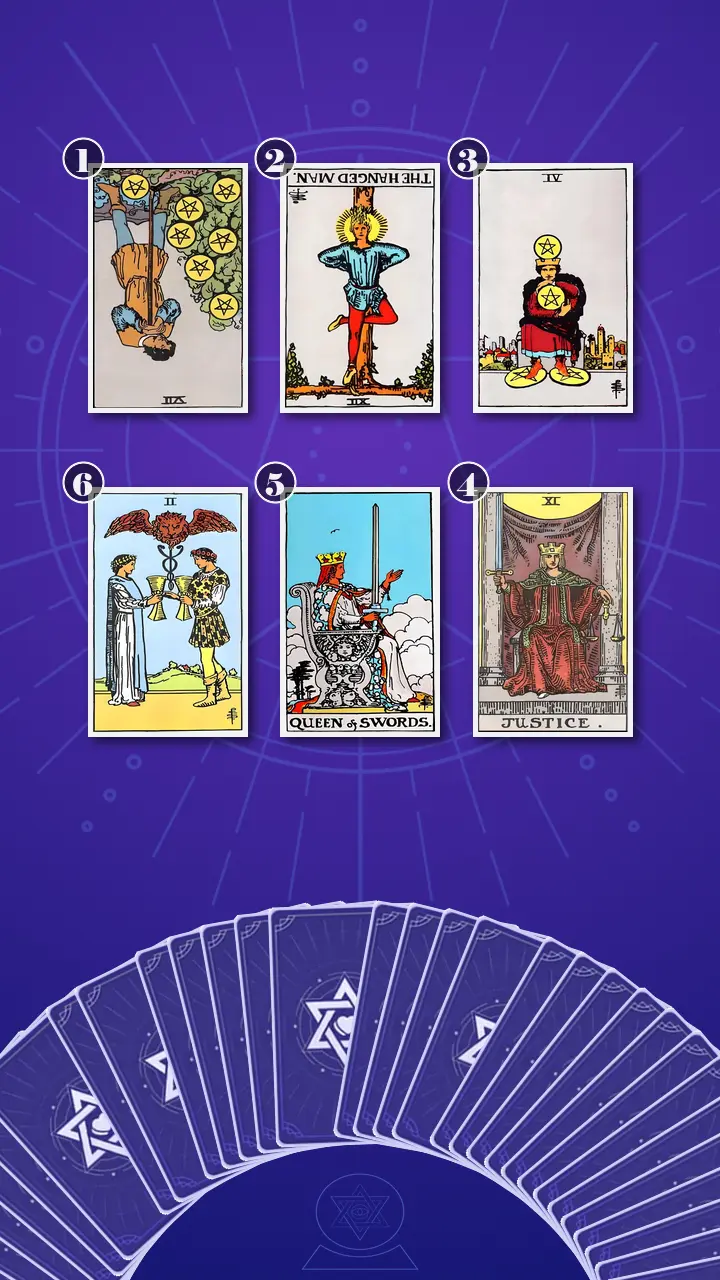
“I’m using a six-card Transformation Path Grid (6) · Context Edition,” I told her. “For a recurring waiting pattern, six positions are enough to follow the whole chain: what is visible, what keeps it stuck, what fear sits underneath, where reality can interrupt the loop, what action is available, and what reciprocity could look like when the insight is integrated.”
I explained this to Maya and to anyone reading along because tarot works best here as a structured reflection tool. It does not prove what her friend secretly intends or predict whether a particular text will receive a yes. It puts the situation into card meanings in context, so observable behaviour, emotional investment, and available choices can be examined together.
The upper row would show the present state, the blockage, and the root. The lower row would turn at the key trigger, then move through an action plan and an integration standard. The shape itself mattered: three cards looking down, hanging, or gripping would meet three cards that weigh, speak, and face one another.
The Gardener Who Kept Refreshing the Chat
Present State: The Seven of Pentacles, Reversed
“Now I’m turning over the card for the present state: the observable waiting behaviour and delayed-reward fatigue occupying your calendar.” The Seven of Pentacles appeared in reversed position.
The gardener's tired pause became Maya's repeated glance from the chat to the blank Saturday square. She had spent several Thursdays protecting the same afternoon because her friend kept saying they needed to hang out soon. In the card's reversed energy, patient cultivation had tipped into depletion: she was still tending a promised harvest, but there was no date, no location, and no present evidence that another person had joined the work.
“This is the difference between patience that leaves room for your life and waiting that quietly cancels other options,” I said. “A warm intention can matter emotionally, but it does not automatically earn calendar space. Ask what evidence would justify another reservation. If the answer is ‘a specific day and time,’ then you have a fair standard rather than a punishment.”
Maya gave a short, bitter laugh instead of nodding. “That is almost painfully accurate. I keep thinking, I have already made room for this, so maybe waiting a little longer will make the investment count.”
I let the sentence stand. Her hand stopped above the phone, her breath paused, and then her eyes moved back to the card as if replaying every Thursday she had defended the same possibility. “You have already invested,” I said. “The card is not telling you to send an ultimatum or erase the friendship. It is asking whether the investment is producing reciprocity now.”
Blockage: The Hanged Man, Reversed
“Now I’m turning over the card for the blockage: the suspension mechanism that keeps you waiting.” The Hanged Man appeared in reversed position.
The figure hanging by one foot from a living tree mirrored Maya's calendar and attention suspended until her friend decided whether the promised plan would become real. The reversed energy showed a pause that had stopped teaching her anything. She called it giving her friend space, but the space had also become a browser tab spinning so long that waiting itself began to feel like the task.
“If I stay patient, I am protecting us,” Maya said quietly. “If I stop waiting, I might be the one who ends it.”
Her fingers reached for the phone and pulled back. Her chest tightened; her gaze lost focus as the old messages seemed to replay. Then she pressed her palm flat against the counter and exhaled through her nose. The movement was small, but I saw the recognition arrive before she could soften it.
“That is the conflict,” I said. “Waiting gives you temporary relief because it preserves hope and postpones a clear answer. But it also keeps your own choices between stations. You are not required to decide the friend's character today. You can ask whether this pause is still creating perspective, or whether it has become a substitute for information.”
Root: The Four of Pentacles
“Now I’m turning over the card for the root: the deeper fear beneath the waiting.” The Four of Pentacles appeared upright.
The figure clutched a pentacle to the chest, held another on the crown, and planted two beneath the feet. Behind them, a city remained close enough to see but far enough to keep outside the grip. I read the image as Maya protecting the imagined future hangout so tightly that definite invitations from other people began to feel strangely dangerous.
“Making another plan can feel like releasing your place in the friendship,” I said. “The fear is not really about one Saturday. It is the story that if you stop preserving the possibility, your friend may stop trying, choose someone else, and prove you were replaceable.”
Maya's jaw tightened. She looked toward the rain-dark window, where apartment lights floated in separate squares. “If this promise never becomes real, I have to face the possibility that I cared more than they did.”
“You may have cared differently, or your friend may be unreliable with plans, or the pattern may be telling you something about the current level of reciprocity,” I said. “We can hold those possibilities without turning any one response into a verdict on your worth. The question is what you are protecting: the bond itself, or the hope that the bond will eventually become what you need.”
When Justice Put the Promise on Trial, Not Maya
Key Trigger: Justice, Upright
The room became unusually still when I turned over the card for the key trigger: the reality-check that separates future-oriented promises from present evidence. Justice lay upright between two stone pillars, red-robed, balanced, and unsentimental without being cruel.
“Justice brings the situation back to what can be observed,” I said. “One side of the scale holds the warm words: ‘we should do this soon.’ The other holds the number of dates actually proposed and confirmed. The sword is not an accusation. It is one clean question: What has actually been agreed?”
I have a diagnostic lens I call Sidekick Syndrome Diagnosis. I use it when a close-knit group quietly assigns someone a role that keeps the group comfortable: the clown, the therapist, the easygoing one, the person who absorbs the uncertainty so nobody else has to name it. Maya had begun playing the low-maintenance friend who never needed a firm answer. That role made her convenient, but it did not make her cared for.
“A warm promise can be sincere as a feeling and still not be a plan,” I said. “You do not need to turn vague promises into a reason to keep waiting; let Justice's scales weigh consistent actions alongside kind intentions, then make a present-tense plan that respects your time.”
For a moment, Maya did not move. Her breath caught; her eyes widened slightly as she reread the imagined phrase “we should” beside the empty calendar square. Then the meaning travelled through her: the friendship did not need to be convicted, and she did not need to keep serving a sentence of indefinite patience. Her fist loosened around the phone. A quiet, shaky exhale left her, followed by a flash of anger.
“But does this mean I was wrong about everything?” she asked. “All those times I thought they wanted to see me?”
“No,” I said. “It means intention and follow-through are different kinds of information. You can have read the warmth accurately and still have overestimated what that warmth was capable of organizing. Justice is not asking you to become suspicious. She is asking you to stop doing the other person's confirming for them.”
Maya's shoulders dropped, but the release left her briefly pale and unsteady, as if a heavy bag had been set down before her hands remembered what to do next. The clarity was relieving and vulnerable at once. I asked, “Now, using this new view, can you remember last Thursday? What might have felt different if you had treated the promise as kind intention rather than a booking?”
She closed her eyes. “I might have replied to the definite invitation. I might still have wanted to see my friend, but I would not have made my whole weekend wait for them.”
That was the first crossing in the emotional transformation: from fear-driven waiting and rationalized disappointment toward an evidence-based boundary. The cards had not decided whether the friendship would deepen. Maya had begun separating another person's availability from her sense of belonging.
Action Plan: The Queen of Swords, Upright
“Now I’m turning over the card for the action plan: the small behaviour that translates clarity into a boundary.” The Queen of Swords appeared upright, her sword raised in a clean vertical line and her open hand making room for an answer.
“She does not make the friend's decision for them,” I said. “She names what she wants, asks for a date, and refuses to convert vague future talk into an obligation to wait. A boundary can leave the door open without leaving your whole life on hold.”
Maya opened the message field. She typed, “I would love to see you. Are you free next Saturday afternoon? If not, no worries, I will make other plans.” Then she added three apologetic sentences and deleted them.
Her mouth tightened as she looked at the shorter version. “It feels vulnerable. Like I am making it a test.”
“It is only a test if the other person does not know they are being tested,” I said. “This is an invitation with information attached to your own calendar. You can name what you want without controlling what they choose.”
The Queen's raised sword and open hand became a communication model: one honest invitation, one specific time, and room for the other person to answer. Maya's thumb hovered, then pressed send. She immediately turned the phone face down. Her body froze for one beat, her eyes tracked toward the device, and then she picked up her notebook instead. The direct text had not solved the relationship; it had returned one decision to its rightful owner.
Integration: The Two of Cups, Upright
“Now I’m turning over the card for the integration: what present-tense reciprocity looks like when the insight is lived.” The Two of Cups appeared upright, two figures facing one another with cups offered and received.
“This is not a forecast that your friend will suddenly change,” I said. “It is a standard you can observe. Does initiative move both ways? Can plans become specific? Do both people make room for connection in the present, rather than one person waiting for a future version of it?”
Maya studied the two figures. “I can care about this bond and still notice whether care is moving both ways.”
“Exactly. Belonging does not have to be proved by waiting alone.” The Two of Cups brought water back into the reading, but it was not the flood of longing from the opening. It was an exchange: a cup offered, a cup met. Hope could remain, but it no longer had to impersonate evidence.
The Calendar Audit and the Role Resignation Act
When I placed the six cards in their snake path, the story became clear. The reversed Seven of Pentacles showed Maya investing time in a delayed harvest. The reversed Hanged Man showed that waiting had become suspension rather than perspective. The Four of Pentacles revealed the fear beneath the grip: if she released the possibility, she might lose belonging. Justice interrupted that loop by comparing kind intentions with confirmed follow-through. The Queen of Swords gave her language, and the Two of Cups gave her a present-tense measure of mutual effort.
The blind spot was not that Maya cared too much. It was that she had allowed the friend's future-oriented words to receive the same authority as a confirmed invitation. The deeper shift was from reserving time for vague promises to asking once for a specific day and time, then making independent plans when there was no confirmation. Her calendar could be open-hearted without being held hostage by a maybe.
I suggested two small experiments. They were options, not commandments.
- Run the Promise-to-Plan CheckChoose one vague promise in the current chat. In ten minutes, write the exact words under “what was said,” then write the date, time, location, and follow-through under “what was confirmed.” Send one concise message naming a single available day and time: “I would love to see you. Are you free Saturday afternoon? If not, I will make other plans.”Keep it to one sentence if the question feels exposed. A specific request is a reality-check, not a pass-or-fail test.
- Use the 24-Hour Calendar ReleaseMark the proposed slot as “unconfirmed,” set a 24-hour reminder after the specific request, and release the hold if no clear confirmation arrives. Reply to one definite invitation or schedule a 30-to-60-minute solo plan such as a walk, library visit, or dinner with someone who is available.The time window is for planning, not punishment. Move the chat out of favourites or choose one time to check it if monitoring has become automatic.
- Resign the Assigned CharacterBefore replying, notice whether you are being cast as the endlessly easygoing friend who absorbs every delay. Borrow my Role Resignation Act: say, “I would like to make an actual plan. Are you free Saturday afternoon? If not, I will choose something else this weekend.” Leave the door open while stepping out of the waiting role.If the direct version feels too large, draft it in Notes first, read it aloud once, and decide later whether to send it. The role is optional; the choice remains yours.
“Your task is not to force reciprocity into existence,” I said. “It is to notice it accurately and protect the part of your life that already belongs to you. You can appreciate the friend, leave room for a future invitation, and still stop giving an undefined future the best seat in your present.”

A Week Later, One Real Invitation
Five days later, Maya texted me from a west-end cafe. She had released the Saturday hold after twenty-four hours, accepted a definite coffee invitation, and put a short walk on her calendar for the following afternoon. The original friend replied two days later with another warm “soon,” but this time Maya answered, “I’d like that. Send me a day and time when you know your schedule.” Then she closed the chat.
She told me the relief was not dramatic. At the cafe, coffee steam blurred the edge of her laptop, and she still had a brief thought that maybe she had handled it badly. But her shoulders settled when she looked at the calendar. One square held a real plan. Another held her own life. The bittersweet part was that she had expected to celebrate by feeling completely certain; instead, she felt quietly understood by her own choices, with some sadness still present.
“I thought making another plan would mean I cared less,” she wrote. “It actually made the friendship easier to see.”
That was her micro-proof. Nothing had been magically repaired, and no card had guaranteed an outcome. Maya had simply stopped treating a vague friendship promise like a confirmed booking. She had moved from fear-driven waiting toward evidence-based boundaries, self-directed planning, and a clearer chance to recognise present-tense reciprocity.
I think of our lives as films still in production. A painful scene can run longer than it deserves when we mistake staying in it for loyalty. Tarot can hold up the frame, name the pattern, and show where the light changes, but the querent is the one who picks up the pen. Maya did that when she sent one clear invitation and let her calendar become hers again.
When a warm promise keeps your weekend blank, your chest can tighten around the fear that making other plans will prove you were easier to replace than to choose. If only confirmed plans received your calendar space, what small plan of your own might you quietly let back into this weekend?