When Secret Access Became Proof of Friendship: Reading Reciprocity
The 11:40 p.m. Message Loop: Finding Clarity in Friendship Breadcrumbing
I recognized Jordan as the kind of late-twenties hybrid tech worker in Toronto who could critique a product flow in ten minutes, then lose an entire evening to one friend's "I know something, but I can't tell you yet" message.
At 11:40 p.m. on a Tuesday, she sat on the edge of her bed with her knees tucked beneath an oversized sweatshirt. The radiator clicked in the dark, and blue phone light washed over the room as she drafted three replies, deleted each one, and finally sent a personal confession she had never intended to share. Her chest tightened. Her jaw ached from holding the same question in place.
"Why do I keep chasing a friend who uses secrets to control closeness?" Jordan asked. "I know this feels unequal. But if I stop asking, I'm scared she will stop choosing me."
What she called anxiety about exclusion had become a tiny emergency siren beneath her skin. Whenever contact became ambiguous, her hand reached for the phone before her thoughts had finished forming. She wanted genuine mutual closeness, yet she kept offering more messages, more context, and more of herself to earn access that the other person still controlled.
I leaned forward and let the silence stay kind. "You are not chasing gossip; you are chasing the feeling of being chosen. We can look at that without shaming your openness or assuming we know your friend's private motives. Today, we will try to draw a map through the fog, so you can decide what the friendship needs from you and what it does not get to demand."

A Compass for the Friendship Crossroads
I asked Jordan to place both feet on the floor, loosen her jaw if that felt comfortable, and take one slower breath. Then I shuffled the cards at an even pace. For me, this small preparation is not a supernatural test. It marks the transition from reacting to an ambiguous message to observing a pattern with enough space to think.
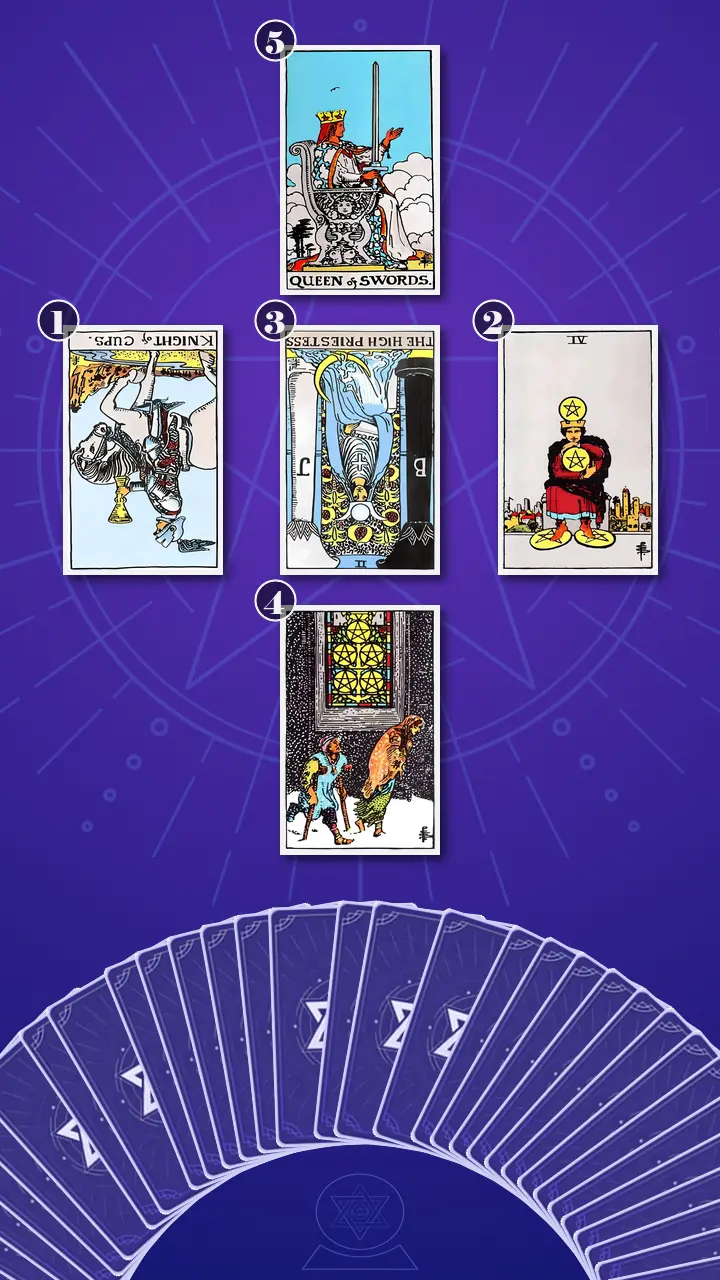
Today, I used a classic five-card Relationship Spread. When people ask how tarot works in a friendship problem, I explain that the spread gives card meanings in context. It separates Jordan's behavior from the friend's observable behavior, then shows the interaction those two positions create, the fear beneath the cycle, and the response that remains within Jordan's control. It does not give me access to the friend's thoughts, predict an inevitable outcome, or decide whether Jordan must stay or leave.
This five-card Relationship Spread fit the question because it is focused enough to examine an unequal friendship without adding unnecessary layers. The first card would show the current symptom, the repeated messaging and over-disclosure. The second would examine the friend's observable gatekeeping. The central card would reveal how pursuit and secrecy become transactional closeness. Below it, I would look at the attachment-linked fear of being left outside, and above it, the boundary-based perspective that could restore agency.
The layout formed a cross like a small compass. The horizontal line held Jordan's pursuit on one side and the friend's withholding on the other. The vertical line moved from the fear beneath the pattern toward the clear language that could orient her above it.
Reading the Map: The First Signals
The Cup She Kept Carrying
I began at the left side of the cross. "This position presents the current symptom: Jordan's repeated messaging and over-disclosure when she feels access to closeness being withdrawn."
I turned over the Knight of Cups, in reversed position. In the classic meaning of this first position, the card reflects Jordan's current stance, emotional needs, and habitual behavior within the relationship.
At 11:40 p.m., Jordan receives a half-disclosure and begins carrying another emotional offer toward the friendship: first a careful reply, then a check-in, then an intimate story she had not intended to tell. Reversed in the position of her current stance, the Knight shows that vulnerability has become a pursuit strategy. The issue is not that she cares too much. It is that she keeps supplying more emotional material before the other person has shown reciprocal movement.
The cup held forward is the personal story in her message draft. The carefully stepping white horse is the meticulous calibration of every word, as if the right tone might cross the digital distance. The river dividing the landscape is the uncertainty she keeps trying to swim across. This is water in an overextended, blocked state: feeling is moving outward, but not through a channel of mutual exchange.
"Maybe if I make this reply warmer, clearer, more honest, then she will finally tell me what happened," Jordan said, almost under her breath. "Maybe then the friendship will feel solid again."
She did not nod. First, her breath caught and her thumb pressed hard into the edge of her phone. Then her eyes dropped to the card, replaying the bedroom scene as if she were watching a message she had sent after midnight. Finally, she gave a short, bitter laugh. "That is almost too accurate. It feels a little cruel."
I let the reaction arrive without correcting it. "The card is not condemning your capacity for emotional honesty," I said. "It is showing the moment when honest sharing becomes an emergency bid for certainty. We can respect the part of you trying to preserve the friendship while also asking whether this strategy is making you work for contact that should have some movement toward you."
The Coin Held Against the Chest
I moved to the right side of the cross. "This position examines the friend's observable gatekeeping behavior without claiming access to the friend's private motives."
The card was the Four of Pentacles, in upright position. Traditionally, this position describes the other person's expressed stance, conduct, and mode of participation in the relationship.
At a crowded Ossington cafe, Jordan's friend leans in, lowers her voice, and begins a story before saying, "Actually, never mind. I shouldn't." Cups clatter. Roasted coffee smells bitter. The vinyl seat sticks beneath Jordan's legs while her jaw clenches, and part of her begins calculating which personal story might reopen the exchange.
The Four of Pentacles shows guardedness, control, and the tight management of something treated as valuable. The pentacle pressed against the figure's chest resembles a secret displayed as important precisely because it will not be released. The coins beneath the feet pin movement in place. In this position, the card describes a pattern of information being managed as a relational resource, not a hidden motive I can diagnose.
"Privacy is not the problem by itself," I told Jordan. "A person can keep someone else's confidence and still be a trustworthy friend. I am asking you to distinguish keeping a confidence from announcing that access exists and then making someone pursue it. A Close Friends green ring can be a fun feature, but it becomes painful when private information is treated like a loyalty program and access starts functioning as social currency."
Jordan's shoulders lowered by a fraction. Her jaw loosened, then tightened again as she looked toward the cafe window. "Yes," she said. "It is the hinting that hooks me. Not simply the fact that something is private."
I marked that distinction carefully. The card offered observable evidence about what the interaction does to the friendship, while leaving room for facts I did not have. Tarot could help Jordan assess the effect of controlled access without turning uncertainty into a verdict about the friend's character.
The Veil That Kept Her Scrolling
I returned to the centre of the cross. "This position reveals how pursuit and secrecy combine into a transactional closeness cycle in which private information functions as social access."
I turned over The High Priestess, in reversed position. The traditional central position shows the bond or recurring interaction pattern produced between the two people.
The card took me back to Jordan's 8:17 a.m. commute on the TTC Line 1. An Instagram Story showed an inside joke from a gathering she did not know about. She opened the group chat, searched an old keyword, and compared reaction timestamps while the train brakes shrieked and someone's damp wool coat brushed her arm. Her thumb kept refreshing. Her shoulders climbed toward her ears.
The black and white pillars framed a threshold. The pomegranate veil concealed a chamber behind it. The partially hidden scroll made knowledge visible without making it accessible. In modern life, the veil looked like a notification preview, a group-chat fragment, or a Close Friends Story that revealed enough to trigger pursuit but not enough to resolve the story.
"Once I know what happened, I will finally know where I stand," Jordan said. "Then I can stop thinking about it."
But the reversed High Priestess showed blocked intuition and outsourced knowing. The missing information had become more authoritative than Jordan's direct experience of inconsistency. Like a redacted document that seems more powerful than every visible sentence, the concealed detail kept commanding her attention. The incomplete-information world of Severance came to mind, where the hidden system becomes the object of obsession even while the visible conditions are already unsettling.
"The need to keep decoding is already data," I said. "It does not prove why your friend withholds information. It tells us something about the repeated effect on you and about the system the two patterns create together. The question can shift from "What secret am I missing?" to "What is this cycle asking me to believe about my place?""
Jordan's thumb stopped above the screen. Her breathing paused, and her eyes went unfocused as if the train window had become a replay of every half-finished conversation. Then her fingers relaxed around the phone. A long breath left her chest. "Oh," she said quietly. "I keep treating the missing part like it has the answer to whether I belong."
The Lit Window Beneath the Story
I lowered my hand to the card beneath the centre. "This position uncovers the attachment-linked fear of being left outside and the Meaning-Collapse Split that makes stepping back feel like invalidating the entire friendship."
The card was the Five of Pentacles, in upright position. In the challenge position, its standard meaning reveals the principal wound, fear, or obstacle constraining how the relationship can develop.
At 6:28 p.m. on a Sunday, Jordan stood beneath fluorescent lights in a Queen Street grocery checkout line when a warm voice note arrived, followed by, "I can't tell you the rest yet." Refrigerator cases hummed. A cold carton numbed her palm, but heat rose into her face. She opened the chat three times before the cashier finished scanning.
The two figures in the Rider-Waite-Smith image pass beneath an illuminated stained-glass window through falling snow. Jordan had been carrying that window in her body. A group photo, an inside joke, or a warm message that stopped halfway could turn an ordinary gap in knowledge into a lit room where everyone else seemed to have been admitted.
"If I stop asking, she will tell everyone else and forget me," Jordan said. "And that will mean I was never really inside. It would make all those late-night conversations feel fake."
The Five of Pentacles does not say Jordan lacks belonging. It shows the scarcity story activated by controlled access. The deeper fear is that pausing the chase will expose grief about being unchosen, and that grief will collapse the meaning of the entire friendship. The card asks her to separate two painful but different questions: What did those moments mean then, and does this relationship offer consistent care now?
"A friendship can have been real and still be unequal now," I said.
For a moment Jordan's fingers froze around the grocery receipt. Her eyes fixed on the glowing card, then shifted toward the empty space beside it. Anger arrived before tears, sharp and clean. "That makes me mad," she said. "I have been acting like stepping back would delete the whole history. Maybe I am protecting the meaning of the friendship from having to meet the present."
I nodded. That was not a demand for an all-or-nothing decision. It was the first separation between past intimacy and present consent, between longing for repair and evidence of reciprocity.
When the Queen Raised the Sword
The Open Hand, the Upright Blade
The room grew very still as I turned over the card above the centre, the position that identifies the self-directed way forward: a direct reciprocity standard, a clear boundary, and observation of behavior rather than further pursuit.
It was the Queen of Swords, in upright position. Her energy was clear discernment, direct communication, emotional independence, and the ability to hold a boundary without turning it into punishment.
Her modern translation was practical: Jordan prepares one calm sentence, "I want a friendship where closeness is not tested through hints about information I cannot access." She does not add a confession, an apology, a threat, or a demand for the missing detail. She states what respectful reciprocity means and observes what the friend consistently does.
The Queen's upright sword separates privacy from control. Her open hand remains available for honest dialogue, but it does not surrender authority. The windblown clouds suggest thought becoming clear instead of remaining trapped inside hidden meanings. She resolves the Knight's over-offering, challenges the Four's guarded resource, and parts the High Priestess's veil without requiring Jordan to become less caring.
At this point I used one of my signature diagnostic lenses, Clique Power Dynamics. I use it to examine the subtle hierarchy inside a tight-knit group, including who distributes context, who waits for context, who gets rewarded with insider status, and whose uncertainty keeps the arrangement stable. It is a way of reading group mechanics, not a label for a person. In Jordan's case, the observable structure had one person carrying emotional bids and another controlling the timing of access.
I added my Sidekick Syndrome Diagnosis to the picture. I asked what role Jordan had been boxed into whenever the group became uncertain. She was not simply a friend who wanted too much. She had become the decoder, the pursuer, and the person expected to prove closeness by tracking what others knew. When a group grows accustomed to someone performing that role, the status quo can continue without anyone having to speak plainly.
My own artist's mind made an immediate connection. I have always felt our lives are films in production, and sometimes a person feels stuck because she has stayed in a painful scene a little too long. The Queen did not ask Jordan to destroy the film or deny the good scenes. She showed her the edit: keep the history, change the part she keeps auditioning for.
The Sentence That Changed the Reading
It was 11:40 p.m., the radiator was clicking, and Jordan was about to send a confession she had never planned to share because one unfinished message had made the whole friendship feel unfinished too. She was caught between decoding the missing fact and protecting the meaning of what they had shared.
Closeness is not something you must earn by decoding withheld information; name your standard and let the Queen's raised sword separate reciprocity from control.
Jordan froze at the semicolon. Her fingers hovered above the phone, and the muscles around her mouth tightened as if the sentence had interrupted an old reflex. Her eyes widened, then lost focus while she replayed the meme, the check-in, and the confession she had sent after the first message went unanswered. A flash of anger moved across her face. "But does that mean I was wrong about all of it?" she asked.
I answered slowly. "No. It means past closeness and present reciprocity are separate facts." Her shoulders dropped, not all at once but in small releases. Her clenched hand opened against her knee. She took one shallow breath, then a fuller one, and her voice changed from a tight whisper to something steadier. The relief carried a trace of dizziness, the light disorientation of having no secret left to solve before making a choice. She looked frightened by the space, and also less owned by it.
I placed her phone face down and asked her to set a timer for no more than ten minutes. "Write two lines in Notes: "My reciprocity standard is..." and "The behavior I can actually observe is..." You do not have to send anything during the timer. Now, use this new perspective to remember whether there was a moment last week when this insight could have made you feel different."
Jordan looked back at the Queen. "The office kitchen," she said. "I typed, "I don't like feeling tested," then replaced it with "Everything okay?" I could have cared about the friendship without bargaining for clarity."
I named the movement plainly: from anxious pursuit and outsourced certainty toward clear reciprocity standards, direct discernment, and steadier self-respect. The cards had not given Jordan the missing information. They had helped her notice that the repeated need to decode was already information she could use.
The Open-Hand, Clear-Sword Boundary
When I gathered the five cards into one story, the sequence was clear. The reversed Knight of Cups showed Jordan offering more feeling whenever contact became uncertain. The Four of Pentacles showed the friend's observable control of private information as a guarded resource. At the centre, the reversed High Priestess turned that withheld information into a hidden authority, so Jordan searched chats and social posts instead of trusting the visible repetition. Beneath it, the Five of Pentacles revealed the lit-window fear that pausing would prove she was outside and make the past meaningless. Above it, the Queen of Swords supplied the missing air: clear words, a standard, and a way to observe without mind-reading.
The cognitive blind spot was not that Jordan cared about the friendship. It was that she treated access to secrets as stronger evidence than consistent care. The transformation direction was not from vulnerability to coldness. It was from using secret access as proof of friendship to naming reciprocity once and evaluating the bond through behavior. A friendship can remain complicated while Jordan stops allowing ambiguity to set the price of admission.
"A boundary is not a silent test; it is a clear description of your participation," I told her. "You are not trying to provoke a confession or score who initiates more. You are making your own participation visible, then allowing the pattern to answer."
I translated the reading into two small experiments. They were actionable advice, not commands, and each had a stopping point. Jordan could revise them, delay them, or choose not to use them if the situation felt too exposing.
- The One-Message Reciprocity TestOn the next ambiguous message this week, send no more than one sincere reply. Put a private 24-hour reminder in her phone rather than sending a second message, a meme, or an extra disclosure. During the pause, write in Notes: "I want friendships where closeness is shown through consistency, not hints about information I cannot access."If 24 hours feels too sharp, use a ten-minute version. The pause is an experiment, not a punishment, and Jordan can stop, shorten, or leave the conversation untouched.
- The Role Resignation ActIn one low-stakes conversation, Jordan can say or text: "When closeness comes through hints about secrets, I end up feeling pulled into guessing. I would rather we speak directly or leave private information private." Afterward, she can keep a seven-day two-column note titled "What happened" and "What I imagined it meant," recording observable behavior without turning it into a scorecard.Use one neutral observation and one preference. Do not add an apology, confession, threat, or evidence brief. The minimum version is the sentence read aloud once, followed by a check of whether the friend responds with directness.
I also asked Jordan to widen the evidence base for belonging. She could schedule one twenty-minute coffee or walk with someone whose contact usually felt steady, keep a Friday plan even if a late invitation arrived, or put her phone face down and name five visible objects when an inside-joke post triggered checking. This was not about recruiting allies, exposing the friend, or replacing one intense bond with another. It was about proving that one inconsistent friendship did not need to function as the only illuminated window in her social life.
"Say the standard once. Let the pattern answer," I said. "Your friend may agree, disagree, change, or remain vague. Those responses belong to the relationship's evidence. Your decision about what you send, what you share, and what you continue participating in belongs to you."

A Week Later, Her Attention Came Back
Five days later, I received a text from Jordan: "I used the sentence and kept my Saturday plan. I slept through the night, then woke thinking, What if I'm wrong? I still smiled." The friendship was not solved, and the friend had not become a different person overnight. But Jordan's attention had returned to her own life.
I thought of the Queen's open hand and raised sword. The cards had not instructed Jordan to cut someone off or force an answer. I had sat beside her while she examined the difficult scene, and she had picked up the pen. Finding clarity meant separating privacy from controlled access, past meaning from present inequality, and longing from evidence. The first proof was small: one sentence sent without over-explaining, one plan kept without waiting for permission.
When one vague message tightens your chest and sends your hand back to the phone, you are not only chasing an answer; you are trying to keep the friendship meaningful without having to discover whether it can choose you back.
If you let consistency, rather than secret access, answer the question of closeness, what small difference might you notice in the next conversation, perhaps in the space between the Queen's open hand and her raised sword?