Closing the Pricing Tabs: From Side-Hustle Plans to One Uneven Row

Monetizing Every Hobby Before the First Stitch
I recognized the pattern before Jordan, a twenty-seven-year-old digital marketing coordinator in Toronto, finished describing it: they worked in metrics all day, paid big-city rent, and somehow every new hobby became a side-hustle deck before it became something they had practised five times.
At 11:40 on a Tuesday night, I could see an unopened embroidery kit beside their laptop. Blue light washed over the folded fabric while Etsy seller fees, domain searches, and a half-written Instagram bio filled the screen. Their radiator clicked behind them. Jordan lifted a mug, grimaced at the metallic taste of cold tea, then returned their warm phone to a hand that would not stop tapping.
“I wanted to learn one stitch tonight,” they said. “Instead, I calculated how many pieces I'd need to sell to recover the $86.42 I spent. I keep building launch plans for skills I've barely practised. When the fun disappears, I assume I chose the wrong interest.”
I watched their jaw tighten. The urgency seemed to sit under their sternum like a checkout countdown, turning every unpriced minute into an item they were about to lose. They wanted the physical pleasure of thread passing through fabric, but making the interest commercially legible felt safer than remaining an unseen beginner. The attempt to make the hobby real was preventing direct contact with it.
“You are building the shop before you have met the practice,” I said. “That doesn't make your ambition fake, and it doesn't make your concern about money irrational. Toronto rent is real. Creator-economy pressure is real. What we need to examine is why revenue has become the first test of whether your desire deserves time.”
I explained that I would not use tarot to decide whether Jordan was supposed to monetize embroidery or predict whether a business would succeed. My role was to help them see the loop clearly enough to choose their next move. “Let's give this fog a map,” I said. “The cards can make the pattern visible, but you will decide what to do with what we find.”

Choosing the Switchback Through the Garden
I asked Jordan to close the pricing tabs, place both feet on the floor, and take one ordinary breath before I shuffled. I treat this small pause as a change of cognitive gears, not a mystical performance. It gives the question somewhere quieter to land.
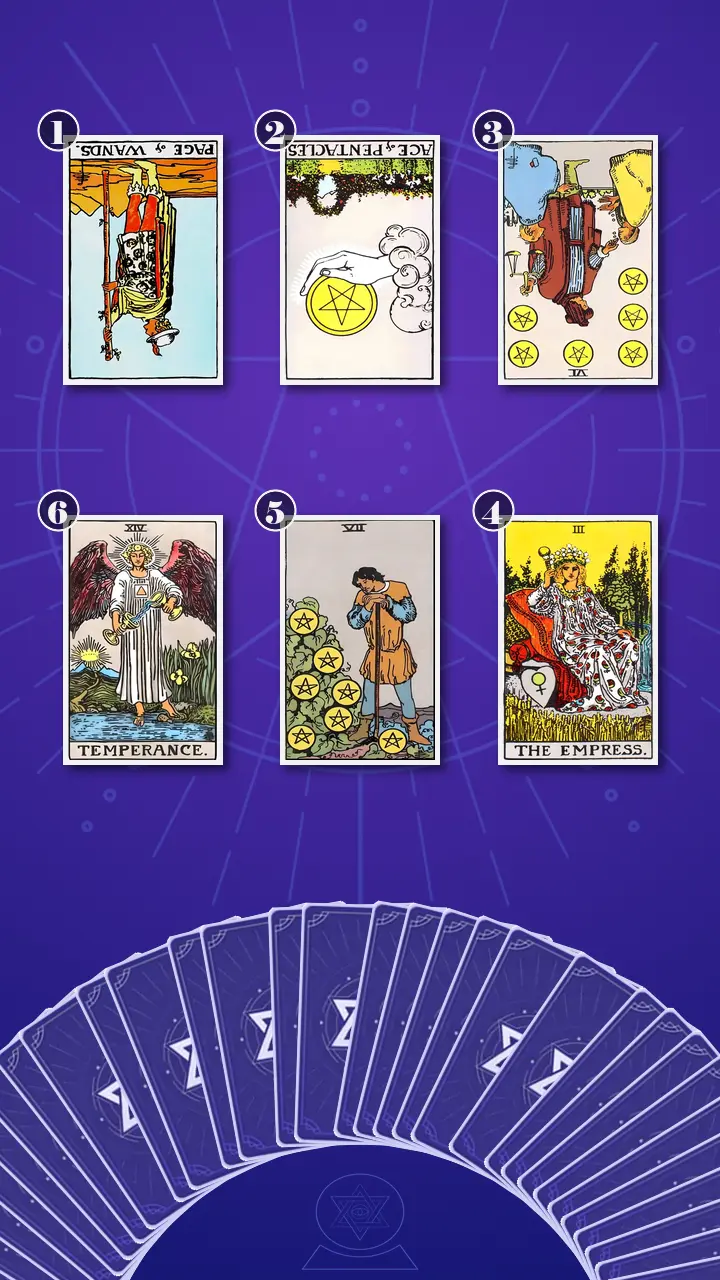
I chose the six-card Transformation Path Grid · Context Edition. For anyone wondering how tarot works in a situation like this, I use the spread as a structured reflection tool. Jordan's problem was not one isolated decision between hobby and business. It was a recurring system: excitement became a commercial plan, the plan introduced performance pressure, pressure weakened enjoyment, and that loss of enjoyment sent them looking for a fresher spark. The spread was designed to trace that full side-hustle burnout cycle without pretending the cards could issue a verdict about Jordan's future.
I arranged the cards in two rows of three. The upper row would show the visible pattern, the immediate blockage, and the belief keeping it in place. From the upper-right card, the reading would drop to the key catalyst below it, then travel left through a practical experiment and an integrated way of relating to pleasure and money. On the table, the route resembled a switchback path through a garden: diagnosis in one direction, transformation on the return.
This structure mattered because card meanings in context are more useful than isolated keywords. The first card would ask what Jordan actually did after a spark appeared. The third would examine who had been given authority to assign value to that spark. The fourth, our key card, would identify the leverage point capable of changing the sequence. The last two would turn insight into observable next steps rather than leaving Jordan with a beautiful idea and no way to test it.
Reading the Metrics Loop
The Spark That Became a Founder Announcement
I turned over the card representing Jordan's observable present pattern: the behaviour between the first rush of interest and the moment branding displaced private practice. It was the Page of Wands, reversed.
The Page studies a sprouting wand in a landscape where no garden has formed yet. I read that reversed Fire as genuine enthusiasm becoming overextended and directionally blocked. The creative energy was not missing. It was being scattered across a future identity, public promises, social handles, and imagined offers before repetition could give it a stable direction.
“This is Monday-to-Friday embroidery,” I said. “You discover it on Monday, reserve a brand name on Wednesday, draft a founder-style announcement on Thursday, and feel detached from the unopened kit by Friday. The inner script sounds like, ‘I'm excited, so I need to make this official before the feeling disappears.’”
That was the Page's modern-life scenario almost literally: Jordan had converted beginner curiosity into premature identity construction. Creating the account offered a quick hit of certainty, but it also made every uneven stitch feel like evidence about a public project rather than a normal part of learning. If the announcement received little engagement, the interest itself appeared to lose value.
Jordan gave one short laugh, but their expression did not brighten. Their fingers paused over the phone, their gaze drifted toward the kit, and then their shoulders sank by a fraction. “That's too accurate,” they said. “Honestly, it feels a little brutal. I've announced three projects this year that don't exist anymore.”
“The accuracy is not an accusation,” I replied. “The Page also confirms that the original excitement was real. We are separating the spark from the job you assigned it. A launch plan can make uncertainty look productive, but it cannot do the beginner hours for you.”
The Coin Demanded at the Garden Gate
I turned over the card representing the immediate blockage: the demand that a new interest become a viable material opportunity before it had roots. It was the Ace of Pentacles, reversed.
On the card, a single pentacle is offered above a garden path that still has to be travelled. In reversal, I read the Earth energy as blocked by premature materialization. Jordan was trying to collect the return at the entrance. The requirement for immediate financial sense was postponing the experience that could eventually support a sensible practical decision.
I pointed to the unopened kit and the receipt tucked beneath it. “The $86.42 has become a break-even target before one piece exists. The phone warms in your hand while you move through price fields. Your jaw tightens, and the thought arrives: ‘If this can't pay for itself, I shouldn't spend this much time or money on it.’ The seed has been given a sales quota.”
Jordan rubbed their thumb across the edge of the receipt. I saw their chest rise without a full exhale. “Researching fees feels responsible,” they said. “Sitting here being bad at embroidery feels like I'm wasting the evening.”
“That distinction is the blockage,” I said. “Business research produces clean numbers, so it can protect you from the uncertainty of being new. But market data and practice data answer different questions. Pricing can tell you what an offer might require. It cannot tell you whether you enjoy returning to the activity, whether your hands learn through repetition, or whether the interest fits your actual capacity.”
The Ace did not warn Jordan against earning money. It showed a timing problem. Their practical instinct was running in excess while embodied contact remained deficient. Possibility had been mistaken for an immediate return requirement, and the resulting pressure was preventing the foundation it demanded.
When the Market Took the Scales
I turned over the card representing the psychological root: the belief that desire becomes legitimate only when payment, demand, or visible approval assigns it measurable value. It was the Six of Pentacles, reversed.
The traditional image places scales in the hand of a standing figure while coins fall toward people positioned below. Reversed, the reciprocity of the card had become conditional and unequal. Jordan had handed an imagined market the scales, then waited for customers, followers, or friends to decide how much weight a private desire deserved.
“You send a poll asking whether people would buy custom embroidery before you've decided whether making it is enjoyable,” I said. “A friend replies, ‘Maybe,’ and the answer lands like a verdict. Underneath the poll is a quieter request: ‘Tell me you would buy this, and then I'll know I'm allowed to keep wanting it.’”
Jordan's hand went still on the receipt. Their eyes lost focus for a moment, as though they were replaying old message threads, and then they released a low breath. “I thought I was validating an idea,” they said. “But I was asking for permission.”
I used my Shadow Path Analysis to lay out the fear-based logic without turning it into a diagnosis. The trigger was a desire that could not yet be measured. The shadow fear said unprofitable time might prove Jordan was wasteful, unserious, or out of control. The protective move was to poll, price, brand, or announce. That move created short-term certainty, but its hidden cost was giving outside response admin access to Jordan's private calendar.
I flashed back to conversations I had heard across different cities and cultures, where the currency and career language changed but the bargain often sounded the same: prove your usefulness first, then permit yourself to want. The market was not the villain in Jordan's reading. Paid creative work could be meaningful and fair. The problem was the authority Jordan had assigned to exchange before lived desire had been allowed to speak.
When the Empress Refused the Early Harvest
The Key Card: A Field That Did Not Need to Pitch Itself
The room seemed to become quieter before I turned the fourth card. Even the radiator stopped clicking. I revealed the card representing the catalyst capable of replacing conditional valuation with protected, embodied cultivation: The Empress, upright.
At 11:40 p.m., the unopened embroidery kit was still beside Jordan while Etsy fees, domain tabs, and a half-written launch bio occupied the screen. Their hands looked busy, but they had not made a single stitch. They were trying to solve the uncertainty of desire without touching the desire itself.
The Empress changed the sensory field of the reading. Her ripe wheat, pomegranate-patterned gown, flowing water, and cushioned seat showed growth supported over time. I read her upright energy as balanced nourishment: not passive waiting, but the deliberate creation of conditions in which something living could become observable.
In Jordan's life, that meant leaving the kit within reach, choosing thread for its colour rather than its saleability, turning off notifications, and protecting two quiet evenings from content planning. The drag of cotton through fabric, the warmth of the lamp, the frustration of a snag, and the easing of their hands after several stitches would all count as information. Nobody needed to see the result for the contact to be real.
This was where I brought in Authentic Desire Decoding. I asked Jordan to separate three voices that had been compressed into one urgent command. One voice carried a socially inherited pseudo-expectation: every spare hour should improve income, status, or identity. A second voice carried a legitimate practical concern about cost and financial security. Beneath both was a quieter, authentic motive: Jordan liked colour, texture, and the possibility of making something slowly with their hands after a day spent inside campaign dashboards. The Empress did not ask them to silence the practical voice. She asked them to stop letting it interrupt before the quieter motive had finished a sentence.
Your interest does not have to earn its right to exist; give it protected time, repetition, and sensory attention, as the Empress tends a field before asking it for a harvest.
I let the sentence remain between us for a moment. Then I added, “An interest does not need to pay rent to deserve room in your life; money can be a later container, not the entrance exam for desire.”
Jordan's breath stopped first. Their thumb froze above the dark phone screen, and their eyes widened slightly before drifting away from me toward the folded fabric. I watched recognition move in slowly: their brow tightened, their lips parted, and one hand closed around the sleeve of their sweatshirt. Then resistance arrived. “But doesn't that mean I've been doing this wrong for years?” they asked, their voice suddenly sharper. “I've spent so much time on brands that went nowhere.” I did not rush to turn the discomfort into relief. “No,” I said. “It means a protective strategy gave you certainty when uncertainty felt unsafe. We can respect why it formed without requiring it to run the next experiment.” Their fist loosened one finger at a time. Their shoulders dropped, followed by a long, uneven exhale that sounded relieved and almost bereaved. For a second, the clarity seemed to leave them unsteady. “If I don't make a plan,” they said more quietly, “I have to find out whether I actually like it.” “Yes,” I said. “And you remain free to dislike it.”
I invited them to test the insight against real life. “Now, with this new perspective, think back to last week. Was there a moment when this could have made the experience feel different?”
Jordan looked at the kit. “Wednesday,” they said. “The thread caught three times, and a LinkedIn notification came up about a former coworker's creator business. I opened Canva because being strategic felt better than being clumsy. I could have stayed with one more stitch instead of deciding what the whole thing meant.”
That answer marked the breakthrough. It was not certainty about embroidery and not a rejection of commerce. It was one step from urgent, market-validated excitement toward grounded curiosity that could weigh pleasure and practical value in sequence. Private did not mean pointless. It meant Jordan could collect lived evidence before submitting desire to a public score.
The Gardener's Thirty-Day Pause
Patience With a Review Date
I turned over the card representing the behavioural experiment that could make the Empress's catalyst visible in daily life: the Seven of Pentacles, upright.
The gardener on the card leans on a tool and studies a vine that is growing but not ready to be stripped. I read the upright Earth energy as steady and balanced. The pause was not vague patience, a lifetime commitment, or a demand to preserve every hobby forever. It was an evidence-gathering period long enough for repetition to reveal something that first-week revenue forecasts could not.
For Jordan, the card translated into a 30-day no-monetization trial with two short private practice sessions each week. At the end, they would review the minutes practised, what became easier, whether they wanted to return, how their energy changed, and whether the activity fit their actual schedule. Only then would they consider whether a commercial layer belonged in the next stage.
“Think of it as reviewing a project after enough data exists,” I said. “You don't need to promise embroidery a place in your life forever. You need enough repeated contact to see what is actually growing. Protect the practice before you test the market.”
Jordan reached for their phone, stopped, then asked, “Can I put the sessions in my calendar, or does scheduling turn it into work again?”
“Scheduling protects the opportunity to practise,” I replied. “The boundary is around what the session must produce. It does not need to create inventory, content, a post, or a future identity. Missing a session is information about capacity, not evidence that you failed or need to restart from zero.”
They opened their calendar and chose Tuesday and Thursday evenings. The movement was small, but I noticed that they entered private practice, not embroidery launch.
Two Cups, Two Different Questions
I turned over the final card, representing the integrated relationship available when the insight and experiment were combined. It was Temperance, upright.
Water moved continuously between two cups while the figure kept one foot on land and one in water. I read this as balanced integration, sequencing, and proportion. Jordan did not have to choose between keeping every interest commercially pure and monetizing every interest immediately. Pleasure and practical value could communicate without being forced to answer on the same day.
The modern version was a two-stage workflow. Jordan could begin with private exploration, review the interest after repeated practice, and then choose among three valid options: continue privately, pause without declaring failure, or test one limited paid offer. If they chose a paid experiment, it could have one product, one time cap, one spending cap, and one review date. At least one weekly practice session could remain free of filming, customer requests, analytics, and sales targets.
“I can care about pleasure and practical value without asking both questions at once,” Jordan said.
“Exactly,” I replied. “Temperance does not erase your ambition. It gives ambition the right timing and proportion. Money becomes one possible container for established desire, not the condition that determines whether desire is valid.”
I also noted what was absent from the spread. No Sword card had appeared. Jordan worked in a profession built around analysis, and another strategy deck was not the missing ingredient. The relevant clarity had to come from embodied experience: thread in hand, mistakes repeated, energy noticed, and actual capacity observed. The final card was a direction for reflection, not a predicted outcome. Jordan would still author the decision.
The Practice-Before-Pricing Gate
I drew the six cards into one story. The reversed Page showed a real spark stretched into a public identity before it had direction. The reversed Ace showed that spark being forced into a premature coin. The reversed Six revealed the deeper rule: the imagined market was holding the scales and using payment as permission. The Empress returned authority to lived contact, the Seven gave that contact a bounded review period, and Temperance allowed optional commerce to enter later without taking over the entire practice.
The central blind spot was simple but consequential: Jordan had been treating market data as if it were desire data. A customer poll could test demand, but it could not reveal whether making the work felt absorbing. A price calculator could estimate costs, but it could not show whether skill deepened through repetition. A launch plan could organize a business, but it could not determine whether there was a practice worth organizing around.
The transformation direction was therefore not “never monetize a hobby.” It was a change in sequence: move from pricing a new interest during its first week to giving it a protected practice-before-pricing period. Let enjoyment, learning, consistency, and capacity become observable. Then decide whether money belongs, and in what proportion.
I gave Jordan three small experiments. Each included an exit route because a supportive boundary should not become another productivity test.
- Open the Private Beginner Window. On Tuesday and Thursday evening, Jordan would place the embroidery kit on the kitchen table, set a 20-minute timer, and stitch without opening Etsy, Shopify, Canva, Instagram, or a domain registrar. The thread, fabric, and scissors would be prepared in advance so the first action was physical contact, not project management. If 20 minutes felt heavy, five minutes or one basic stitch would count. Questions about prices or posting could go into a Later, Maybe note rather than being solved during practice.
- Run the Three-Day Persona Detox Protocol. For five minutes before bed on three consecutive days, Jordan would divide a private note into two columns: What I Should Want and What I Actually Desired Today. They would record the productivity script in the first column, then one sensory detail, one thing learned, and whether they wanted another session in the second. The point was to distinguish inherited creator-economy expectations from direct experience, not to force one voice to defeat the other. No polished explanation was required. A line as brief as “I should build an audience / I liked the blue thread” would be enough to recalibrate the inner compass.
- Set the Thirty-Day Garden Review. Jordan would schedule two private sessions per week for four weeks and use a tracker with four fields: date, minutes practised, one thing learned, and energy afterward from 1 to 5. Until the review date, there would be no storefront, customer poll, new social account, premium branding purchase, presale, or public launch deadline. On day 30, Jordan would ask: Did I return? Did enjoyment change? What became easier? Do I have capacity for a commercial layer? They could then continue privately, pause, or test one limited paid offer. Thirty days could become seven if the longer window felt unrealistic. A missed session would remain data about capacity, not a reason to reset the experiment or criticize the beginner.
I asked Jordan to start with ten minutes that night rather than waiting for a perfectly organized Tuesday. They threaded the needle while we were still on the call. When the timer ended, they would write three notes: what felt good, what felt difficult, and whether they might want another ten minutes someday. No pricing, posting, purchasing, or decision about embroidery's future was allowed inside that small window.
“And stopping at ten minutes?” Jordan asked.
“A complete version,” I said. “This is an experiment in contact, not endurance.”

A Week Later, One Uneven Row
Six days later, I received a message from Jordan with no photo attached. That absence felt important. “Two sessions done,” they wrote. “The stitches are uneven. I liked the dark green thread more than I expected. I wanted ten extra minutes on Thursday, but I stopped because I said I would. I still haven't checked the domain.”
They had also completed the Persona Detox note. The phrase that appeared most often under What I Should Want was “a distinctive thing that could get me out of marketing.” Under What I Actually Desired, they had written, “quiet hands after a loud screen day.” The hobby had not solved their career crossroads or Toronto's cost of living. It had simply stopped being responsible for solving both before its third practice session.
That night, Jordan slept through until morning. Their first thought was still, “What if I'm wasting time?” This time, they noticed it, smiled once, and made coffee before answering.
I did not consider the reading successful because tarot had discovered Jordan's true calling. It had done something more grounded: the six-card Transformation Path Grid made a self-reinforcing pattern visible, and Jordan used that clarity to run a voluntary experiment. The cards offered the map; Jordan moved the needle, protected the time, and retained the right to choose what embroidery would become.
When a new interest lights up and your hands immediately reach for the price calculator, the tightness in your chest may be the strain of wanting something for yourself while fearing that unprofitable desire will make you look wasteful, unserious, or out of control. Simply noticing who is holding the scales means you are no longer standing at the same garden gate.
If your next interest had 30 days in which it did not need to prove anything, what small, unposted part of the practice would you be curious to meet before asking the field for a harvest?