A Career Offer, an Empty Downside Column, and One Verifiable Question

The Bright Offer and the Fine Print: Finding Clarity at a Career Crossroads
At 6:18 p.m., after a repetitive day as a Toronto product coordinator, I watched Jordan (name changed for privacy) reopen a new-role offer and highlight the words "rapid growth," "flexibility," and "ownership." She left the salary progression, expected workload, and exit terms unopened because "rapid growth" felt like the cure for her Sunday Scaries.
Her apartment kitchen held the stale warmth of the day. The fridge hummed, the overhead light buzzed, and a rent-autopay notification sat behind the opportunity page. I saw her thumb scroll upward, then downward, then upward again. Her phone was warm against her palm. Her chest lifted at every polished promise, while her jaw tightened around every unanswered question.
"What risk do I keep ignoring when an option feels tempting?" she asked. Then she gave a small, embarrassed laugh. "The fact that it excites me has to mean something. If I keep asking questions, I will miss the window. I can deal with the downside once I am in."
I recognized the pattern without reducing it to a personality flaw. The immediate excitement and relief of a bigger life were competing with the risk and consequences she had not yet made concrete. Her anticipation moved through her like a bright elevator with a stuck button, lifting her chest while her jaw held the brake. I told her that the rush could be meaningful without being proof, and that our Decision Cross tarot spread would help us examine the choice without predicting its outcome.
"We are not here to make the cards decide for you," I said. "We are here to put the promise, the cost, the fear, and the possible next test in the same room. Let us make a map before the excitement chooses the route."

Choosing the Compass at the Crossroads
I asked Jordan to place her phone face down and take one slow breath. I shuffled deliberately, giving the simple movement a practical purpose: the question moved from a looping screen into a shared space where we could look at it from more than one angle.
I told her, and I tell you as well, that I was using the Decision Cross - Context Edition, a five-position Decision Cross tarot spread designed for a tempting choice. It is a compact tarot framework for examining risk without forecasting the result. It lets desire stay visible while requiring evidence, cost, assumptions, values, and reversibility to become visible too.
The first position would show the present situation: the promise pulling her forward. The second would cross it with the concrete risk or hidden condition being minimized. The third would reveal the conscious benefit receiving the most attention. The fourth would show the fear beneath the urgency. The fifth would not predict an outcome; it would offer a self-authored decision criterion and one bounded next step.
I chose this structure because Jordan was not asking for a broad life forecast. She was asking why an attractive option kept making her overlook practical details. The cross would let us see the central conflict clearly: temptation on one side, consequence on the other, with conscious desire and unconscious fear moving above and below it.
"A card can give us a useful external surface for thought," I said. "It cannot replace a contract, a budget, a conversation with a manager, or your own judgment. The point is to make your judgment easier to hear."
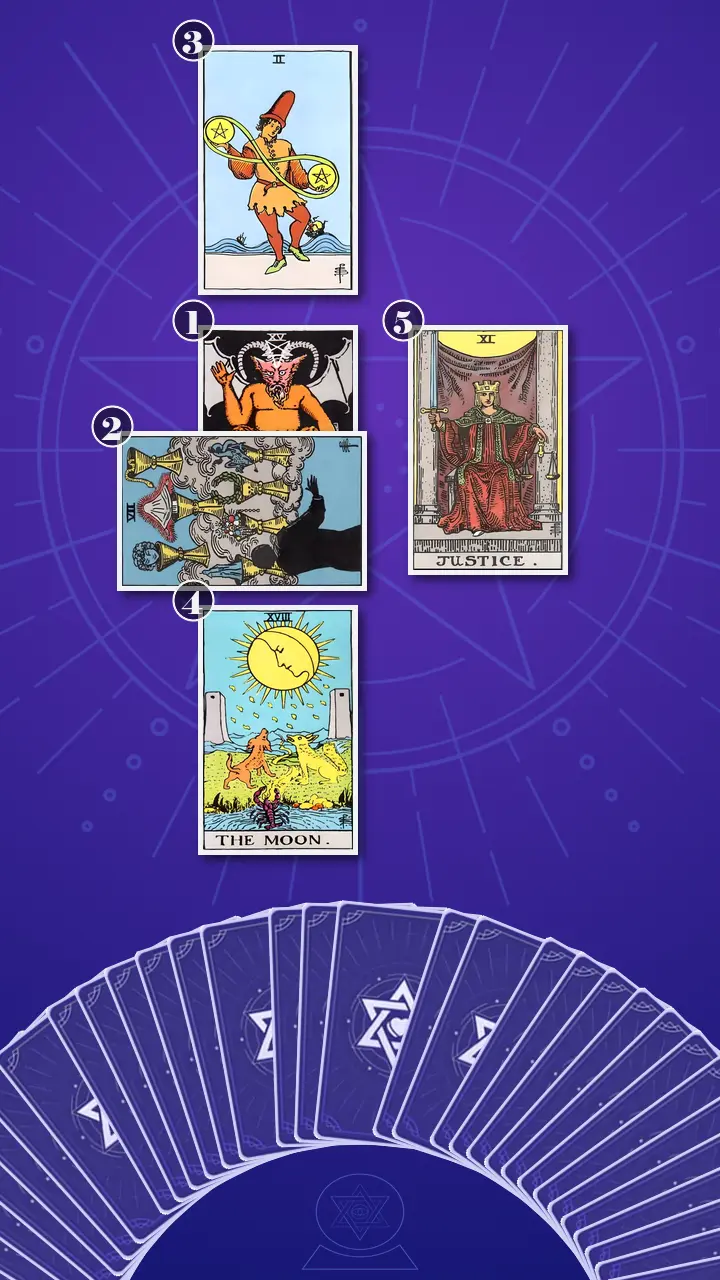
The Pull That Felt Like Proof
Position 1: The Devil and the Offer Above the Fold
Now I turned the card for the present situation or central issue: the immediate pull of the tempting option and the behavior of focusing on its upside before checking its downside.
The card was The Devil, in upright position.
I looked first at the loose chains around the two figures. They were not tight enough to describe absolute captivity, but they were easy to forget while the horned figure dominated the scene. I connected the image to the opportunity page on Jordan's phone: the bold promise sat above the fold, while expected hours, manager support, income stability, tax responsibility, and exit conditions remained in the shadow below it.
"This is not a card telling me the role or project is bad," I said. "It is showing me how quickly an attractive story can become attached to your sense of relief. The emotional charge is doing too much of the deciding. The excess is intensity; the blockage is that intensity is being treated as evidence."
I asked, "If the exciting paragraph disappeared and I wrote the obligations plainly on a separate page, what would you still want?"
Jordan did not nod. She gave a short, bitter laugh and rubbed the hinge of her jaw. "That is a little rude," she said. "But yes. I reread the words that make me feel chosen, then call it research."
I kept my voice even. "Wanting more is not the problem. You do not need to shame the part of you that wants freedom, money, or a fresh identity. I am only separating the desire from the contract it may be attached to."
Her shoulders lowered by a fraction, though her thumb still rested near the phone. I saw the first opening: the temptation could be examined without being condemned.
Position 2: Seven Browser Tabs Behind the Question
Now I turned the card for the crossing influence or obstacle: the concrete risk, hidden condition, or consequence being ignored when the option feels tempting.
The card was Seven of Cups, in reversed position.
I placed the card across The Devil. The seven cloud-held cups became seven browser tabs for the same opportunity: more money, creative freedom, status, escape from repetitive work, a better LinkedIn story, a new professional identity, and an ideal future in which every practical problem could be solved later. Each tab looked vivid. None was evidence simply because it was attractive.
"A polished future is not the same thing as a tested option," I said. "The risk you keep ignoring is not mysterious. It is the workload, the financial downside, the unknown conditions, and the question of how you would leave if the fit was wrong. The reversed position shows selective visibility: the future you can imagine is receiving more attention than the terms you can verify."
I described the inner operating system I could hear beneath her scrolling: "I keep asking what this could become, but I have not written what it will require."
Jordan's breathing paused. Her eyes moved from the cups to the opportunity page as if she were replaying the last hour. Then her hand, which had been curled around the phone, loosened. A small drop seemed to pass through her stomach, followed by a cautious curiosity.
"That is the actual risk," she said quietly. "Not that I cannot know everything. I just keep giving the polished future more attention than the facts that would tell me whether it fits."
I asked her to close the testimonials for a moment. "Choose one claim that makes the option feel most exciting. Do not ask five friends what they would do. Turn that one claim into a factual question."
She highlighted "high growth" and typed: "What would success in this role require in weekly hours during the first six months?" The action was small enough to avoid killing the dream and concrete enough to interrupt it.
"You do not need total certainty," I said. "You need one thing you can verify before you make the next move."
Position 3: The Spreadsheet That Never Lands
Now I turned the card for the conscious influence: the benefit, imagined future, or practical argument receiving the most attention in Jordan's deliberate thinking.
The card was Two of Pentacles, in upright position.
The figure's looping motion immediately reminded me of the Google Sheet Jordan had described. I pictured the cells she kept moving between: current salary, possible freelance income, rent, transit, evenings, sleep, and the hours required to build something independently. The ships rising and falling behind the figure became the real background of her choice: a demanding job, limited financial room, and a side project competing for the same small supply of energy.
"Upright, this is a genuine capacity for adaptation," I said. "You can manage moving parts. But here, the balancing motion is becoming a way to avoid choosing the trade-off. Flexibility is useful until it becomes another word for never naming what you are willing to spend."
I asked, "Which cost are you actually willing to carry if you say yes: less income, less rest, less flexibility, or less time for your existing commitments?"
Jordan looked down at her hands. "I keep telling myself that a more motivated version of me will make it work once I am in. I do not want to admit that my capacity is part of the decision."
"Your capacity is not a character judgment," I said. "It is information. A choice that requires you to ignore sleep, savings, or basic support is not automatically ambitious. It is simply asking for a cost that deserves to be named."
She opened a half-filled budget tab and stared at the numbers. Her posture stayed careful, but the endless loop had acquired an edge. For the first time, the question was not just whether the opportunity was exciting. It was what she would have to exchange for it.
Position 4: The Moon Beneath the Deadline
Now I turned the card for the unconscious influence or root factor: the hidden fear and projection making the option feel more urgent than the available evidence supports.
The card was The Moon, in upright position.
I followed the winding path between the two towers. The dog and the wolf responded to the same moonlight in different ways, while the crayfish rose from the water before the path had become clear. I did not read this as a bad omen. I read it as a picture of incomplete visibility: facts, predictions, and nervous reactions entering the same mental frame.
"At 10:31 p.m., when you are in bed under blue phone light, the ideal future and the feared missed chance can both look more convincing than they will in daylight," I said. "A former coworker's promotion post, a friend's confidence, and a difficult day at your current job all become one emotional picture. Your body reacts before the evidence has been sorted."
I gave her three lines to separate: I know.I am assuming.I am afraid. Under the first, she wrote that the offer existed and had a decision window. Under the second, she wrote that it would lead to rapid growth and a better identity. Under the third, she wrote, "If I pause, someone else will take it and I will prove I cannot control my future."
Her pen stopped. The radiator clicked behind us, then the room settled into a soft, almost deliberate silence.
"The Moon is showing the fear that turns attraction into urgency," I said. "It does not say yes or no. It asks you to stop treating an intense reaction as a clear instruction."
Jordan read the three lines twice. Her mouth tightened, then softened. "I thought I was afraid of missing the job," she said. "I might be more afraid of having to own the choice myself."
When Justice Cut the Story Down to Evidence
Position 5: The Sword, the Scales, and the Choice That Stays Yours
Now I turned the card for advice and integration: the grounded action that could convert the conflict into a self-authored decision test.
The card was Justice, in upright position.
The seated figure held the scales at equal height and the sword vertically, without drama. I told Jordan that Justice does not remove uncertainty or announce a guaranteed result. It asks for proportion: the benefit beside the cost, the desire beside the evidence, and the possible commitment beside the way out.
This was where I used my signature Decision Timing Calibration. I was not asking whether the stars had approved the offer or whether an invisible cycle had declared the correct day. I was checking whether Jordan's current environment was structurally steady enough for a high-stakes crossroads choice. She was coming straight from a repetitive workday, carrying the pressure of a short window, and looking at an incomplete offer while her body was still activated. That did not mean "no." It meant "not until the missing variables are visible."
I also used my Cyclical Variable Filtering lens. I asked her to strip away temporary friction: today's bad meeting, the dopamine of a LinkedIn success story, and the fantasy of becoming a completely new person overnight. Then I asked her to lock in the variables that could shape her long-term orbit: actual pay, expected hours, manager support, savings buffer, values, and an exit condition.
By the time I reached the right-hand position, I could see the loop: the same offer had become a promise, a deadline, and a test of her ambition. I described the choice on the TTC, the warm phone in her hand, the empty questions note, and the fear that waiting meant losing her future.
The rush is real, but it is not a verdict. Desire can point to what matters without being allowed to decide what the option will cost.
You do not have to obey the rush to prove you are decisive; let Justice's scales weigh the upside and downside while its upright sword cuts the story down to what you can verify.
The sentence stayed between us. Outside my window, a streetcar bell sounded once and faded, leaving the room quieter than before.
Jordan's breath stopped halfway in, and her fingers hovered over the edge of the card. First, her face went still; her eyes widened slightly, as if her mind had reached for the familiar instruction to act and found no place to put it. Then her gaze lost focus and moved through the memories behind the offer: the difficult workday, the promotion post, the friend saying, "I would do it," and the blank downside column she had avoided. Her lower lip tightened. Finally, a long breath moved out of her chest. Her shoulders sank, her closed hand opened on the table, and a little colour returned to her face. When she spoke, her voice was quiet and rough at the edges. "I can let this be exciting and still require evidence," she said. "I do not have to make the feeling choose for me." Relief crossed her expression, followed by a brief, almost dizzy blankness. Clearer did not mean certain. It meant she could now see the responsibility as hers without treating that responsibility as a punishment.
I asked, "Now, use this new angle to revisit last week. Was there a moment when this insight could have made the choice feel different?"
Jordan looked toward the kitchen window. "When I saw the short deadline," she said. "I could have asked what was actually fixed and what was negotiable instead of assuming the whole future was closing."
I told her that this was the first meaningful shift in the reading: from charged excitement and fear-of-missing-out urgency toward accountable self-trust. The goal was not to extinguish desire. It was to let desire remain information while evidence, cost, values, and reversibility joined the conversation.
The One-Page Ledger and the Rollback Button
When I placed the five cards together, I saw one coherent story. The Devil showed the immediate relief that made the opportunity feel binding. The reversed Seven of Cups named the ignored risk: unverified costs, constraints, unknowns, and exit conditions were being pushed out of view while several ideal futures received the spotlight. The Two of Pentacles showed Jordan's real adaptability, but also the spreadsheet loop that kept every trade-off moving without choosing one. The Moon revealed the fear beneath the urgency: pausing felt like losing control of the future. Justice offered the missing structure, not a prediction.
I named the cognitive blind spot carefully. Jordan was not failing to gather information. She was gathering information selectively, allowing confirming stories to count as evidence while treating practical questions as threats to the excitement. The transformation direction was equally concrete: move from treating intensity as proof to separating desire, evidence, downside, assumptions, values, and reversibility in writing before making a larger commitment.
Because her fear was tied to timing, I introduced my Orbital Pause Strategy: a calculated 72-hour delay whenever the option and the circumstances allow it. The pause is not a command to reject the opportunity or wait for perfect certainty. It is a way to let temporary macro-friction settle before making the choice permanent. During those 72 hours, she would stop collecting testimonials, ask for the missing facts, and run one bounded test. If a genuine external deadline did not allow 72 hours, she could still ask for the terms in writing, request the most reasonable extension available, and use the time she had without pretending that urgency was proof.
"The pause protects your agency," I said. "It gives curiosity room to move without handing over your whole future. Self-trust is not making the fastest call. It is making the trade-off visible."
I gave her three small next steps. None required a permanent yes or no.
- Start the Four-Line Decision LedgerAfter work this week, choose one tempting career role or side-project option, set a 10-minute timer, and write one benefit, one cost, one unknown, and one reversible test in a blank note. Add one exit condition, such as a review date, minimum savings threshold, workload limit, or clear way to stop.When you feel pulled toward another testimonial or friend opinion, keep the page deliberately short. If "cost" feels activating, begin with the neutral heading "what this would require."
- Run the Evidence-Before-Euphoria CheckIdentify the single claim making the opportunity feel most exciting, such as "high growth," "flexible," or "good earning potential." Turn it into one factual question and send it to the hiring manager, project owner, or relevant source. Record the reply under "evidence," not under "reasons to say yes."Write the question before sending it so you do not soften it into reassurance-seeking. You do not need to explain your whole decision process or treat the answer as an instruction.
- Try a Reversible Assumption TestChoose one assumption that can be tested in under two hours, such as talking with someone already doing the role, completing a sample task, or building a one-weekend prototype. Set a time, money, and energy ceiling before you begin, then write what the test showed and what it did not show.A reversible test is not a disguised commitment. Decide in advance what would make you stop, revise, or continue. You can leave the option open without proving anything about your ambition.
I watched Jordan copy the steps into her Notes app. This time, she titled the page "Decision Ledger" instead of "questions to ask," and the distinction mattered. A question list could become another place to postpone responsibility. A ledger gave each side of the choice a visible line.
A Quiet Proof, Not a Perfect Answer
Four days later, I received a message from Jordan. She had sent the hiring manager one question about expected weekly hours and received an answer that made the offer less shiny but more real. That evening she sat alone with coffee, relieved and still unsure, then wrote a review date beside the option instead of forcing a yes.
She had not solved her entire career. She had not become immune to polished success stories or short decision windows. She had created one small piece of evidence, named one boundary, and kept an exit route visible. That was enough to show that her orbit had shifted.
I thought about what I had learned after a decade of guiding people beneath the night sky: cycles can describe context, but they do not own the person moving through them. A low tide may explain why the shore looks far away; it does not decide where someone walks next.
The Decision Cross tarot spread did not choose Jordan's next role. It gave her a way to let desire stay alive while evidence earned a seat beside it. Finding clarity did not mean removing every risk. It meant making the risk specific enough to test, and the choice visible enough to belong to her.
When a bright option leaves your chest buzzing and your jaw tight, it can feel safer to call the rush a verdict than to face the fear that pausing might let your future slip away. But the rush is information, not a verdict, and your desire does not become less valid when you ask it to share the page with facts.
If excitement could stay as information rather than proof, what small benefit, cost, unknown, or exit condition would you feel curious enough to place on paper?