Perfect-Timing Trap: Closing the Job Listing, Then Gathering Evidence

Finding Clarity in the 10:40 p.m. Career Change Spiral
If you are a London product operations manager who saves meaningful-work listings, opens a budget spreadsheet whenever you feel the urge to apply, and closes the tab when the Sunday Scaries begin, I know the pattern. Maya sat across from me with the posture of someone trying to keep an entire life balanced on one careful fingertip. At 10:40 p.m. on a Sunday, she had been at her kitchen table with a purpose-led job listing beside a colour-coded Google Sheet; the radiator clicked, her phone felt warm in her palm, and the blue laptop light caught the untouched mug beside her. I watched her add one more exit condition, close the listing, and open Monday's work calendar.
She told me she wanted to leave her secure product operations role for work with visible human purpose, but every time she approached an application, another financial, professional, or timing requirement appeared. A former colleague's polished LinkedIn post had made the comparison sharper, and reaching the savings milestone that was supposed to make leaving possible had only moved her target departure month. She said, almost apologetically, Every time I get close, another reason to wait suddenly looks responsible.
I could see the apprehension in the tightness around her mouth and the way her fingers pressed into the phone case. It moved through her like a browser with twelve career tabs open, each one offering another route around the single click that would make her preference real. A stable job can be real safety and still leave a real question unanswered. I told her I would not turn the cards into a command to resign or a verdict on her judgment. I would use them as a structured mirror, so we could make the hidden loop visible and draw a map toward clarity together.

Choosing the Shadow Spread at a Career Crossroads
I invited Maya to put both feet on the floor, take one slower breath, and name the question without trying to solve it. Then I shuffled at an even pace. The preparation was not meant to summon certainty; it gave her mind a clean boundary between another evening of researching and a focused conversation with herself.
I chose a five-card Shadow Spread for career indecision because Maya was asking why the timing never felt right, not asking me to forecast the outcome or choose leave versus stay. In my Jungian psychological approach, shadow work does not mean searching for something frightening or defective. It means noticing the protective pattern that has begun operating outside conscious choice. For anyone wondering how tarot works in a career reading, I was using the images as an outside perspective: a way to separate observable behaviour, hidden fear, defensive rules, reclaimed values, and practical integration.
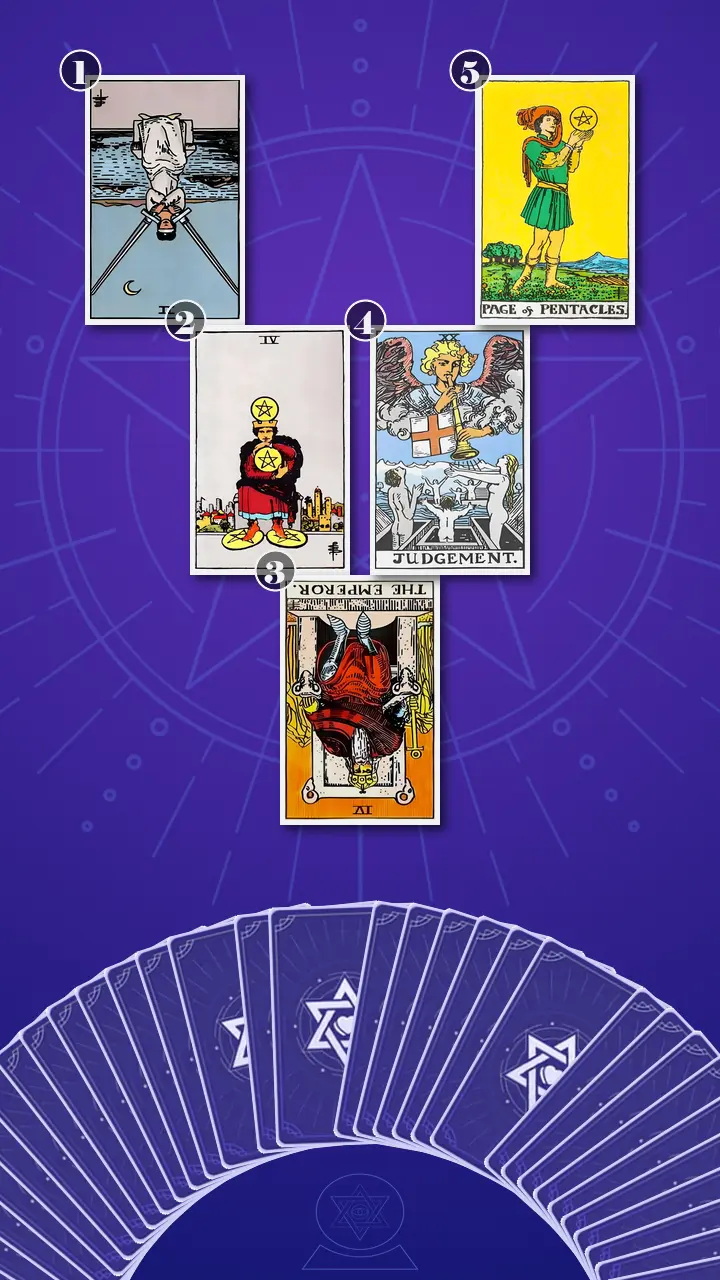
I placed the five cards in a shallow V. The first would show the observable career-timing blockage. The second would uncover the fear beneath the visible delay. The third would reveal the protection strategy that kept turning uncertainty into more research and prerequisites. The fourth would hold the truth Maya needed to reclaim, and the fifth would translate that truth into a bounded, reversible meaningful-work experiment. The shape gave us a descent into the mechanism and a return through action.
The Open Tabs That Kept the Decision Suspended
Position 1: The Loop That Looked Like Research
Now the card I turn over represents the observable career-timing blockage identified in Maya's diagnosis: repeatedly postponing applications and departure planning whenever a new uncertainty appears. It is the Two of Swords, in reversed position.
The blindfolded figure and crossed swords immediately brought me back to Maya's Sunday table. At 10:40 p.m., she had several career tabs, a budget sheet, and a revised departure timeline open at once. She was not peacefully waiting for the right moment. She was protecting herself from choosing by keeping every option suspended. The blindfold became information overload; the crossed swords became defensive tabs and spreadsheets; the rocky sea became the uncertainty she kept trying to exclude.
I read the reversed Air here as blockage combined with excess: thought was moving constantly, but it was not producing a usable boundary for action. The energy was not a lack of intelligence. It was intelligence recruited as emotional protection. The card did not ask her for a final leave-or-stay verdict. It pointed toward one reversible action capable of producing evidence that another round of analysis could not provide.
Maya gave a short laugh with a bitter edge. That is annoyingly accurate. I keep calling it research. I let the recognition settle rather than asking her to agree with me. Then I said, Good. We do not have to shame the research. We only have to notice when it stops giving you new information. Her shoulders stayed high, but her hand moved away from the spreadsheet and rested beside the card.
Position 2: The Emergency Fund as a Locked Door
Now the card I turn over represents the underlying fear that leaving without complete security could expose poor judgment and a loss of control. It is the Four of Pentacles, in upright position.
I asked Maya what the salary, benefits, predictable progression, and London rent calculation had come to mean beyond their practical value. She looked down at the card. The figure gripping one pentacle to the chest resembled the way she held her stable income and dependable professional identity as proof that she made sound decisions. The two pentacles beneath the feet became the conditions she believed could never shift. The distant city reflected how tightly protecting stability could keep her outside the work and community she wanted to explore.
Upright Earth can be careful, responsible, and genuinely protective. Here, though, the energy had become over-held. A reasonable need for a financial floor was turning into a rule that any reduction in income, status, routine, or predictability counted as evidence of danger. I asked which exact level of security was non-negotiable and which requirement kept expanding because uncertainty felt like a loss of grip.
Maya opened her banking app, saw the balance notification from her latest salary payment, and then locked the screen again. I heard the conflict before she explained it. I do not want to blow up a stable life just to feel inspired. I told her that caution was not the enemy in this reading. The question was whether caution was protecting her life or protecting her from ever being seen wanting something different. She nodded once, slowly, as if the distinction had landed somewhere below the spreadsheet.
The Checklist with No Final Box
Position 3: The Internal Manager Who Keeps Rejecting the Plan
Now the card I turn over represents the protection strategy that maintains the cycle: converting uncertainty into expanding rules, research, and prerequisites for permission to move. It is The Emperor, in reversed position.
I asked Maya to describe the latest version of her transition plan. She told me about a document titled Responsible Exit Criteria. It contained savings, qualifications, references, notice periods, salary expectations, manager coverage, a quieter quarter, and a list of possible regrets. Whenever she checked one item, another requirement appeared. I could almost see the heavy stone throne in the document: designed to bear every possible risk at once, but so rigid that nothing living could move through it.
The Emperor reversed is not an absence of structure. It is structure hardened into an internal compliance system. The armour beneath the robes became Maya's defensive planning posture; the barren mountains became a future in which no amount of preparation produced permission. I said, If one variable is still unknown, I have no right to move. She repeated the sentence under her breath, and the neatness of the checklist suddenly looked different beside her clenched jaw.
I watched the reaction move through her in three small stages. First, her breathing paused and her thumb stopped halfway across the screen. Then her eyes lost focus as if she were replaying the last three revised departure dates. Finally, she pressed her lips together, exhaled, and admitted, That is the rule I keep adding without writing it down. I told her that the rule had begun as care for stability, but it was now turning every unknown into an automatic veto. Naming that did not make financial caution wrong; it made the mechanism available for choice.
When Judgement Answered the Snoozed Notification
I slowed down before the fourth card. The room had become quiet enough for the traffic outside to sound distant. Then a calendar notification chimed from Maya's phone and disappeared beneath the screen. She had snoozed it without reading. The sound gave the next card its modern setting, not as a supernatural command, but as a persistent signal waiting for a conscious response.
Position 4: The Call That Needed a Response, Not a Prophecy
Now the card I turn over represents the truth Maya needs to reclaim: repeated longing for meaningful work deserves honest evaluation and a consciously chosen response, even without certainty. It is Judgement, in upright position. This is the catalyst card, carrying values-based self-accountability, renewed self-trust, and the willingness to respond without demanding a guarantee about the final outcome.
The trumpet did not tell Maya to resign. It asked her to stop asking the job market to certify that her desire was valid. The figures rising with open arms contrasted sharply with the covered eyes, locked chest, armour, and stone rigidity in the earlier cards. I returned to the Sunday table and said, I keep asking for proof that the call is valid. What if the honest response is not a final verdict, but one accountable way to answer it? The feeling might be persistent, I told her, while the response could still be modest: one conversation, one defined task, one piece of contact with the work.
This was the point where I used my Fear-Driven Logic Decoupling lens. I wrote two sentences on separate lines. The first was, I want work with visible human purpose. The second was, If I try and the next move is not clearly better, I will have proved that I lack sound judgment. I asked Maya to see that the sentences could sit beside each other without being the same fact. One described an authentic desire. The other described a subconscious fear of failure. Separating them did not force the desire to win. It stopped fear from disguising itself as a complete decision matrix.
Maya was still caught between the thought that she must produce a flawless case and the fear that any imperfect move would expose poor judgment. The listing glowed beside the spreadsheet; the radiator clicked; the newest condition waited in her notes. She wanted a verdict before she allowed herself a preference.
You do not need a risk-free moment to validate the call; you need an honest response and a practical next step, like the figures who rise when Judgement's trumpet sounds.
For a second, Maya's breath stopped. Her index finger hovered over the edge of the card, and the muscles beside her mouth tightened as if she were about to argue with it. Then her eyes lost focus. I watched her replay the moved savings target, the missed application deadline, the Sunday spreadsheet, each memory arriving as evidence that she had been waiting for permission disguised as certainty. Her fingers closed around the mug, released it, and closed again. Finally, her shoulders lowered by a fraction. A breath left her chest in a shaky, almost embarrassed laugh, and the skin beneath her eyes reddened. She did not look triumphant; she looked briefly unguarded, as though the floor had become visible after she had spent months checking the ceiling. When she spoke, her voice was quiet: I could protect the important things without making every unknown a veto. I heard relief, but I also heard the vulnerability of having to choose. The clarity did not remove responsibility. It returned responsibility to her, where it could become a decision rather than a sentence.
I asked, Now, using this new perspective, can you think back to last week and recall one moment when this insight might have made you feel differently?
Maya looked again at the card. The figures were not celebrating a guaranteed outcome; they were responding to information they could no longer pretend not to hear. I explained that this was the first movement from contracted apprehension and moving-goalpost perfectionism toward evidence-based self-trust while uncertainty remained manageable. She had not solved her career. She had stopped treating uncertainty as the only voice allowed to speak.
A Small Plot of Ground
Position 5: The Practical Experiment
Now the card I turn over represents the integration step that embodies the key shift: a bounded, reversible meaningful-work experiment supported by a clear minimum-safety threshold. It is the Page of Pentacles, in upright position.
The Page studies one pentacle at eye level while standing in an open, cultivated landscape. I connected it directly to Maya's saved purpose-led roles, skills, and conversations. She did not need to decide her complete vocation before touching the work. She could choose one role or organisation, speak with one person about the unglamorous day-to-day reality, or complete one defined work sample, then observe what happened to her attention and energy.
The Earth energy had changed. The Four of Pentacles gripped resources to prevent movement; the Page held one concrete piece of evidence carefully enough to learn from it. This was balance rather than excess: practical, patient, and beginner-minded. I said, Research can map the options. Only contact with the work can tell you how it feels. Maya ran her thumb along the card's edge and replied, I keep researching meaningful work instead of testing what it feels like. This time, her voice carried curiosity alongside the fear.
A Threshold You Can Explain
I gathered the five cards into one story. The Two of Swords reversed showed thought multiplying without producing a boundary. The Four of Pentacles showed why: salary, routine, status, and savings had become evidence of personal competence as well as practical protection. The Emperor reversed showed the defence that kept the cycle alive, turning every new uncertainty into another required field on a career-change form. Judgement returned authority to Maya's values, and the Page of Pentacles gave those values somewhere tangible to begin.
The hidden cost was not only the possible financial cost of leaving. I used my Hidden Cost Deconstruction lens and asked Maya to write two headings: practical cost and emotional bill. Staying carried a real bill too: the Sunday tight chest, the clenched jaw over another forecast, the late messages that made her harder to replace, and the shrinking amount of first-hand evidence about meaningful alternatives. Leaving carried uncertainty around income and professional identity. We gave each emotional bill a rough rating from one to five, not to manufacture false precision, but to stop one option from appearing free while the other appeared to contain every possible loss.
Her blind spot was not that she cared too much about money or that she lacked ambition. It was that she had confused responsible planning with the elimination of every unknown. The right time is not zero risk; it is a boundary you can explain and a step you can test. A threshold protects you. An endless list keeps you waiting. The transformation was not from caution to recklessness. It was from forecast-driven hesitation to a clearer relationship with evidence, values, and choice.
I offered one additional private exercise from my own practice, The Shadow Choice Experiment. For 48 hours, Maya could write on paper, I choose the option I am most afraid of, and then record every defensive argument that appeared. She would not resign, announce a career pivot, or send a message because of the exercise. The point was to let her subconscious reveal what it was protecting when the feared option was temporarily treated as chosen. If the exercise felt pressuring, she could stop. It was a way to expose the internal manager, not a dare to hand over her life.
- Define the minimum-safety thresholdOn Tuesday, open the existing budget sheet for 20 minutes and write only three conditions: essential monthly costs, the minimum cash buffer that would feel materially protective, and the minimum notice or planning period you would want before a change. Add one separate line labelled Allowed to remain unknown, such as the exact long-term job title, then close the sheet when the timer ends.Use rough figures from current accounts instead of building a perfect forecast. Do not create a fourth threshold. Writing the boundary is information for your choices, not a promise to resign.
- Ask for one real conversationBy Thursday, choose one saved purpose-led role or organisation that still interests you. Find one current or recent employee through LinkedIn or your existing network and send a short request for a 30-minute informational conversation about the actual day-to-day work, useful skills, and one realistic entry route. Ask for information, not a referral or commitment.If there is no reply, treat that as neutral data rather than a verdict on your suitability. Contact one person, keep the request easy to decline or reschedule, and do not turn the message into a public career announcement.
- Keep an evidence-before-exit logAfter the conversation or another small work sample, take 10 minutes on Friday to record which task held your attention, what your body felt before and after, and which question became more specific. Score curiosity and depletion separately from 1 to 5, then schedule one next evidence-gathering step only if the first experiment gives you a reason to continue.Keep the log to one page and describe observable details rather than interpreting your entire identity. An awkward experiment does not settle the future, and an exciting one does not require an immediate leap.

The First Plot of Evidence
Four days later, I received a message from Maya: I set the three thresholds, put the exact long-term title under Allowed to remain unknown, and sent the message. The person replied with a very unglamorous description of the work, and I liked it more than the polished LinkedIn version. I could hear the difference. She was no longer comparing her private uncertainty with someone else's public announcement. She was holding evidence in her own hands.
On Friday evening, Maya sat alone in a cafe after the call, still wondering, What if I am wrong? She finished her one-page log, scored curiosity and depletion separately, and let the question remain. The coffee was ordinary, the future unresolved, and her next step was real.
That was her Journey to Clarity: not a clean answer delivered by the cards, but a clearer relationship with the question. Tarot had helped her see the difference between a minimum-safety threshold and an endless permission system. Maya remained the person who would decide whether to stay, explore, apply, or wait. The cards did not take ownership of her future; they helped her reclaim it.
When a meaningful-work listing makes your chest tighten because you want the work and fear regretting the choice, it can feel safer to call the missing guarantee proof that wanting to leave would be reckless. I see that tension as a sign that you are trying to protect a life that matters while listening for what matters next.
If you could keep your essential bills protected while allowing one noncritical variable to stay unknown, what small, reversible way of touching meaningful work would you feel curious enough to imagine this week?