Sunday's Salary Spreadsheet Gives Way to One Saturday Workshop

The Sunday Spreadsheet Inside a Golden Cage
I know a particular kind of career pivot anxiety by its Sunday-night glow: a blank document called “Next Steps” becomes forty minutes of salary calculators, job boards, and deleted notes before short videos take over.
At 8:47 PM, Taylor, a 29-year-old non-binary operations coordinator in Toronto, joined me from their kitchen table. Their laptop cast a blue-white rectangle across the dim apartment. I could hear the refrigerator humming through the call as they built columns for salary, benefits, rent, savings, and worst-case outcomes. Their phone, they told me, already felt warm in their palm.
Taylor stopped before adding a column for the cost of staying. Their jaw tightened when they imagined leaving the stable tech job; when they pictured returning to the same Monday routine, their shoulders dropped and their limbs seemed to acquire the weight of wet laundry. Apprehension moved through them like a smoke alarm reacting to two opposite threats: change tightened their chest, while stillness filled their body with lead.
“I keep calling it security because I don’t want to call it a cage,” they said. “Nothing is technically wrong. The pay is reliable. I have benefits. I’m financially independent. But I can justify another six months and still can’t say what I’m building.”
I let the silence remain for a moment. I did not want to turn their stability into a moral failure or their dissatisfaction into an order to resign. Toronto rent was not imaginary. Neither was the relief of a predictable paycheque.
“You are not ungrateful for noticing that a stable life has a cost,” I told them. “I’m not here to tell you whether to stay or leave. I’d like us to examine the risk that your current method of staying safe may be leaving out. Let’s make a map of the fog, then see whether one small piece of reality can tell us more than another month of prediction.”
Choosing the Map for a Career Crossroads
I invited Taylor to place both feet on the floor, take one unforced breath, and hold the question in plain language: “What risk do I keep ignoring inside the golden cage?” I shuffled slowly. I use this pause as a transition of attention, not as theatre or a supernatural demand for belief.
I chose a five-card layout called The Shadow Spread. For anyone wondering how tarot works in a reflective career reading, I treat a spread as a structured inquiry. The cards provide an external set of images against which assumptions, contradictions, and choices can be examined. They do not make the choice, and they do not guarantee an outcome.
The Shadow Spread suited Taylor’s question because it was focused. A ten-card Celtic Cross would have introduced broader influences and timelines that might have fed the very analysis loop we were trying to understand. This five-card line would show the visible behaviour, the hidden cost beneath it, the protective pattern keeping it in place, the archetype capable of loosening it, and one grounded integration step.
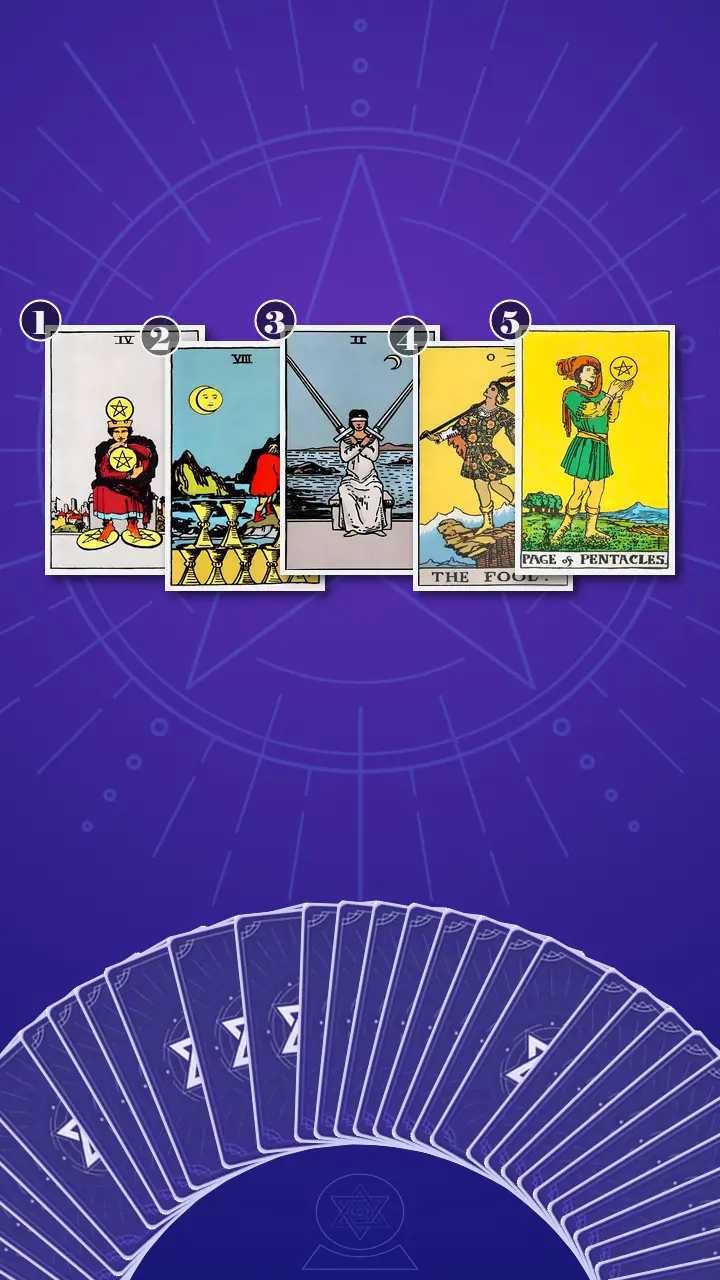
I placed the cards from left to right. The first would show the visible shadow of repeatedly auditing the risks of leaving. The second would reveal the risk Taylor had not been counting. The central card would identify the defence that kept the question abstract. The fourth would offer a liberating energy, and the fifth would turn that energy into a practical next step.
Laid across my table, the structure resembled a locked room opening onto a narrow path. I told Taylor that we would read the card meanings in context, pausing wherever their lived experience agreed, disagreed, or added information. Their recognition mattered more than my authority.
The Cards That Tightened the Room
The Visible Shadow: Four of Pentacles, Upright
I turned over the card representing The Visible Shadow, the concrete behaviour keeping the golden cage intact. It was the Four of Pentacles, upright.
The figure held one pentacle against the chest, stood on two more, and balanced another above the head. I saw a complete security system surrounding the body. Nothing had been lost, but almost no movement remained possible.
“This is you with a salary spreadsheet open on one screen and a possible career change on another,” I said. “You press every financial fact against your chest until movement feels irresponsible. The benefits, rent, savings target, and predictable income are real protection. But the same routine is under your feet, the same practical explanation is above every thought, and there is no open hand left to test what you want.”
I described the card’s energy as an excess of contracted Earth. Earth supports material stability, patience, and responsible planning. In excess, it can make preservation the only acceptable form of responsibility. Taylor’s caution had stopped functioning as one value among several and had become an identity: the dependable person does not move until movement is guaranteed.
The image reminded me of a well-organized Notion dashboard that has quietly become a beautifully labelled waiting room. It can look productive for months while protecting its owner from the unfinished awkwardness of actual experience. I also mentioned the useful part of The Truman Show comparison: a world can be comfortable and carefully structured while still narrowing authentic choice. I was not suggesting a dramatic escape. I was asking whether the structure still allowed Taylor to author a life inside it.
“When you open the savings tracker,” I asked, “what are you trying hardest to keep untouched?”
Taylor gave a short laugh with a bitter edge. “That’s so accurate it’s almost rude.” Their thumb rubbed the side of their mug. “I’m protecting independence. But I think I’m also protecting my reputation as the person who doesn’t make messy decisions.”
“That reputation has probably served you,” I replied. “We don’t have to insult it to notice where it has become restrictive. A protective pattern can be intelligent and still need updating.”
The Hidden Risk: Eight of Cups, Upright
I turned over the card representing The Hidden Risk, the unacknowledged cost beneath Taylor’s practical case for staying. It was the Eight of Cups, upright.
A cloaked figure walked away from eight carefully arranged cups beneath a moonlit sky. One deliberate gap interrupted the arrangement. I did not read the departure as an instruction to abandon a job. I read the gap as the difference between external adequacy and inner fulfilment.
“This is the moment after another good performance review, raise, or thank-you from your manager,” I said. “You feel grateful and relieved for a few hours, but the next quarter still does not answer what you want your working life to mean. Your career is not empty of value. It may simply be emotionally incomplete.”
Here the energetic problem was a deficiency of emotional contact. The upright Water of the Eight of Cups was available as honest recognition, but Taylor had repeatedly filtered it out of the decision process. The ignored risk was gradual self-abandonment: making the sensible choice so consistently that curiosity became faint, then mistaking the quiet for clarity.
“The risk of staying deserves the same careful attention as the risk of leaving,” I said. “That sentence is not a verdict in favour of leaving. It is a correction to a one-sided audit.”
Taylor’s eyes shifted away from the cards. They told me about a recent rollout they had rescued at work. Their manager praised their reliability and mentioned the next raise cycle. On the TTC ride home, Taylor saw a former colleague’s LinkedIn post about starting a small creative business. They had felt genuinely happy for the colleague, followed almost immediately by a hollow pressure below the ribs.
“The raise made me feel better until I got to the elevator,” they said. “Then I thought, if this is working, why does it feel like less of me is present?”
I watched their fingers tighten once around the mug and then release. “That question belongs in the reading,” I said. “Not as proof that the job is wrong, but as evidence that the current definition of ‘working’ is incomplete.”
The Protective Pattern: Two of Swords, Upright
I turned over the card representing The Protective Pattern, the defence that converted uncertainty into endless analysis. It was the Two of Swords, upright.
The blindfolded figure held two swords across the chest while dark water waited behind them. I saw no lack of intelligence in the image. I saw intelligence recruited to prevent emotional information from entering the room.
“This is you asking three friends for practical opinions, comparing salary ranges and course reviews, and still leaving one exploratory email in drafts,” I said. “No answer removes the uncertainty you are trying not to feel. The blindfold is not ignorance. It is the decision rule that says no action is permitted until every consequence is visible.”
I brought Taylor back to a scene they had described near Bloor Street: a job board, a salary comparison tool, and a friend’s offer of an introduction open beside a cooling espresso. The machine hissed, the laptop fan blew warm air over their wrist, and their shoulders stayed lifted as they copied more advice into a table. The email remained unsent.
The card showed Air in excess until it became Blockage. Analysis created short-term calm, but it also prevented the direct evidence that could update the analysis. Taylor’s internal operating system kept switching between “I am still gathering evidence” and the more revealing “I am protecting myself from becoming responsible for what I learn.”
“Research can prepare a first step, but it cannot perform the first step for you,” I said. “What is the smallest action you keep in draft form, and what feeling appears when you imagine sending it?”
I saw Taylor’s breath pause first. Their fingers hovered above the trackpad without touching it. Then their gaze lost focus as if they were replaying the coffee-shop evening frame by frame. Finally, a low exhale left their chest and their shoulders moved down by a fraction.
“There’s a beginner studio workshop I’ve looked at four times,” they said. “The feeling isn’t that the class is unsafe. It’s that if I enjoy it, I’ll have information I can’t un-know.”
“That makes sense,” I replied. “The protected state is not only the job. It is the period before your preference becomes concrete. We can respect why that threshold feels serious without pretending that an unsent email is neutral forever.”
When The Fool Opened the Sky
The Liberating Archetype: The Fool, Upright
Before I turned the fourth card, the refrigerator in Taylor’s apartment clicked off. The sudden quiet seemed to widen the room. I revealed the card representing The Liberating Archetype, the counterforce to certainty-dependent control. It was The Fool, upright.
After three visually closed cards, The Fool brought open sky. The figure carried a small bundle, held a white rose, and approached the cliff with a dog close by. I read the small bundle as limited scope, the rose as open attention, and the dog as practical awareness. None of those symbols required recklessness.
“This is one beginner workshop, one informational conversation, or one private prototype,” I said. “It is not a resignation letter. It does not have to become a new career, a public announcement, or a five-year identity. The risk stops being an imaginary cliff spanning your whole future. It becomes one experience you can enter, observe, and leave.”
I named the energy as balanced Fire: curiosity, beginner’s mind, proportionate courage, openness to revision, and the willingness to build self-trust through contact with reality. The Fool did not remove uncertainty. The card changed Taylor’s method of meeting it.
The image sent my mind briefly back to archaeological sites where a defensive wall had survived long after the danger that justified its design. The wall still contained enduring value, but later inhabitants had to create gates, roads, and new uses around it. Demolishing every wall would have been foolish. Treating every wall as permanently sacred would have been equally limiting.
I call this lens Historical Crossroad Matching. At a historical turning point, an old structure can remain useful while becoming insufficient for the life developing around it. Taylor did not need to destroy the protections they had built. They needed to test whether the structure still had a working gate.
I returned them to the image of standing outside a Toronto studio with one notebook and no resignation letter. “Your old demand is, ‘I need this to guarantee my future.’ The Fool offers a different sentence: ‘I can let this one experience give me information.’”
I saw Taylor glance back toward the blank part of the Next Steps document. They were still caught in the belief that a responsible person must make the correct career decision before taking even a reversible step. The card was asking them to separate beginning from committing.
“The risk is not proven by leaving or disproven by staying,” I said. “It becomes visible when you stop asking hypothetical analysis to speak for lived experience and allow one bounded step to show you whether this structure still supports your freedom.”
Do not wait for certainty to prove that the cage is costing you freedom; take one bounded step like The Fool at the cliff edge and let lived experience replace endless hypothetical risk analysis.
I let the words remain without immediately explaining them. I watched Taylor’s breath stop at the top of an inhale. Their mouth opened slightly, then closed; their pupils widened as their gaze moved from The Fool’s open sky to the Four of Pentacles at the other end of the line. One hand tightened around the cuff of their sleeve before slowly letting go. Their eyes reddened, their shoulders descended, and a long breath left them with a tremor that sounded partly relieved and partly angry.
“But doesn’t that mean I’ve been wrong this whole time?” they asked. The question came out sharper than anything they had said before. Afterward, their expression went briefly blank, as though clarity had removed a familiar weight and left them dizzy with the responsibility underneath it.
“No,” I said. “It means your method protected real things, perhaps for years. We are noticing that it can no longer answer the whole question. Revising a method is not condemning the person who needed it.”
I then asked, “Now, with this new perspective, think back to last week. Was there a moment when this insight could have made you feel different?”
Taylor remembered hovering over the workshop registration page. “I treated clicking ‘register’ like I was choosing a new life,” they said, their voice quieter now. “If I’d treated it as one data point, I might still have been scared. But I wouldn’t have felt trapped by the click.”
I named the movement I was seeing: from apprehensive control and career-analysis paralysis toward curious self-trust grounded in bounded lived experience. It was not certainty, and the new clarity carried vulnerability. Taylor would now be responsible for gathering a little honest evidence. But that was already different from waiting for an abstract guarantee no spreadsheet could provide.
The Integration Step: Page of Pentacles, Upright
I turned over the final card representing The Integration Step, the immediate practice through which the insight could enter daily life. It was the Page of Pentacles, upright.
The Page held one pentacle at eye level in a cultivated field, with mountains still visible in the distance. I saw the existing stable job in the cultivated ground, a practical base that did not have to disappear. The pentacle was one real observation. The mountains were possible directions, present but not yet chosen.
“This is you examining what actually happened after one experiment,” I said. “How focused were you in the workshop? What questions came alive in the conversation? Did a small project hold your attention? What practical barriers appeared? You do not have to turn the evidence into a five-year plan.”
The Page represented balanced Earth, material caution restored to a useful role after Water, Air, and Fire had been allowed to speak. Security could become a platform for learning instead of a permanent argument against movement.
I used my second archaeological lens, Enduring Value Assessment. I asked Taylor to separate what needed to survive the test of time from what belonged to the emotional weather of a single week. Financial independence, health, curiosity, and authorship were enduring values. LinkedIn comparison, resentment after a difficult meeting, and the fantasy of total reinvention were shorter-term signals. They could contain information, but none deserved solitary control of the decision.
“Let security set the limits, not the entire direction,” I said. “A spending cap, a time limit, and a stopping point can protect what matters. They do not need to veto curiosity before it begins.”
Taylor looked along the five cards from the enclosed body of the Four of Pentacles to the Page studying one tangible object. “So I’m not trying to prove I should leave,” they said. “I’m trying to learn whether I’m still choosing to stay.”
“Exactly,” I replied. “That distinction belongs to you, not to the cards.”
Turning the Golden Cage Into a Testable Question
I drew the five cards into one coherent story. Taylor’s competence, praise at work, financial independence, and awareness of Toronto’s cost of living had taught them to protect a genuinely valuable structure. The Four of Pentacles showed that protection becoming enclosure. The Eight of Cups named what the practical audit excluded: dwindling meaning, curiosity, and self-directed choice. The Two of Swords explained why the conflict persisted, because hypothetical analysis maintained calm while preventing new evidence. The Fool reopened the system through proportionate curiosity, and the Page of Pentacles returned that curiosity to solid ground.
The cognitive blind spot was simple but consequential: Taylor had been treating a lack of lived evidence as proof that no preference was clear, while repeatedly avoiding the experiences that could create evidence. They also counted risk as though it existed only outside the current arrangement. In reality, staying and leaving both carried costs, protections, and unknowns.
The transformation direction was therefore not “be brave and quit.” It was to stop demanding certainty before acknowledging the cost of staying, then run one bounded, reversible experiment to learn what freedom and responsibility felt like in practice. Tarot had not supplied a verdict. It had made Taylor’s decision method visible enough for them to revise it.
The View From 2036
Before choosing an action, I guided Taylor through The Time Stratigraphy Exercise, a mental time-travel protocol I use when immediate anxieties have covered a dilemma in too many thin layers. I asked them to imagine standing ten years ahead, looking back at the current job as one period in a much longer personal history.
“From 2036,” I said, “the useful question is probably not, ‘Did I quit in 2026?’ It is, ‘Did I gather honest evidence about the life I was building, or did I keep postponing contact with myself?’ Your future self does not need today’s self to know the ending. They need today’s self to leave an accurate record.”
Taylor’s first answer was that their future self would still care about financial independence. Their second was that ten years of avoiding every beginner experience would feel far more costly than one awkward Saturday class. The exercise did not erase rent or risk. It restored a sense of proportion.
When I suggested a twenty-minute informational conversation, Taylor pushed back. “But I can turn even that into a three-week research project. I’ll compare people, rewrite the message, and decide I need a course first.”
I adjusted the plan around the real obstacle. The action would need a research boundary, an exit point, and a review method that did not demand an immediate career conclusion.
- Run the Ten-Minute Cost-of-Staying Audit. Once this week, open the existing Next Steps document at the kitchen table. Add a section titled “Cost of Staying,” set a ten-minute timer, and record only observable moments from the last month: a project postponed, a part of yourself left unused, a flat commute, or an opportunity researched but not tested. Finish with one line titled “What Remains Secure” so the job’s real protections stay visible. Use concrete verbs such as “declined,” “avoided,” “wanted,” and “stopped.” Do not assign scores or forecast five years. Stop when the timer ends.
- Choose One Bounded Freedom Experiment. Before Friday, choose one action that cannot change your job, housing, income, or public identity: register for one beginner workshop with a fixed spending cap, send one request for a twenty-minute informational chat, or complete one short course module. Write the time limit, budget, and stopping point in a single sentence before taking the first contact step. Keep only two browser tabs open: one for essential research and one for the action itself. After twenty minutes, act or reduce the experiment to drafting the message. You retain the right to pause, leave, or decline any second step.
- Collect One Real Data Point. Within ten minutes after the experiment, write three headings: “What I Felt,” “What I Learned,” and “What I Still Need to Know.” Record attention, energy, curiosity, cost, and practical fit before deciding what the experience means for your career. Treat discomfort, interest, boredom, and no clear signal as information rather than success or failure. One experiment is allowed to remain only one experiment.

A Week Later, One Real Data Point
Six days later, I received a message from Taylor. They had registered for the Saturday workshop with a sixty-dollar cap and no promise to return. At 9:05 AM, they stood in the hallway smelling coffee and wet clay, heard chairs scraping inside, and nearly went home. Then they entered with one notebook.
“It didn’t solve my career,” they wrote. “I was awkward for the first twenty minutes. Then I forgot to check the time for forty-seven minutes. I haven’t done that on a Saturday in ages.”
They added one bittersweet detail: they slept through the night, but their first thought in the morning was still, “What if I’m wrong?” This time, they smiled, wrote the thought down, and made coffee.
I did not read the workshop as proof that Taylor should leave their job. I read their follow-through as the first evidence of a changed relationship with uncertainty. Their security remained intact, but it no longer held exclusive authority over curiosity. The cards had not opened the door for them. Taylor had tested the handle.
My years among Cambridge libraries and archaeological ruins have taught me that a fracture in an old structure is not always a prophecy of collapse. Sometimes it is simply the first place where light reveals how the structure was built, what remains valuable, and where a new opening might be made. Taylor’s Journey to Clarity did not end with certainty. It began with ownership.
I know that when a stable life makes your chest tighten at the thought of leaving and your limbs grow heavy at the thought of staying, it can feel safer to call the cage security than to admit how much freedom is missing inside it. Simply noticing that both risks deserve a place in the record means the old spreadsheet no longer contains the whole story.
I will leave you with the question I placed beside Taylor’s white-rose card: if you let one small, reversible experience teach you something before asking it to determine your future, what might your own bounded step help you quietly notice?