Career Choice Paralysis: A Seven-Day Test Beyond the Spreadsheet

The Long-Term-Fit Column That Made Every Career Option Feel Wrong
When I met Jordan (name changed for privacy), I saw a 28-year-old London product designer with a stable tech job, three private future plans, and a spreadsheet that gained a new column whenever someone on LinkedIn announced a promotion, a move, or a freelance launch.
“At 12:14 on Tuesday, I was in the Shoreditch office kitchen,” she told me. “My laptop was balanced beside a mug of coffee that had gone cold. The fridge was humming, the fluorescent lights were buzzing, and I added another column called ‘long-term fit.’ Then I stared at the three career options, felt my shoulders climb toward my ears, and closed the file.”
She rubbed her thumb along the edge of her phone case as she spoke. “I keep waiting for one option to feel like the obvious answer. Every path sounds good until I imagine actually having to live it. Then I can explain why it’s wrong.”
What she called confusion felt less like ordinary uncertainty and more like trying to read a Tube map while every colored line redrew itself the moment she chose a destination. She wanted a life that felt genuinely chosen, yet she treated any flicker of doubt as evidence that the option belonged to the wrong life.
“You are not short on options,” I said. “You are short on lived evidence. I don’t think our task is to force a final answer today. I think we need to identify the rule that keeps rejecting every answer before reality gets a chance to respond. Let’s draw a map through that fog.”

Choosing the Narrow Bridge: The Shadow Spread
I invited Jordan to place both feet on the floor, take one slower breath, and hold the question in plain language: “What belief keeps making every option feel like the wrong life?” I shuffled slowly, using the small ritual as a transition from circulating thoughts to focused observation, not as an attempt to summon certainty.
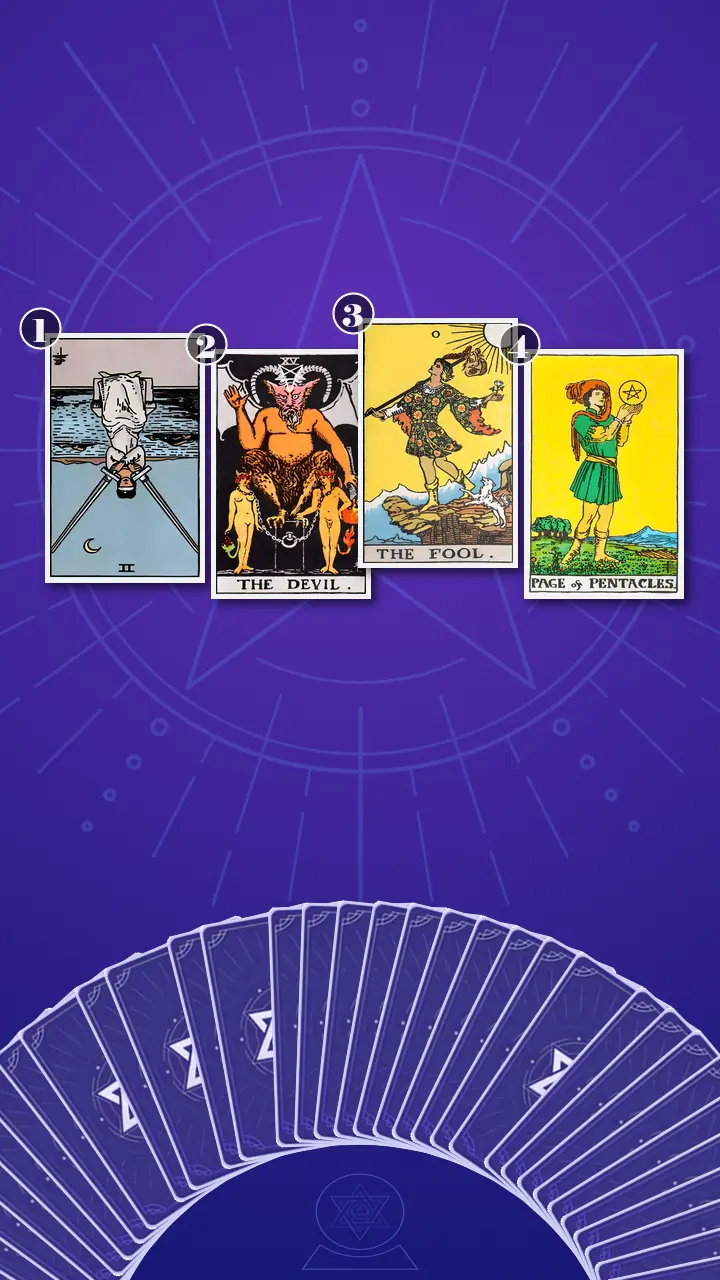
I chose The Shadow Spread, a four-card linear tarot spread designed to trace a visible pattern back to the belief sustaining it, then move toward an integrating perspective and one grounded action. For anyone wondering how tarot works in a decision-paralysis reading, I use the cards as an external cognitive map. They do not nominate a destined career. They help separate behavior, belief, possibility, and next step so that card meanings can be examined in context.
This compact spread suited Jordan’s question better than a decision-comparison spread. Comparing the careers again would only have fed the system already keeping her stuck. The first position would show the visible loop. The second would expose the hidden rule and fear beneath it. The third, our key position, would introduce the energy capable of loosening that rule. The fourth would turn the insight into observable practice.
I placed the cards in a horizontal line. The third card sat slightly higher, like the raised section of a narrow bridge between a blocked entrance and solid ground.
Reading the Comparison Loop
Position One: When Careful Preparation Stops Moving
Now I turned over the card representing Jordan’s visible shadow pattern: repeatedly comparing possible paths, rejecting each as wrong, and postponing the smallest lived choice. It was the Two of Swords, reversed.
I pointed to the blindfolded figure, the two swords crossed over the chest, and the water held in unnatural stillness behind her. Upright, the card can describe a conscious pause while someone gathers themselves. Reversed, its air energy had become blocked. The pause was no longer creating perspective; it was recycling the same comparison.
“This is your lunch-break spreadsheet,” I said. “You reopen the same three directions, check salary, meaning, flexibility, and long-term fit, then add another criterion instead of sending one informational message. Each added column looks like progress, but every option gets rejected before it can create lived evidence.”
I thought of a product design review in which the team keeps changing the success criteria instead of shipping a small prototype and watching what users actually do. Jordan’s internal process had become exactly that. Her personal algorithm was trained to reject anything with one imperfect review, so it kept refreshing the feed without ever letting her try the product.
“What fact are you waiting for,” I asked, “that only a small lived experiment could provide?”
Jordan gave a short laugh, but no relief came with it. Her fingers tightened around the phone case, her gaze dropped to the crossed swords, and then she exhaled through her nose. “That’s so accurate it’s almost rude,” she said. “I keep calling it research.”
“Research is useful when it changes what you know,” I replied. “It can also become a very polished way to avoid finding out. That isn’t a character flaw. It’s a protective strategy. We’re simply checking what it protects you from, and what it costs.”
Position Two: The Rule Hidden Inside the Loose Chain
Now I turned over the card representing the underlying belief, attachment, and fear sustaining the loop: the rule that the right life must feel certain before Jordan chooses it, and that later doubt would prove she could not trust herself. It was The Devil, upright.
I immediately clarified that The Devil was not an omen, an external force, or a prediction of entrapment. In this position, it described an attachment to a restrictive story. The card’s figures wear chains, but the loops around their necks are loose. The pattern has power because it is repeated and obeyed, not because escape is forbidden.
“You see a good-enough opportunity and immediately search for the reason it cannot be your life,” I said. “You tell yourself, ‘This is careful preparation.’ Underneath, another sentence answers, ‘This gives me relief from having to find out.’ Ordinary uncertainty gets converted into a red warning label, and changing your mind gets misread as evidence that your judgment failed.”
The Devil’s earth energy was in excess here. Practical consequences had hardened into identity pressure. A workshop was no longer a workshop; it became the opening scene of an entire future. An informational conversation became a public declaration. A reversible career experiment felt like signing terms of service that somehow guaranteed the rest of her life.
Jordan’s shoulders rose. Her fingers began tapping against the phone case, then stopped in mid-rhythm. She held her breath long enough for the rain against my window to become the clearest sound in the room.
“If I choose something and later question it,” she said slowly, “I’m scared it will prove I never knew myself. Or that I’m not capable of making a good decision.”
There it was: not fear of one imperfect career move, but fear that revision would expose a flaw in her worth. I kept my voice level. “The chain is the belief that sound judgment never revises itself. But changing your mind after receiving new evidence can be judgment working. It is not automatically evidence that judgment failed.”
When the Fool Stepped Beyond the Spreadsheet
Position Three: The Conscious Beginning
When I reached the third position, the room seemed to narrow around the small gap between us. Even the rain softened. Now I turned over the card representing the perspective that could move Jordan from certainty-seeking toward a bounded experiment and a more flexible relationship with choice. It was The Fool, upright.
I asked her to picture 8:47 p.m. on the Northern Line: the phone warm in her hand, train brakes shrieking, a former teammate’s decisive career announcement on-screen, and the comparison sheet waiting at home. Her old sentence was already there: “I need to know this is right before I begin.”
The Fool offered a different sentence: “What if beginning is how I find out?” I showed Jordan the forward gaze, the white rose held without tension, the small pack of limited but sufficient resources, and the cliff edge beneath the figure’s feet. I did not read that edge as a command to leap recklessly. It was a bounded threshold, the place where imagined knowledge ends and direct experience begins.
In Jordan’s life, The Fool looked like one public workshop, one consensual informational conversation, or one small portfolio experiment given seven days. It offered balance through mobile air and emerging fire: enough openness to move, enough curiosity to notice, and no promise that the path would become permanent.
This was where I used my Decision Timing Calibration. Jordan had been treating two very different choices as though they carried equal stakes: making an irreversible career commitment and running a reversible learning test. A late train, an exhausted nervous system, and someone else’s polished LinkedIn announcement were poor structural conditions for deciding an entire future. They were still useful signals that something wanted attention.
I paired that calibration with Cyclical Variable Filtering. I stripped away temporary friction such as the long workday, the comparison spike, and the pressure created by another person’s announcement. The variables worth keeping in Jordan’s long-term orbit were more concrete: whether the actual beginner task held her attention, which tradeoffs felt acceptable, what drained her, and what she wanted to investigate again.
You do not need to prove an option is your whole life before you are allowed to learn from it. A choice can be information, not a verdict on your worth or your judgment.
The right life does not have to be recognized in advance; like the Fool at the cliff, take one conscious step and let experience teach you what fits.
I let the sentence sit between us.
Jordan’s inhale stopped high in her chest. Her eyes widened, then lost focus as if she were replaying every deleted message, abandoned workshop page, and closed spreadsheet at once. Her jaw tightened. “But doesn’t that mean I’ve been doing this wrong for years?” she asked, and a flash of anger sharpened the last word. I did not rush to turn that reaction into relief. “No,” I said. “It means a strategy that once gave you short-term protection has stopped giving you useful information. Seeing that now does not make your earlier self foolish.” Her fingers slowly uncurled. One shoulder lowered, then the other, and a long breath left her with a slight tremor. For a moment she looked almost unmoored, like someone setting down a suitcase she had forgotten she was carrying. I asked, “Now, with this new perspective, think back to last week. Was there a moment when this insight might have made the experience feel different?”
“Saturday,” she said. “I found a workshop that looked interesting, but it wasn’t a perfect match, so I closed it. I could have treated it as one Saturday, not a referendum on my life.”
I named the crossing clearly. This was not a move from uncertainty to permanent certainty. It was the first move from certainty-seeking comparison, self-doubt, and fear of choosing the wrong life toward flexible self-trust built through lived evidence and revisable choices. The relief was real, but so was the new responsibility: if uncertainty was no longer a stop sign, Jordan would have to decide which small experience she was willing to meet.
Position Four: The Apprentice Collects Evidence
Now I turned over the card representing Jordan’s practical integration step: one observable action capable of building self-trust through direct evidence rather than a final identity decision. It was the Page of Pentacles, upright.
The Page held a single pentacle at eye level. Behind the figure stood a cultivated field and a distant mountain ridge. The card did not ask Jordan to explain her whole career arc. It asked her to study one real thing with sustained attention.
“This could be one focused session making a small case-study fragment, completing an introductory lesson, or asking a practitioner what the work is actually like,” I said. “Then you record what held your attention, what felt draining, which tradeoff seemed acceptable, and what remains unknown. The Page gives The Fool’s openness a practical container.”
Its earth energy was balanced rather than constricting. The Devil had used earth to make one choice carry the weight of a permanent identity. The Page used earth as a workbench: one task, one observation, one next question. The spread contained little water, so I also invited Jordan to restore emotional information without treating any feeling as an oracle. A tightening chest, a spark of interest, boredom, relief, or reluctance could be recorded as data. None had to dictate a verdict.
“What can you practice this week,” I asked, “instead of deciding for life?”
Jordan looked at the Page for several seconds. Her hand did not reach for her phone. “I could make the first screen of that public-interest design case study,” she said. “Not the whole portfolio. Just enough to find out whether I care about the problem once I’m actually working on it.”
“Exactly,” I said. “Self-trust can be collected in observations.”
The Career Decision That Became a Conversation with Reality
I read the four cards back to Jordan as one coherent story. The past influence was not a single wrong decision; it was the accumulated habit of turning doubt into a judgment about identity. In the present, the reversed Two of Swords showed the comparison loop. The Devil exposed the hidden rule beneath it: the right life should feel certain in advance, and revision would prove personal failure. The Fool restored curiosity, while the Page of Pentacles supplied a grounded method for learning.
Jordan’s cognitive blind spot was the assumption that the absence of certainty was evidence against an option. She had also been mistaking the immediate relief of postponement for proof that postponement was wise. The transformation direction was specific: replace the demand for a permanently correct answer with a time-bounded experiment, then let one choice become a concrete conversation with reality.
“But what if I turn the experiment into another spreadsheet?” she asked.
“Then we limit the container,” I said. “One question, one action, four lines of evidence, and ten minutes for the review. No life score.”
The Evidence-Before-Verdict Plan
- Use the 72-hour Orbital Pause.When a LinkedIn post, difficult workday, or comparison spiral creates pressure to make or abandon a high-stakes career choice, place a 72-hour hold on irreversible action. During the pause, close the comparison tabs and use Cyclical Variable Filtering: label the temporary friction, then write the one long-term variable that actually needs evidence. The pause does not apply to a small learning step; schedule that step before the 72 hours end.Treat the pause as a timing filter, not an indefinite waiting room. Do not add new decision criteria while the clock is running.
- Run a Seven-Day Reality Conversation.By Wednesday, choose one possible career direction and write one observable question, such as, “Do I enjoy the actual beginner task, not only the idea of this field?” Within 48 hours, take one reversible step: book a public workshop, send one concise informational message to someone open to speaking, complete one focused lesson, or make a ten-minute portfolio sample. At the end of seven days, record three observations under “more curious,” “more tense,” and “still unknown,” then choose whether to repeat, revise, pause, or close the experiment.If ten minutes feels loaded, use a two-minute version. Keep the log factual and stop before it becomes another performance review.
I reminded Jordan that none of these actions required a resignation, an announcement, or a coherent new identity. She retained full authority to continue, revise, or stop. Tarot had supplied the map; it had not taken ownership of the journey.

Seven Days Later: The Quiet Proof
Seven days later, I received a message. Jordan had sent one informational note and spent twenty-five minutes on a public-interest design sample. She slept through the night. Her first morning thought was still, “What if I’m wrong?” This time, she smiled and wrote, “Still unknown.”
She had not solved her entire career crossroads, and I would not have trusted a story that claimed she had. The meaningful change was smaller: she had completed an action, observed herself inside it, and allowed an unanswered question to remain unanswered without converting it into a judgment about her worth.
I saw the whole Journey to Clarity in that short phrase, “Still unknown.” The cards had not chosen a life for Jordan. She had used them to distinguish temporary turbulence from the variables that deserved her attention, then gathered one piece of evidence under her own authority.
When every promising option tightens your chest, rejecting the whole future can feel safer than choosing, changing your mind, and mistaking that doubt for proof that you cannot trust yourself. I hope Jordan’s reading offers a quieter truth: noticing the hidden rule already changes your relationship to it.
If one path only had to enter your orbit as a seven-day conversation with reality, what small, reversible thing could you try simply to notice what happens?