Career Pivot Rescue Fantasy: Twelve Tabs Become One Hypothesis to Test

The 10:47 p.m. Career Pivot Rescue Fantasy
If you are a late-twenties hybrid professional in Toronto who opens LinkedIn after one brutal deadline and starts planning three unrelated exits before dinner, I may already know the rhythm of your Career Pivot Anxiety.
Jamie (name changed for privacy) joined my video session from the kitchen table of their Toronto apartment at 10:47 on a Wednesday night. Cold noodles had gone glossy beside the trackpad. The refrigerator hummed behind their microphone while twelve tabs glowed across the laptop: a design boot camp, nonprofit vacancies, product roles, postgraduate programs, Glassdoor salary pages, and a half-edited résumé whose headline had already changed three times.
Their fingers kept flicking between tabs, but their shoulders were drawn so close to their ears that their neck looked braced for impact. One difficult work moment had happened, so they had started trying to become someone else before the night was over.
Then an application asked, “Why this role?” Jamie's hands stopped above the keyboard.
“I keep choosing a new direction before I know what I'm trying to leave,” they said. “I don't want another job that only changes the logo on my laptop. But I also feel like I have to make a move now, before I waste more time.”
I heard the central contradiction immediately: Jamie wanted a career pivot powerful enough to fix everything, while the pressure to rush prevented them from defining what “everything” contained. Their urgent dissatisfaction felt like an electrical current trapped between their fingertips and shoulder blades, demanding motion while offering no direction in which the body could safely release it.
“I don't think your desire for change is the problem,” I told them. “I think too many unnamed needs have been compressed into one emergency. Speed can create movement without creating direction. Let's use the cards to draw a map of the pressure before we ask you to choose a destination.”

Choosing the Shadow Spread as a Career Map
I asked Jamie to place both feet on the floor, turn their phone face down, and take one unforced breath while holding the question: “Why do I keep expecting a rushed career pivot to fix everything?” I shuffled slowly, not to manufacture mystique, but to give their mind a clean transition from frantic research into focused observation.
I chose a five-card Shadow Spread. I want to pause here for anyone wondering how tarot works in a career reading: I do not use a spread to predict which job someone will take or to declare that leaving is right or wrong. I use card meanings in context as a structured way to separate visible behaviour, hidden assumptions, protective fears, integrating insight, and practical next steps.
This issue needed that structure because Jamie was not choosing between two clearly defined offers. They were trying to understand why every difficult workday activated the same rushed professional reinvention. A larger Celtic Cross would have added external and future-facing layers we did not need. The Shadow Spread was precise enough to examine the pattern without pretending the cards could make the decision for them.
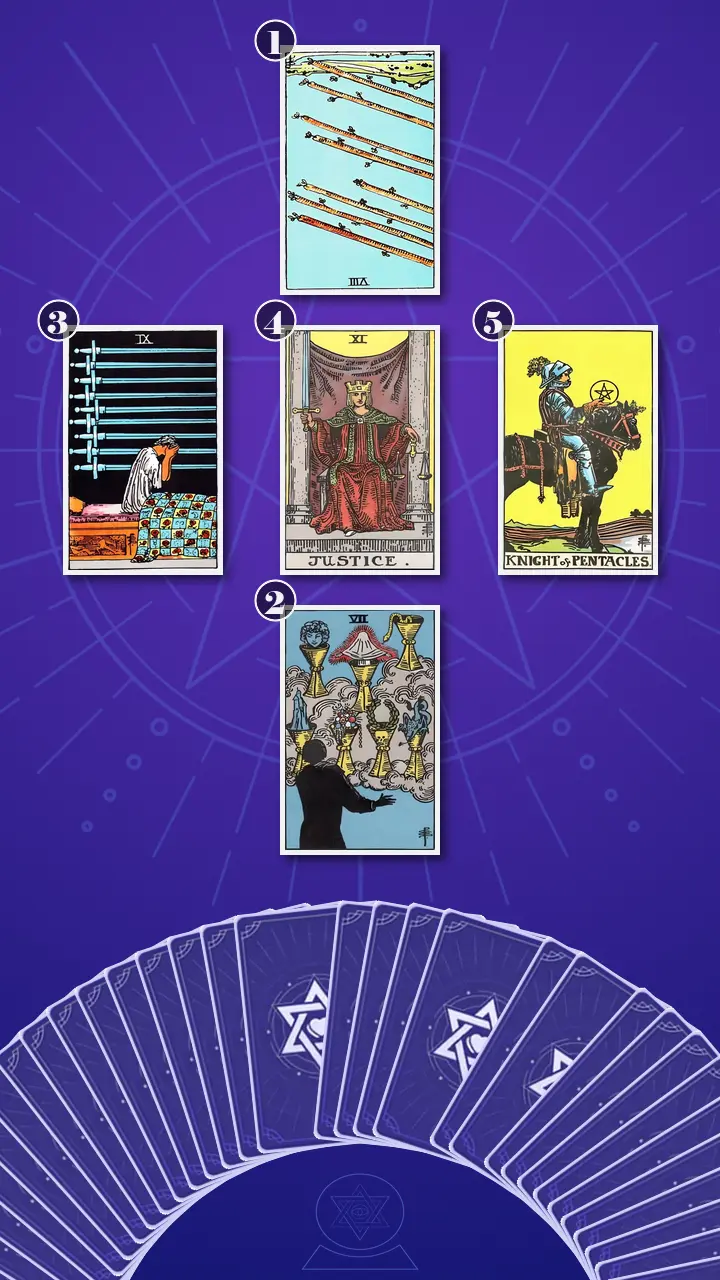
I placed the fourth card in the centre. The first went above it, representing the observable behaviour. The second went below, revealing the hidden projection beneath that behaviour. To the left, the third card would show what the rescue fantasy protected Jamie from feeling. The centre card would offer an integrating truth, and the final card on the right would turn that truth into a reversible career experiment. The layout looked like a signpost mounted on a set of scales.
Reading the Map of Speed, Fantasy, and Fear
Position 1: The Applications Already in Flight
I began with the card representing Jamie's observable career behaviour: rushing into job searches and professional reinvention before defining the problem. I turned it over.
The Eight of Wands, reversed.
In the image, eight parallel wands are already flying across an open landscape, yet no person is visible steering them. I asked Jamie to look again at the laptop beside them. LinkedIn, Indeed, course pages, résumé edits, and Easy Apply forms were their airborne wands. After a difficult campaign meeting, they could launch five career actions before naming whether the actual problem was unclear priorities, limited growth, poor management, inadequate pay, or exhaustion that would follow them into another field.
Reversed, the card showed Fire in excess but direction in deficiency. The energy was not absent. It was blocked by being spent too early. Clicking and rewriting briefly restored control, but each action pointed somewhere different. Beneath the cursor movement I could almost hear the private bargain: “If I keep moving, I will not have to feel how unclear this is.”
Jamie gave a short laugh, but no smile reached their eyes. “That's too accurate. Kind of brutal, actually.” Their fingers tightened around the edge of the table, then released it.
“It would be brutal if I were calling you careless,” I said. “I'm not. This burst of action has been trying to help you. It gives you hope after a day when other people changed the priorities and left you feeling powerless. We just need to ask whether that strategy still works once the immediate relief wears off.”
I invited them to return to the ten minutes before their latest search. Jamie remembered receiving vague feedback on a campaign, sitting in an office phone booth under buzzing fluorescent lights, and opening Easy Apply before asking what the feedback actually meant. The card did not accuse them of moving. It showed that the movement had been launched before its purpose was agreed.
Position 2: Every Tab as an Emerald City
I turned over the card representing the hidden assumption beneath the behaviour: the belief that several different career possibilities might each possess the power to fix an undefined “everything.”
The Seven of Cups, upright.
A silhouetted figure faces seven cups floating inside a cloud. Each cup offers a different treasure, identity, promise, or threat. I saw Jamie's screen immediately: design boot camp, nonprofit communications, product work, and postgraduate study, each displayed as a complete future self.
“In this version of my life, I would finally be creative,” I said, pointing to one cup. “In this one, I would finally do meaningful work. Here, I would become strategic. Here, intellectually credible. But the missing sentence is: ‘An ordinary Tuesday in this role would involve...’”
Jamie looked at the BrainStation tab and went quiet.
The Seven of Cups held Water in excess: imagination, longing, and symbolic possibility had flooded the evaluation process. Contact with ordinary working conditions was in deficiency. Jamie knew what each path represented, but much less about its repetitive tasks, entry barriers, salaries, decision authority, and trade-offs.
I compared the options to separate versions of the Emerald City. Each destination appeared capable of granting a finished identity. Yet, as in that familiar journey, the capacities Jamie wanted most, discernment, courage, and self-trust, could not be handed over by an external title. They had to be developed through the act of travelling, observing, and choosing.
“The design path makes me imagine being someone who trusts their ideas,” Jamie said. Their eyes stayed on the card. “I know the aesthetic of that life better than I know the job.”
I nodded. “Your imagination is not the enemy. It is showing us what you value. We simply cannot treat a polished ‘day in the life’ video as a full software demo. A new job can change the conditions of work; it cannot carry every unnamed problem in your life.”
Position 3: The Verdict Written at 12:23 a.m.
I turned to the card representing the fear or protective purpose that kept the rescue fantasy alive. This position would show what Jamie avoided having to feel while the tabs were open.
The Nine of Swords, upright.
The card showed a figure sitting upright in bed with their face covered, nine swords fixed across the dark wall above them. I asked Jamie about the time after the search ended.
They described lying awake at 12:23 a.m., their phone lighting the ceiling while a streetcar rattled through the intersection outside. Their eyes would sting as they compared salaries, reread a former colleague's promotion announcement, and searched “is 29 too late to change careers.”
I traced the escalation aloud: “Work was difficult. Then: I chose badly. Then: I cannot trust myself. Then: I must fix this now.”
The Nine of Swords showed Air in excess. A temporary work period had become a permanent conclusion about Jamie's judgment. The job search protected them by interrupting that conclusion. For a few minutes, another vacancy meant there was still an escape route. But no application had actually tested the belief that an imperfect decision would prove Jamie lacked control over their life.
Jamie inhaled and held the breath. Their gaze drifted away from the screen as if a month of late-night searches were replaying behind it. Finally, the breath left their chest in one long, uneven release.
“If I take my time and the option turns out to be wrong,” they said, “I think I'll have to admit I wasted years and still can't trust myself.”
“That is the fear,” I said. “It is not the verdict. Research can give you information about a role. It cannot fairly prosecute your entire history.”
When Justice Cut the Word “Everything” Apart
Position 4: The Integrating Truth
The refrigerator behind Jamie clicked off just as I reached for the central card. The sudden quiet felt almost architectural, as if the room itself had cleared a space at the centre of the spread.
I turned over the card representing the key transformation: separating causes, defining limits, and evaluating what a career pivot could realistically change.
Justice, upright.
The figure held level scales in one hand and an upright sword in the other. I explained that Justice was not asking Jamie to suppress their dissatisfaction or build a case for staying. It was asking for proportion. The scales would weigh each source of dissatisfaction separately. The sword would cut the word “everything” into questions specific enough to answer.
Here I brought in one of my core diagnostic lenses, Career Cycle Phase Identification. When someone's career feels stalled, I do not immediately label the problem a personal failure or a wrong profession. I separate three possibilities: a skill gap that can be developed, an organization-specific constraint such as poor role design or blocked advancement, and an industry-wide contraction that no amount of individual self-criticism can reverse.
Justice refused to let Jamie call all three conditions “I chose the wrong life.” Limited strategic experience might require skill development. Constant last-minute briefs might be a local management problem. A tightening job market might be macroeconomic weather. Loneliness outside work might need its own response altogether. Each condition deserved the correct owner, evidence, and scale of action.
I had the quiet professional flash I often experience when career questions resemble orbital weather. A temporary low tide, a local obstruction, and a true directional mismatch can feel identical from inside a tense body, but they do not ask for the same move. A planet's difficult season is not a moral verdict on the planet. Neither was Jamie's difficult quarter.
Jamie was still caught in the demand for one correct, comprehensive decision. Twelve tabs had created the sensation of control, but the blank “Why this role?” field exposed the deeper fear: if no option fixed everything, perhaps their judgment had never been reliable.
I said the first truth plainly: “A career change can solve a defined work problem. It cannot carry every unnamed dissatisfaction without collapsing under the weight.”
Then I placed my finger beside the level scales and gave Jamie the sentence at the centre of the reading.
You do not need one dramatic move to prove your life can change; weigh each problem on Justice's scales, then give each one a proportionate response.
Jamie went completely still. Their breath stopped halfway in, and their fingers hovered above the table as though they had forgotten what they were reaching for. Their pupils widened first. Then their gaze lost focus, not in confusion, but with the unmistakable distance of someone replaying several memories at once. Their jaw tightened; a quick flash of anger crossed their face before their eyes began to shine. “But doesn't that mean I've been doing all of this wrong?” they asked, their voice low and sharper than before. The question hung between us. Their shoulders remained high for another second, then dropped with a trembling exhale. Both hands opened slowly on the tabletop. Relief arrived, but it carried a moment of vertigo: if the cards were not choosing for them, the responsibility for the next experiment was returning to their hands. “Oh,” they whispered. “I don't have to make the next job explain my whole life.”
I did not rush to smooth away the anger. “It means your strategy served a purpose,” I said. “It helped you feel agency when work made you feel cornered. Now you can build a strategy that gives you agency without demanding a total reinvention every time something hurts.”
“Now, using this new perspective, think back to last week,” I invited. “Was there a moment when this insight could have made the situation feel different?”
Jamie remembered the vague feedback in the office phone booth. “I could have asked whether I needed a new career, a clearer brief, or a better conversation with my manager,” they said. “Those aren't the same question.”
That distinction was the first real movement from urgency-driven professional reinvention toward grounded confidence. Jamie did not suddenly know which field to choose. They had crossed a more important threshold: uncertainty was becoming something they could investigate rather than a verdict they had to outrun.
The Knight Who Held One Question Still
Position 5: Evidence Before Identity
I turned over the final card, representing the practical expression of integration: one reversible next step tested slowly enough to produce usable evidence.
The Knight of Pentacles, upright.
The contrast with the opening card was immediate. The Eight of Wands showed many objects moving quickly without a rider. Here, a rider sat on a motionless horse and studied one pentacle. The cultivated fields behind the Knight suggested that progress could be quiet, repeated, and visible over time.
This was balanced Earth energy: patience without passivity, structure without imprisonment, and follow-through without an identity-level promise. In Jamie's life, it looked like choosing one hypothesis such as, “A role with longer project cycles may reduce the deadline pressure that drains me,” then testing it through one informational interview, three carefully read job descriptions, and one small related project.
“You are not choosing a finished identity; you are testing a career hypothesis,” I told them. “The goal is not to stop moving. It is to know what each move is for.”
Jamie reached for a notebook, then paused. “But I genuinely don't have sixty minutes for another project this week. Work is already taking everything.”
I adjusted the scale of the experiment immediately. “Then sixty minutes is the wrong dose. Use fifteen. Read one full job description instead of thirty headlines. Ask one person what a normal Wednesday looks like. Record only three things: more appealing, less appealing, and still unknown. Evidence is allowed to arrive before certainty.”
Jamie wrote the headings down. Their movements were slower now, but the slowness did not look depleted. It looked directed.
The Justice Three-Bucket Sort and the Next 30 Days
I gathered the spread into one coherent story. A difficult work moment triggered scattered action. Scattered action opened a cloud of attractive professional identities. Those identities briefly protected Jamie from the fear that time was running out and their judgment could not be trusted. Justice interrupted the cycle by separating causes and limits. The Knight of Pentacles then replaced a dramatic escape with a bounded experiment.
The cognitive blind spot was not that Jamie lacked options or discipline. It was that intensive career activity had become evidence of control, while the undefined word “everything” prevented any option from being evaluated fairly. The transformation was not from staying to leaving. It was from asking one career move to rescue an entire life toward identifying what a job change could affect, what could change without leaving, and what needed a separate response.
I gave Jamie three practical next steps. None required a resignation, a course payment, or a final declaration on LinkedIn.
- Run the 10-Minute Justice Sort. At the kitchen table, set a ten-minute timer and list five sources of dissatisfaction. Place each under “A job change can affect this,” “I can change this without leaving,” or “This needs a separate response.” Add one piece of evidence beside each item. For example, limited growth may belong in the first bucket, unclear briefs may warrant a manager conversation, and loneliness outside work may need its own plan. If the exercise starts becoming another high-pressure life audit, stop after placing one trigger in one bucket. The goal is differentiation, not a verdict.
- Use the 30-Day Micro-Orbit Observation. For five minutes each Friday, track subtle workplace blueshifts and redshifts. Blueshifts are signs of expanding opportunity, such as clearer ownership, funded projects, useful feedback, or a manager opening a path toward growth. Redshifts are signs of contraction, such as repeated budget freezes, cancelled work, shrinking scope, or advancement routes closing. Mark each signal as a possible skill issue, organization issue, or industry-wide condition. Treat these signals as observations, not omens. A redshift is a reason to gather information and prepare options, not a prediction of layoffs. Two entries per week are enough.
- Launch One Career Hypothesis Pilot. Choose one item from the job-change bucket and rewrite it as a condition to test: “Would clearer ownership and longer project cycles materially improve my week?” Within seven days, send one request for a 20-minute informational interview, read three complete job descriptions from the same field, or try one 15-minute role-related task. Put a review date on your calendar before adding another hypothesis. Keep an energy budget of one question, one contact, and one exposure task. You are gathering evidence about a condition, not promising to become a new person.

A Week Later, the Quiet Proof
Six days later, Jamie messaged me: “I sent one informational-interview request, then slept through the night. I woke up thinking, ‘What if I'm wrong?’ But this time I laughed, made coffee, and left the question open.”
They had not solved their career, and I would not insult the complexity of their life by pretending otherwise. They had done something more credible: they had interrupted one automatic application, named the work condition beneath it, and chosen a small test that could produce information. The tarot had offered a map, but Jamie had decided where to place their feet.
I think of this reading as a Journey to Clarity not because uncertainty disappeared, but because Jamie stopped treating uncertainty as proof of failure. Their confidence began to move into a steadier orbit, built from proportionate questions, observable evidence, and the right to revise.
If your hands are racing across job-board tabs while your chest drops at the question “What do you actually want?”, I hope you remember that noticing the mismatch between your speed and your destination already means you are no longer fully inside the old cycle.
If you placed your current crossroads into this five-card Shadow tarot spread and asked Justice to weigh only one small career question, which question would you be curious enough to test without asking it to decide your whole future?