Six Weeks of Notes Replace Crisis Proof with a Seven-Day Test

The 11:40 p.m. Note Behind a “Sudden” Life Pivot
I knew career pivot anxiety had become specific when Jordan (name changed for privacy), a 29-year-old product marketing coordinator in Toronto, showed me five planning tabs while the Apple Notes entry that started the search still said only, “Something feels off.” Their stable hybrid job covered the rent. Their decks were polished, their Slack replies were prompt, and nothing was technically wrong. That sentence had become both shelter and trap.
At 11:40 p.m., through the blue light of our video call, I watched Jordan add “felt detached from the week again” to a note and find three nearly identical lines below it. The radiator clicked beside them. A streetcar bell carried through the apartment window, and cold coffee reflected the phone screen in a flat grey sheen. Their jaw locked; their thumb renamed the note “ideas for later” and opened a Toronto-versus-Vancouver cost sheet.
“I keep waiting for the signal to become impossible to ignore,” Jordan said. “I can explain every possible next chapter, but I can’t tell you what I keep not naming. What do I keep glossing over before a sudden life pivot?”
Each recurrence seemed to tighten a small metal hinge behind their molars. Their breathing stayed high in the chest while their hands kept moving, as though enough swiping could stop the hinge from becoming a door.
“I’m not going to use the cards to tell you that you must quit, move, or reinvent yourself,” I said. “I’d rather help us separate observation from interpretation. We can draw a map of the fog without pretending the map chooses the road.”
I paused beside the question already visible in Jordan’s notes: What if the pivot only looks sudden because the evidence never arrived at crisis volume? Nothing has to be on fire for a pattern to deserve a look.
Choosing the Compass: The Five-Card Shadow Spread
I asked Jordan to place both feet on the floor, take one slower breath, and hold the question without trying to solve it. I shuffled while they closed the planning tabs. The gesture was not mystical theatre; it marked a deliberate shift from scanning possibilities to examining one present-tense pattern.
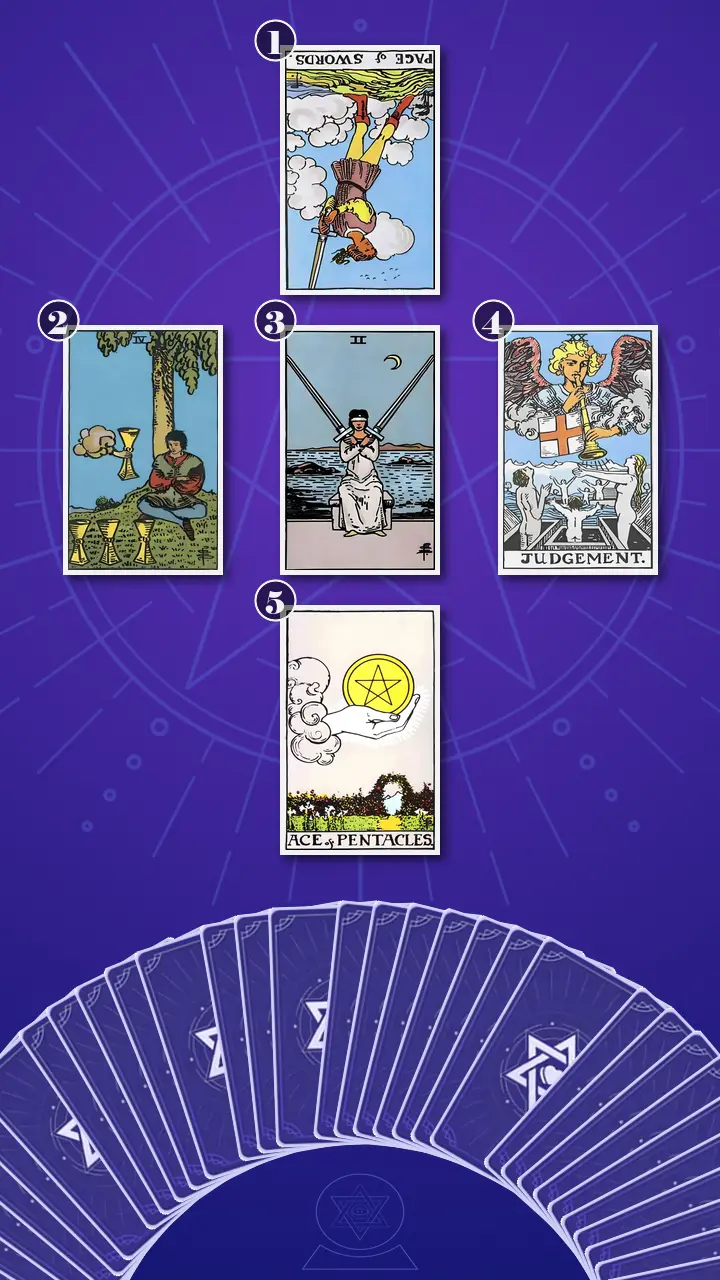
I chose the five-card classic Shadow Spread, arranged like a compass. For this question, I needed an Inner Excavation reading rather than a prediction. A Celtic Cross could have introduced timing, outside influences, and outcomes, but those layers would have widened a focused inquiry. The Shadow Spread was the smallest map capable of showing why change could feel sudden: visible avoidance, overlooked emotional material, the protection created by indecision, conscious recognition, and one grounded response.
The top card would reveal Jordan’s observable habit of glossing over the signal. The left card would show what their quick research kept outside the frame. The centre would expose how remaining inconclusive protected control. The right card would identify the integration point, and the lower card would place one response in ordinary life.
This is how I use tarot when someone is feeling stuck: not as an authority issuing a verdict, but as a structured way to externalise a sequence that can be checked against notes, calendars, body reactions, and actual choices. Card meanings in context matter more than dramatic predictions. Jordan would remain the person deciding what counted, what felt proportionate, and what happened next.
Reading the Map: Noise, Flatness, and the Perfect Tie
Position One: Research Without Contact
The first card represented the observable habit through which Jordan glossed over recurring signals: rapid research, relabelling, and future-focused planning. I turned over the Page of Swords, reversed.
The figure’s sword was raised, the trees and hair were being pushed by the wind, and birds circled through an unsettled sky. The mind was unmistakably active, but its stance was unstable. I read the reversed Air as both excess and blockage: too much incoming information, too little sustained contact with the observation that prompted it.
At 11:40 p.m., Jordan had seen three versions of “felt detached again.” Instead of comparing them, they had opened LinkedIn, two job boards, a Toronto-versus-Vancouver cost sheet, and a group chat. The inner sequence was quick: Maybe it’s the role. Maybe it’s Toronto. Maybe I need more information. I’ll come back to the feeling later.
“Research can create movement without creating contact,” I said. “Each new source may be relevant, but every switch carries you farther from the one fact that started the search. Your attention is behaving like an algorithm trained on dramatic reinvention. It ranks LinkedIn announcements and move-abroad content above the quiet evidence from your own week.”
Jordan gave a short laugh, but the sound caught behind their teeth. “That is so accurate it feels a little brutal.” Their thumb hovered over LinkedIn without touching it.
“Then we won’t use accuracy as a weapon,” I replied. “The Page is not accusing you of being careless. It is showing us a strategy that once restored a sense of movement. We’re only asking whether it still helps. What happened in your body or your day immediately before you opened the first tab?”
Jordan looked back at the note rather than the job board. Their fingers stopped moving. “I had seen Monday’s project sync on my calendar,” they said.
Position Two: The Cup Outside the Frame
The second card represented the quiet dissatisfaction Jordan kept overlooking because it did not appear dramatic enough. I revealed the Four of Cups, upright.
I pointed to the seated figure’s crossed arms, the three cups already on the ground, and the fourth cup offered just beyond their engaged attention. The upright Water was available, but attention to it was blocked. The card did not prove that Jordan’s job was wrong. It showed that a repeated response had been excluded because the rest of life remained functional.
Jordan described the previous Sunday at 9:18 p.m. Rain had tapped the kitchen window while the fridge hummed and their tea cooled beside Google Calendar. The same Monday meeting sat in the same slot. Their shoulders rose before they had formed an explanation. The meeting was survivable, their performance remained solid, and so they closed the calendar with the familiar thought: It isn’t bad enough to mean anything, so why does my body react before I even start?
“The overlooked cup is not a spectacular warning,” I said. “It may be the recurring drop in energy that you keep excluding because you can still function through it. Functioning and feeling engaged are not the same measurement. The card asks us to record the difference without exaggerating what it means.”
Jordan’s hand moved to the base of their throat. They inhaled, held the breath for a beat, and then looked toward the dark window. “I’ve been shortening plans after that meeting too,” they said. “I kept calling it scheduling.”
I did not turn that admission into a diagnosis. I asked only, “How many times has that happened?” The question left the offered cup on the table where Jordan could inspect it, not obey it.
Position Three: The Tie That Protects Control
The centre card represented the psychological mechanism that preserved Jordan’s sense of control by keeping the repeated signal inconclusive and unactionable. I turned over the Two of Swords, upright.
The blindfold covered the figure’s eyes. Two blades crossed over the chest while a calm sea and exposed rocks waited behind them. Here, Air had shifted from the Page’s scattered excess into rigid control. The card’s neutrality was overextended until useful response became blocked.
Jordan showed me a polished Notion page with two columns: “The role is wrong” and “I’m just tired.” Both contained reasonable arguments. Both remained permanently plausible. Until one explanation could be proven completely, no experiment was allowed to produce evidence for either.
“This stalemate gives immediate relief,” I said. “If neither interpretation can count, neither can ask anything of you. But the same structure also prevents reality from teaching you something. Which fact remains true whether the role is wrong or you’re temporarily depleted?”
Jordan went still. Their breathing paused; their gaze slipped away from the screen as though replaying several Mondays; then their fingers released the frayed edge of a paper coaster beside the laptop. “The meeting has produced the same physical reaction for at least four weeks,” they said. “That’s true under both explanations.”
“Good,” I said. “You can name the pattern without signing a contract with the outcome. We don’t need to settle the entire career question before responding to the common fact.”
When Judgement’s Trumpet Became a Pattern Review
Position Four: Recognition Without a Verdict
The room became unusually quiet as I reached the card representing the key transformation: moving from waiting for dramatic proof to reviewing accumulated evidence and answering it proportionately. Even the radiator had stopped clicking. I turned over Judgement, upright, and a streetcar bell sounded once beyond the glass.
The card showed an angel sounding a trumpet while figures rose with open arms. I set it beside the blindfolded Two of Swords. The visual change was immediate: sealed perception gave way to conscious response. I read Judgement as balanced recognition, not an external alarm and certainly not a prediction of upheaval. Its trumpet was the same concern becoming audible when scattered entries were finally read together.
I translated the card into a modern scene: a twenty-minute review of six weeks of notes and calendar changes, the same detachment found in four contexts, and one honest sentence written without a dramatic conclusion: “This has repeated four times; I do not yet know what it means.” That was enough to permit one measured response.
On archaeological digs, I learned to distrust the phrase “sudden collapse.” A textbook may assign the Western Roman Empire a fall date, while the material layers show repairs, reused stone, changing trade, and local adaptations accumulating across time. Jordan’s career question was not the fall of an empire, but the perceptual error was comparable: a headline can make a long transition look like one event.
I call this Historical Crossroad Matching. I use the wider historical frame to separate the final visible pivot from its quieter prehistory. It helped Jordan see that the present signal did not have to become a catastrophe before it qualified as part of the record.
I watched Jordan glance toward the blue-lit Notes screen. At 11:40 p.m., the old sequence had been automatic: add a fourth line, rename the note, browse cities. The screen changed; the observation did not. They still believed acknowledging it would make the whole pivot binding.
You do not need a crisis to certify what you already notice; answer one repeated signal now, as Judgement's figures rise to meet the trumpet.
The sentence rested in the room.
Jordan’s breath stopped first. Their right thumb froze above the Notes screen, and their gaze lost focus as if six weeks of evenings were replaying behind the glass. Their pupils widened. The muscles beside their mouth pulled tight, then their eyes reddened. “But doesn’t that mean I was wrong every time I dismissed it?” they asked, their voice suddenly sharper. I let the anger have room. “No,” I replied. “It means the strategy protected your sense of control until its cost became visible. Recognition is not a prosecution.” Their crossed ankles uncoupled. Their shoulders dropped a fraction, their fist opened against the tabletop, and a breath came out with a tremor at the end. Relief arrived, but it left a small blankness behind, the dizziness of realising that clarity restores responsibility as well as choice. I asked, “Now, using this new perspective, think back: was there a moment last week when this insight could have made you feel different?”
Jordan looked down. “When I cancelled my Saturday class, my shoulders relaxed,” they said. “Then I opened relocation spreadsheets because the relief scared me. I thought it had to mean something huge.”
“A recurring signal is data, not a command,” I said. “You can acknowledge it and still choose the pace, scope, and meaning of your response.”
I asked Jordan to set an eight-minute timer and open the notes they had filed under “later.” They wrote only three lines: “The repeated fact is...”; “I do not yet know...”; and “One response small enough to test is...” I made it clear that they could skip anything too exposing and stop when the timer ended. This was not a commitment to a career pivot. It was a brief act of honest self-review.
Jordan counted four references to the Monday meeting and three cancellations later in the same week. They did not declare the job broken. They wrote, “I do not yet know whether this is the role, the workflow, winter, or accumulated fatigue. One response small enough to test is protecting one lunch after the meeting.”
I named the crossing I had just witnessed: from guarded future-scanning and waiting for crisis-level proof to evidence-based self-trust and a proportionate response. It was not certainty. It was the first moment Jordan allowed evidence to count without surrendering control.
The Pentacle Close Enough to Put on a Calendar
Position Five: One Piece of Usable Evidence
The final card represented the embodied practice through which Jordan could ground the insight in one observable experiment without forcing a complete life decision. I revealed the Ace of Pentacles, upright.
A hand held one golden pentacle close in the foreground. Behind it, a path passed through a flowering arch toward distant mountains. Earth arrived in balance: the immediate step was tangible, while the larger direction remained open. No Wands appeared anywhere in the spread, so I saw no reason to manufacture urgency. Momentum would come from evidence, not a burst of dramatic Fire.
In Jordan’s life, the Ace could be one no-meeting lunch protected for seven days, one routine attended after several cancellations, or one bounded request to change a weekly workflow. The test would be placed on the calendar with a start date, an end date, and a simple before-and-after observation. It would not decide the job, city, or next chapter.
I brought in my Enduring Value Assessment here. Midnight fantasies about Vancouver might fade by morning, while a repeated need for recovery, autonomy, or meaningful engagement might remain visible across several contexts. I was not deciding which need Jordan had. I was asking which observation survived changes in mood, platform, and explanation, and which small response respected something they would still value after the immediate pressure passed.
“Make the next step small enough to teach you something,” I said. “What can you put on this week’s calendar that is reversible, low-cost, and real?”
Jordan opened Google Calendar and protected the lunch after Monday’s project sync. They added an end date seven days later and two prompts: “Tension before, 0 to 10” and “Tension after, 0 to 10.” Their hands slowed. The larger relocation spreadsheet remained open in another tab, but for the first time that evening, it was no longer pretending to be the next step.
From the Dashboard Light to a Seven-Day Test
I drew the five cards back into one sequence. Jordan worked in an environment that rewarded rapid synthesis and polished certainty, while Toronto’s cost of living made experimentation feel as consequential as resignation. When a quiet concern returned, the reversed Page moved attention into research. The Four of Cups showed the low-volume dissatisfaction left behind. The Two of Swords kept “the role is wrong” and “I’m just tired” in a perfect tie, creating short-term control at the cost of usable feedback. Judgement made the accumulated record visible, and the Ace of Pentacles turned recognition into one bounded encounter with reality.
The spread’s central metaphor was a dashboard light dismissed because the car was still moving. Jordan’s blind spot was not a lack of intelligence or courage. It was the rule that noticing equalled commitment, combined with the belief that evidence counted only when it became dramatic. That rule produced the false suddenness of change: every quiet warning stayed below the threshold until a later pivot appeared to have arrived from nowhere.
The transformation direction was therefore precise. Jordan did not need a complete explanation. They needed to review one recurring concern, identify the fact that remained true across competing interpretations, and test one proportionate response. Recognition would remain separate from obligation.
The Time Stratigraphy Exercise
Before we set the practical next steps, I introduced my Time Stratigraphy Exercise. I asked Jordan to imagine sitting at the same kitchen table as their ten-year future self. I did not ask that future self to predict the correct career. I asked them to look back through the layers: Which present concern kept recurring? Which midnight fear disappeared once the screen closed? Which small experiment protected an enduring value without demanding a total reinvention?
The historical distance worked like stepping back from an excavation trench. A mark that looked enormous at ground level could become surface noise; a thin line repeated across several layers could become the more durable finding. Jordan still owned every decision. The exercise changed the scale of attention, not the authority over their life.
Two Next Steps That Leave the Larger Road Open
- Pin “One Fact, One Question.”The next time the concern appears, Jordan will open one pinned Apple Note before LinkedIn, Instagram, a job board, or a group chat. In two minutes, they will record one observable fact and one genuinely unanswered question, such as “jaw tightened when Monday’s meeting appeared” and “does the response change when I protect recovery time afterward?”Tip: Keep one sentence under each heading. If two sentences feel too exposing, use a date and five neutral words, such as “cancelled class; felt relief again.”
- Run a Low-Volume Signal Review and Seven-Day Evidence Test.On Sunday, Jordan will sit at their kitchen table or a quiet library desk for twenty minutes. They will review six weeks of notes, calendar changes, and cancellations; count one repeated concern without explaining it; use the final three minutes to apply the ten-year perspective; then schedule one reversible seven-day adjustment with a 0-to-10 before-and-after rating.Tip: Define the end date and cap the time or cost before starting. If six weeks feels too charged, review two. The aim is usable feedback, not a verdict about the whole future.
I reminded Jordan that tarot had not discovered a hidden fate. The cards had arranged familiar evidence into a sequence clear enough to examine. The choice to close a tab, count a recurrence, protect a lunch, revise the experiment, or stop altogether remained theirs.

A Week Later: The Quiet Proof
Six days later, I received a photo of pale winter light across Jordan’s kitchen table. They had kept one no-meeting lunch; tension fell from seven to four. They slept through the night. At breakfast, “What if I’m wrong?” returned. This time, they laughed and kept the evidence.
I did not read that message as a life solved or a pivot confirmed. I read it as the first concrete proof of a changed relationship with uncertainty. Jordan had noticed one signal, answered it proportionately, and retained control over everything that came after.
That was the real Journey to Clarity: not moving from doubt to perfect certainty, but from restless scanning to attentive observation, and from waiting for a crisis to choosing one measured response. The cards provided the map. Jordan supplied the honesty, the boundary, and the action.
If the same concern returns and your jaw tightens, I want you to remember why calling it “not urgent” can feel safer. Naming it may resemble surrendering control to a change you have not chosen. But noticing the dashboard light is not handing it the steering wheel.
If noticing the signal did not commit you to a pivot, which quiet dashboard light would you be willing to let count this week, and what single seven-day test could give it a fair hearing?