DNA Match Contact Limbo: From Drafting and Deleting to Self-Trust

The Cursor Beneath the Family Story
If you have searched a DNA match for more information, asked three friends what they would do, and still cannot press Send, I know the problem may not be a lack of facts. It may be the fear of emotional exposure disguised as research.
Casey (name changed for privacy) was a project coordinator in Toronto who could keep three people's deadlines moving in Asana while leaving her own personal question in a permanent draft state. At 8:47 p.m. on a Tuesday, she sat at her kitchen table with a half-finished takeout container beside her. The fluorescent light buzzed overhead, her phone felt warm in her palm, and her thumb hovered over Send while her chest tightened.
I watched her open the DNA match profile, copy a possible greeting into Notes, change I would love to connect to I was wondering if you might be open to a question, and then delete the whole thing. For a second, her shoulders dropped because nothing had been risked. Five minutes later, the profile was open again.
“I want to know who they are,” she told me, “but I do not know what knowing would ask of me. If I send the message, I might not be able to keep the rest of the feelings separate.”
I could feel the shape of her ambivalence without reducing it to a label. It was like two browser tabs arguing over the same decision while a blinking cursor waited between them, and every possible sentence seemed to carry the weight of an entire family story. She wanted the clarity of contact, but also wanted to keep control over what contact might set in motion.
“That makes sense,” I said. “Curiosity can be real without becoming an obligation. We do not have to decide the whole relationship tonight. We can look closely at what is happening, name the boundary you need, and let you keep the pen.” As an artist and a tarot reader, I have always felt that our lives are films still in production. When a scene keeps repeating, the answer is not always a dramatic ending. Sometimes it is the moment we realise we have permission to write the next line.

Choosing a Compass for DNA Match Contact Limbo
Before I dealt the cards, I invited Casey to put both feet on the floor and take one slow breath. I shuffled without trying to make the moment mysterious. The purpose was simpler: to move her from the rapid editing loop in her phone into a room where the question could be observed.
“Today I am using a five-card cross called The Shadow Spread,” I explained. “I use tarot here as an external structure for reflection, not as a prediction about your relative or a command about what you must do. The cards can help us separate what is known, what is imagined, what belongs to you, and what remains outside your control.”
The Shadow Spread suited Casey because her question was not really a relationship forecast. There was no established two-way relationship for the cards to measure, and looking too closely at the relative's imagined perspective would only add another layer of speculation. This spread traces the visible DNA match contact limbo into the hidden fear, the emotional meaning attached to a possible family connection, the recognition that can loosen the stalemate, and a bounded next step.
I placed the first card in the centre, the second above it, the third to the left, the fourth to the right, and the fifth below. I told Casey, and I tell you as well, that the centre would show the conscious impasse, the card above it would reveal the fear beneath the hesitation, and the card to the left would ask what the possible connection symbolised. The right-hand card would show integration, while the final card would translate clarity into a boundary-led choice.
It was a doorway viewed from the middle. We would not force our way through it. We would first notice why Casey's hand kept reaching for the handle and pulling back.
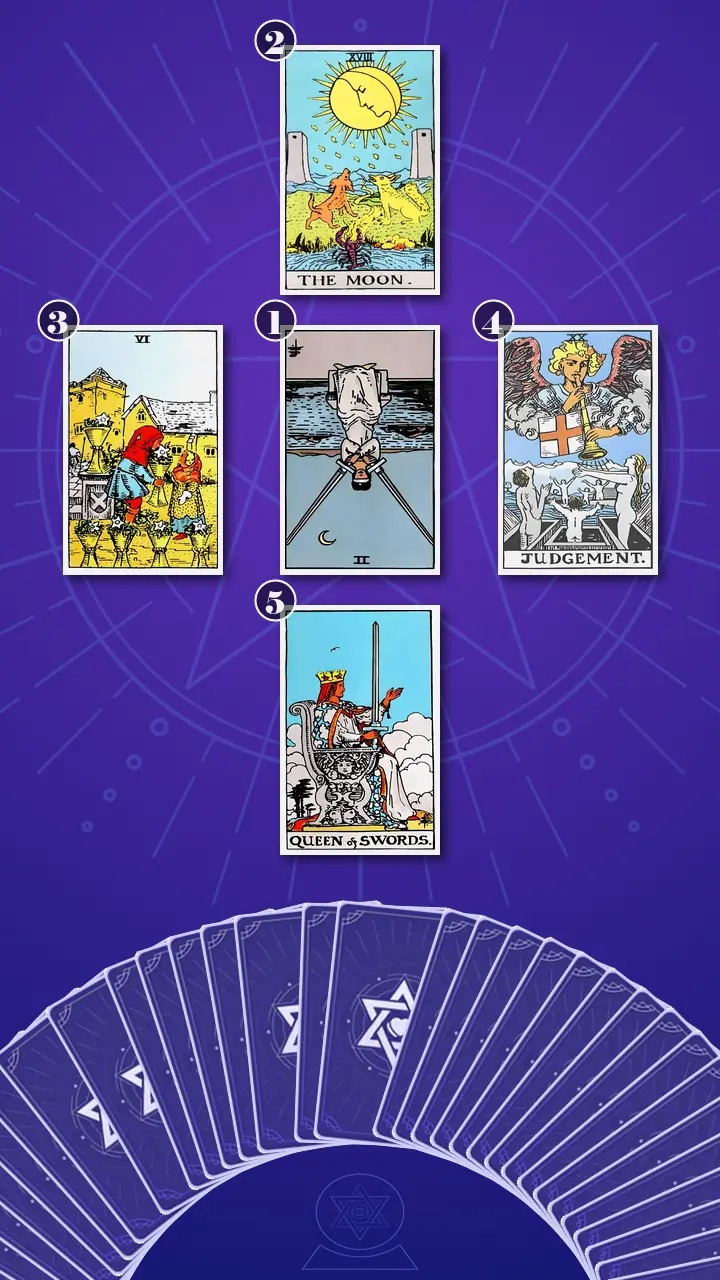
Reading the Map Without Predicting the Road
Position 1: The Draft That Never Receives Approval
Now I turn over the card representing the conscious impasse and observable contact pattern: the specific cycle of reopening the DNA match profile, drafting and deleting a message, and postponing a decision.
The card is the Two of Swords, in reversed position.
In the image, the blindfolded figure holds two crossed swords over her chest, with moonlit water behind her. The reversed card shows blocked Air. Thought is active, but judgment is held in suspension. The energy of research has become excessive, while the energy of choosing a boundary remains deficient. Casey is not short of words. She is using words as an approval loop, sending every draft back for another round of review because the next click feels like agreement to the entire transaction.
“This is the match profile on your phone,” I said. “The cursor blinks beneath three competing greetings. One internal voice says, If I send this, then I may have to deal with everything it opens. The other says, If I do not send it, I may be choosing stuckness. Both swords are trying to protect you, but neither one is helping you name what you are actually ready to choose.”
Casey gave a small, bitter laugh. “That is almost rude. I keep calling it research, but I am really waiting to feel certain.”
I let the sentence stand. The protection was not foolish. Repeated research brought temporary relief because it postponed exposure, a response, and the possibility that the match might become emotionally present in a new way. But relief was not the same as clarity. I asked her to distinguish the wording she could choose from the response she could not control. Her hand stopped moving over the edge of her phone case, and she looked at the profile as if she had finally noticed the loop itself.
Position 2: The Line 1 Fog
Now I turn over the card representing the hidden fear beneath the hesitation. It is The Moon, in upright position.
The Moon brings the spread into Water. Feelings, projections, and half-seen possibilities rise around the narrow path between the towers. The energy is not a warning of danger; it is uncertainty amplified by the mind's attempt to give the unknown a complete shape. A neutral detail on a profile can become several possible futures: a warm exchange, no reply, intrusive questions, or a relationship that suddenly feels much larger than a first message.
Casey told me about reading the match profile on the Line 1 platform at Yonge-Bloor. The train announcement had echoed through the station while she reread the same shared-DNA detail for the third time. She had called it information gathering, but she had not written down a single fact about her own limits.
“The Moon asks a very specific question,” I said. “When you imagine no reply, a warm reply, or an intense reply, which possibility makes your chest, stomach, or shoulders react most strongly? Is that reaction supported by present information, or is the unknown generating a whole season of possible plotlines?”
She went quiet. Her eyes moved from the card to the window, where streetlights blurred in the glass like reflections on wet pavement. First her breath paused. Then her gaze lost focus, as if she were replaying the three imagined replies. Finally she released a long breath and lowered her shoulders.
“The intense reply,” she said. “I think I am afraid the conversation will ask for more of me than I can give.”
“That is useful information,” I replied. “It is not a prediction. It is a boundary waiting to be written.”
Position 3: The Small Cup With the Large Meaning
Now I turn over the card representing the emotional meaning being activated by the possible family connection. The card is the Six of Cups, in upright position.
The Six of Cups carries memory, tenderness, recognition, and the past-linked feeling of something that might connect one personal story to another. It does not prove what the DNA match means, and it does not promise intimacy. Its energy is available and gentle, but it can become overloaded when a small possible connection is asked to explain an entire history.
I brought Casey back to a scene she had described from an ordinary morning before work. She had been making coffee and imagining the simplest message: Hi, I think we may be related through a DNA match. The sentence was small. The meaning attached to it was not. She had held her mug with both hands and thought, “I want to know who they are, but I do not know what knowing would ask of me.”
“The flower-filled cup in this card matters to me,” I said. “It is an offering, not a demand for a complete exchange. The first message does not have to explain the whole story it came from. It can hold one respectful question and nothing more.”
Casey's mouth softened, but her fingers tightened around the mug she had brought to the session. For a moment, I saw tenderness and grief arrive together, not because the cards had declared a missing piece, but because the possibility of recognition had been emotionally real to her long before another person had answered.
I have learned, as an artist, to respect the scale of an image without confusing it with the scale of the event. A flower in a cup can matter deeply and still be only a flower in a cup. Casey could honour what the match symbolised without allowing that symbolism to make the decision for her.
When Judgement Made the Question Audible
Position 4: The Trumpet, Not the Command
The room changed when I reached for the fourth card. Even the radiator seemed to quiet, and the phone between us looked less like a doorway and more like an object we could place down.
Now I turn over the card representing integration and conscious reckoning. It is the key card, Judgement, in upright position.
Judgement is the sound of an inner question becoming clear enough to answer. The trumpet does not predict what the relative will do. It does not tell Casey to contact them, and it does not make silence morally wrong. It asks her to bring the hidden conflict into language: what she is ready to ask, what she is ready to share, and what she will leave outside the first exchange.
By then, Casey was no longer asking only whether to say hello. She was trying to guarantee that no reply, warm reply, or intense reply could disturb her before she moved. The draft on her phone had become an irreversible doorway, and certainty seemed like the admission fee.
You do not have to remain suspended until every feeling is settled; name what you are ready to ask, set a boundary around what you will share, and let Judgement's trumpet call you toward a conscious choice rather than a forced resolution.
For a moment, Casey did not blink. Her fingers froze above the phone, and the muscles along her jaw tightened. Then her eyes moved across the card, unfocused, as if the trumpet had made several old conversations visible at once: friends saying, “I would just message them,” her own repeated searches for what to say to a DNA match, and every private promise to decide after one more piece of information. Her face flushed lightly around the eyes. She looked angry before she looked relieved.
“But does that mean I have been doing this wrong?” she asked.
“No,” I said. “It means the strategy that once gave you distance has outlived its usefulness. You are allowed to thank it and choose something more precise.”
Her breath caught again, then left her in a shaky exhale. Her shoulders lowered by degrees, and the hand that had been gripping the phone relaxed against the table. The release brought a brief, almost dizzying emptiness. Without the old urgency, she had to face the responsibility of choosing for herself. I watched her sit inside that blank space without rushing to fill it.
“Now, use this new perspective to remember last week,” I invited. “Was there a moment when you could have asked a smaller question instead of trying to predict the entire emotional future?”
She nodded slowly. “When I was on the TTC. I could have written down what I wanted to know. I did not need to decide what this person would become in my life.”
This was the bridge. Judgement moved Casey one step from tense ambivalence toward self-trusting, boundary-led choice. The emotional transformation was not a sudden cure or a guaranteed family answer. It was the first honest separation between curiosity and obligation, between a question she could own and a response she could not manage.
Position 5: A Clean Sentence in the Wind
Now I turn over the card representing the boundary-led next step. It is the Queen of Swords, in upright position.
The Queen returns Air to the spread, but this time it is clear rather than defensive. Her upright sword represents discernment, and her direct gaze represents the ability to read a message the next morning and still recognise it as her own. Her energy is balanced: honest communication without emotional overexposure, independence without shutting down connection.
“Think of this as a strong project brief,” I said. “Purpose, one manageable question, and a defined scope. Clear is not the same as exposed. You can send it, keep it as a draft, revise it later, or choose a deliberate pause. A clear message can belong to you without making the other person's response yours to manage.”
Casey opened Notes. Instead of writing a long explanation about family history, she typed three lines: why she was reaching out, one question she genuinely wanted answered, and a sentence saying she was not ready to discuss sensitive family information. She read it once, then placed the phone face down.
Her hand still trembled slightly, but it no longer hovered over Send. The change was modest and unmistakable. She had moved from asking the profile to make the choice obvious to asking herself what boundary she could stand behind tomorrow.
A Boundary Around One Small Step
When I gathered the cards together, the story became clear. The reversed Two of Swords showed the visible research-draft-delete cycle. The Moon revealed why more information had not settled it: the unknown was carrying imagined futures and the fear of losing emotional control. The Six of Cups showed the tenderness underneath, the wish for recognition and continuity that made an ordinary greeting feel symbolically enormous. Judgement made the real task audible, and the Queen of Swords gave it a usable form.
Casey's blind spot was not that she lacked courage or facts. She had been treating emotional certainty as a prerequisite for any movement, while treating another person's response as evidence she needed in order to trust her own decision. I named the shift plainly: from research-driven emotional suspension to a small, self-trusting, boundary-led choice. She was not choosing the whole relationship. She was choosing the boundary around one possible first step.
This is where I used my Narrative Fork Analysis. I placed the competing plotlines side by side. One plotline said, Keep researching until the story becomes risk-free. Another said, Send an emotionally enormous message and let the reply decide what this means. The third plotline was quieter: Name one honest question, protect one clear limit, and allow the connection to remain unknown. That third option served Casey's growth arc because it gave her agency without demanding certainty.
I also used my Safe-Choice Sabotage Recognition lens. Endless research looked logical, but it was functioning as a defence against the necessary inciting incident of naming her own boundary. That did not mean every pause was avoidance. A pause with a reason, a limit, and a date could be a conscious choice. The difference was whether Casey was directing the pause or disappearing inside it.
I offered her three small practices.
- The Ready-to-Ask ListSet a 10-minute timer this week and write two separate notes: three things you are genuinely curious to learn from the possible relative, and three things you are not ready to discuss. Do this offline before reopening the match profile.If your chest tightens or your stomach drops, stop at five minutes, close the app, and do something grounding. The list is meant to clarify your boundary, not force contact.
- The Three-Sentence Contact CheckWithin the next 24 hours, use my Protagonist Pivot Action: draft one short message with one sentence explaining why you are reaching out, one manageable question, and one line that leaves room for the other person to reply when they are comfortable. Do not send it unless it feels like your choice.Use placeholders instead of perfect wording. The first message can be honest, limited, and easy to stand behind tomorrow. It does not need to carry the whole story.
- The Deliberate Seven-Day ChoiceBefore opening the app, choose one boundary, such as not sharing your phone number, not discussing sensitive family history in the first exchange, or checking for a response no more than once a day. Then choose what the next seven days mean: send the short message, revise it later, or pause contact until a named date.Record the decision as a decision, not as proof that you are failing to decide. You can stop replying, mute notifications, change the boundary, or choose not to continue.
I reminded Casey that tarot could not tell her whether the relative would respond warmly, respond intensely, or not respond at all. It could help her ask a better question of herself. The decision remained hers, and every legitimate option needed to protect her privacy, emotional boundaries, and right to change course.

A Week Later, the Quiet Proof
Six days later, Casey sent me a message from a cafe near Queen Street West. She had completed the two lists, shortened the draft, and sent it without including her phone number or sensitive family details. The relative had not replied yet. That was not the proof she was looking for.
The proof was that Casey had checked the app once, then put her phone away and returned to her coffee. She told me, “I still wondered if I made the wrong call. But I did not feel like I had handed my whole identity to the inbox.”
She had made a clear choice while leaving room for revision. The fear had not vanished, and curiosity had not become certainty. Still, the two feelings were no longer pulling her through opposite ends of the same locked door.
I think of that as the real Journey to Clarity. The cards did not decide whether Casey should contact a relative from her DNA match. They helped her see the difference between an unsent message and an unowned decision, then helped her write a boundary she could live with. I did not take the pen from her. I placed it back in her hand.
When the match profile is open and your chest tightens over the Send button, it can feel as though one small message might force you to carry an entire family story before you even know what you are ready to ask. But you are allowed to let curiosity and self-protection sit beside each other. If you allowed curiosity and self-protection to sit beside each other for a moment, what small choice about this match would feel most like your own?