Late-Apology Anxiety: How One Boundary Kept the Future Moving

The Warm Phone and the Old Doorway: Late-Apology Anxiety
I recognize the exact late-apology anxiety that can hit a twenty-nine-year-old communications coordinator at a Toronto nonprofit: tomorrow's creative-course reminder sits untouched while a former connection's message turns the phone into a magnet.
At 8:47 p.m. on the TTC Line 1 train south from Bloor-Yonge, Alex held her warm phone above her laptop bag and reread the apology while fluorescent lights buzzed overhead. The brakes squealed at each stop, and her thumb hovered over Reply although she was supposed to review tomorrow's lesson before getting home.
When I asked what had brought her in, she gave me a tired half-smile. “I was finally looking ahead, and now I am back in the waiting room. They apologized, but there is no clear request. I keep trying to figure out what it means before I ask what I want.”
The conflict was painfully precise: she wanted to keep building the future she had chosen, with protected weekends, close friendships, and a creative life that felt like hers, while every late apology pulled her toward reopening an old connection. Her hands kept moving as if they were drafting a reply in the air. Her chest tightened, her stomach dropped, and the feeling became a browser tab reopening itself after she had already started the next project.
“You are not doing anything wrong by feeling the pull,” I told her. “We do not have to decide whether the sender is good, bad, sincere, changed, or meant to return. We can look at what the message activates in you, what it does not change, and how to keep your own direction visible. Let us draw a map through the fog, so the next scene belongs to you again.”

Choosing a Compass at the Crossroads
I asked Alex to put the phone face down and take one slow breath before touching the deck. I shuffled gradually, giving the ordinary movements a practical purpose: a pause between the notification and the response, a way to let the nervous system catch up with the information.
I used a five-card Relationship Spread · Context Edition. This is how tarot works in a reading like this: the cards are not an outside authority issuing a verdict, and they do not reveal a former connection's private motives as fact. They give us a visual system for testing patterns against present reality. Their value is in making the invisible sequence visible: interruption, emotional activation, nostalgia, discernment, and the next chosen action.
I chose this spread because the question was relational, but the pressure was also happening inside Alex's meaning-making loop. A classic decision spread might have pushed us toward choosing between reply and no reply. This five-card relationship tarot spread was more precise. It could show how a late apology interrupted her future, what feeling the message raised, how the old bond occupied the center of her attention, which boundary could restore clarity, and what practical step would keep her moving.
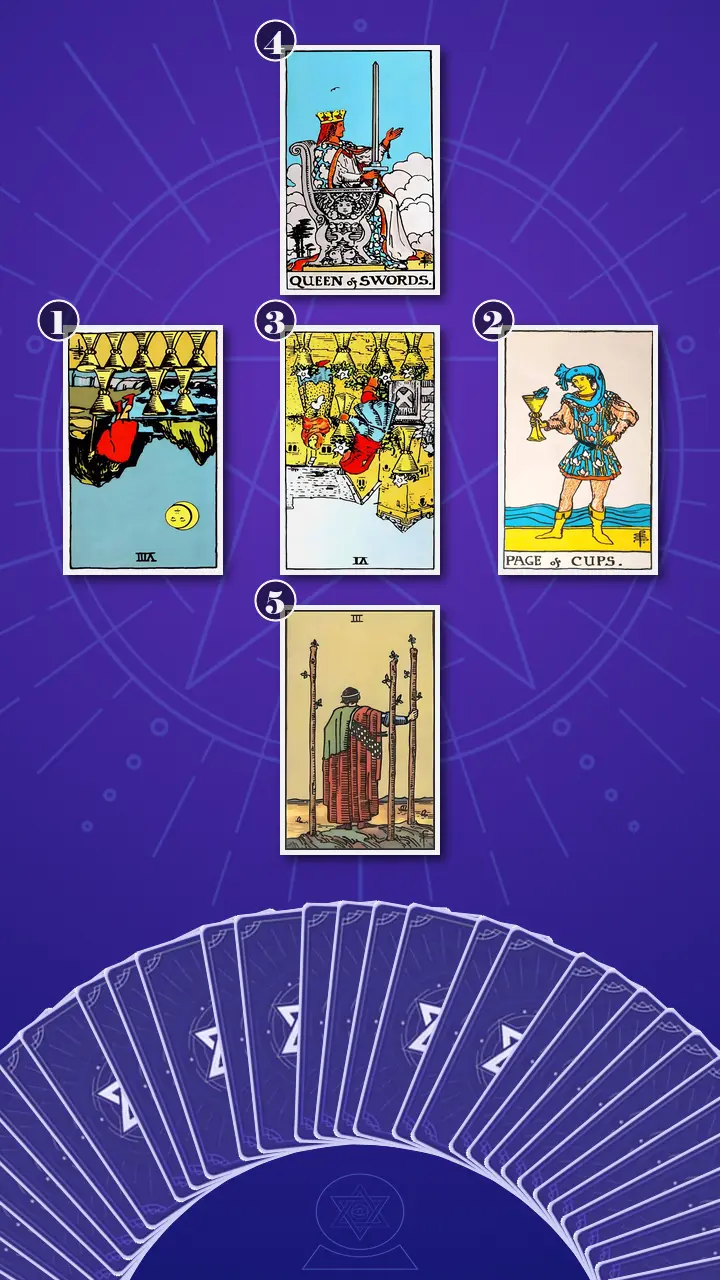
I explained the route before turning anything over. Position 1 would show the current relational stance, the observable behavior that pulled her from a future-facing plan. Position 2 would examine the impact of the late apology without making claims about the sender. Position 3 would expose the vision-connection dynamic underneath the loop. Above that center, position 4 would test the boundary between acknowledgment and renewed access. Position 5 would offer a future-aligned next step that remained entirely in Alex's hands.
The Turn Back Before the Next Stop
I began with position 1, the Current relational stance: reveal the observable card-point behavior in which a late apology pulls the querent away from a future-facing plan and back into emotional review.
I turned over the Eight of Cups, in reversed position. In the Rider-Waite-Smith image, a cloaked figure has turned away from eight carefully stacked cups, but the moonlit path is uneven and the body still seems caught between leaving and returning. Reversed, the water is not moving cleanly forward. It is circulating backward through unfinished meaning.
In modern life, this is the 10:38 p.m. version of a late apology: the phone held over a laptop where tomorrow's course reminder is open, an old thread reopened for context, three replies drafted and deleted, and the future-facing task left untouched while the past grows louder. The card did not say Alex had to return or had failed to move on. It asked a sharper question: what was she actually returning to, and what one future-building action could continue before any response?
The blockage was the reflexive turn. One message became a physical change in direction before Alex had decided whether she wanted contact. The overcorrection on the other side would be to ignore everything the apology stirred, abruptly cut every channel, and call the unprocessed feeling closure. Neither reflex gave her authorship. The useful pause was smaller and more honest: acknowledge the emotional movement, then keep one chosen commitment in view.
Alex gave a short, bitter laugh and looked away from the card. “That is too accurate,” she said. “Almost cruel. I have called it research, but I am just reopening the same door.” I let the silence stay kind. “Research can be a way of delaying the question that belongs to you,” I said. “Feeling pulled back is not the same as choosing to return.”
Her thumb stopped rubbing the edge of her phone case. She did not nod right away. Instead, she moved the phone farther from her knee, as if testing whether distance could be a choice rather than a punishment.
The Fish Inside the Notification
I moved to position 2, the Impact of the late apology: examine what the returning message activates and offers in the querent's inner experience without claiming the sender's motives or deciding what access the sender should receive.
The card was the Page of Cups, in upright position. A fish rises unexpectedly from the cup in the Page's hands, and the young figure looks surprised, receptive, and unprepared to explain what has appeared. The image gave the apology its proper scale. It was an emotional interruption, not a complete instruction.
The upright Page carried openness and tenderness in balance, but that openness could become excess when Alex treated the first feeling as a decision. A short notification can carry more emotional data than its word count suggests. The apology had arrived without a clear request, and the missing meaning left Alex supplying the labor. She was not only reading the words. She was trying to determine whether tenderness, guilt, suspicion, irritation, or hope was the correct response, then asking friends to interpret the sender before returning to her own life.
I asked her to name the first sensation before explaining the sender's intention. She looked at the blue water behind the Page and said slowly, “Something in me moved. I do not yet know what it means. I can let the feeling arrive without giving it the steering wheel.”
That sentence changed the pace of the room. Alex reread the original apology once, then placed the phone beside her notebook instead of opening the old conversation. Her shoulders remained high, but her eyes settled on the card. The feeling was vivid, and it was still not a command.
The Highlight Reel in the Enclosed Village
I placed my hand near position 3, the Vision-connection dynamic: expose how nostalgia, attachment, and the Inner Conflict pattern make connection compete with the future the querent is building.
The card was the Six of Cups, in reversed position. The children, the flower-filled cup, and the enclosed village created a softened emotional archive. Reversed, the card showed memory blending with the present until the remembered version of the connection began making current decisions.
In real life, this was the moment when one compassionate sentence became an Instagram Memories highlight reel. Alex compared the apology with the bond's best scenes, then allowed those scenes to compete with her current standards, friendships, routines, and future plans. The reversed water held the past in a loop. It did not mean the memories were false. It meant they were incomplete evidence.
“This mattered then,” I said. “You remember it selectively now. You still get to ask what fits your life today.” I invited her to make two columns in her notebook: what I remember and what I know now. The first could hold warmth, history, and the parts she genuinely missed. The second could hold the conditions she needed in a relationship, what had actually changed, and what the apology did not promise.
Her breathing paused halfway in. Her fingers tightened around the mug and stayed there while her eyes lost focus, as if an old message thread had begun playing behind the room. Then she blinked, released the mug, and let out a quiet, chest-deep “Ah.” Her jaw loosened only slightly before she said, “I am comparing this message with the best version of the past.”
I did not ask her to disown the tenderness. “The memory can be meaningful without becoming a map,” I said. “And protecting your direction is not the same as abandoning someone. Belonging does not have to require living inside an old emotional village.”
When the Sword Refused to Become a Deadline
The Boundary Above the Memory Loop
The room became unusually quiet before I turned position 4. Outside the window, rain traced thin lines down the glass, and the radiator clicked once before settling. I was holding the Boundary and clarity test: identify the self-authored criterion that can separate emotional acknowledgment from renewed access and challenge the fear of losing belonging.
The card was the Queen of Swords, in upright position. Her sword is raised clearly before her, while her other hand remains open. Truth and receptivity occupy the same image. She does not need to become cold in order to see. She does not need to explain every detail of the past in order to set a present-tense boundary.
The Queen introduced air into a reading dominated by water. Her energy was discernment, not emotional denial. She asked Alex to stop treating the sender's timing as the deadline and to evaluate the apology against a criterion she authored herself: what can I offer now, what can I not offer now, and what level of contact actually fits the life I am living?
At this point, I used my signature Narrative Fork Analysis. I asked Alex to imagine three competing plotlines without choosing any of them yet. In the first, she replied immediately and handed the evening, the calendar, and the next emotional scene to the apology's timing. In the second, she cut everything off abruptly to escape uncertainty, then mistook the absence of contact for proof that she was free. In the third, she waited twenty-four hours, named what the apology changed and did not change, completed one future-building action, and then decided whether a reply, a delayed reply, a decline, or no reply best matched her present values.
The point was not to identify the most comfortable plotline. It was to see which one served the character Alex was already becoming: someone who could care, remember, and still direct her own life. I also named a pattern I call Safe-Choice Sabotage Recognition. The seemingly logical option was to gather enough context to become certain about the sender's motives before asking what Alex wanted. That looked careful, but it was a defense against the necessary inciting incident: making a choice from her own present-tense criteria.
The Sentence That Changed the Question
I could see the old question tightening around her: Was the apology sincere? Had the sender changed? Would a reply prove that she cared, while silence proved she was cruel? Alex wanted to solve every uncertainty before allowing herself to return to the course, the calendar, or her own desire.
I let one sentence sit between us first: A late apology can be real without becoming a new obligation. You can acknowledge what it stirs, decide what is true now, and keep the next part of your life on your calendar.
You do not have to reopen the whole connection to prove the apology mattered; raise the Queen's sword of discernment, name what is true now, and let your next action serve the future you are building.
Alex's thumb stopped above the notebook. Her breath caught, then her eyes unfocused, as if the train at Bloor-Yonge had carried her back through every deleted draft. Her fingers tightened around her sleeve and released. A small, disbelieving laugh left her, followed by a long exhale that lowered her shoulders. Her eyes shone, but she did not look rescued; she looked newly responsible for a choice that had previously belonged to the apology's timing. “So I can care and still not make this my emergency?” she asked. “Yes,” I said. “You can wait, reply, decline, or leave it unanswered. The choice returns to you.” Rain tapped the window. She whispered, “Their timing is information, not a decision I have to make.” Her voice was thin but steadier when I asked, “Now, use this new perspective to think back to last week. Was there a moment when this distinction could have made the next hour feel different?” The pause did not erase longing. It gave longing a chair instead of the steering wheel.
That was the first visible crossing from emotional whiplash and nostalgia-driven backward pull toward self-authored boundaries and renewed commitment to a chosen future. Nothing about the relationship had been predicted or settled. The change was that Alex no longer needed the apology to tell her who she was.
The Horizon That Would Not Disappear
I finished at position 5, the Future-aligned next step: translate the transformation into one small action that protects the querent's chosen direction while leaving the response to the apology in the querent's hands.
The final card was the Three of Wands, in upright position. The figure stands with three planted wands and looks toward ships on an open horizon. The future is not guaranteed in this image, but attention has a direction. The figure does not wait for certainty before continuing to watch what is developing.
For Alex, the Three of Wands was a course lesson, a confirmed coffee with a trusted friend, or the next ten minutes of a creative project already on her calendar. The apology could be evaluated alongside that commitment, not instead of it. The card did not predict whether the connection would return. It restored the horizon as a valid place to keep looking.
The fire of the Three of Wands received the Queen's clear air and gave the water somewhere to go. I also pointed out that no Pentacles appeared in the spread. That was useful rather than ominous. It meant the insight would become real only through something tangible: a calendar block kept, a phone placed in another room, a boundary sentence written, or a reply delayed until the body was no longer in a jolt.
Alex looked at the course reminder on her phone. Her hand moved toward it, stopped, and then turned the screen face down again. “I can keep the next step on the calendar while the meaning catches up,” she said. Her voice still carried a trace of grief, but the grief no longer sounded like an instruction.
Finding Clarity with a Calendar Still Yours
I gathered the cards into a single story. The reversed Eight of Cups showed the visible interruption: a late apology made Alex physically turn from a chosen future toward an old doorway. The Page of Cups explained the first jolt, when a few words raised an entire emotional history before she knew what she wanted. The reversed Six of Cups revealed the center of the loop, where a softened memory made continued connection feel like a moral requirement and made forward movement resemble abandonment.
The Queen of Swords changed the question. Alex did not need to determine what the apology required from her. She needed to decide what was true now and what access, if any, fit her present life. The Three of Wands then gave that clarity a direction. Her future did not have to wait in a station while the past finished explaining itself.
As an artist, I had one of my familiar flashes while looking at the spread. On a film set, a painful scene can keep demanding another take long after the story has learned what it needed from it. Staying for one more take may feel responsible, but sometimes the next honest act is to call the scene complete enough and move the camera. I did not want to coldly analyze Alex from a distance. I wanted to sit beside the difficult footage, name what it showed, and hand her the pen.
The cognitive blind spot was not that Alex cared too much. It was that she treated emotional labor as proof of care and the sender's late timing as a decision she had to make immediately. Her transformation direction was from emotional acknowledgment to renewed access as two separate questions. The apology could matter. The connection could have history. Neither fact automatically received her calendar, attention, or emotional life.
This is the practical value of a five-card Relationship Spread - Context Edition for old connections resurfacing. It helps examine the current pull, the emotional trigger, the nostalgia pattern, the boundary challenge, and the future-aligned next step without pretending that tarot can decide a relationship's outcome. I offered Alex three small practices that kept the response voluntary.
- The 24-Hour Return PauseWhen a late apology arrives during a TTC commute, a work handoff, or a Sunday planning session, mark the time in Notes, turn on Do Not Disturb, and wait twenty-four hours before drafting a reply. Put the phone in another room while you return to the task or person already in front of you.If waiting feels like withholding care, name it as a pacing boundary, not a punishment. You can reply later, decline contact, wait longer, or choose no reply.
- Acknowledge Without AccessBefore opening the old conversation, spend ten minutes in a Notes page answering What is true for me now, independent of their timing? Then write one present-tense sentence describing what you can offer and what you cannot offer, without explaining the entire history. Keep it private until it sounds like yours.Lower the difficulty by writing one factual line first, such as I received this, and I am taking time before I decide what contact fits now. A boundary can be a message, a delayed message, or a decision you keep only for yourself.
- The Protagonist Pivot ActionWithin the same twenty-four-hour pause, choose one existing future-facing item on this week's calendar, such as the creative course, a friend coffee, or a personal project block. Complete its smallest visible step for ten minutes: open the lesson, send the confirmation, or put the materials on the desk.This is my twenty-four-hour creative mandate: one micro-action aligned with the daunting but authentic plotline. You do not need to decide the relationship before taking the step. Keep the next step on the calendar while the meaning catches up.
I reminded Alex that the exercise could stop if it became too uncomfortable. She could return to a neutral task, drink water, or ask for support without handing the decision to a group chat. The pause belonged to her. So did the pace, the boundary, and the next scene.

A Week Later: The Quiet Proof
Five days later, Alex texted me: “I opened the course page for ten minutes and kept the friend coffee.” The apology remained unanswered. She woke asking, “What if I am wrong?” then smiled, made coffee, and kept the calendar block before checking the thread.
That was not a perfect ending, and I would not have wanted to sell her one. It was a small proof. She had completed one future-building action before deciding what the apology deserved, and the decision had come from her present life rather than from a late notification. The longing had not vanished. It had stopped running the schedule.
I told Alex that clarity had not arrived as a final answer about the former connection. It had arrived as a cleaner relationship with her own attention. Tarot had not pulled her forward. It had helped her see the fork, name the pattern, and choose the next direction herself. She was still writing the film, and the pen was back in her hand.
If a late apology has ever tightened your chest around your phone, making you fear that protecting the life ahead means abandoning the bond behind you, I want you to know what I told Alex: their timing is information, not a verdict on whether you are allowed to belong.
If the apology could matter without setting tomorrow's route, what is one small thing already on your calendar, a course lesson, a friend coffee, or a creative step, that you would still like to keep for yourself?