Reduced Hours, Same Workload: Learning to Make Scope Visible

When Reduced Hours Still Carry a Full-Time Workload
I knew the scene before Jordan finished describing it: a scheduled day off in a Toronto apartment, a kettle clicking off while they sat on the edge of the bed refreshing Slack. Their phone felt warm in one hand. Pale kitchen light caught three unread notifications, and their shoulders rose toward their ears before they had even opened one. The thought arrived with the badge: "It will only take five minutes."
By breakfast, those five minutes had become three replies, a project-board check, and a supposedly minor handoff. Jordan was a 29-year-old project coordinator on a reduced-hours schedule in a busy hybrid team. The formal hours had changed, but the responsibilities, deadlines, and volume of requests had not. They gave me the sentence that had been circling their week: "I reduced my hours, but apparently not my responsibilities."
Guilt sat in their clenched jaw like a notification badge under the skin. Each closed task brought a quick release, followed by a restless scan for the next unfinished item; underneath the exhaustion was resentment, and beneath that a fear that stopping would look like a lack of commitment. I told Jordan that the problem was not a character flaw and that the cards would not issue a verdict. I wanted to help separate workload facts from the old fear attached to them. "Let us draw a map of this gap together," I said. "The point of this Journey to Clarity is to help you hear the wisdom you already have, with a little more structure around it."

Choosing a Ladder Out of the Work Loop
I invited Jordan to take one slow breath, name the question, and notice the chair beneath them. Then I shuffled at an unhurried pace. For me, this was a psychological transition into focused observation, not a supernatural test or a promise about what an employer would do.
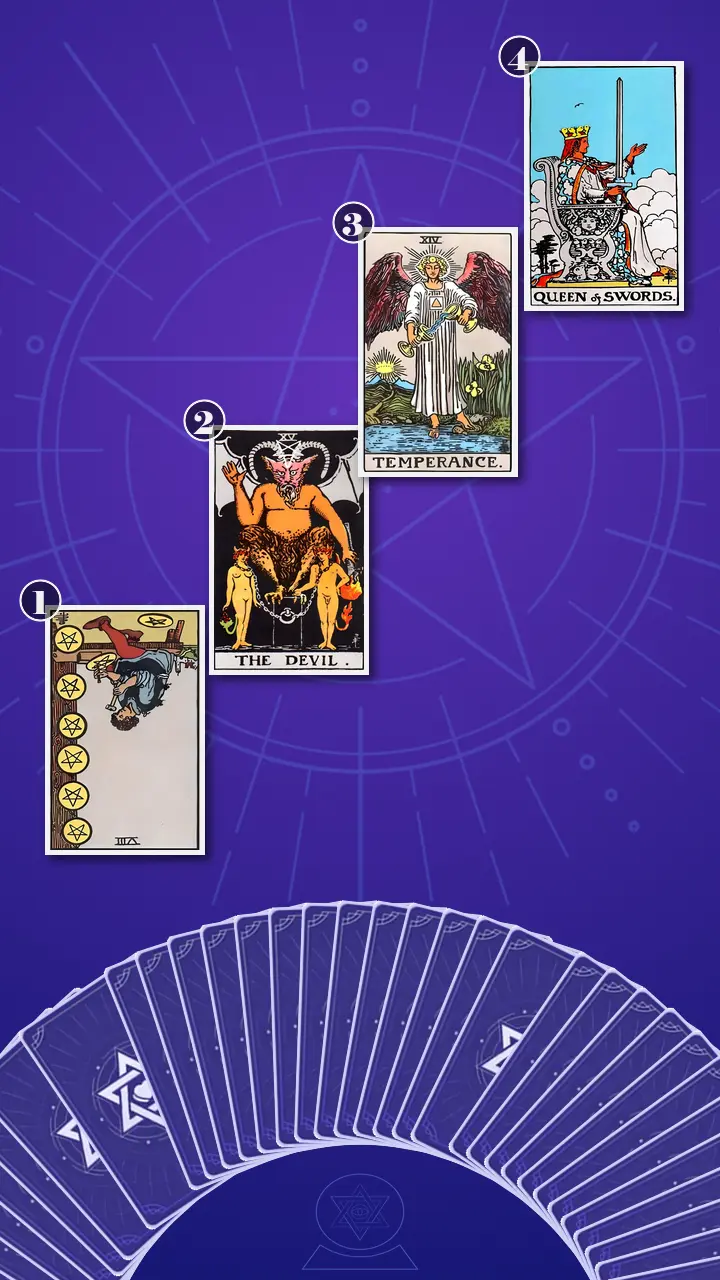
I explained that I was using the Four-Layer Insight Ladder · Context Edition, a focused four-card tarot spread built for tracing behavior rather than forcing a binary decision. It is useful when reduced hours but the same workload form a self-reinforcing loop: the first card shows the current manifestation, the second identifies the attachment sustaining it, the third reveals the transformation, and the fourth turns that insight into an observable boundary.
This is also how I explain how tarot works when someone wants card meanings in context. The image on each card gives the mind something concrete to examine, while the position gives that image a disciplined question. The spread moves from visible overwork to its root mechanism, then to scope rebalancing and practical boundary integration. A Decision Cross would assume discrete options, and a broad Celtic Cross would add positions this focused behavioral system does not need. The Four-Layer Insight Ladder keeps the attention on what is happening, what keeps happening, what can change, and what can be tested.
I told Jordan that the key position would ask what needed to change for reduced hours to become real rather than remain a smaller number on Google Calendar. The final position would ask for a factual boundary, a handoff, and a stopping time. No card would decide for Jordan; the layout would simply make the pattern easier to see.
The Workbench That Forgot to Stop
Position 1: The Current Manifestation Gap
I turned over the card representing the Current manifestation gap: the observable behavior of doing full-time work after reducing hours, including after-hours checking, extended tasks, and stagnant emotional energy.
Eight of Pentacles, in reversed position.
The card showed the craftsperson at the workbench, repeating the same careful motion while the row of pentacles grew. In Jordan's modern version, a shortened Tuesday ended with the planned deliverable complete, one small imperfection glowing on the task board, and the laptop reopening after sign-off. The repeated work felt responsible because every extra revision brought immediate relief, but the reduced-hours schedule remained a smaller clock attached to the same full-time scope. The distant town on the card became the personal time left outside the workbench.
The energy was diligence in excess: practical effort had become a loop with no clear stopping point. This was not laziness turned upside down, and it was not evidence that Jordan was bad at boundaries. It was a work habit using productivity as proof of worth. The visual question was simple: which task genuinely belonged inside the revised scope, and which one could remain visibly unfinished until the next scheduled block?
Jordan gave a short, bitter laugh. "That is too accurate. Almost cruel." I watched their breath pause, their fingers hover above the card, and their eyes move back to the imagined task board as though replaying the last Tuesday. Then their mouth tightened, and finally their shoulders dropped with a reluctant exhale. I said, "The card is showing the stopping point you have been denied, not accusing you of failing to find it."
I asked Jordan to notice what reopening the laptop promised to prove. They did not need to answer immediately. The question was already shifting the issue from personal efficiency to visible scope.
Position 2: The Root Mechanism of Constant Availability
I turned over the card representing the Root mechanism: the attachment that turns unfinished work, responsibility, or perceived commitment into a reason to keep expanding the workday, with the value or control fear underneath.
The Devil, in upright position.
I named this as an attachment pattern, not an omen and not a threat. The two figures on the RWS card are chained to the pedestal, but the chains look loose enough to notice. I connected that image to Jordan's phone lying face-up on the kitchen counter during an agreed day off. Slack badges kept arriving. The phone was not physically holding them, yet each reply temporarily quieted the thought, "If I leave this unanswered, what will people decide about me?"
The energy here was blockage: the bond between availability, control, and personal worth had become stronger than the formal schedule. Staying online produced immediate relief from guilt and a brief sense of command over the queue. That relief then concealed the capacity gap, so the unchanged workload appeared to confirm that stopping was unsafe. Jordan was not trapped by the card. They were being shown the link that could be examined.
I asked, "When you say you are being responsible, which part is actually required, and which part is protecting you from the moment another person has to see that the hours are smaller?" Jordan's shoulders lifted again. Their thumb rubbed the edge of the phone, their jaw tightened, and then their eyes softened with recognition. "Being reachable does make me feel safer," they said. "Even when it costs me the day off."
I let that sentence stand without turning it into a moral lesson. The work notification was doing two jobs at once: delivering information and soothing fear. Separating those functions would matter later.
When Temperance Made Room in the Cups
Position 3: The Key Transformation
The room grew quieter as I turned over the card representing the Key transformation: the shift from reducing hours on paper to reducing scope in practice, using the contradiction between reduced hours and continued full-time work as the point of self-understanding.
Temperance, in upright position.
The angel pouring liquid between two cups gave me the precise image this reading needed. One foot stood on land and one in water: commitment was present, but so was proportion. In Jordan's week, the cups were available work hours, realistic deliverables, handoff time, and personal recovery. Temperance did not ask them to care less or withdraw without communication. It asked which combination could honestly fit inside the container.
The energy was balance. A shorter clock cannot carry a full-time scope, no matter how efficient the person operating it becomes. Before opening a new request, Jordan would need to look at the hours available, choose what fit, move one item to the next scheduled block, and identify what needed a new owner or later deadline.
This was where I used my signature lens, Imposter Syndrome Auditing. I use the phrase as a Jungian working tool, not as a diagnosis. I asked Jordan to separate objective professional competence from the subconscious fear of exposure: one column for verifiable achievements, completed coordination work, successful handoffs, and facts about the agreed schedule; another for predictions such as "They will think I do not care" or "A competent person would absorb this without showing the gap." The second column could be emotionally loud without becoming evidence.
For a moment, I remembered conversations I have had across cultures about the word commitment. In one context it can mean constant presence; in another, it can mean making a reliable promise and respecting its actual limits. The two cups held both meanings without asking either to disappear. I thought, I thought the answer was becoming more efficient. What if the real question is which commitments belong in this container?
I could see Jordan running the old calculation: if the hours were smaller, competence had to make the same scope fit somehow. The Thursday scene returned: the kettle clicking off, the warm phone, three Slack badges, the list shrinking while the protected morning vanished.
Stop treating a reduced-hours schedule as proof that you can still absorb a full-time scope, and use Temperance's two cups to blend commitment with a firm limit that can be named and maintained.
First, Jordan froze without nodding; their fingers stopped against the card and their breath held halfway in. Then their pupils widened, their gaze went past the cups, and I watched the 8:06 a.m. scene seem to replay behind their eyes. Finally, their jaw loosened, both hands opened on their knees, and their shoulders sank a fraction. "So reducing my hours was never the same as reducing what I carry," they said. The words came out thin, followed by a long exhale that trembled on the way down. Relief arrived, but it was not clean. Beneath it was the dizzy blankness of realizing that a real boundary would require choices, handoffs, and the possibility that someone might be disappointed. Jordan looked at Temperance less like a judgment and more like a decision returned to its rightful owner. The radiator clicked once in the quiet. I let the silence remain long enough for self-trust to begin as an experience rather than an idea.
I asked, "Now, use this new perspective to remember: was there a moment last week when this insight could have made you feel different?"
Jordan remembered a colleague's message during the day off and the automatic reach for the phone. They could now imagine asking what actually fit before answering. That was the first movement from guilt-driven overwork, fear of seeming uncommitted, and constant availability toward self-trust, visible scope boundaries, and sustainable pacing. It did not solve the workload in one breath. It changed what the unfinished task meant.
Position 4: The Open Hand and the Upright Sword
I turned over the card representing the Action and integration: the concrete boundary practice that makes reduced hours observable through clear scope, handoffs, and ending work at the agreed time.
Queen of Swords, in upright position.
The Queen held an upright sword and extended an open hand. I translated the image into a concise project update: facts, limits, and next steps in three lines. In Jordan's life, that could sound like, "Within my reduced schedule, I can complete X by Friday. Y needs a new owner or a later deadline. I will next be available Monday morning." The message did not need an apology, a threat, or a disappearance.
The energy was clear air in balance: discernment made speakable. This card completed Temperance's inner rebalancing by carrying it into communication. It could not guarantee that a manager would respond perfectly or that every task would immediately become lighter. It could make the capacity gap visible to the people who could act on it, instead of keeping the gap hidden inside Jordan's evenings.
I offered the sentence, "I can make the constraint visible without making myself smaller." Jordan's gaze moved from the sword to the open hand. I saw a little space return to their chest. They began typing a draft in their notes app, deleted an apology, and replaced it with a deadline and an ownership question. The shift was quiet, but it was observable: silent overfunctioning was becoming direct, calm communication.
The Workweek Gets an Edge
When I placed the four cards in their rising line, the story became coherent. The reversed Eight of Pentacles showed the repeated workbench: effort continuing after the available time had ended. The Devil revealed why the loop survived: being available gave Jordan temporary control and relief from the fear of looking uncommitted. Temperance introduced proportion, asking work, handoffs, and personal time to share one honest container. The Queen of Swords supplied the language that could make that proportion real in a team.
The cognitive blind spot was treating the scope gap as a personal efficiency problem. Jordan had been trying to prove that the same full-time workload could fit inside reduced hours, quietly absorbing extra tasks so no one else had to see the mismatch. The cards pointed in a different direction: move from proving commitment through availability to communicating capacity, from treating unfinished work as a character verdict to reading it as information about scope.
I wanted the next steps to be small enough to test and factual enough to learn from. The cards did not make the boundary; Jordan would. I simply helped turn an invisible sacrifice into a visible experiment.
The Scope-Before-Clock Check
I gave Jordan three pieces of actionable advice, beginning with a planning exercise that combined Temperance's proportion with my Competence Anchoring Exercise. The purpose was to anchor self-worth to verifiable achievements rather than external validation while deciding what the current work container could hold.
- Scope-Before-Clock CheckAt the start of the next scheduled work block, spend 10 minutes at the top of the Notion, Jira, Asana, or paper task list writing the actual hours available. Choose the two or three commitments that genuinely fit, mark one lower-priority item as next scheduled block or needs a new owner, then list three verifiable achievements beneath the plan.Tip: Review only the next three deliverables, not the whole board. If the exercise creates pressure, pause and return later; it is a planning aid, not a test of commitment.
- Three-Line Scope BoundaryBefore the next team stand-up or project update, draft a message in Slack, Teams, or the project tool stating what fits within the reduced schedule, what needs a new owner or later deadline, and when Jordan will next be available. Send it to the relevant manager or owner after checking it against the current commitments, then record the response or handoff on the project board.Tip: Use facts, limits, and next steps in three lines. Keep the message neutral rather than apologetic, and share only the detail needed to make ownership visible.
- Next-Block Parking ExperimentTen minutes before the agreed stopping time on one reduced-hours day, write one sentence naming the next action for an open task. At stopping time, set Slack or Teams to Do Not Disturb, close the work tabs, and put the phone out of reach for the first 20 minutes away from work. Notice whether the first thought is guilt, urgency, or fear.Tip: Let one nonessential task remain visibly unfinished. Notice the feeling without treating it as an instruction, and revise the experiment later based on what actually happened.
A Week Later, the Queue Was Still There
A week later, I received a message from Jordan after a Thursday work block: "I moved one deliverable to Monday and sent the three-line note. I felt sick for about ten minutes, but I did not open Slack that night." The message was not a victory lap. It was a small piece of evidence that the boundary could exist without Jordan disappearing from the team.
Jordan told me they slept through the night after parking the task. On waking, the first thought was still, "What if I am wrong?" This time, they smiled, left the task where it was, and made coffee. The morning was lighter, though the quiet still felt unfamiliar.
I saw the Journey to Clarity take its first practical step: not a perfect workweek, not guaranteed approval, but a smaller scope, a visible handoff, and one stopping time that belonged to Jordan. Tarot had offered a structured mirror. Jordan chose what to do with what they saw.
When your shortened workday ends but the queue is still glowing, your shoulders may tighten and your jaw may lock because leaving work unfinished can feel like leaving proof of your worth on the table. The queue is still there; it is not a verdict on your worth.
If reduced hours could mean a smaller scope rather than a better performance of the same scope, what tiny part of your next workday would you be curious to leave for the next scheduled block?