Missed Milestones, Cancelled Pleasure: Pairing One Step With a Reward

The Dinner I Watched a Moving Finish Line Delete
I recognised the delayed gratification guilt immediately. Jordan, a 28-year-old communications specialist working a hybrid role in Sydney, had checked a stalled portfolio target after a long week and deleted Saturday dinner before the dashboard had even finished loading.
As Jordan described the moment, I pictured it with them: 8:47 p.m. on a packed T4 train leaving Town Hall, their phone warm against their palm while the carriage air-conditioning hummed overhead. The brakes shrieked through their headphones. A red percentage sat on the portfolio tracker, and their thumb moved from the dashboard to Google Calendar.
“I was going to keep dinner as a reward for getting back on schedule,” they told me. “But the target was still behind, so I cancelled. If the bigger plan is behind, I have no business enjoying the smaller things.”
I watched their shoulders lift as they said it. Their limbs seemed filled with wet concrete, while their jaw held shut like a vice tightened one turn too far. They wanted an ordinary evening with friends, but the idea of accepting it produced the same bodily alarm as breaking a serious promise.
Jordan had watched the group’s Instagram Stories from their flat that Saturday instead. Other people appeared able to work, socialise, save money, finish courses, and enjoy rooftop drinks inside the same perfectly edited week. Jordan had reopened Notion and rewritten the next three weeks of their portfolio plan.
“Then I felt resentful,” they said. “Which made me think I was even less deserving of the reward.”
I told them, “An unfinished goal is not a court ruling against tonight. I’m not here to tell you to abandon the goal, and I’m not here to hand you permission that already belongs to you. I want us to see why one missed milestone has been given authority over dinner, rest, books, and time with people you care about. Let’s draw a map of that fog.”

The Ladder I Chose for a Closed Loop
I invited Jordan to take one ordinary breath and hold the question without trying to solve it. I shuffled slowly, using the movement as a transition from auditing the problem to observing it.
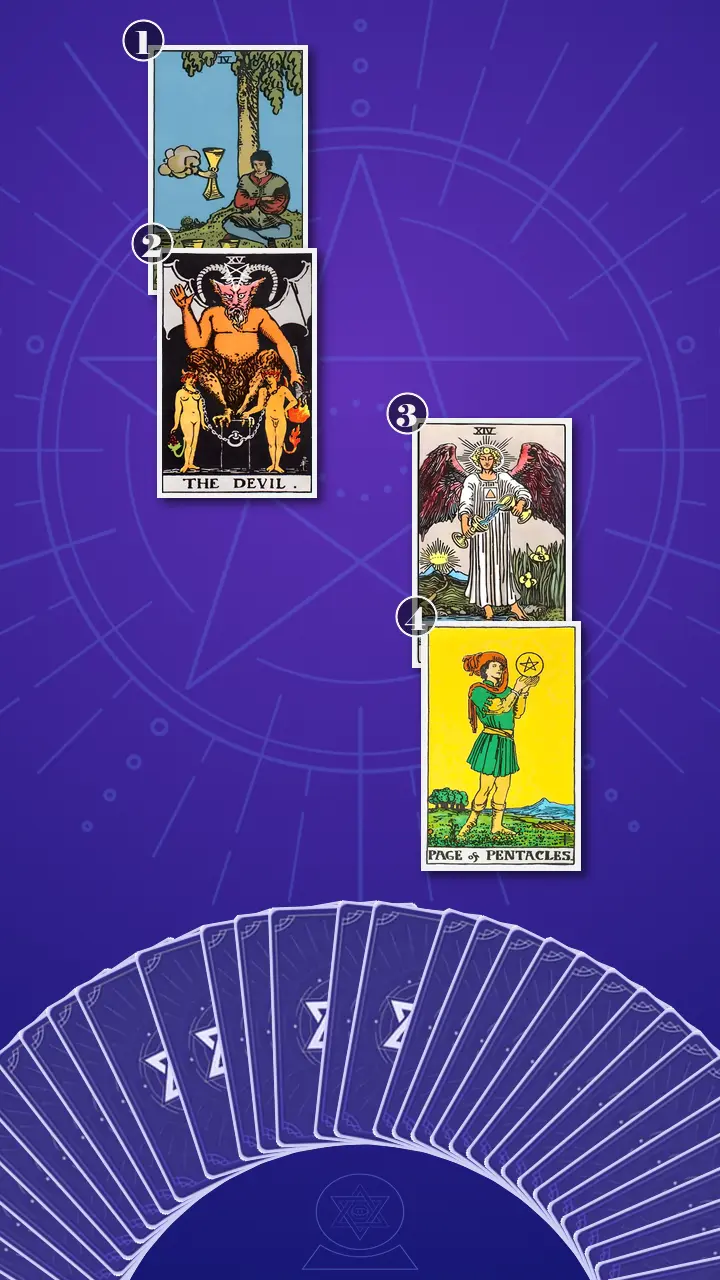
I chose the Four-Layer Insight Ladder - Context Edition. Its four cards form a compact map: visible symptom, hidden rule, balancing insight, and practical integration.
For anyone wondering how tarot works in a consultation like this, I use the cards as structured prompts rather than predictions. Jordan was not choosing between two external paths, so a Decision Cross would have created a false either-or choice between discipline and pleasure. A Past-Present-Future spread would have added chronology when the real issue was a self-reinforcing system operating in the present.
I wanted the smallest sufficient structure for tracing the reward-delay loop. The first position would show the visible act of postponing pleasure. The second would expose the private rule and fear beneath it. The third would reveal the key transformation, and the fourth would ground that insight in one repeatable action.
I placed the cards as a descending ladder. The first two formed a tight diagnostic pair; the third sat slightly to the right as a bridge; the fourth created a stable landing point. I told Jordan that the spread would not decide whether they were disciplined enough. It would help us examine the system by which they had been measuring discipline.
The Offered Cup I Found Beside the Dashboard
Position 1: The Reward Left Unreceived
I turned over the card representing the current symptom and visible reward deferral: the Four of Cups, upright.
I pointed to the seated figure’s crossed arms, lowered gaze, and the fourth cup being offered from a cloud. I explained that, in Jordan’s life, the cup looked like a dinner booking, a cafe visit, a new book, or an afternoon off already waiting in the calendar.
After a full week of communications work, Jordan would see that one portfolio or course milestone was behind and immediately cancel the modest reward already available. The evening did not disappear, but their ability to receive it did. They kept staring at the dashboard, translating the crossed arms of the card into a declined dinner, a closed laptop reopened five minutes later, and another attempt to plan harder.
I read the Four of Cups here as a blockage in emotional receptivity. The problem was not that no pleasure existed. Attention had become so fixed on what had not counted that every available form of replenishment looked irrelevant, suspicious, or too small to matter.
I asked, “After your most recent progress check, which specific reward did you remove, and what did you do instead?”
Jordan gave a short laugh with a bitter edge. Their breath caught first; then their eyes dropped to the phone beside them; finally, their fingers loosened around the sleeve of their jumper. “Saturday dinner,” they said. “And I spent most of that evening building a better system for not falling behind. That’s painfully accurate. Almost rude, honestly.”
I smiled without softening the point. “The card isn’t accusing you. It is showing the distance between an offered cup and the hand that has learned not to reach for it. Your reward was present. A rule made it feel unavailable.”
Position 2: The Rule with an Adjustable Chain
I turned over the card representing the underlying rule and hidden fear: The Devil, upright.
I explained immediately that I did not read The Devil as a prediction of danger or evidence that anything was wrong with Jordan’s character. I read it as an image of attachment: a repeated agreement that feels compulsory because it has been obeyed so many times.
Jordan’s modern version of the card was exact. They missed a milestone, deleted a planned reward, experienced that cancellation as proof of commitment, and repeated the same punishment when progress slowed again. The identity of “the disciplined person” had become tied to the belief that an easier or kinder choice could not be trusted.
I read the card’s energy as an excess of control producing a blockage in choice. I drew Jordan’s attention to the loose chains around the two figures. The chain existed, but it was not locked as tightly as it first appeared.
Looking at those chains, I had a restrained flashback to my years on Wall Street. I did not see a supernatural threat; I saw a badly designed contract with an automatic renewal clause. Jordan’s conditional reward rule resembled a workplace approval workflow in which every small pleasure required sign-off from a larger milestone, while that milestone kept being returned for revision.
I brought us back to the train. “The visible choice was deleting dinner,” I said. “The hidden function was trying to buy back self-trust through deprivation. The inner contract sounds something like this: If I enjoy dinner while I’m behind, then I’ll lose control. If I lose control, then I’ll prove I can’t trust myself. So cancelling dinner briefly feels like evidence that I’m still serious.”
Jordan’s jaw tightened before they answered. Their gaze went unfocused, as if the calendar scene were replaying behind their eyes. Then they pressed both feet into the floor and said, “The exact sentence is: If I keep the plan, I’m choosing comfort over the future I said I wanted.”
I asked, “Is that a fact about your portfolio, or a rule about what discomfort is supposed to prove?”
Jordan sat with it. “A rule,” they said quietly. “But it feels like the only thing keeping me from becoming careless.”
I nodded. “That fear deserves to be taken seriously, but it does not have to run the calendar. The loose chain matters. You can examine the rule without swinging to the opposite extreme. This reading is not asking you to spend recklessly, drop the course, or call every impulse self-care. It is asking whether deprivation is actually producing the self-trust you hoped to buy.”
I placed the Four of Cups beside The Devil. “You keep moving the finish line, then mistake the empty space behind it for proof that you need more discipline. The first card shows the unreceived reward. The second shows the contract that keeps your hand away from it.”
When Temperance Put Two Cups on One Calendar
Position 3: The Controlled Pour
I reached for the card representing the key transformation and balancing insight. The building’s air-conditioning clicked off, and the room became unusually still. When I turned the card, I saw Temperance, upright.
I showed Jordan the angel pouring liquid between two cups, with one foot on land and one in water. I read its energy as balance: not an excess of pleasure, not a deficiency of effort, but a measured exchange between practical progress and emotional replenishment.
In Jordan’s life, the two cups could become two adjacent calendar blocks. One would hold a clearly bounded 30-minute portfolio or course task. The other would hold a coffee, a walk, one chapter of a book, or an hour with friends. Jordan would complete the defined task, stop at the agreed boundary, and receive the modest reward without reopening the entire progress audit.
The long-term goal would remain unfinished. That was precisely the point. Temperance did not place discipline and enjoyment at opposite ends of one timeline; it put them into the same sustainable rhythm.
I used one of my core diagnostic tools, the Resource Readiness Assessment. In commercial terms, a long project often has delayed external returns. Jordan’s portfolio could remain behind even while their internal assets—attention, energy, patience, creativity, and goodwill toward the work—were being used every day. Their current system responded to slow external timing by stripping those internal assets further.
I told them, “You have been treating pleasure as a payout that can happen only after the investment fully performs. Temperance treats proportionate replenishment as part of keeping the person doing the work resourced. Pleasure does not need to justify itself by increasing your output, but the assessment makes one thing objective: removing every source of replenishment is not protecting readiness. It is reducing it.”
I returned us to 8:47 p.m., with Wynyard behind the train and Saturday dinner disappearing from the phone. Jordan had been treating one missed target as a referendum on self-control: if the plan was unfinished, pleasure itself became evidence for the prosecution.
Do not make pleasure wait for perfect progress; blend a measured reward into the path, as Temperance blends two streams without wasting either.
I let the sentence remain between us. First, Jordan’s breath stopped and their fingers hovered above their phone without touching it. Then their pupils widened while their gaze slipped past the table, as though every cancelled dinner and delayed book had begun replaying in sequence. Their chin lifted, and a flash of anger entered their voice. “But doesn’t that mean I was wrong every time I cancelled something?”
I said, “It means the strategy had a cost you can now see. You were trying to protect something important. We do not need to shame the earlier version of you in order to update the rule.”
The anger did not vanish; I watched it change shape. Jordan’s fist slowly opened. Their shoulders dropped, their eyes reddened, and a trembling breath left their chest as a quiet “Oh.” For a moment they looked almost unsteady, as if setting down the punishment had also removed a familiar handrail. Clarity had created relief, but it had also returned responsibility to them. I asked, “Now, with this new perspective, think back to last week. Was there a moment when this insight could have made you feel different?”
Jordan looked again at Temperance. “Thursday night,” they said. “I did complete one section of the course. I dismissed it because the module was still unfinished. I could have stopped there and taken the walk I planned.”
I asked them to imagine the angel’s cups as that evening: one cup holding the completed section, the other holding the walk. “What changes when neither cup has to defeat the other?”
Jordan breathed out more steadily. “I can keep the goal important without making tonight conditional on its final result.”
I told them that this was the pivotal movement in the reading: a first step from guilt-driven self-denial and moving-finish-line thinking toward proportionate replenishment, renewed self-trust, and steadier fulfilment alongside unfinished progress. It was not a dramatic promise that guilt would disappear. It was a controlled pour—small enough to practise and clear enough to observe.
Position 4: The One Task Held at Eye Level
I turned over the card representing action and practical integration: the Page of Pentacles, upright.
I pointed to the Page holding one pentacle at eye level while mountains remained visible in the distance. I saw the larger goal staying meaningful without being allowed to erase the cultivated ground beneath the Page’s feet.
For Jordan, the Page looked like one finite task written in Google Calendar, completed inside a defined block, with a modest reward allowed to follow. The portfolio or course would still have a long way to go, but today’s action could be seen, finished, and acknowledged without pretending the whole journey was over.
I read the Page’s energy as a balanced practical beginning. It corrected the deficiency of present-tense acknowledgement created by constant outcome auditing. Instead of staring at the distant mountains and calling the field empty, Jordan could work one visible patch of ground.
“Let the next task be finite enough to finish and the reward modest enough to keep its meaning,” I said. “One 30-minute action. No quietly adding five more tasks when the timer ends. Then the coffee, walk, chapter, or social hour stays exactly where you placed it.”
Jordan tilted their head. “That feels almost too small.”
I replied, “Small is not a flaw here. The Page is an apprentice, not a performer pretending to have completed the mountain. We are looking for a repeatable act of self-trust, not an impressive story about overnight transformation.”
The Calendar I Took Out of the Courtroom
I gathered the four cards into one line. The Four of Cups showed Jordan refusing an available source of replenishment because the larger result was unfinished. The Devil revealed the self-imposed contract beneath that refusal: pleasure had become conditional on visible performance. Temperance replaced the contract with measured exchange, and the Page of Pentacles brought that exchange into one bounded task in an ordinary week.
I named the cognitive blind spot directly. Jordan believed withholding pleasure restored control and proved they could trust themselves. In practice, the punishment reduced energy and satisfaction, made consistent effort harder, and allowed slower progress to appear as evidence that even more pleasure should be removed.
“Discipline that removes every source of replenishment eventually starts working against the goal it was meant to protect,” I said. “Your direction is not from discipline to indulgence. It is from outcome-based permission to process-based pacing. The progress review can inform your next action, but it does not get to decide whether an ordinary evening is allowed.”
The Strategic Holding Pattern
I framed the next week through my Strategic Holding Pattern. I use this when external timing has not yet delivered the hoped-for result, but forcing harder would create unnecessary friction. A holding pattern is not anxious stagnation. It is a bounded period in which I protect essential resources, prepare one high-value next move, and refuse to confuse waiting with failure.
For Jordan, the long-term portfolio remained important. The holding pattern simply stopped its delayed return from liquidating the rest of their life. I gave them two actionable next steps.
- The 30-Minute Process-Step Reward PairI asked Jordan to open Google Calendar within the next ten minutes and schedule one visible portfolio or course action lasting 10 to 30 minutes. I had them define “done” before starting—one paragraph, one slide, or one lesson section—and place one modest reward immediately afterward, such as coffee near the office, a chapter of a new book, or a 30-minute walk. Once the defined action ended, the reward would remain in place without an additional dashboard review.I told them to use the 10-minute version if the task began expanding, and to stop when the timer ended. The experiment could be changed or paused; it was not a test of character or self-control.
- The 10-Minute Stop-the-Audit BoundaryI asked Jordan to set a Sunday 5 p.m. timer for ten minutes and review only one goal. They would write two lines: what moved, and the next observable process step. I had them place that review in a separate calendar block from dinner, rest, purchases, and social plans, so a disappointing number could not automatically delete something restorative.I made the boundary explicit: the review may choose the next task, but it cannot revoke a previously planned evening. When the timer ends, the tracker closes and the restorative plan remains unchanged for at least that night.
I asked Jordan to record one neutral observation after trying the first pairing: energy, mood, or willingness to return to the work. I did not ask them to grade themselves as disciplined or undisciplined. The goal was to gather evidence about the system, not create another performance dashboard.

A Week Later, I Saw the Quiet Proof
Six days later, I received a message from Jordan. They had scheduled 25 minutes to revise one portfolio case-study paragraph, written the stopping point in advance, and closed the laptop when the timer ended. Then they walked to a cafe and read one chapter of the book they had kept postponing.
The portfolio was still behind. On Sunday morning, Jordan’s first thought was, “What if I’m letting myself off the hook?” They told me they had smiled at the thought, kept Saturday dinner in the calendar, and completed the ten-minute review without turning it into a full-night audit.
I did not see a person whose entire reward-delay loop had vanished. I saw a quieter and more credible proof: Jordan had allowed one unfinished week and one ordinary pleasure to exist at the same time. The cards had not granted that freedom. They had helped Jordan see the adjustable chain, the two cups, and the finite patch of ground; Jordan had chosen what to do with them.
I know how quickly the jaw can tighten around the fear that enjoying tonight will expose a lack of discipline. I also know that a moving finish line can keep an entire life waiting in the background. Finding clarity here did not mean becoming certain that every reward was correct. It meant recognising that one delayed outcome did not own every other decision.
I leave the same two cups with you: if one unfinished week no longer had the authority to empty either of them, what small, proportionate pleasure would you quietly leave on your calendar tonight?