Can You Choose Without Permission?

A clear definition of approval-checking, related tarot cards, and reading insights showing how this pattern appears in spreads.

Permission-dependent Self-worth
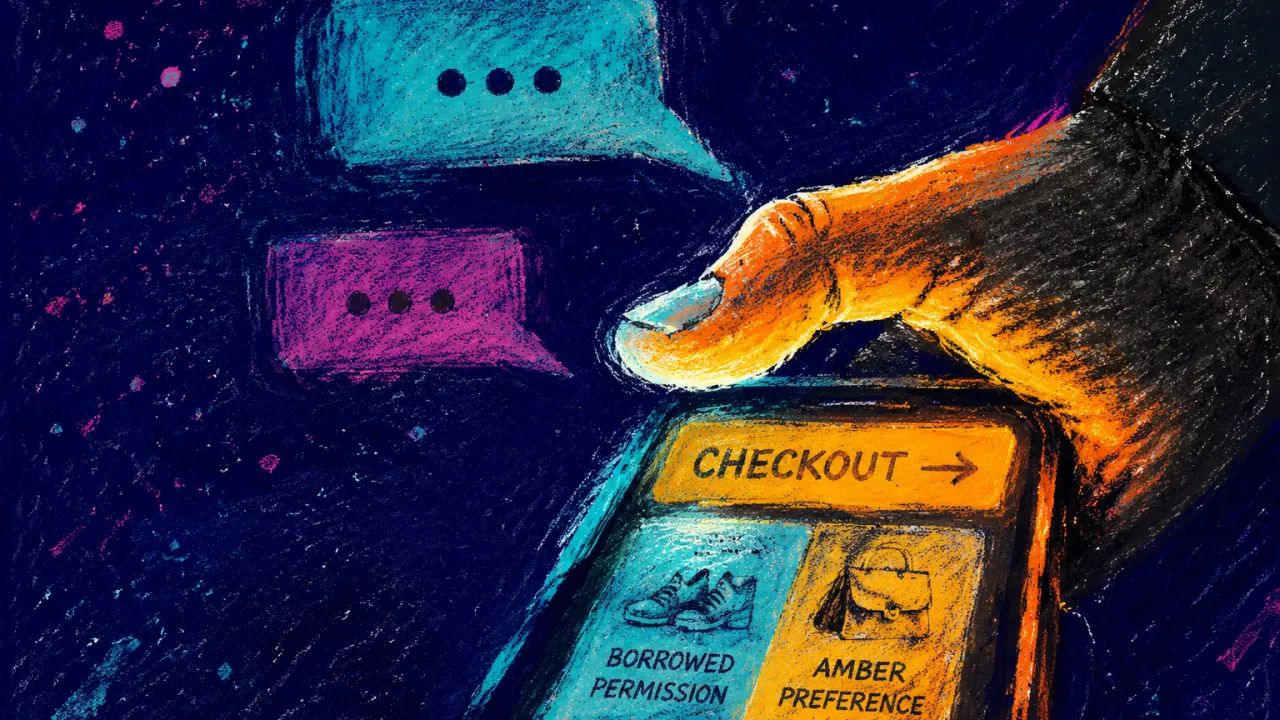
A figure leans toward a cyan phone, fingers curled at its edge beside two amber option screenshots and empty reply bubbles.

What is this really?

You pause over ordinary choices, turn statements into 'Does that make sense?', and wait for a manager, partner, friend, or audience to signal that your preference is acceptable. You are trying to secure a sense of legitimacy before taking up space, so another person's approval feels like protection from the exposed moment of choosing on your own. Yet this approval loop creates cognitive dissonance: each borrowed green light makes you more fluent in the approved version of yourself and less able to hear what you want, much like the two kneeling figures in The Hierophant, looking upward while authority occupies the center.

Why did it happen?

At some point, getting a nod before acting may have reduced the hot-faced exposure of guessing wrong and helped you stay in step with people whose responses mattered. Now that inner pattern can turn a neutral pause, an unread message, or an undecided manager into a verdict, leaving your shoulders braced and your mind drained while you wait for a green light that may never come.

How does it feel?

  • In a meeting, you begin with 'I think...', glance at the most senior face, and add 'but I could be wrong' before finishing the point. In that beat, your shoulders lift and your breath stalls high in your chest, as if your body is waiting with the sentence; the pause can be allowed to exist without forcing certainty.
  • When a friend asks where you want to eat, you name a place, catch their half-second pause, and quickly add, 'Anywhere is fine.' Right afterward, your jaw stays set and a flat heaviness settles across your chest; not knowing how the first answer landed can remain unresolved for a moment.
  • With two shopping tabs open, you screenshot both options, type 'Which one should I get?', and leave the checkout button untouched while replies arrive. Your thumb hovers over the screen as your palm tingles and your breath turns shallow; you can notice the waiting without turning it into a verdict.
  • Before sharing a drawing, you replace 'I love this' with 'Just trying something,' hover over Post, and tap refresh three times once it is live. Heat gathers behind your eyes and your fingertips turn cool before any response appears; that surge can exist without an immediate label.
  • At the end of the workday, you lower your laptop lid halfway, notice a coworker's green status dot, reopen the file, and type 'Anything else before I log off?' Your shoulders stay braced and your eyelids feel grainy even while you sit still; the need for a clear stopping signal can be acknowledged without judgment.

Permission-dependent Self-worth in Tarot Cards

The reflex to turn a decision into a request for approval becomes visible when your shoulders lift and your breath stalls high in your chest. Jungian archetypal theory offers one lens for understanding the gap between the approved role and the preference left unspoken. The Tarot Cards below mirror the unconscious dynamics beneath that waiting posture:

The Hierophant
Upright
The Hierophant sits between pillars while two followers kneel beneath his gesture of sanction, creating a complete architecture of external legitimacy. The keys at his feet suggest access, but their position also shows how authorization has been concentrated outside the followers themselves. As a growth pattern, you may become highly skilled at embodying identities that respected people will approve while remaining unsure which values are genuinely yours. The developmental task visible here is differentiation: recognizing inherited guidance without requiring it to certify every new expression of selfhood.
The Lovers
Reversed
The man's attention moves toward the woman while her gaze rises toward the angel, forming a sequence between relationship, values, and a higher source of sanction. The separate figures and central mountain show that alignment cannot be reduced to simple agreement. In this reversed expression, you may betray an emerging value to preserve approval and then use the resulting acceptance as evidence that the compromise was correct. The pattern's growth cost is cognitive dissonance: the socially approved self becomes easier to perform while the unapproved value remains increasingly difficult to name.
Judgement
Reversed
The angel's trumpet calls exposed figures upward from enclosed spaces, presenting development as a response to something that has become impossible to ignore. Their raised arms convey openness, but the commanding source above also evokes the expectation of a decisive verdict. In this reversed expression, you may hear your own developmental call and then wait for an authority to certify that answering it is wise, mature, or deserved. The delay protects against shame if the change is questioned, while the deeper growth edge lies in distinguishing accountable reflection from the demand that another person authorize your becoming.
Three of Pentacles
Upright
The craftsperson presents work to two figures who consult a plan, creating a concrete scene of skill meeting informed assessment. The exchange can support mastery, but the worker's elevated yet observed position also captures the vulnerability of submitting something that must stand on its own. You may keep revising an essay, proposal, or research idea until a tutor reassures you that it is acceptable to submit. Feedback then becomes less about improving the work and more about protecting your identity from the exposed possibility of independent judgment.
Six of Pentacles
Upright
The standing figure distributes coins while holding the scales, and the two kneeling recipients must orient themselves toward his judgment of what will be given. Material support and evaluative power occupy the same hand. In a family system, practical help, attention, or warmth may have taught you that approval determines both belonging and access to support. You may therefore shape adult choices around the relative who still seems to hold the scales, even when the deeper cost is losing contact with preferences that cannot be guaranteed a reward.
Two of Swords
Upright
The blindfolded figure crosses two swords over her chest while water and moonlight remain behind the defended posture. Emotional signals are present in the landscape, but the body is organized around keeping competing positions perfectly balanced. When you have repeatedly substituted other people's approval for your own preference, not knowing what you want can become an honest consequence rather than a personal failure. The suspension protects you from discovering a desire that might be disapproved of, while also showing exactly where internal listening has been interrupted.
Eight of Swords
Upright
The figure is blindfolded and bound, yet the enclosure remains incomplete and no external person is shown maintaining it. The visual paradox makes internalized restriction observable without denying the genuine fear held in her posture. You may block an emerging capacity, identity, or practice because nobody has explicitly confirmed that you are allowed to claim it. The pattern protects you from premature exposure, but growth stalls when the absence of authorization is confused with evidence of incapacity; that confusion can be named without forcing immediate certainty.
Six of Wands
Reversed
The laurel-crowned rider is elevated by a scene of public recognition, with personal achievement and audience response fused into one visible identity. The wreath marks accomplishment, but the crowd supplies the mirror through which that accomplishment becomes socially real. In this reversed expression, private growth may feel pointless until someone notices, praises, or certifies it. You can abandon practices that are working because they do not generate applause, revealing a value system in which recognition grants permission to count development as meaningful.

Permission-dependent Self-worth in Tarot Card Reading Insights

When a clear preference becomes 'Does this seem okay?', others have brought the same approval reflex into readings and noticed which cards appeared around it. Below are Tarot Reading Insights in which permission-seeking entered the spread.

Psychological Patterns Related to Permission-dependent Self-worth