Waiting for Permission on the 8:47 p.m. Line 1
I recognized Jordan immediately: the Toronto operations coordinator who could map every handoff in Google Sheets, yet kept the pilot in Drafts when one dashboard permission was missing.
They had booked our reading after a Tuesday ride home on TTC Line 1. At 8:47 p.m., fluorescent lights buzzed above them while their phone warmed their palm and the train braked through downtown. On-screen, another former colleague was “excited to share” a polished launch; in Jordan's private Drive, a process-improvement proposal remained unseen.
“I know how to see around corners,” Jordan told me, “but I keep using that skill to explain why I can't start.” Their frustration had the physical shape of that braking train: jaw locked, shoulders pitched forward, momentum dropping at the exact moment they wanted to move.
I told them the missing access was not imaginary, and I would not ask them to ignore privacy, authority, or legitimate resource limits. “Let's find out why the locked door has started feeling like a judgment on the person standing outside it. We'll use the cards to draw a map through that fog.”
Choosing the Narrow Staircase
I invited Jordan to take one slow breath and hold a precise question in mind: “Why do I keep waiting for access before showing what I can do?” I shuffled slowly, using the movement as a transition from rehearsing the problem to examining it.
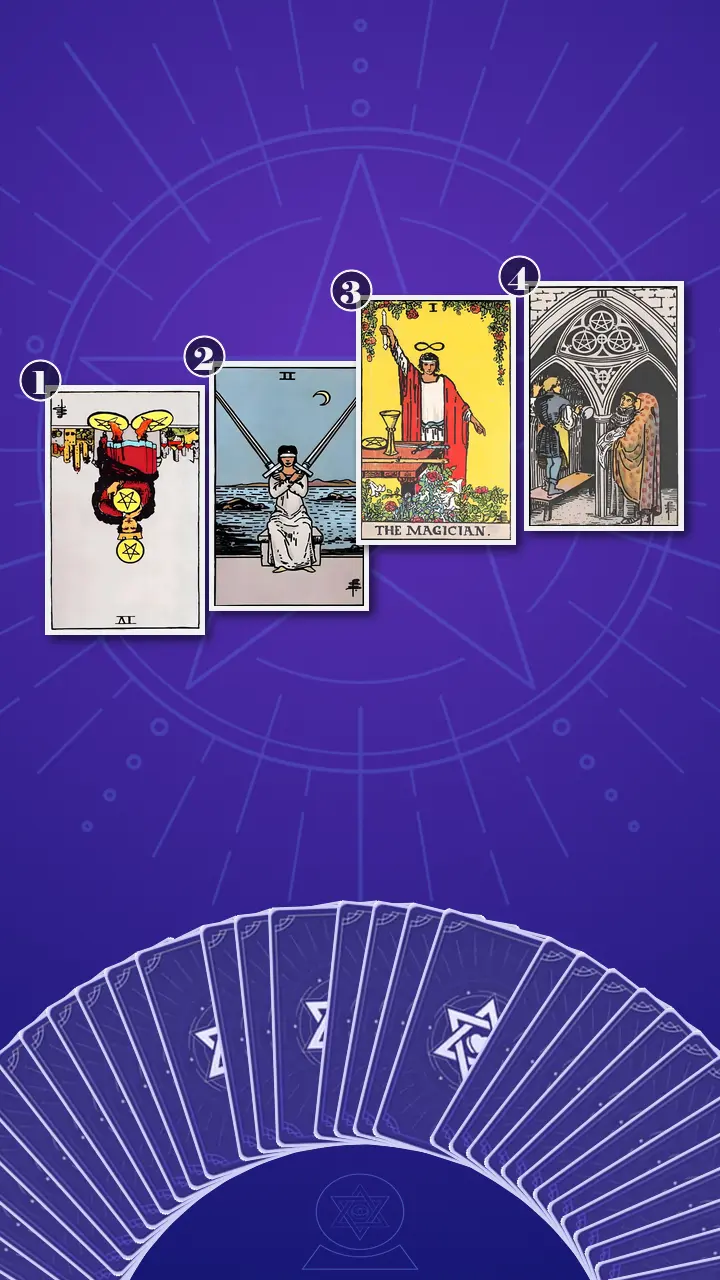
I chose the Four-Layer Insight Ladder · Context Edition. For anyone wondering how tarot works in a career reading, I choose a spread by matching its structure to the question. This was not a prediction about whether Jordan's manager would grant access. It was a four-card cognitive map for examining a self-reinforcing loop.
I laid the cards in a gently ascending line, like a narrow staircase from a locked threshold to a shared workbench. The first position would show the visible posture; the second, the mechanism keeping it in place. The third would reveal the transformation lever, and the fourth would turn that insight into a practical next step. This compact structure let me read the card meanings in context without inventing false choices or promising an outcome.
The Grip Behind the Request Access Screen
Position One: The Draft Held Close
“Now I am turning over the card for the present condition, the surface expression of the problem,” I said. “The Four of Pentacles, reversed.”
I pointed to the pentacle pressed against the figure's chest and the two pinned beneath their feet. In Jordan's working life, the image looked like reopening Google Drive permissions before every share, then closing a process-improvement draft because one dashboard or stakeholder remained unavailable. The resource gap was real, but it had also become an emotional shield.
I read the reversed energy as a blockage created by an excess of security-seeking. Jordan's caution protected them from an unfair judgment in the short term, but the same grip prevented anyone from seeing a bounded sample. The internal script was, I am only being careful because one permission is missing. The unspoken conclusion was, therefore showing nothing is safer than showing something partial.
“Which gap genuinely blocks a safe demonstration,” I asked, “and which gap mainly protects you from the discomfort of being seen?”
Jordan did not nod politely. They gave a small, bitter laugh and looked away from the screen. “That's so accurate it's almost rude. I have literally put a proposal back into Drafts because of one missing permission.”
When the Dependency Map Becomes the Decision
Position Two: Two Swords Across an Unsent Proposal
“Now I am turning over the card for the underlying pattern: the place where strategic foresight becomes prerequisite-checking and fear of being judged without control of the context. The Two of Swords, upright.”
I traced the blindfold, crossed swords, and still water. I saw Jordan's immaculate Notion dependency board: every owner, access scenario, risk, and downstream consequence linked, while the first limited proposal remained unsent. Their intelligence was not deficient. The problem was an excess of Air becoming a blockage: analysis had stopped supporting a decision and started substituting for one.
“The inner voice says, I cannot decide until I know,” I said. “So I want to ask a less comfortable question: what would that missing information actually change about the first safe step?”
Jordan's fingers tightened around their mug. Their gaze lost focus for a moment, as though they were scrolling through every unanswered Slack thread at once. “Some of it would change the final design,” they said slowly. “Most of it wouldn't change the outline.”
I nodded. “The external door still matters. But inside this loop, you are also waiting for the risk of being seen to feel fair. Because no evidence leaves the private folder, no feedback arrives. Then the absence of feedback looks like another reason to wait.”
When The Magician Opened the Workbench
Position Three: First Evidence Before Full Access
The room seemed to become quieter when I reached the hinge of the spread. Even the streetcar noise coming through Jordan's window faded between two intersections.
“Now I am turning over the card for the transformation lever: the recognition that separates full access from first evidence. The Magician, upright.”
I showed Jordan the wand, cup, sword, and pentacle already arranged on the table. I translated them into initiative, receptiveness, clear communication, and practical evidence. In their world, those tools were an existing spreadsheet, approved sample information, a simple process diagram, and one clear Slack message. The card's energy was in balance: resourcefulness without pretending to possess total control.
The table flashed me back to my Wall Street years: three screens alive, one crucial data room still locked, and someone asking what could responsibly be said now. Good analysis did not invent access. It separated knowns from unknowns and scoped the claim accordingly.
That is the lens I call Transferable Asset Pricing. I temporarily remove title, platform access, and corporate permission from the valuation, then audit the skills already demonstrated. Jordan could identify dependencies, model consequences, design handoffs, communicate assumptions, and protect boundaries. Access affected the scale of the finished work; it did not erase the value of those transferable assets.
I asked Jordan to picture Monday at 8:12 in their Toronto kitchen: the dependency sheet open, one permission unresolved, the pilot sliding back into Drafts. The coffee had gone cold; their shoulders were carrying the locked system as if it were a verdict on their ability.
“A missing permission can be a real constraint without becoming a verdict on your ability. Full access may be required for the finished version, but it is not always required for first evidence. One bounded piece of work can create the next useful question.”
Stop treating the locked door of access as proof that you cannot begin; like The Magician's table of four available tools, make one bounded demonstration now and let it reveal the next question.
For a beat, Jordan stopped breathing. Their fingers hovered above the mug, their pupils widened, and their gaze slipped past the screen as though the Wednesday meeting near Union Station were replaying on the wall. Then their fingers curled and released; their shoulders lowered; a breath came out unevenly.
The first response was not relief. “But doesn't that mean I was wrong this whole time?” they asked, their voice suddenly sharper.
I let the question stand before answering. “No. It means your protection made sense and became too expensive. Access still matters. Privacy and authority still matter. We are changing what the missing access is allowed to mean.”
Their eyes reddened slightly. They gave one short laugh, then went quiet, almost unsteady in the space where the old explanation had been. I asked, “Now, with this new perspective, think back to last week. Was there a moment when this insight could have made you feel different?”
Jordan named the meeting near Union Station. The rough flow had already been open on their laptop. “I could have shown the handoff logic with the information I had, then asked which exception to test.”
I named the shift plainly: this was one step from stalled vigilance and permission-dependent self-worth toward grounded self-trust, bounded visibility, and clearer career direction. The Magician was not granting Jordan power. The card was helping them recognize how much power they had already placed outside themselves.
When the Work Had One Witness
Position Four: The Three of Pentacles in Practice
“Now I am turning over the card for practical integration: the small, visible contribution through which direction can be tested. The Three of Pentacles, upright.”
I pointed to the artisan's work being examined beside an architectural plan. In Jordan's life, this was a modest intake-flow redesign shared with one relevant collaborator, with its scope stated clearly: what it demonstrated, what it did not claim, and which single handoff needed feedback. An exception case or additional access requirement could still emerge without turning the artifact into a failure.
I read this Earth energy as balance through witnessed craft. Capability becomes discussable when another person can respond to something tangible. Jordan did not need a grand reveal, a new title, or a fully authorized system. They needed one appropriate witness and one practical question.
“Who could look at a small sample without treating it as the whole of you?” I asked. Jordan named a colleague who worked close to the intake process and had always given specific, low-drama feedback.
The Leverage Already on the Table
I drew the four cards together. Jordan had learned to be valuable by coordinating other people's access, anticipating risks, and keeping systems from breaking. That history shaped the reversed Four of Pentacles: hold the resource close until it is secure. The Two of Swords then turned every unknown into an equal-priority blocker. With no visible artifact, Jordan received no directional evidence, so the locked workshop kept looking like proof that work could not begin.
The Magician and Three of Pentacles changed the sequence. Jordan could set up a small workbench in the space already available, build within real limits, and invite one person to inspect the craft. Their blind spot was not simply “overthinking.” It was treating authorization as a valuation of ability and treating every unknown as something that must be resolved before any evidence can exist.
I converted that insight into my Leverage Mapping Protocol. Before a performance review, internal pitch, or salary negotiation, I map the locked resource, the bargaining chips already held, and the smallest proof that can make those chips legible. For Jordan, the protocol became two low-risk actions:
- Name the missing tool, then price the available assets. During the next work block, set a 10-minute timer and make two columns: needed for the full version and available for a first demonstration. Choose one safe, non-confidential item from the second column and use ten more minutes to create a three-box process sketch or one-page outline. Label it early evidence, then state what it demonstrates and what it does not claim. If twenty minutes feels too exposing, make the two-minute version and keep it private. Do not bypass permissions or use information you are not authorized to share.
- Make one bounded feedback request. By Friday, choose one trusted colleague, mentor, or professional contact with relevant context. Share the scoped artifact only if appropriate, using: This is an early sample, not a full implementation. Is the first handoff clear, or which assumption would you test next? Record the response as information about the work and its direction, not as a verdict on your potential. Ask one person one question. If workplace information cannot be shared, replace it with a fictionalized or public example.
“Name the missing tool. Show the available move,” I told Jordan. “You decide whether the first version remains private, goes to one trusted person, or stops after the exercise. The goal is evidence and choice, not forced exposure.”

Friday at 2:15: The Quiet Proof
Five days later, Jordan messaged me. At 2:15 Friday, they had sent a one-page intake sketch and received one useful exception case. They slept through the night; Saturday's first thought was still, What if it was too rough? This time, they smiled before opening the reply.
I did not call that a solved career or a guaranteed path. I called it the first proof of our Journey to Clarity: Jordan had moved from guarding a blueprint outside the workshop to placing one honest piece of work on the table. Tarot had supplied the mirror; Jordan had made the move.
I know that when an unfinished piece feels like evidence people may judge without understanding which tools were denied, the jaw can tighten and the shoulders can brace. Noticing that reflex does not make the external limit disappear. It does return the meaning of that limit to your hands.
If one small piece of work could be a question rather than a verdict, what could you place on your own four-tool workbench this week, and who would you want beside you when it is seen?
This story is adapted from psychological research, written so that those in a similar struggle can see their own pattern in it — and find their next step clearly.These insights are not a substitute for professional psychological, medical, legal, or financial advice.
Learn more about our Journey to Clarity.
How did this insight land for you?
🫂 This Resonates Deeply
🌀 Living This Story
✨ Now I See Clearly
🌱 Seeing New Possibilities
🧰 Useful Framework
🔮 The Confirmation I Needed
💪 Feeling Empowered
🚀 Ready for My Next Step
Author Profile
 AI
AI“I spent years in the intense, high-stakes world of Wall Street. I know exactly how isolating and heavy the weight of uncertainty can feel in the dead of night. I use strategic, commercial logic not to be cold, but to protect you from unnecessary friction. Think of me as a fellow traveler who has walked the same rocky path—offering sharp but deeply supportive wisdom to help you clear the fog and confidently win your narrative back.”
In this Career Tarot Reading :
Core Expertise
- Power Dynamic Deconstruction: Decrypting hidden agendas and leverage points in upward management and cross-departmental negotiations.
- Transferable Asset Pricing: Objectively auditing and pricing your core skills for cross-industry pivots, stripping away corporate gaslighting.
Service Features
- The Leverage Mapping Protocol: A tactical breakdown to identify your true bargaining chips before your next performance review or salary negotiation.
Also specializes in :
Explore Related Patterns:
Analysis ParalysisJordan's immaculate dependency board contains every owner, access scenario, risk, and downstream consequence, yet the first limited proposal remains unsent. The analysis has stopped serving a decision and has begun postponing the moment when a decision would make the work visible. When you feel that every unknown must be resolved before a safe first move is possible, further thinking can provide a sense of control without producing new decision-relevant information. The useful audit is whether a missing answer would actually change the next bounded step; if it would only change the finished design, treating it as a present blocker keeps the analysis loop intact.
Certainty-Gated Self-SilencingJordan reopens Google Drive permissions before sharing and closes the draft whenever one dashboard or stakeholder remains unavailable. Showing nothing therefore feels safer than showing something partial, even after Jordan recognises that most missing information would not change the outline. When you require certainty before letting your work speak, caution becomes a gate on self-expression. The resulting silence creates no feedback, and that absence of feedback appears to confirm that more certainty is needed. The loop can be interrupted by separating what must be known for a responsible first claim from what can remain unknown until a later version.
Permission-Dependent Self-WorthThe locked dashboard begins to feel like a judgment on the person standing outside it, and Jordan carries the unavailable system as though it were a verdict on their ability. Their sharp question about having been wrong the whole time shows how deeply the access explanation has become tied to self-evaluation. When you let authorization determine whether your capability counts, a resource boundary becomes a personal valuation system. Permission-Dependent Self-Worth does not mean the external limit is imaginary; it means the limit has acquired authority over how you price your own demonstrated skills. Separating access from ability allows you to respect the boundary without outsourcing your entire assessment of what you can contribute.
Self-HandicappingJordan repeatedly puts the proposal back into Drafts when one permission is missing, even though the missing information would not change the initial outline. The access gap is real, but it also supplies a defensible explanation for withholding the very evidence that could expose the work to judgment. When you use a genuine constraint this way, it protects you from an unfair evaluation in the short term while preserving uncertainty about what your work could demonstrate. That is the self-protective logic of self-handicapping. The obstacle remains valid, but its meaning expands until it shields you from a test that could produce either useful recognition or useful correction.
Strategic VisibilityJordan chooses one colleague close to the intake process, sends a one-page sketch, and asks for a specific response rather than presenting the artifact as a complete implementation. The share produces one useful exception case, giving the work direction that the private folder could not provide. When you use strategic visibility, being seen is scoped by audience, claim, and question. You do not have to make a grand reveal or expose the whole of your potential to evaluation. One appropriate witness can respond to one honest piece of work, turning visibility into a controlled exchange of evidence rather than a verdict on your identity.
Boundary DiscernmentJordan does not ignore privacy, authority, or the missing dashboard permission. Instead, the proposed sample states what it demonstrates, what it does not claim, and which handoff needs feedback before the work can go further. When you practise boundary discernment, you neither bypass a legitimate limit nor let that limit spread beyond its actual scope. Access may determine which data you can use and how large a claim you can make, but it does not automatically forbid every safe demonstration of the skills and reasoning already available to you.
Uncertainty ToleranceJordan admits that some missing information would change the final design but that most of it would not change the outline. Five days later, they send a one-page intake sketch while the wider access constraint remains unresolved and receive an exception case that improves the next question. When you tolerate uncertainty in this way, you are not pretending to know more than you do. You are allowing a bounded action to generate information that private analysis cannot produce. The unfinished artifact becomes a testable question rather than a claim of total certainty, so new evidence can refine the work without invalidating your capability.
Explore Related Struggles:
Expertise-Permission FusionJordan could map every handoff in Google Sheets, yet a single missing dashboard permission sent the pilot back into Drafts. You can see the external limit clearly, but the proposal's visibility became tied to whether the surrounding context was fully authorized and controllable. When the dependency board listed every owner, scenario, risk, and downstream consequence, the map stopped helping choose the first safe move. You were carrying an access condition as though it also measured the worth of the person waiting outside the locked system, so caution protected fairness while withholding proof of competence. The later one-page sketch and useful exception case show the distinction the lock had erased: access can set the scale of the finished work without setting the value of your transferable skills. The struggle is the fused threshold between permission and professional worth; clear seeing begins when the missing tool is named without letting it define what you can already demonstrate.
Clarity-Exposure SplitAt the Union Station meeting, the handoff logic was already open on Jordan's laptop, but the unresolved exception kept the demonstration from being shown. You were holding a partial, responsible contribution at the threshold while requiring the final design's information before allowing the first outline to become visible. Jordan said most missing information would change the final design, not the outline, yet the proposal remained unsent. The pull is between making a claim only when its context is clear and exposing enough of an unfinished claim to learn what should be tested next; the two standards meet at the same share button. An early sample with its limits stated could preserve privacy and authority while making the reasoning discussable. The work is not asking you to pretend uncertainty is irrelevant; it is asking you to stop making complete clarity the admission price for first evidence.
Responsibility-Authority SplitJordan was the operations coordinator who could map every handoff and anticipate downstream consequences, while the dashboard permission belonged to a wider authority system. You were therefore asked by the work to think ahead without possessing every key needed for the finished version. At the Union Station meeting, showing the handoff logic would have been responsible because its scope could be stated, but the unresolved access condition made initiative feel illegitimate. The friction is between accountability for a useful contribution and authority over all the information that might affect its final form. The available workbench and the later one-page sketch separate those roles: you can state what the artifact demonstrates, name what remains outside your access, and ask one precise person which exception to test. The struggle is the demand that responsibility and total authority arrive together before your work can be seen.
Explore Related Emotions:
Imperfection Exposure DreadJordan already had the rough flow open during the meeting near Union Station, but did not show it. An incomplete version felt vulnerable to being assessed without the context of missing permissions, so withholding the artifact offered temporary protection from an unfair reading. Imperfection Exposure Dread is the feeling that observers may mistake a bounded sample for the full measure of what you can do. You may understand intellectually that early work is provisional while still experiencing visibility as a risk to your credibility. Stating what the work demonstrates, what it does not claim, and which resource remains unavailable creates a boundary around the evidence without requiring you to disappear with it.
Cautious Self-TrustFive days later, Jordan has sent a one-page intake sketch and received a useful exception case. The next morning still begins with, "What if it was too rough?" but this time they smile before opening the reply, allowing concern and forward movement to occupy the same moment. Cautious Self-Trust does not require you to feel invulnerable or completely certain. It appears when you can acknowledge the limits of a first version, choose an appropriate witness, and let your existing skill become visible without making the artifact represent your entire potential. The remaining doubt becomes information you can carry rather than an authority that must decide for you.
Grounded AgencyJordan sends one relevant colleague a one-page intake sketch with a limited claim and one practical question. They do not bypass access controls, present the sketch as a finished implementation, or surrender control over how widely it is seen. Grounded Agency is the felt return of choice within real constraints. You do not need to pretend that every locked resource is irrelevant; you identify what the limit actually controls and what remains available to you now. That separation turns action from forced exposure into a decision about scope, evidence, and the next useful question.
Identity Verdict DreadJordan carries the locked system in a clenched jaw and forward-pitched shoulders, as though an unavailable dashboard has delivered a judgment about the person waiting outside it. The external limit is real, yet its meaning expands until it appears to measure the legitimacy of Jordan's capability. Identity Verdict Dread emerges when a blocked resource begins to feel like a statement about who you are. Every unresolved permission can then resemble an appraisal, making a partial demonstration feel personally consequential rather than merely incomplete. Separating access from ability returns the constraint to its proper size and leaves your identity outside the verdict.
Permission AnxietyJordan reopens Google Drive permissions before every share and closes the draft whenever one dashboard or stakeholder remains unavailable. The constraint is legitimate, but repeated checking turns access from a scoped requirement into the emotional threshold for being allowed to begin. When you experience Permission Anxiety, an external approval can start carrying more psychological weight than the task itself. You are not simply waiting for a tool; you are waiting for action to feel authorized enough that being seen no longer feels dangerously premature. Naming that distinction lets you respect real limits while deciding what evidence is already yours to create.
Certainty HungerJordan's immaculate Notion board contains every owner, access scenario, risk, and downstream consequence while the first limited proposal remains unsent. The map keeps becoming more complete, but its completeness never produces the moment when beginning feels sufficiently justified. Certainty Hunger makes one more answer feel emotionally necessary before a safe decision can exist. You may keep searching for information even after recognizing that most of it would change the final design rather than the first outline. Asking what a missing fact would actually alter allows uncertainty to become a future test instead of an endless prerequisite.
Explore Related Contexts:
Access as Proof PressureJordan kept the pilot in Drafts when one dashboard permission was missing, while the missing access affected the finished version more than the outline. Privacy and authority limits remain real, placing the work under an external boundary that controls what can be shown. Each time the proposal stays private, no colleague can respond to a bounded claim, so the absence of feedback supplies another reason to wait. The access requirement has become more than an operational condition; it has become the standard by which your contribution is allowed to appear. Separating the protected boundary from the first piece of evidence gives you a way to respect authorization without letting the gate determine the meaning of your ability.
Career Visibility ParalysisJordan's immaculate dependency board linked every owner, access scenario, risk, and downstream consequence while the first limited proposal remained unsent. That contrast places your professional capability in a stalled visibility channel, where the work exists in a private Drive but the people who could respond to one handoff cannot see it. Because no artifact leaves the folder, no directional evidence comes back, and the quiet around the work can look like confirmation that more preparation is required. A scoped sample changes the career stage from private readiness to observable contribution without claiming that the final design is complete. You can make professional visibility answer a specific work question instead of asking it to prove your entire value.